

Integrating ESG — Environmental, Social, and Governance — into facility management operations means embedding sustainability targets, safety standards, and accountability frameworks into the day-to-day work of maintaining buildings and assets. Facilities teams that do this well don't just reduce energy bills; they cut carbon emissions, improve occupant wellbeing, satisfy board-level reporting requirements, and protect their organizations against tightening regulation.
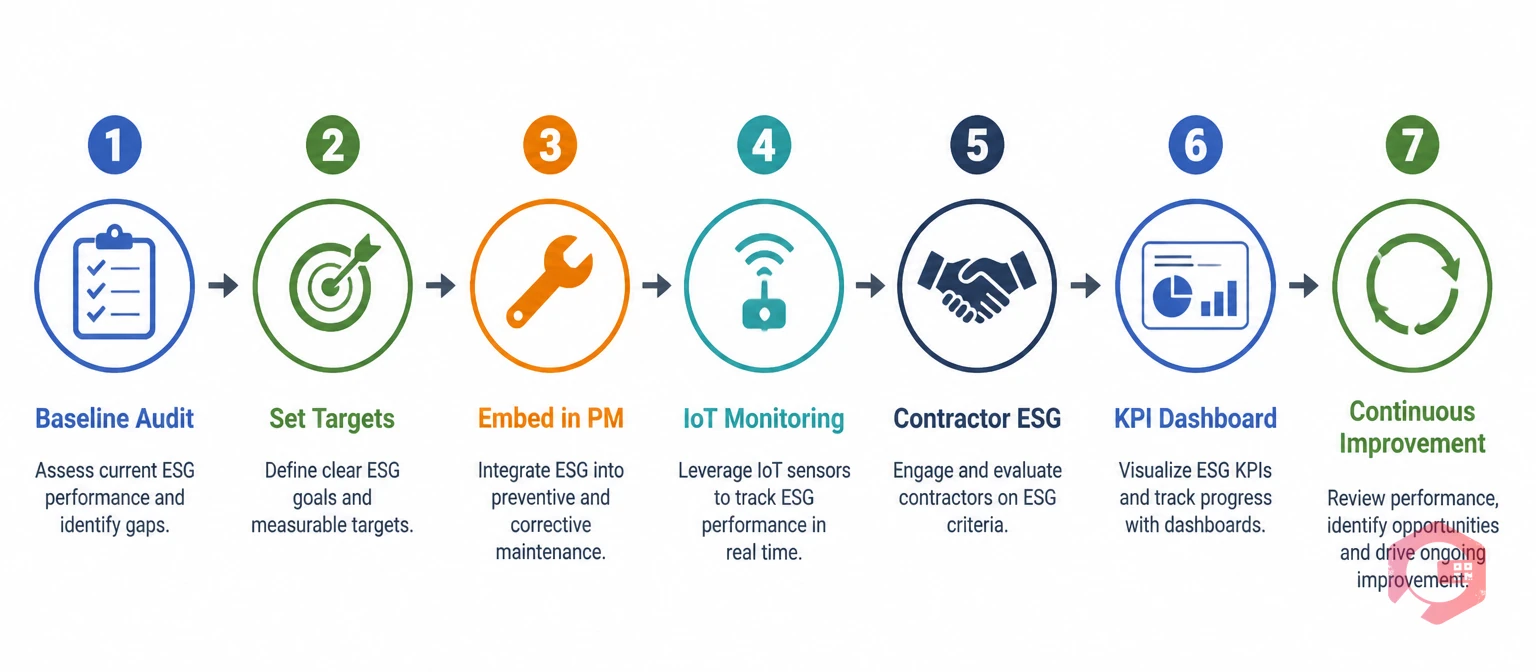
According to a McKinsey report on ESG and the bottom line, companies that embed sustainability into operations see measurable improvements in operating margins and asset longevity — outcomes that map directly to what facility managers are already measured on. The seven steps below give you a practical roadmap for making ESG part of how your FM team operates, not just how it reports.
You can't improve what you haven't measured. The starting point for any ESG integration program is a baseline audit that covers all three pillars across every facility in your portfolio.
Use your CMMS to pull asset-level data into this audit. If your system doesn't surface energy and downtime data in one place, that's the first gap to close before you can build a credible ESG baseline.
A baseline is only useful if it anchors specific, time-bound targets. FM-relevant ESG targets should be tied to the assets and processes your team already controls — not lifted wholesale from corporate sustainability documents that were written without operational input.
Good FM-level ESG targets look like this: reduce HVAC energy consumption by 15% within 18 months; achieve zero lost-time incidents for contracted maintenance crews by end of year; complete 100% of compliance inspections on schedule for the next four quarters. Each of these is achievable through the maintenance planning tools your team uses every day.
Link targets to the KPIs you already track — MTTR, uptime, and inspection completion rates. This makes ESG progress visible in the same dashboards where operational performance already lives, rather than in a separate annual report that nobody reads until audit season.
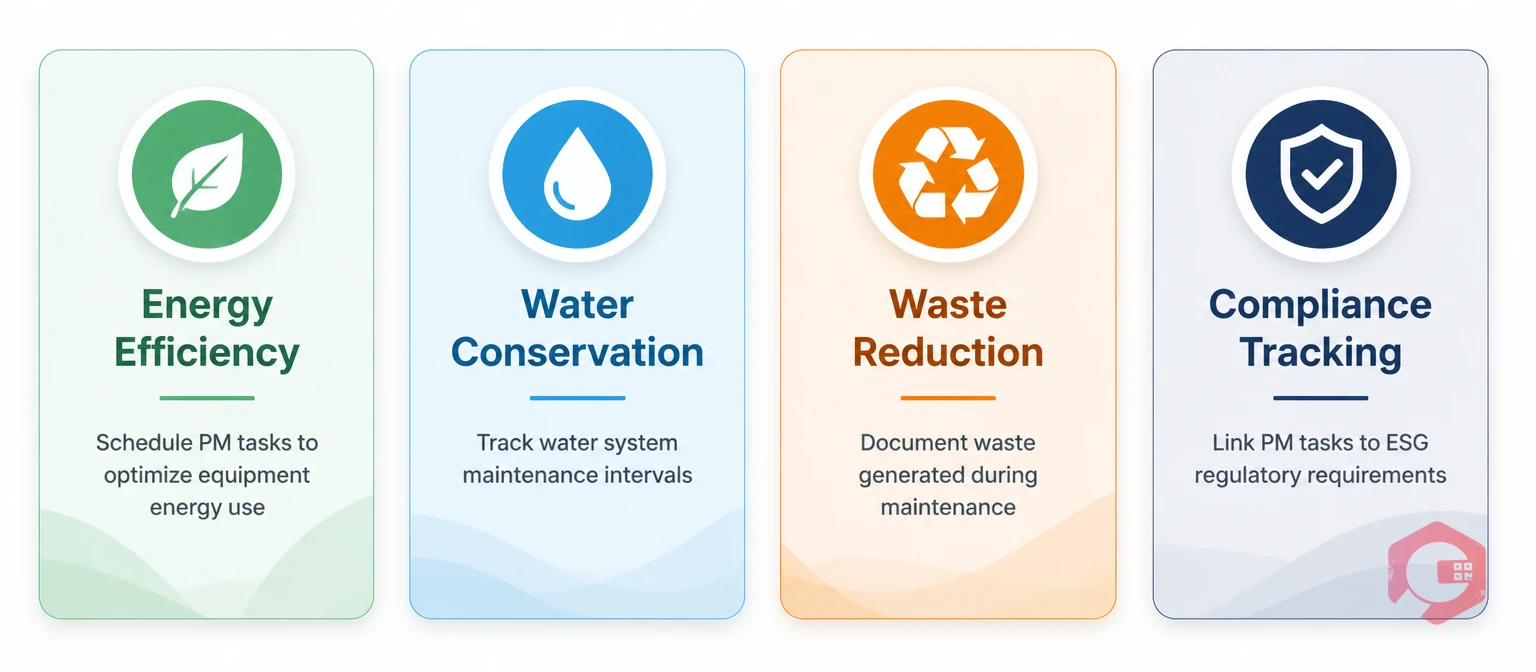
Preventive maintenance is the highest-impact point for environmental ESG work. Equipment that runs outside its design parameters consumes more energy, generates more waste, and fails faster — all of which damage your environmental footprint and your asset lifecycle costs simultaneously.
Cryotos's preventive maintenance software supports customizable checklists that can be configured to capture energy readings, waste volumes, and inspection outcomes alongside standard task completion data. Teams using structured PM programs report up to 30% reductions in unplanned downtime — and less downtime means fewer emergency callouts, fewer parts expedited via air freight, and a smaller operational carbon footprint.
Manual meter readings give you a snapshot once a month. IoT sensors give you continuous visibility into energy use, water consumption, temperature variance, and air quality — the data that makes ESG targets actionable rather than aspirational.
When a chiller starts consuming 20% more energy than its baseline, IoT-connected monitoring can trigger a work order before the fault escalates. That's both a maintenance win and an ESG win: you've prevented wasted energy, avoided a refrigerant leak risk, and extended the asset's life — all before anyone noticed a problem.
The IoT meter reading feature in Cryotos connects sensor data directly to the CMMS, so threshold breaches trigger automated alerts and work orders without manual intervention. This closes the gap between environmental monitoring and maintenance response, which is where most FM ESG programs break down in practice.
For governance, continuous monitoring also creates an auditable data trail. When your sustainability team needs to report on Scope 2 emissions or water use intensity, the data is already there — timestamped, asset-tagged, and queryable.
Facilities teams rarely operate alone. Cleaning contractors, engineering service providers, fit-out firms, and parts suppliers all affect your ESG footprint. If your contractors use diesel-powered equipment unnecessarily, dispose of waste illegally, or have poor safety records, those outcomes reflect on your governance score whether or not your own team caused them.
Integrate ESG criteria into how you select, brief, and audit contractors:
Cryotos's permit to work software helps enforce safety and compliance requirements at the point of work authorization. Automating LOTO procedures and safety sign-offs means contractors can't start work without meeting your governance conditions — which reduces risk and creates the documentation your compliance team needs.
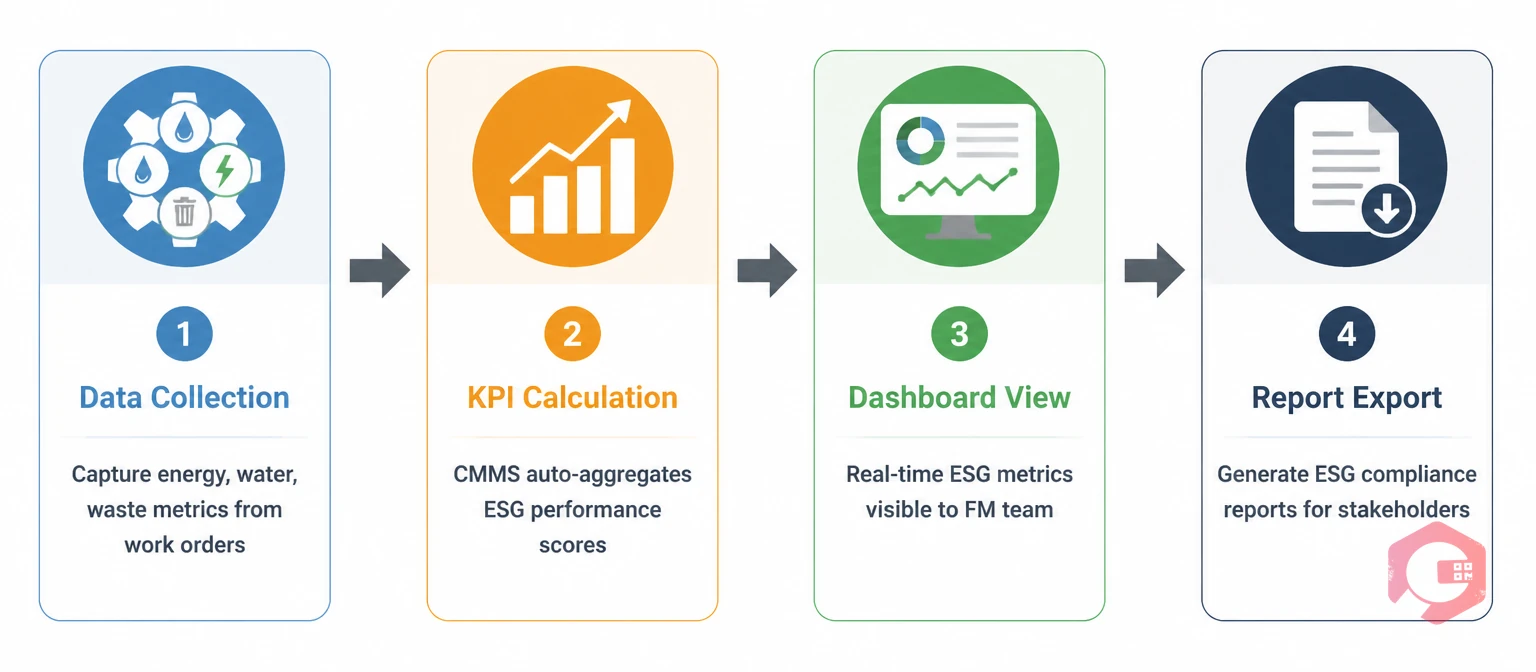
ESG reporting is only credible when the data behind it is traceable to actual operational records. The most common failure in FM ESG programs is that sustainability data lives in spreadsheets disconnected from the maintenance system — meaning it's assembled manually, prone to error, and impossible to audit in real time.
Your CMMS should be the single source of truth for the operational data that feeds ESG reports. That means energy and downtime data from assets, compliance inspection outcomes, contractor safety records, and maintenance cost data should all flow through the same system.
Cryotos's BI Dashboard lets teams drill down from organisation-level KPIs to individual asset performance — exactly the granularity ESG reporting requires. Scheduled reports can be pushed to sustainability managers and board stakeholders automatically, removing the manual assembly work that delays reporting cycles.
ESG integration is not a one-time project. The final step — and the one most teams skip — is building a structured review cycle that uses operational data to drive ongoing improvement.
A quarterly ESG review for FM operations should answer three questions: Did we hit our targets? Where did we fall short, and why? What changes to maintenance planning, asset investment, or contractor management will close the gap next quarter? This is the same logic as a reliability-centered maintenance review — you're using failure data to improve future planning, except the "failure" here includes an HVAC unit running at 140% of its baseline energy consumption, not just a breakdown.
Involve operations, sustainability, and procurement in these reviews. ESG targets that are set by sustainability managers but reviewed only by FM teams tend to drift — and targets that are reviewed but never connected back to budget or contractor decisions don't change behaviour. The goal is a review process that makes ESG data consequential, not decorative.
According to the World Green Building Council's net zero roadmap, buildings that implement structured, data-driven maintenance improvement programs consistently outperform peers on energy intensity reduction over a five-year horizon.
ESG in facility management means applying environmental targets (energy, water, emissions), social standards (occupant wellbeing, contractor safety), and governance requirements (compliance documentation, audit trails) to how buildings and assets are operated and maintained. It goes beyond annual sustainability reports to influence day-to-day maintenance planning and contractor management decisions.
A CMMS supports ESG reporting by centralising the operational data — energy readings, inspection outcomes, safety records, downtime events — that sustainability metrics are built from. When this data lives in the same system as work orders and asset histories, it's traceable, auditable, and available in real time rather than assembled manually at the end of a reporting cycle.
The most important ESG metrics for FM teams are energy use intensity, planned vs. reactive maintenance ratio, compliance inspection completion rate, contractor lost-time incident rate, and carbon output per asset. These connect directly to the three ESG pillars and can be tracked using standard CMMS reporting capabilities.
Most FM teams see measurable environmental improvements — reduced energy consumption, higher PM completion rates — within 6 to 12 months of embedding ESG criteria into maintenance planning and IoT monitoring. Governance improvements, like audit trail completeness and supplier compliance scores, often show faster results because they depend on process changes rather than capital investment.
Integrating ESG into FM operations is not about adding a sustainability workstream on top of an already busy team. It's about using the maintenance data, asset records, and compliance workflows you already have to serve a broader set of objectives — ones that are increasingly required by regulators, investors, and the organisations your facilities support.
The seven steps above give you a practical path: audit your baseline, set operational targets, embed ESG into PM planning, apply IoT monitoring, hold contractors to your standards, report through your CMMS, and review continuously. Each step builds on the last, and all of them are more achievable when your maintenance operations run on a single platform that connects asset data to compliance records to performance dashboards.
Cryotos's facility management software gives FM teams the tools to put ESG where it belongs — inside the maintenance workflow, not in a separate report. If you're ready to make sustainability a measurable part of how your facilities operate, explore what Cryotos can do for your team.




Cryotos AI predicts failures, automates work orders, and simplifies maintenance—before problems slow you down.



