

Integrity operating windows help maintenance teams prevent corrosion by setting limits on damaging process conditions and defining what to do when a limit is crossed. Corrosion rarely comes from one event. It builds when a process spends too much time too hot, too acidic, too wet or too fast. Inspection finds the damage months later. A window catches the cause sooner.
This guide explains what an integrity operating window is and which variables matter. It covers how response levels work and a four-step loop that turns limits into maintenance work. It also shows what a maintenance system can and cannot do.
Key Takeaways
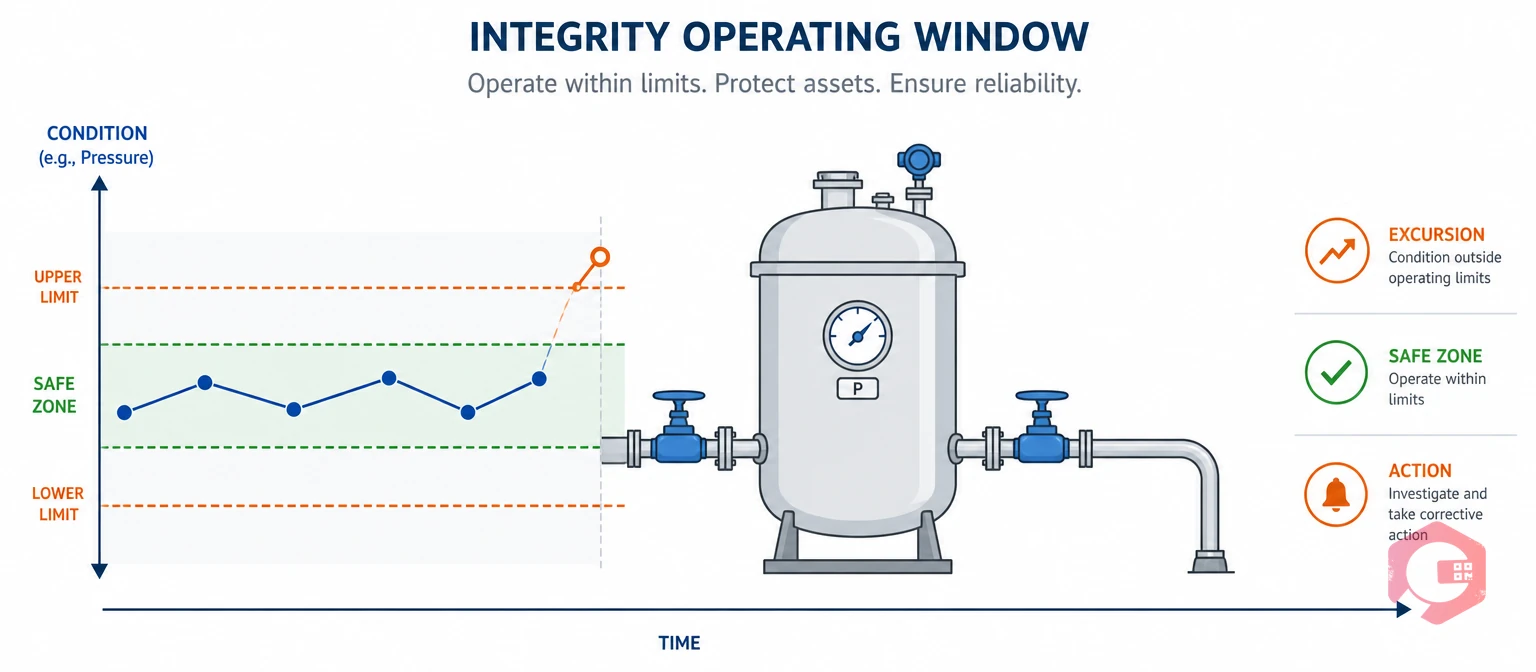
Think of it as a safe range for the conditions inside your equipment.
An integrity operating window (IOW) is a set of limits on process variables that can damage equipment. The American Petroleum Institute describes the idea in API RP 584. If the process stays outside a limit for long enough, equipment integrity can suffer.
An excursion is a period when a process variable moves outside its limit. The window says how serious an excursion is and what response is due. In the US, the OSHA process safety management rule also expects mechanical integrity programs at covered plants.
The idea started in refining and petrochemical plants. It works for any system where corrosion matters, such as boilers, cooling water, chemical dosing and tanks. Engineers set the limits for each process, so treat any example here as an illustration only. For corrosion control guidance, see AMPP.
A process alarm is a signal that helps operators keep the process stable. A safe operating limit keeps the process inside safe design limits. An integrity operating window protects equipment from damage over time. The three overlap and share data, but each has a different job.
| Concept | Purpose | Typical Focus | Usual Owner |
|---|---|---|---|
| Integrity operating window | Protect equipment from damage | Variables that drive corrosion, cracking or erosion | Integrity or corrosion engineers, with operations |
| Process alarm | Help operators keep the process stable | Day-to-day control of the running process | Operations and control engineers |
| Safe operating limit | Keep the process inside safe design limits | Pressure, temperature and flow limits for safety | Process safety and engineering |
One reading can feed all three. Do not treat one as a replacement for another.

The right variables depend on your process and the damage types in play. A corrosion or materials engineer should confirm your list. These are common examples. For background on how corrosion works, see this overview of corrosion.
Each of these depends on a reading you can trust. Sensors, lab samples and operator logs all feed the window, so a drifting sensor is an integrity risk. Check yours with the IoT sensor deployment validation checklist.
The level of a limit decides how fast the team must act. This matrix shows a typical pattern. Your plant's own IOW document sets the real responses and times.
| Level | What It Means | Typical Response | Who Acts |
|---|---|---|---|
| Critical | Fast damage or failure is possible | Bring the process back inside the limit now; raise an urgent inspection request | Operations first, then integrity and maintenance |
| Standard | Damage builds if the process stays outside | Correct within a set time; review how long and how far outside | Operations and the integrity engineer |
| Informational | Long-term life is affected, not near-term failure | Trend it and review at the regular integrity meeting | Integrity or reliability engineer |
| Instrument fault | A reading is missing or wrong | Treat it as an excursion risk; repair or calibrate fast and use lab samples as backup | Instrument technicians and maintenance |
API 584 describes levels like these, commonly called critical, standard and informational. Confirm the names your plant uses.
Here is an illustrative example. A cooling water loop has windows on pH and chlorides. A dosing pump fails overnight and pH drifts low. A standard-level alert opens a work order, the pump is repaired, and the excursion is logged. Inspection planners later see the event and add a check on the heat exchanger.
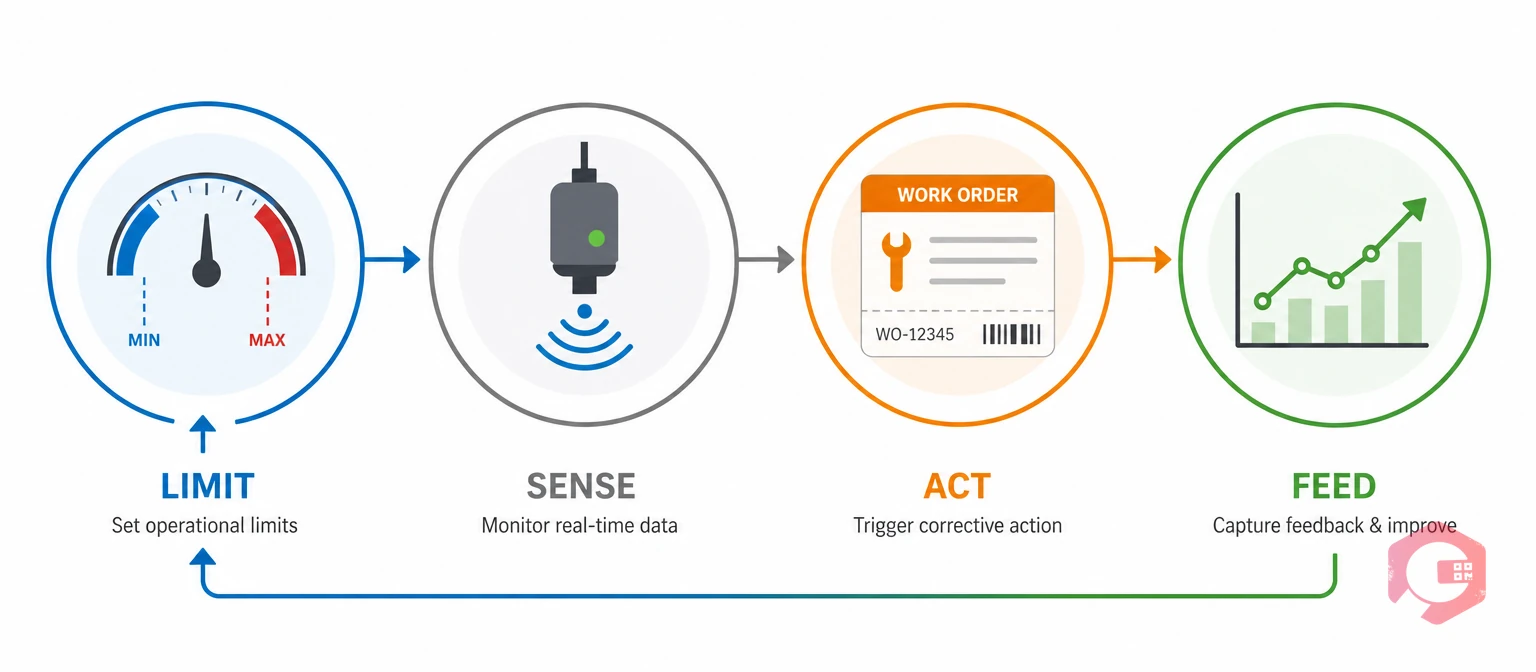
The LIMIT-SENSE-ACT-FEED loop turns an IOW from a document into a routine. Maintenance has a clear role at each step.
The LIMIT-SENSE-ACT-FEED Loop Framework:
Most failures here are quiet. The window exists, but the routine around it does not. Most maintenance teams recognize at least two of these.
A Computerized Maintenance Management System supports integrity operating windows by turning excursions into assigned work. It also keeps the records. Integrity engineers set the limits and calculate corrosion rates. Cryotos is a maintenance platform, not an IOW library or a corrosion calculator.
Maintenance teams using Cryotos have reported up to 30% reduction in unplanned downtime and 25% faster repair turnaround. Early warning only helps when someone acts on it, and assigned, tracked work orders make sure they do.
Some needs sit outside a maintenance system: the limit library, time-outside-window calculations and remaining-life estimates. Keep those in your integrity tools, and ask any software vendor how they connect.
It is a set of limits on process variables that can damage equipment, with a defined response when a limit is crossed. Its aim is to stop damage such as corrosion before it builds. Engineers set the limits for each process.
A process alarm helps operators keep the process stable. A window protects equipment from damage over time. They can use the same readings, but the limits, owners and responses differ.
It depends on the damage types in your process. Common examples are temperature, pH, chlorides, water content, flow velocity, inhibitor dose and dissolved oxygen. A corrosion or materials engineer should confirm the list.
Integrity or corrosion engineers usually set them, and operations controls the process. Maintenance keeps sensors working, does the follow-up work and records the results. Name one owner for each window and each response.
A CMMS can bring in readings, create work from threshold breaches, track inspections and keep records. It does not replace the engineering work of setting limits or calculating corrosion rates.
A window only protects assets when someone acts on each excursion. Schedule a free demo to see how Cryotos turns sensor alerts into assigned work and keeps the records in one place.


Cryotos AI predicts failures, automates work orders, and simplifies maintenance—before problems slow you down.



