

Inventory management for FM companies operating across multiple properties is more complex than it looks because every property adds its own demand profile, its own informal stocking habits, its own technician behaviours, and its own SLA clock — and when those variables multiply across 20, 50, or 200 sites, what looks like a spare parts problem is actually a visibility, coordination, and accountability problem that no spreadsheet or site-level system can solve.
A single-site maintenance team managing inventory has one storeroom, one set of assets, and one team to manage it. An FM company managing a portfolio of office buildings, retail units, schools, or healthcare facilities has dozens of storerooms, hundreds of asset types, and teams spread across locations that may never interact with each other. The complexity doesn't add linearly as you add properties — it compounds. Each new site introduces new failure modes, new ordering behaviours, and new ways for inventory data to become unreliable.
According to McKinsey's research on enterprise supply chain management, organisations managing distributed inventory across multiple sites without a unified system routinely carry 20–40% more stock than they need, while still experiencing stockouts on critical items. For FM companies, that combination — excess spend and service failures — is exactly the problem a structured inventory management system is built to prevent.
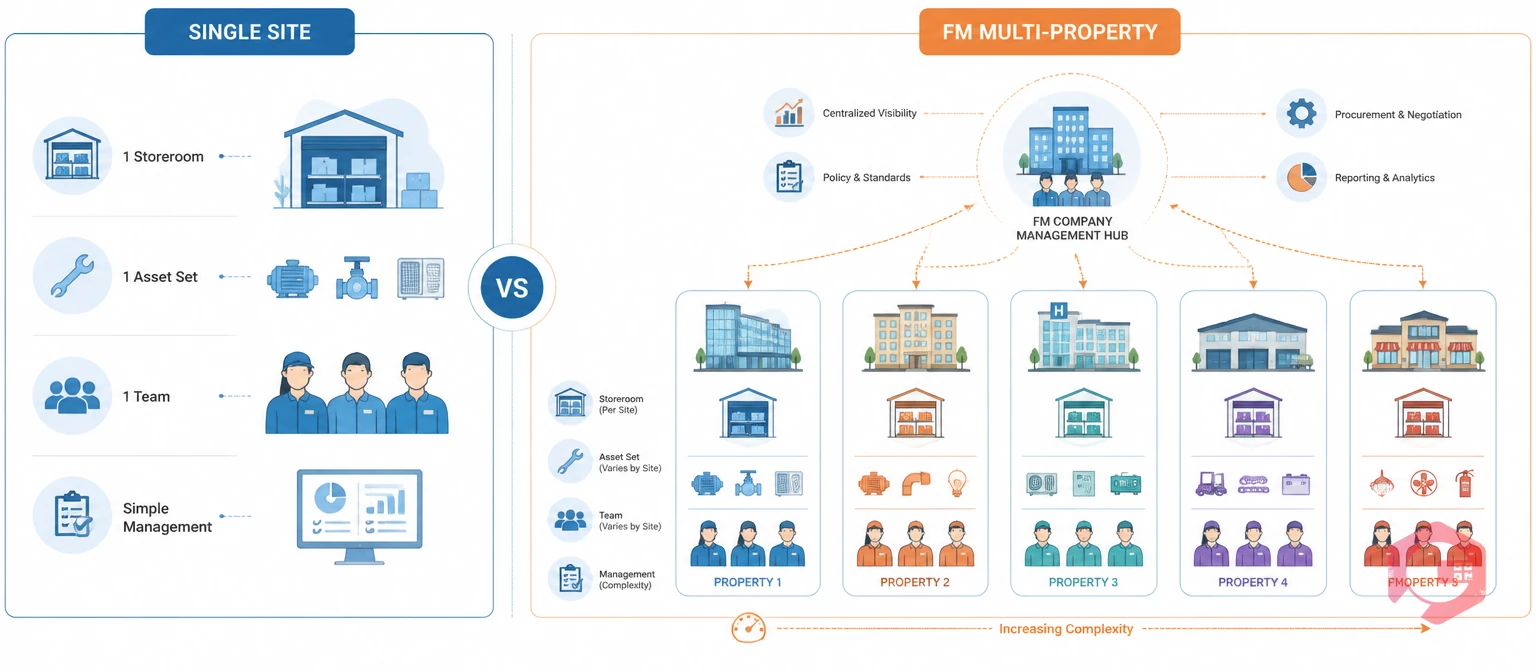
The structural difference between FM multi-property inventory and single-site maintenance inventory isn't just scale. It's the absence of a unified demand signal. According to the International Facility Management Association's operations research, facilities management organisations consistently rank parts and materials availability as one of their top three operational constraints — precisely because demand is fragmented across properties that have no shared inventory visibility. In a manufacturing plant, the maintenance planner can see every asset, every PM schedule, every open work order, and every stock level in one place — and adjust purchasing decisions accordingly. In an FM company managing a portfolio, that visibility is fragmented by design.
Each property has its own asset register (or no asset register at all). Each site technician or site manager makes informal stocking decisions based on their own experience of what breaks, what they've been caught short on before, and what they can get approved. The purchasing function — if it's centralised — is often working from requisition forms rather than real consumption data. And the finance function is looking at total spend without any visibility into what's sitting in site storerooms, what's been consumed against which work orders, or which properties are ordering the same parts independently.
This is why FM inventory management requires a fundamentally different approach from single-site maintenance inventory. It requires a system that connects all sites into a single inventory view — not just a list of parts, but a live picture of what's stocked where, what's being consumed, what's on order, and what the demand pattern looks like across the entire portfolio. The inventory management module in a CMMS built for multi-site operation provides exactly that unified view.
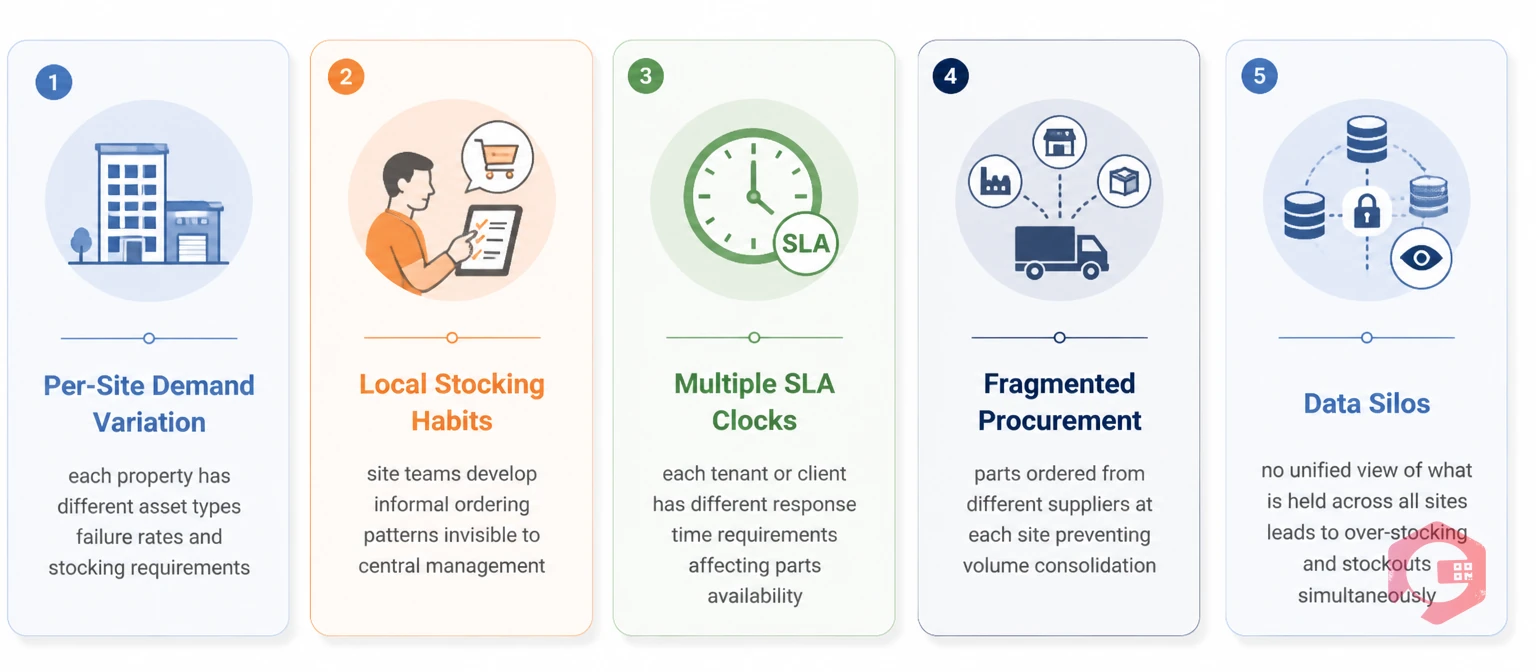
The complexity of FM inventory doesn't come from a single problem. It comes from five distinct failure modes that each site can exhibit independently — and that compound when they appear simultaneously across a portfolio.
In a multi-property FM operation, spare parts and consumables are stored in site storerooms, in engineers' vans, in building plant rooms, in back-of-house storage cupboards, and occasionally in the boots of contractors' cars. There is no single storeroom. There is no single inventory record. When a technician on a job needs a filter or a belt or a solenoid valve, their first question — "do we have one?" — often can't be answered with confidence until someone physically checks multiple locations.
This distributed storage model is operationally necessary — you can't have engineers driving to a central warehouse for every job. But without a system that records what's held at each location and updates in real time as parts are consumed and replenished, the distributed model becomes an invisible model. Parts are consumed without records. Stock counts diverge from system records. Ordering decisions are made without knowing what's already available two sites away.
When each site manager or site engineer is responsible for maintaining their own stock levels, they make rational local decisions that create irrational portfolio-level outcomes. Every site manager who has ever been caught without a critical part on a Friday afternoon will hold more safety stock next quarter. Every site that has experienced a long lead time on a specific component will order earlier and deeper than the reorder point suggests.
Multiply this behaviour across 30 or 50 properties, and the FM company is holding duplicate safety stock at every site for parts that could be shared across a regional cluster — paying for that stock three times over in purchasing cost, holding cost, and eventual write-off when the stock exceeds shelf life or the asset is replaced. According to Reliable Plant's spare parts management research, organisations without cross-site inventory visibility carry an average of 23% more stock than required — with most of the excess concentrated in exactly these behavioural safety buffers.
FM companies operate under service level agreements that specify response and resolution times for different fault categories — typically two hours for urgent faults, four to eight hours for standard, and 24 hours for routine. These SLA clocks start the moment a fault is reported. If the technician who attends the fault doesn't have the right part, the clock doesn't stop. The job stays open. The SLA starts to breach.
In a single-site operation, a stockout is an operational inconvenience. In an FM company, it's a contract performance event. Repeated stockouts on SLA-governed categories accumulate as KPI failures, trigger penalty clauses, and put contract renewals at risk. The inventory system isn't just a logistics tool — it's a contract compliance tool. A work order management system that links parts availability to job scheduling can flag stockout risk before a job is dispatched, allowing the FM planner to stage parts in advance rather than discovering the shortage when the technician is already on site.
Ghost inventory is stock that the system says is available but physically isn't — because it was consumed on a job and never booked out, picked up as a contingency item that didn't get returned, or counted at a previous stock-take and not re-verified since. In a single-site operation, ghost inventory is discoverable and correctable. In a multi-property FM portfolio, it's endemic.
The root cause is almost always the same: parts consumption happens in the field, and field engineers recording parts usage against work orders in real time is a discipline that breaks down under job pressure. When an engineer is on a tight schedule, booking parts out of the system is the last thing they do — if they do it at all. The result is a growing gap between system stock and physical stock that only becomes visible at a stock-take or when someone tries to book out a part that isn't there. A mobile-enabled field service management system that makes parts booking a built-in step of job completion — not an optional admin task — is the only sustainable fix for ghost inventory in a distributed FM operation.
When a technician is on site and needs a part that isn't in the system or isn't available from the central supply chain, they buy it locally — from the nearest trade merchant, from an online marketplace, or from a supplier they know personally. This is entirely rational from a job-completion perspective. From an inventory management perspective, it's a visibility black hole.
Local purchasing bypasses the approved supplier list, creates invoices that don't link to a work order or an asset, generates parts that may not meet specification, and adds to the FM company's tail spend — the long tail of small, uncontrolled purchases that collectively represent a significant and unmanaged cost. Tail spend in FM is notoriously difficult to eliminate entirely, but a CMMS that makes the approved ordering process faster than the local purchase alternative — with pre-approved supplier catalogues, mobile requisitioning, and automatic work-order linkage — reduces it significantly by removing the friction that drives technicians to buy outside the system.
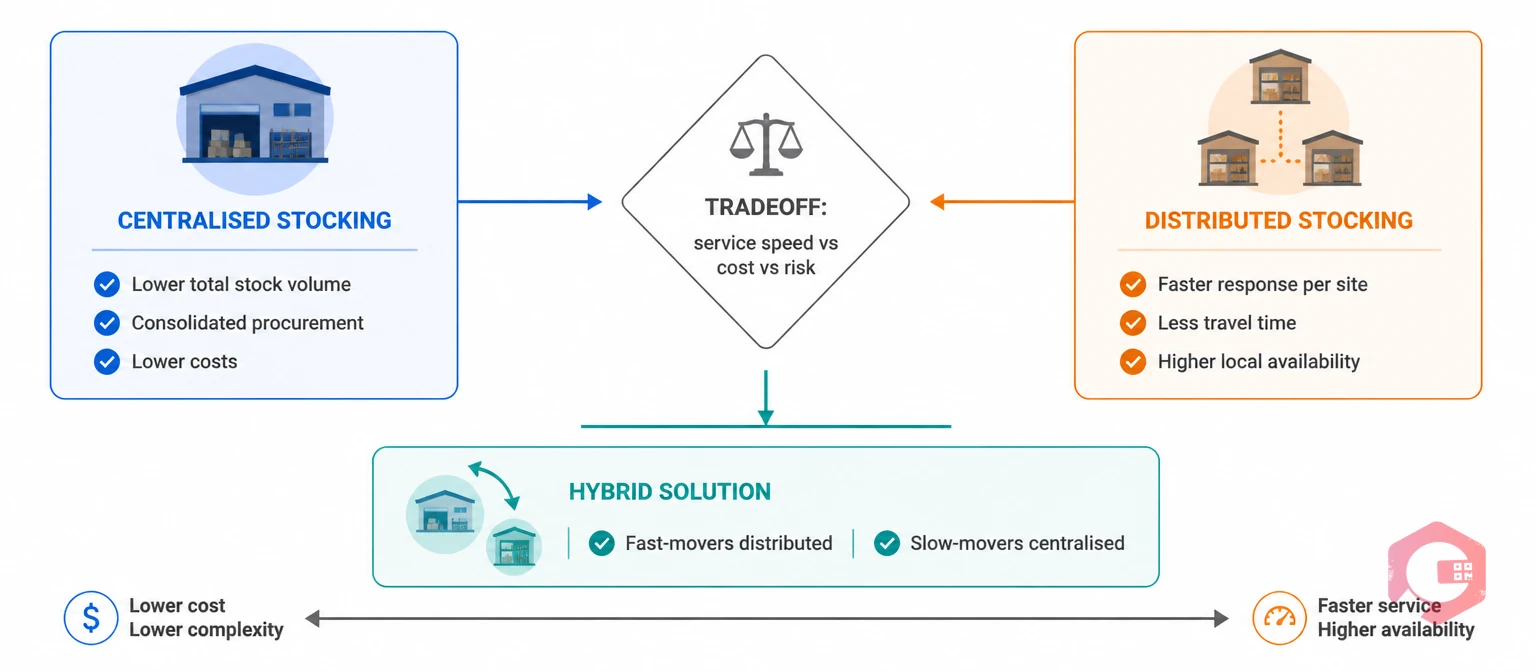
Every FM company managing a multi-property portfolio eventually confronts the same structural question: where should the inventory live? The answer shapes every downstream inventory decision, and there's no universally correct answer — only the right balance for your specific portfolio geography, SLA profile, and asset mix.
A centralised model holds most stock in a single regional warehouse and delivers to site on demand, typically via same-day or next-day logistics. This minimises duplicate safety stock, increases purchasing power through consolidated ordering, and simplifies stock management — but it introduces a lead time between fault occurrence and parts availability that may not be compatible with tight SLA windows.
A distributed model holds stock at each property or in engineer vehicles, minimising response time but maximising holding cost, duplication risk, and management complexity. Most FM companies operate a hybrid: fast-moving consumables and high-frequency wear items held locally at each property, with slow-moving and high-value components held centrally and delivered on demand.
The key insight is that neither model works well without real-time inventory data across all locations. A hybrid model with poor system visibility has all the costs of distributed stocking and all the stockout risks of centralised stocking — the worst of both worlds. Getting the model right requires knowing your actual consumption rates per property, your actual lead times from suppliers, and your actual SLA breach cost per category — all of which your CMMS should be producing automatically from work order history and downtime data.
FM companies that manage multi-property inventory well share a set of operational practices that are enabled by — but not guaranteed by — the technology they use. The ISO 55001 asset management standard provides a useful framework here: it requires that organisations establish information systems capable of monitoring asset condition, maintenance history, and associated costs — requirements that apply just as directly to FM portfolio inventory as to individual asset management.
First, they maintain a unified parts catalogue across all properties. Every part held anywhere in the portfolio has a single SKU, a single description, and a single supplier reference — regardless of which site stocks it. This eliminates the situation where the same filter is recorded as three different parts across three different sites, making cross-site transfers invisible to the inventory system.
Second, they set min/max stocking levels per property based on actual consumption data rather than site-manager instinct. The minimum reorder point for a specific drive belt at a specific property reflects that property's actual failure rate for the asset that uses it — not a generalised safety buffer applied uniformly across the portfolio.
Third, they make parts consumption recording a mandatory step in job closure, not an optional one. Every work order must have parts booked against it before the job can be marked complete in the system. This discipline is what prevents ghost inventory from accumulating.
Fourth, they review cross-site stock utilisation quarterly — identifying parts that are over-stocked at one site and under-stocked at another within the same region, and triggering internal transfers rather than new purchase orders. This single practice, applied consistently, typically reduces portfolio-level inventory spend by 10–15% without reducing service capability.
Cryotos CMMS is built to handle the multi-site inventory complexity that FM companies face — giving operations managers and procurement teams a single real-time view across every property in the portfolio without requiring a separate system at each site.
Key capabilities for FM multi-property inventory management:
FM companies using Cryotos report significant reductions in emergency purchasing, improved first-time-fix rates through better parts availability planning, and cleaner cost allocation per property — outcomes that flow directly from having one inventory system across the whole portfolio rather than a patchwork of site-level records and spreadsheets. If your inventory management currently relies on each site looking after itself, Cryotos CMMS gives your operations team the unified view to manage it properly at portfolio scale.
Multi-property FM inventory is complex because stock is distributed across dozens of locations, consumption happens in the field where recording discipline is inconsistent, demand is fragmented across independent site teams, and SLA pressure means stockouts have direct contract consequences. Unlike a single-site manufacturer, an FM company has no central storeroom and no unified demand signal — which means over-ordering, ghost inventory, and tail spend accumulate simultaneously without a system that provides real-time visibility across all sites.
Ghost inventory is stock that the system records as available but physically isn't — because parts were consumed on jobs without being booked out of the inventory system. In FM operations, it accumulates when field engineers skip parts recording under job pressure. The result is stock records that diverge from physical reality, leading to reorders that aren't needed and stockouts on parts that the system shows as available. The fix is a mobile work order system that makes parts consumption recording a mandatory step in job completion, not an optional administrative task.
Most FM companies benefit from a hybrid model: fast-moving consumables and high-frequency wear items stocked locally at each property for immediate availability, with slow-moving, high-value components held centrally and delivered on demand. The right balance depends on your portfolio geography, your SLA response windows, and your actual consumption data per property. Neither model works without real-time cross-site inventory visibility — without it, a centralised model misses stockouts and a distributed model generates uncontrolled duplication.
FM contracts are governed by SLA response and resolution times that run from the moment a fault is reported. When a technician attends a fault without the right parts, the SLA clock continues to run. Repeated stockout-driven SLA breaches accumulate as KPI failures, trigger financial penalties, and create renewal risk on long-term FM contracts. Inventory management is therefore a contract compliance function in FM, not just an operational one — and the cost of poor inventory visibility shows up directly in contract performance metrics.
You need actual consumption rates per part per property, derived from at least 12 months of work order history that links parts used to assets and fault types. You also need supplier lead times for each part category and the SLA breach cost per category — so you can calculate the economic minimum stock level that balances holding cost against stockout risk. A CMMS that has been recording work order and parts data across your portfolio for 12 months can produce all of this automatically, making min/max level-setting a data-driven exercise rather than a site-manager estimate.
The complexity of inventory management across a multi-property FM portfolio isn't visible until something goes wrong — until the SLA breaches because the technician didn't have the part, until the stock-take reveals that the inventory record is fiction, until the finance director asks why inventory spend is rising while first-time fix rates are falling. By that point, the problem has been building for months or years across dozens of sites, in forms that no individual site manager could see or fix on their own.
Getting FM inventory right at portfolio scale requires a system that treats all your properties as a single inventory ecosystem — with one parts catalogue, one consumption record, one reorder process, and one view that shows the operations manager everything happening across every site in real time. That's what a CMMS built for multi-site FM operation provides. Without it, you're managing a portfolio of independent inventory problems rather than a coordinated supply chain.
Book a free Cryotos demo to see how the multi-site inventory module works across a real FM portfolio — and what the view looks like when all your properties are in one system rather than twenty separate ones.




Cryotos AI predicts failures, automates work orders, and simplifies maintenance—before problems slow you down.



