

IoT sensor-based preventive maintenance for distribution centre conveyor systems uses real-time data from vibration, temperature, belt tension, and motor current sensors to trigger maintenance work orders automatically — before a conveyor failure stops the line. A single conveyor breakdown in a high-throughput distribution centre costs between $10,000 and $50,000 per hour in lost throughput, missed dispatch windows, and emergency repair premiums, according to McKinsey research on maintenance digitisation. Sensor-based PM eliminates that exposure by catching failure signals weeks before they become stoppages.
This guide covers the sensors that matter most for conveyor systems, how to set thresholds that actually work, and exactly how those thresholds connect to automatic work order creation inside a CMMS — so your maintenance team responds to data, not downtime.

Calendar-based preventive maintenance made sense when sensor data was expensive and difficult to collect. In a modern distribution centre, where a conveyor system might run 20 to 22 hours a day across two or three shifts, calendar-based PM creates two simultaneous problems: over-maintenance of components that are fine, and under-maintenance of components accumulating stress between scheduled visits.
A belt conveyor carrying 500 kg/m of packaged goods six days a week does not wear at the same rate as the same conveyor running at 30% capacity. The calendar doesn't know the difference. A vibration sensor on the drive unit bearing does. When bearing wear starts to develop, the vibration signature changes weeks before the bearing fails audibly or causes visible performance degradation.
The business case is straightforward. According to Deloitte's Industry 4.0 research, predictive maintenance programs enabled by IoT sensors reduce equipment downtime by 30 to 50% and cut maintenance costs by 10 to 25% compared to reactive and calendar-based approaches.
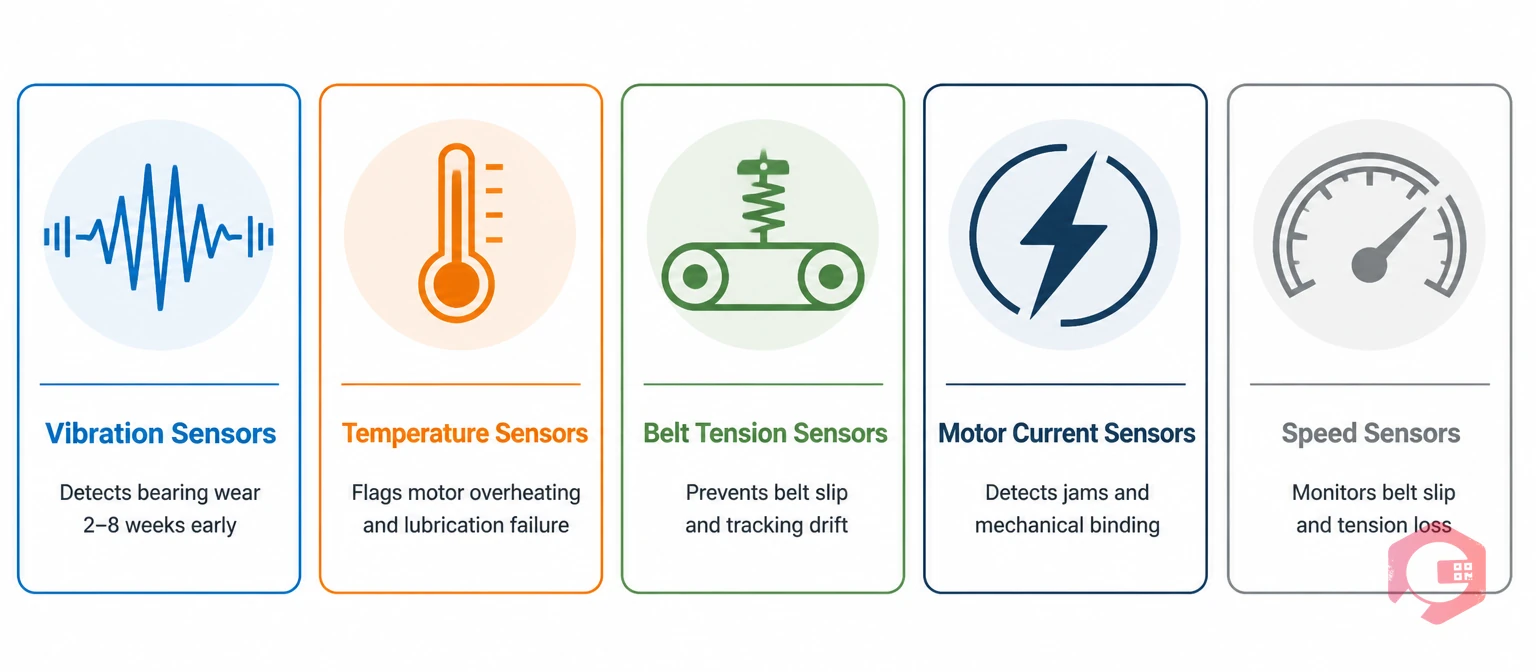
Not every sensor delivers equal value on every conveyor component. Five sensor types cover the majority of high-value conveyor failure modes in distribution centres.
Vibration sensors are the workhorse of conveyor PM. Mounted on drive unit bearings, tail pulley bearings, and idler frames, they detect the characteristic frequency shifts that indicate bearing wear, misalignment, and imbalance.
Temperature sensors on motor housings, gearbox casings, and drive pulley bearings flag thermal anomalies caused by lubrication failure, overloading, electrical faults, and blocked cooling.
Belt tension sensors measure the tension in the conveyor belt in real time and trigger tensioning work orders before tracking problems cause belt damage or product spillage.
Motor current sensors detect load anomalies that indicate jams, mechanical binding, belt misalignment, and developing motor faults.
Speed sensors on drive pulleys and tail pulleys detect belt slip, which increases as belts wear and tension decreases.
Threshold configuration is where most sensor-based PM programs either succeed or fail. Getting thresholds right requires three inputs: baseline data, OEM specifications, and operational context.
Two-tier thresholds work best in practice. The first tier triggers a monitoring alert. The second tier triggers an automatic work order. The condition monitoring approach embedded in Cryotos supports this two-tier model natively.
Each sensor type detects a distinct set of failure modes with different lead times and maintenance responses.
| Sensor Type | Failure Modes Detected | Typical Alert Lead Time | Work Order Type Triggered |
|---|---|---|---|
| Vibration (bearing) | Bearing wear, shaft misalignment, imbalance, looseness | 2–8 weeks before failure | Planned bearing inspection or replacement |
| Temperature (motor/gearbox) | Lubrication failure, overloading, cooling blockage, electrical fault | Hours to days before failure | Urgent inspection; lubrication or cooling check |
| Belt tension | Belt slip, tracking drift, over-tension stress on bearings | Days to weeks before belt damage | Planned tensioning and tracking adjustment |
| Motor current | Jam, mechanical binding, developing motor fault, belt deterioration | Immediate (spike) to weeks (drift) | Immediate inspection (spike) or planned motor service (drift) |
| Speed (differential) | Belt slip, tension loss, belt wear | Days before significant belt damage | Planned belt inspection and tensioning |
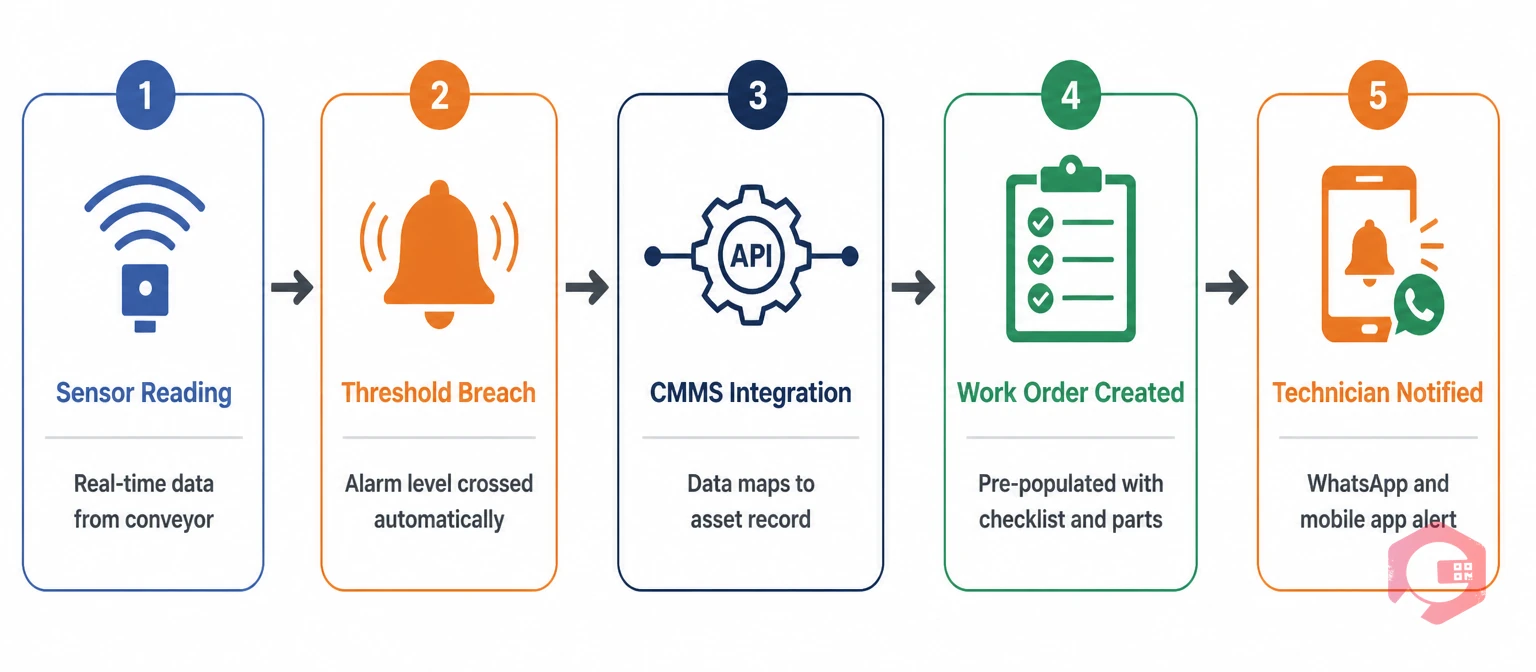
The connection between a sensor reading and a work order is where sensor-based PM becomes operationally real. With CMMS integration, the threshold breach triggers a work order automatically — pre-populated with the asset details, the sensor reading that fired the trigger, the recommended maintenance action, the required parts, and the assigned technician or team.
In Cryotos, the IoT sensor data enters Cryotos via the IoT integration layer, which connects to SCADA systems, PLC outputs, edge computing devices, and cloud IoT platforms via API. When the incoming reading for that asset crosses the configured alarm threshold, Cryotos generates a work order automatically with no human trigger required.
A second-tier alarm work order routes directly to an on-shift technician with an urgent priority tag and a WhatsApp notification via Cryotos WhatsApp integration.
Setting up a functional sensor-to-work-order pipeline for distribution centre conveyors follows a defined sequence.
Distribution centre maintenance teams using Cryotos report a 30% reduction in downtime and 25% faster repair times. Cryotos CMMS connects your sensor infrastructure to a complete maintenance workflow.
Vibration sensors on drive unit and tail pulley bearings are the highest-value starting point. Temperature sensors on motor housings and gearboxes are the second priority. Belt tension sensors and motor current sensors round out a complete conveyor monitoring package.
In Cryotos, each IoT sensor data stream is mapped to a specific asset record via the IoT integration layer. When an incoming reading crosses a configured threshold, Cryotos automatically generates a work order pre-populated with the asset details.
Most distribution centres see measurable ROI within 6 to 12 months of deployment.
Cryotos connects to SCADA systems, PLC outputs, edge computing gateways, and cloud IoT platforms via API.
Thresholds should be reviewed at 30, 60, and 90 days after initial live deployment.




Cryotos AI predicts failures, automates work orders, and simplifies maintenance—before problems slow you down.



