
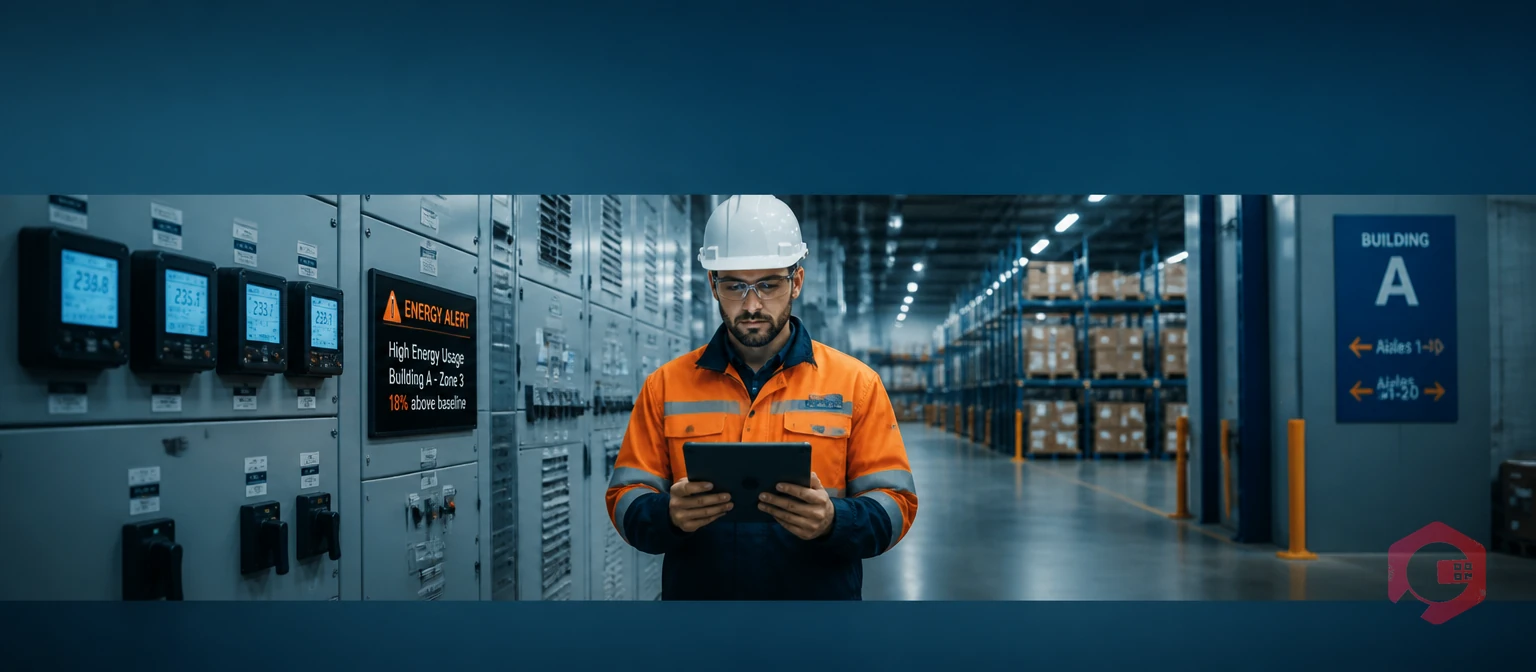
Retail warehouses reduce energy spend with meter-based CMMS alerts by connecting electricity, compressed air, water, and gas meters directly to their maintenance management system — so when consumption crosses a threshold that indicates equipment inefficiency or fault, a maintenance work order fires automatically instead of an energy bill arriving at the end of the month. According to the Carbon Trust energy management research, poor equipment maintenance accounts for 10 to 20% of wasted energy in commercial facilities. In a retail warehouse running refrigeration, conveyor systems, dock levellers, lighting arrays, and compressed air networks 16 to 24 hours a day, that waste adds up fast — and most of it is invisible until a meter-based alert makes it visible in real time.
This guide covers which meters to prioritise, how to set thresholds that trigger maintenance responses rather than ignored notifications, and how the CMMS work order pipeline turns an energy alert into a resolved maintenance fault — closing the loop between energy spend and asset health.

Energy overspend in retail warehouses is almost always a maintenance problem wearing an energy bill. The mechanisms are consistent across facilities: an HVAC unit running with a dirty coil consumes 15 to 20% more electricity than a clean one to deliver the same cooling output. A compressed air system with an undetected 3mm leak wastes up to 10% of total compressor output continuously. A refrigeration condenser with fouled fins runs its compressor harder and longer, increasing kWh consumption per degree of cooling achieved. A conveyor drive unit with a worn bearing creates additional mechanical resistance, increasing motor current draw on every shift.
None of these faults show up as equipment failures immediately. They show up as elevated energy consumption — slowly at first, then more significantly as the underlying fault develops. The problem is that most retail warehouses have no mechanism to connect an energy consumption increase to a specific piece of equipment and generate a maintenance response. The monthly electricity invoice shows total consumption. It doesn't show which compressor, which conveyor zone, or which HVAC unit is drawing more than it should.
Smart meters alone don't solve this. A sub-meter on a distribution board tells you that consumption in a particular zone has increased. It doesn't tell you why, and it doesn't trigger anyone to investigate. The maintenance team doesn't see smart meter data. The energy manager sees the data but has no way to raise a maintenance work order. The two functions operate in parallel with no connection between them — which means energy anomalies get noted on a report and rarely actioned before the next billing cycle.
A CMMS with meter integration closes that gap. When a meter reading crosses a configured alert threshold, the CMMS generates a maintenance work order automatically — assigned to the right technician, linked to the right asset, with the alert data attached. The energy anomaly becomes a maintenance task within minutes, not a line on next month's report. According to IEA Energy Efficiency research, organisations that connect energy monitoring to maintenance workflows reduce energy-related maintenance costs by 15 to 30% compared to those running energy and maintenance as separate functions.
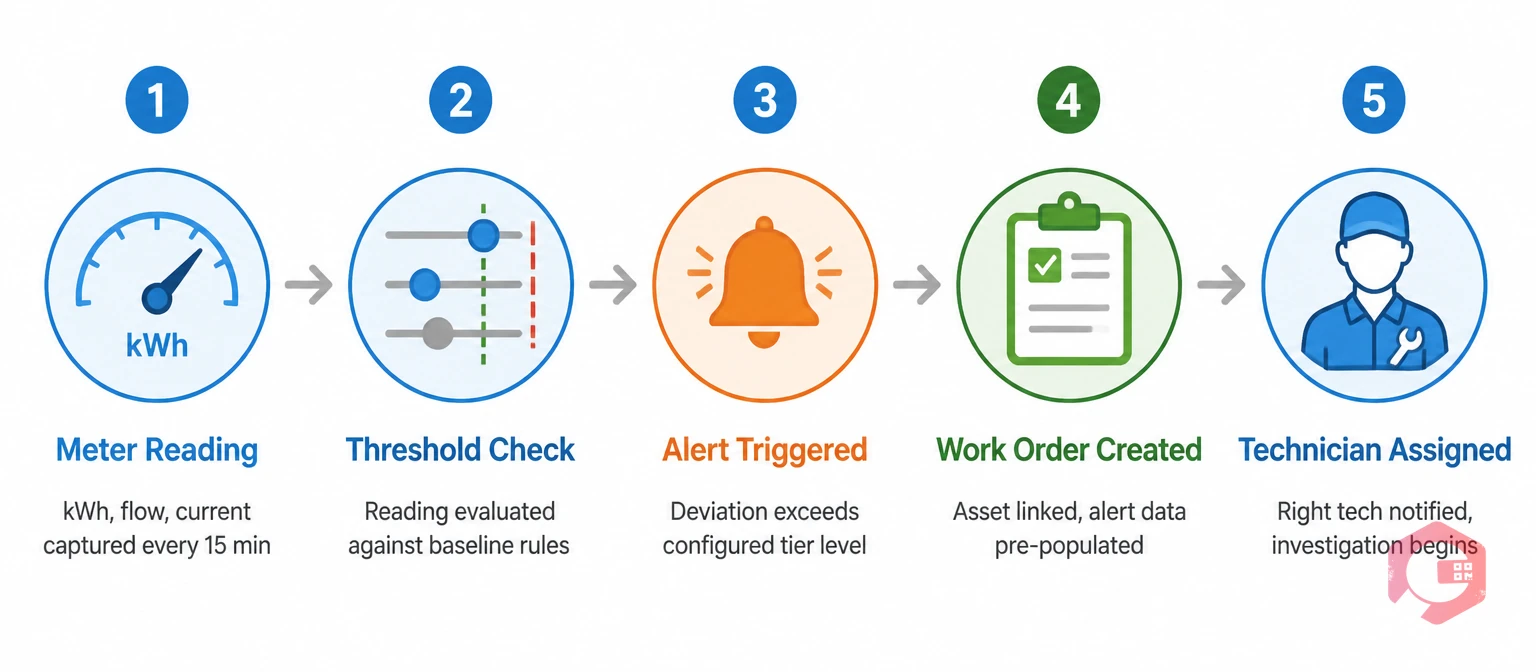
Meter-based CMMS alerts are threshold rules applied to meter data inside the maintenance management system. Each rule defines: which meter or sub-meter to monitor, what reading value or consumption pattern constitutes an alert condition, and what maintenance action the alert should trigger. When the meter feed delivers a reading that crosses the threshold, the CMMS acts — creating a work order, notifying a technician, or escalating to a maintenance supervisor depending on the severity configuration.
The critical difference from a standalone smart meter or building management system alert is the connection to the asset register and the work order engine. A BMS alert tells someone that consumption in Zone 4 has spiked. A CMMS meter alert tells the system that the refrigeration condenser unit on Asset ID WH-REF-004 has increased energy draw beyond its baseline, creates a corrective work order for that specific asset, attaches the meter trend data to the work order, assigns it to the refrigeration technician on shift, and sends a WhatsApp notification to confirm receipt — all without human involvement between the meter reading and the technician receiving the job.
Cryotos's IoT meter reading module connects to electricity sub-meters, water meters, gas meters, and compressed air flow meters via pulse output, Modbus, MQTT, or API integration with existing BMS and SCADA systems. Meter readings update at configurable intervals — typically every 15 minutes for energy monitoring — and the CMMS evaluates each reading against configured thresholds in real time. The asset register links each meter to the specific equipment it monitors, so an alert on a particular meter creates a work order on the right asset, not just a general zone notification.
Two alert types cover the majority of retail warehouse energy monitoring use cases. Absolute threshold alerts fire when a reading exceeds a fixed value — motor current above 45A on a 37kW conveyor drive, for example. Deviation alerts fire when consumption rises above a baseline percentage — electricity draw on a refrigeration circuit 15% above the rolling 30-day average for that circuit at that time of day. Deviation alerts are more sensitive than absolute thresholds and better at catching the gradual consumption increases that indicate developing equipment faults rather than acute failures.
Not every circuit in a retail warehouse warrants immediate sub-metering. The prioritisation question is: which equipment categories consume the most energy, have the highest fault-related consumption uplift, and have maintenance faults that a meter alert can reliably detect before they become failures? Three categories consistently top that list in retail warehouse environments.
Refrigeration systems are the highest-priority metering target in most retail warehouses handling ambient-to-chilled or frozen inventory. A refrigeration plant running a 50,000 square foot cold store typically represents 40 to 60% of total site electricity consumption. Sub-metering refrigeration plant circuits and monitoring against baseline consumption gives the earliest available signal of developing faults — often 2 to 4 weeks before the fault is detectable by any other means.
Compressed air systems are the most consistently wasteful energy system in industrial and warehouse environments. The US Department of Energy estimates that 25 to 35% of compressed air generated in industrial facilities is lost to leaks. Flow meters on compressed air mains detect the characteristic baseline consumption increase that indicates cumulative leak development — triggering a leak detection survey work order before the loss becomes entrenched.
HVAC and ventilation systems are the third priority. Warehouse HVAC draws significant power and degrades predictably with filter loading, coil fouling, and belt wear. Electricity sub-meters on HVAC distribution boards give a reliable signal when a unit is working harder than it should.
After these three, conveyor drive systems, lighting circuits, and dock equipment are the next tier of metering priorities in retail warehouse environments.
Each meter type monitors a specific energy flow and correlates with distinct equipment failure modes. Matching meter type to the faults you're trying to detect early determines how much maintenance value you get from your metering investment.
| Meter Type | Equipment Monitored | Maintenance Faults Detected | Alert Lead Time |
|---|---|---|---|
| Electricity sub-meter (kWh) | HVAC units, refrigeration compressors, conveyor drives, lighting circuits | Filter fouling, coil contamination, bearing wear, lamp failure accumulation | Days to weeks before performance failure |
| Motor current (CT clamp) | Conveyor drives, fan motors, pump motors, compressors | Bearing wear, belt slip, mechanical binding, developing motor fault | 1–6 weeks before failure |
| Compressed air flow (litres/min) | Air mains, zone distribution, specific equipment feeds | Leak development, actuator wear, pressure regulator drift | Continuous — detects as leaks develop |
| Gas meter (m³) | Heating plant, dock heating, hot water systems | Burner inefficiency, heat exchanger fouling, control valve drift | Days to weeks before efficiency loss is significant |
| Water meter (m³) | Cooling towers, condensate systems, welfare facilities | Cooling tower blowdown drift, condenser water leak, welfare system leak | Hours to days — water leaks often develop quickly |
| Power factor meter | Large motor loads, VSD-driven equipment | Capacitor bank failure, VSD fault, harmonic distortion from failing drives | Weeks — gradual PF degradation detectable early |

The most common failure mode in energy alert programs isn't a technical one — it's alert fatigue. Thresholds set too tight generate constant notifications that maintenance teams start ignoring. Getting thresholds right requires the same baseline-first approach used for vibration and temperature sensor thresholds: establish what normal consumption looks like before configuring any alert.
Baseline establishment for energy meters runs for 4 to 8 weeks of normal operations, capturing weekday, weekend, shift start, shift end, and seasonal variation patterns. Cryotos stores meter baseline data against the asset record via the asset tracking module, making it available for every subsequent threshold review.
Two threshold tiers prevent alert fatigue while maintaining sensitivity. The first tier — a monitoring alert — fires when consumption exceeds baseline by 8 to 10% for a sustained period. The second tier — an automatic work order — fires when consumption exceeds baseline by 15 to 20% for a sustained period, or when an absolute limit is breached.
Time-of-day context improves alert precision significantly. Cryotos's meter alert logic supports time-of-day threshold variants, so alerts are calibrated to what normal consumption actually looks like in each operating period.
Review thresholds at 30, 60, and 90 days after initial deployment.
The work order pipeline from meter alert to closed repair is where energy monitoring becomes a maintenance program rather than an energy reporting exercise. Without that pipeline, meter alerts are information. With it, they're operational action.
In Cryotos, the connection works through the IoT meter reading module's integration with the work order management engine. When a meter reading breaches a configured second-tier threshold, Cryotos creates a corrective work order on the linked asset automatically.
When the work order closes, the resolution and any parts consumed record against the asset. The BI Dashboard tracks energy consumption trends by asset alongside maintenance work order history.
Retail warehouse maintenance teams using Cryotos report a 30% reduction in downtime and 25% faster repair times. Cryotos CMMS connects your metering infrastructure to your maintenance workflow — from threshold breach to automatic work order to closed repair record — in one platform that turns energy data into maintenance action. Book a demo at cryotos.com to see how the IoT meter reading integration and energy alert pipeline work for a retail warehouse at your scale.
A meter-based CMMS alert is a threshold rule applied to meter data inside the maintenance management system. When a meter reading exceeds a configured threshold, the CMMS generates a maintenance work order automatically.
Prioritise refrigeration plant electricity sub-meters first. Compressed air flow meters are the second priority. HVAC electricity sub-meters are third.
Establish a baseline consumption profile for each monitored asset before configuring any alert threshold. Run the meter integration in monitoring-only mode for 4 to 8 weeks.
Yes. Cryotos's IoT meter reading module connects to existing building management systems, SCADA platforms, and IoT gateways via Modbus, MQTT, BACnet, and REST API integrations.
Standalone energy management systems generate alerts that go to an energy manager or facilities team as notifications. A CMMS meter alert generates a maintenance work order automatically, pre-populated with the asset record, the alert data, the investigation checklist, and the assigned technician.


Cryotos AI predicts failures, automates work orders, and simplifies maintenance—before problems slow you down.



