

Most conversations about automation in maintenance focus on replacing human labour with machines. Jidoka — one of the two foundational pillars of the Toyota Production System — proposes something more nuanced: automation that is designed to stop and signal a human the moment something goes wrong, rather than automation that continues blindly through problems until they become crises. The term translates not as "automation" but as "autonomation" — automation with a human touch. That distinction, encoded in a single kanji character, is one of the most operationally significant ideas in modern manufacturing maintenance. According to the Toyota Production System documentation, Jidoka alongside Just-in-Time forms the two pillars of TPS — and it is the pillar most directly relevant to how maintenance operations should be designed.
This guide explains what Jidoka actually means, how its four-step cycle maps to autonomous maintenance practice, and how a CMMS extends the Jidoka principle into the digital maintenance operation — turning sensor alerts, operator work requests, and automated work order creation into the modern expression of an idea Sakichi Toyoda first embodied in a loom in 1896.
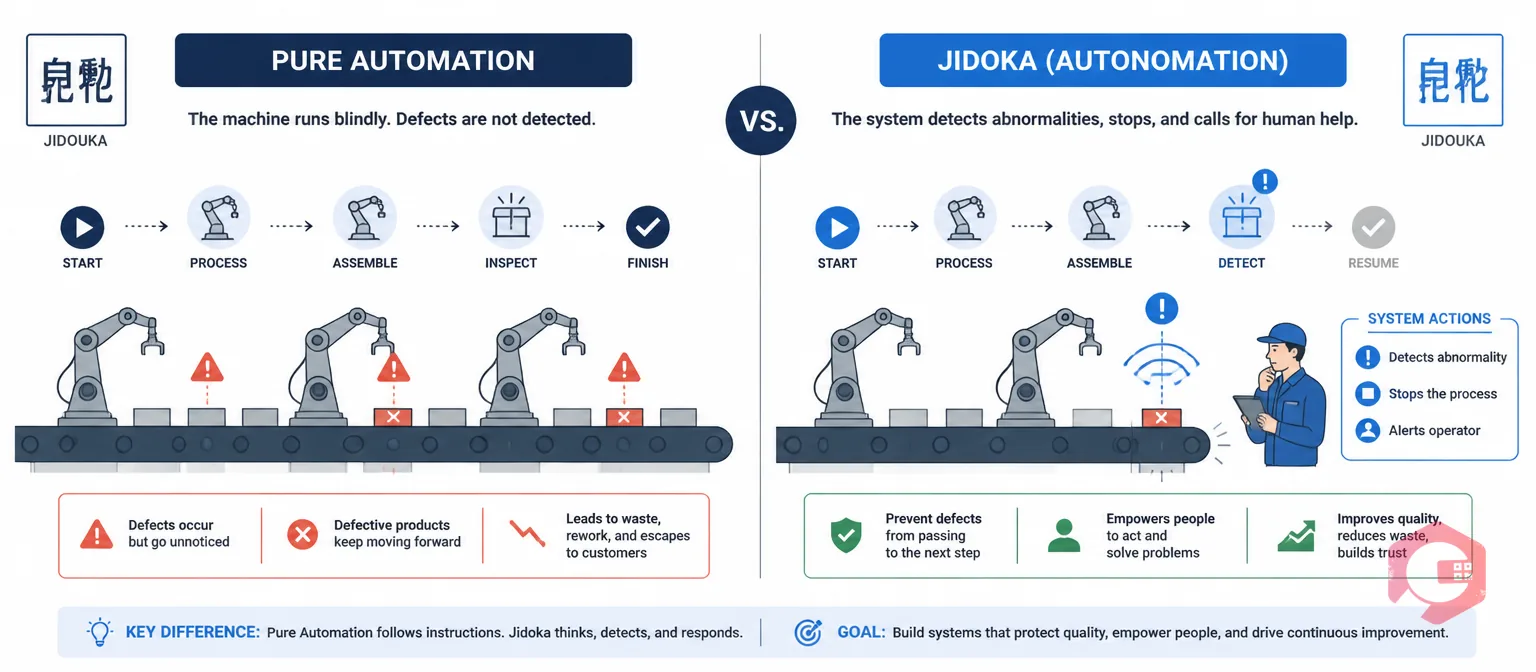
Jidoka is written in Japanese as 自働化. The critical character is the middle one: 働 (hataraku) — meaning "to work" with the radical for "person" (人) embedded in it. Standard automation in Japanese is written 自動化 — using the character 動 (ugoku), meaning simply "to move." The difference is that Jidoka carries the human being inside the concept itself. Autonomation is not automation that replaces human intelligence; it is automation that calls on human intelligence at the precise moment it is needed.
In practical terms, this means that a Jidoka-designed system does not keep running when it detects an abnormality. It stops, signals the problem visibly, and waits for a human to assess, decide, and act. This is the opposite of automation that masks problems by continuing to run — and it is the operating philosophy that autonomous maintenance is built on.
The philosophical gap between automation and autonomation is not academic — it has direct operational consequences. A fully automated system that detects a bearing vibration anomaly and logs it for the next scheduled PM visit is running through the problem. A Jidoka-designed system that detects the same anomaly, stops the process (or signals for a stop), alerts the operator, and requires human assessment before continuing is respecting the boundary between what machines can decide and what humans must decide.
In maintenance operations, this distinction determines whether abnormalities become failures or become findings. Automation without Jidoka accumulates problems silently; autonomation with Jidoka surfaces them immediately and involves the human before the damage propagates.
Jidoka originates with Sakichi Toyoda, the founder of the Toyota group, who in 1896 invented a wooden hand loom and later, in 1924, a fully automated loom with a crucial feature: it stopped automatically when a thread broke. Before this invention, a broken thread would run invisibly through metres of fabric, ruining the entire roll before a human operator noticed. Sakichi's loom detected the abnormality — the missing thread — stopped the process at the point of detection, and signalled for human intervention to fix the thread before production continued.
That 130-year-old loom principle is the direct ancestor of modern autonomous maintenance. The operator who notices abnormal vibration, stops the line, and raises a work request before running the machine to failure is doing exactly what Sakichi's loom did. The difference is that today the operator has a mobile CMMS app instead of a thread detector — but the logic is identical.

Jidoka operates as a four-step cycle. Every step has a maintenance equivalent, and together they constitute the core logic of autonomous maintenance as a TPM discipline.
The first Jidoka step is detection: something is not behaving as it should. In Sakichi Toyoda's loom, detection was mechanical — the thread tension sensor. In a modern maintenance operation, detection happens at multiple levels simultaneously: an operator notices an unusual sound or smell during routine operation; a vibration sensor crosses a threshold and fires an alert; an automated lubrication system fails to register a completed cycle; a temperature reading from a motor exceeds its normal operating range.
Autonomous maintenance expands the detection network by making every trained operator a sensor node. Where a factory with only dedicated maintenance technicians has a small, scheduled detection capacity, a factory with autonomous maintenance-trained operators has continuous, real-time detection across every asset in the operation — because the person closest to the equipment is alert to its normal operating signature and notices deviations before they appear in any data system.
The second Jidoka step is stopping — halting the process at the point of detected abnormality rather than continuing to run through the problem. In manufacturing, this means the machine or line stops. In maintenance, the equivalent is not always a physical stop — it may mean halting work on an asset, preventing a restart after a job, or isolating equipment pending inspection. The principle is the same: do not continue operating a process in a known abnormal state, because continuing accumulates damage and makes root cause identification harder.
This step is where autonomous maintenance culture lives or dies. An operator who notices an abnormality and continues running because "the scheduled PM is next week" is violating Jidoka's second principle. An operator who flags the abnormality immediately and prevents the next production cycle from starting until it is assessed is applying Jidoka correctly — and is precisely the behaviour that autonomous maintenance training is designed to build.
The third step is the immediate response to the stopped abnormality: either fix it if it is within the operator's authorised scope (tighten a loose fastener, restore a lubrication point, reset a tripped sensor), or flag it with sufficient context for the maintenance technician who will respond. This is the "human touch" in autonomation — the step where human intelligence assesses the situation and decides the appropriate response.
In a CMMS-enabled operation, "flagging" means raising a work request from the point of observation: asset identified, abnormality described, photograph attached, location confirmed. That work request is not a verbal report to the supervisor that may or may not be passed on — it is a formal record in the maintenance system that cannot be lost, forgotten, or deprioritised invisibly. The operator's Jidoka act of stopping and flagging creates a durable, tracked event in the CMMS.
The fourth step is root cause elimination — not just fixing the symptom but preventing the abnormality from recurring. This is where Jidoka connects to Kaizen: the stopped abnormality is not just a problem to resolve but an opportunity to improve the system that allowed the abnormality to occur. In maintenance, this means the corrective work order generated by the operator's work request is followed by a root cause analysis that asks why the abnormality appeared, not just how to restore normal function.
Without this fourth step, Jidoka becomes a detection system without a learning system. The same abnormality recurs, gets detected and stopped repeatedly, and consumes maintenance resources without reducing the underlying failure rate. The work order management software module captures the root cause category at task closure — and the accumulated root cause data across all work orders is what enables the fourth Jidoka step to operate at the system level rather than the individual incident level.
Jidoka and autonomous maintenance are not separate methodologies that happen to share vocabulary. They are the same idea at different levels of organisational implementation. Jidoka is the engineering and cultural principle; autonomous maintenance is the operational programme that implements that principle across a production workforce.
In autonomous maintenance, the operator is explicitly repositioned from a passive equipment user to an active participant in equipment health. They are trained to recognise normal vs. abnormal operating conditions, authorised to perform basic maintenance tasks, and authorised to stop or flag equipment when they detect a problem. This repositioning is precisely what "the human touch" in Jidoka describes: the operator is the intelligent layer that the automated detection system calls upon when it encounters a condition beyond its programmed response.
Without Jidoka culture, operators run equipment through problems they notice because stopping feels like disruption and nobody has authorised them to flag abnormalities. With Jidoka culture, stopping and flagging is not disruption — it is the correct response, it is valued, and it is the first step of the improvement cycle. Autonomous maintenance training builds this culture by giving operators the knowledge to distinguish normal from abnormal and the tools to act on that distinction.
The Andon system — the visual signal board that lights up when a line worker detects a problem and pulls the Andon cord — is Jidoka's most famous physical implementation. It makes the stop visible, signals the problem's location, and summons the appropriate responder. In modern maintenance, the CMMS work request from an operator's mobile is the digital Andon cord: it makes the observation visible, records the location and context, and routes the response to the appropriate technician. The mechanism has changed across generations; the principle is identical. Pulling the Andon cord and raising a mobile work request are the same Jidoka act, 70 years apart.
The Jidoka cycle translates differently depending on the maturity of the maintenance operation. The following comparison shows how the same underlying logic is expressed across three operational models:
| Jidoka Step | Traditional (Pre-Autonomous) | Autonomous Maintenance | CMMS-Enabled Digital |
|---|---|---|---|
| Detect the Abnormality | Maintenance technician notices during scheduled PM or breakdown response | Trained operator detects during daily equipment check or production | IoT sensor crosses threshold OR operator detects and logs on mobile app |
| Stop the Process | Machine runs until failure or next scheduled visit | Operator stops or prevents restart; uses Andon signal | Automated stop triggered by sensor breach OR operator raises priority work request |
| Fix or Flag | Verbal report to supervisor; written fault sheet filed manually | Operator performs authorised basic fix or raises abnormality record | Work request submitted from asset location via mobile; corrective work order auto-generated |
| Investigate Root Cause | Post-failure RCA if breakdown significant enough to warrant it | Maintenance technician reviews operator record; joint RCA if recurring | Root cause logged at work order closure; CMMS trend analysis identifies repeat patterns |
The progression from column 2 to column 4 is not a replacement of the human element — it is an extension of it. Autonomous maintenance gives operators the role Jidoka requires; CMMS gives them the tools to fulfil it in a way that creates permanent, searchable, improvable records rather than verbal reports that dissolve between shifts.
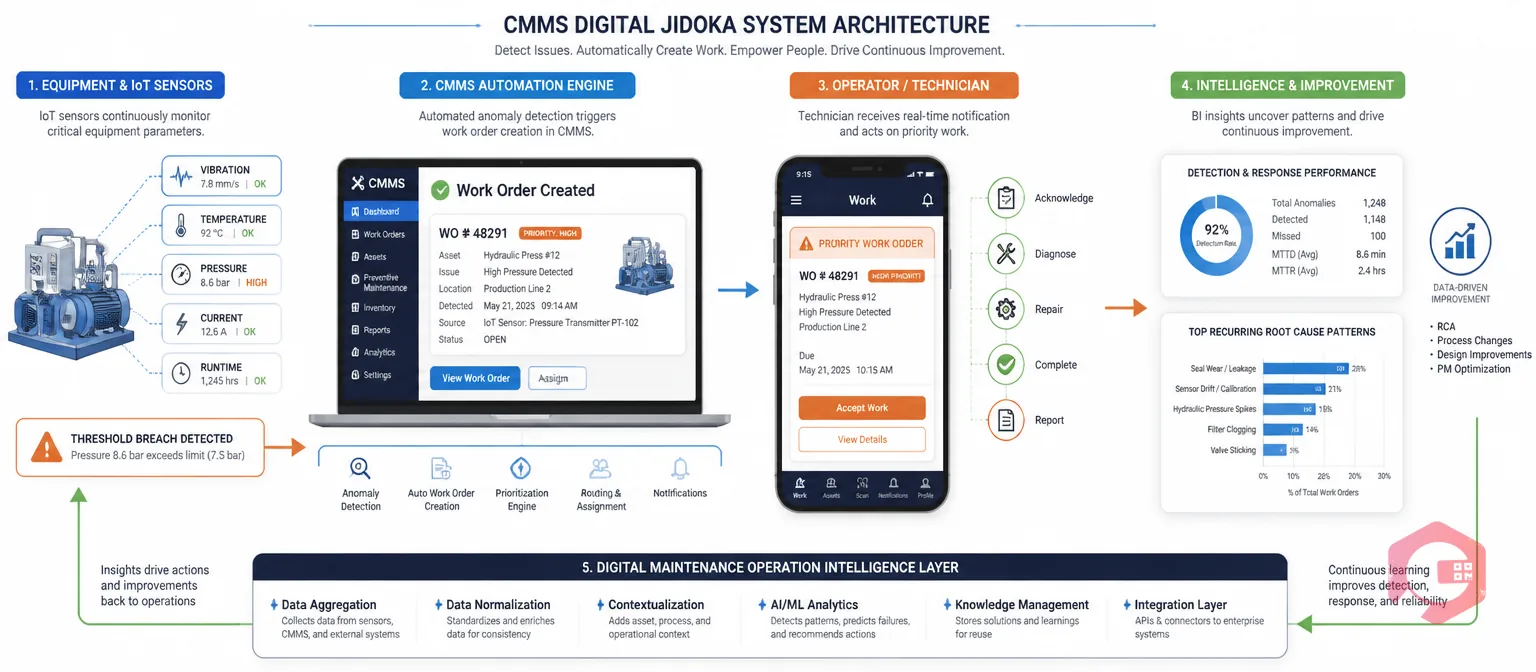
A CMMS extends Jidoka beyond the individual operator-asset interaction into a system-wide intelligence layer. Each of the four Jidoka steps produces data that the CMMS captures, stores, and makes available for analysis — turning the Jidoka cycle from a local event into an organisational learning loop.
Detection data: every sensor alert, every operator work request, and every abnormality record in the CMMS is a detection event. Aggregated over time, detection data shows which assets generate the most abnormalities, which shifts detect the most problems, and whether the operator detection network is performing — or whether equipment is running through problems because detection is failing.
Stop data: every work order generated from a detection event, and its priority classification, constitutes the stop record. The CMMS tracks whether detected abnormalities resulted in timely work orders — or were detected but not acted upon, which is a Jidoka failure that the data makes visible.
Fix and root cause data: every work order closure with its cause code and resolution record is a Jidoka step 3 and 4 record. The preventive maintenance software module uses recurring root cause patterns to adjust PM frequencies and inspection checklists — the fourth Jidoka step operating as a system improvement rather than a one-time fix. According to the Lean Enterprise Institute, continuous improvement without abnormality detection and stopping is improvement on a foundation that keeps eroding — Jidoka is the mechanism that stabilises the foundation.
Cryotos CMMS is configured to support the full Jidoka cycle in a maintenance operation — from detection through to root cause elimination. The work request feature is the digital Andon cord: operators log abnormalities from the asset location using a QR-code scan that links the record to the exact asset, adds a timestamped photograph, and routes the request to the appropriate maintenance team based on the work category. The operator's detection act immediately creates a CMMS record — visible, tracked, and impossible to lose between shifts.
For operations with IoT sensor integration, Cryotos connects sensor threshold breaches to automated work order creation through the workflow automation software — the sensor performs step 1 (detection) and step 2 (stop signal) automatically; the technician receives the work order and performs steps 3 and 4 with full context. This is digital Jidoka: automated detection that calls on human intelligence for assessment and resolution, exactly as Sakichi Toyoda's loom called the weaver's attention to a broken thread.
The BI Dashboard closes the Jidoka learning loop at the organisational level — showing detection rates by asset, area, and shift; work order conversion rates from operator work requests; and recurring root causes that indicate where PM schedules need adjustment or equipment redesign is warranted. The fourth Jidoka step — eliminate the root cause — is only achievable when the root cause data is visible and accumulated; the BI Dashboard makes it so. Teams using Cryotos report a 30% reduction in unplanned downtime, with the combination of operator work request enablement and sensor-triggered work order creation implementing the Jidoka detection cycle digitally at scale.
Automation runs processes without human intervention, including through abnormalities and failures. Jidoka — autonomation — is automation designed to stop and signal when it detects an abnormality, requiring human assessment before the process continues. The philosophical difference is fundamental: pure automation removes the human from the loop entirely; Jidoka keeps the human in the loop at the critical decision points where machine judgement is insufficient. The kanji for Jidoka (自働化) contains the character for "person" (人) embedded in the character for "work" (働), encoding this human presence in the word itself. In maintenance, the practical difference is between a system that logs sensor alerts for the next scheduled visit and one that stops the process and calls for immediate human response.
Autonomous maintenance (Jishu Hozen in Japanese) is the TPM practice of training and enabling production operators to perform basic maintenance tasks and detect equipment abnormalities. Jidoka is the philosophical principle that justifies and frames this practice: if automation should stop and signal a human when something goes wrong, then the human closest to the equipment — the operator — is the ideal first responder. Autonomous maintenance operationalises Jidoka by building the detection and signalling capability into the operator role at every asset, every shift, continuously — rather than relying on periodic maintenance technician visits to find problems that have been accumulating since the last inspection.
Andon is the physical implementation of Jidoka's stop-and-signal step in the Toyota factory. The Andon cord (later Andon button) allows any worker to stop the production line and signal the problem location visually on the Andon board. When the cord is pulled, production stops and the team leader responds to the signalled location. Andon is Jidoka step 2 (stop) and the signal element of step 3 (flag) made physical and visual. Modern mobile CMMS work requests are the digital equivalent of Andon: the operator stops the process at the point of abnormality and signals the location, description, and context to the maintenance team through the CMMS rather than through a visual board — the mechanism differs across generations; the Jidoka logic is identical.
CMMS supports Jidoka at every step of its four-step cycle. For detection, it provides the mobile work request interface that allows operators to log abnormalities at the point of observation — and integrates with IoT sensors to detect abnormalities automatically. For stopping, it creates priority work orders that communicate urgency and prevent ignored abnormalities. For fixing and flagging, it routes work to the correct technician with the operator's context attached. For root cause elimination, it accumulates work order root cause data and surfaces patterns that drive PM schedule improvements and engineering changes. Without a CMMS, the Jidoka cycle produces observations that fade; with a CMMS, every Jidoka act creates a permanent record that drives the next cycle of improvement.
Jidoka is not a manufacturing museum piece. It is the operating principle that defines the relationship between automation and human intelligence in any well-run maintenance operation — and it is more relevant in the age of IoT sensors and mobile CMMS apps than it was in Sakichi Toyoda's loom factory. The question it asks is still the same: when something goes wrong, does your system continue blindly, or does it stop, signal, and wait for a human to decide?
For maintenance teams building autonomous maintenance programmes that embody the Jidoka principle — where every operator is a detection node, every abnormality creates a formal record, and every root cause drives a system improvement — Cryotos CMMS provides the work request, workflow automation, and root cause tracking infrastructure to make the Jidoka cycle work at scale. Book a free demo today and see how the oldest idea in lean manufacturing looks in a modern CMMS.



Cryotos AI predicts failures, automates work orders, and simplifies maintenance—before problems slow you down.



