

The Jishu Hozen Abnormality Register is a structured log used in autonomous maintenance programs to record, track, and resolve equipment abnormalities spotted by machine operators before they escalate into failures. Rooted in the Total Productive Maintenance (TPM) philosophy, this register acts as the first line of defense against unplanned downtime — and it's quietly transforming how automotive, pharmaceutical, and manufacturing plants run their daily operations.
When operators detect a loose bolt, an unusual vibration, or an oil seep during their routine inspection, that observation needs to go somewhere actionable. Without a formal register, these small signals get forgotten — until the machine breaks down at the worst possible moment. With a proper Jishu Hozen Abnormality Register in place, nothing slips through the cracks.
In this guide, you'll learn what this register contains, how it works across high-stakes industries, and how a modern CMMS software like Cryotos turns it from a paper form into a real-time maintenance intelligence tool.
Jishu Hozen — Japanese for "autonomous maintenance" — is one of the eight pillars of Total Productive Maintenance (TPM). Its core idea is simple but powerful: the people who operate machines every day are the best-positioned to detect early signs of deterioration. Rather than waiting for a maintenance technician to discover a problem, Jishu Hozen trains and empowers operators to take ownership of their equipment's basic care.
This pillar moves through seven structured steps — from cleaning and inspection to full self-management. At every step, operators need a system to log what they find. That system is the Abnormality Register. Plants that implement Jishu Hozen correctly report significant reductions in unplanned stoppages, with some manufacturers achieving up to a 30% drop in breakdowns within the first 12 months.
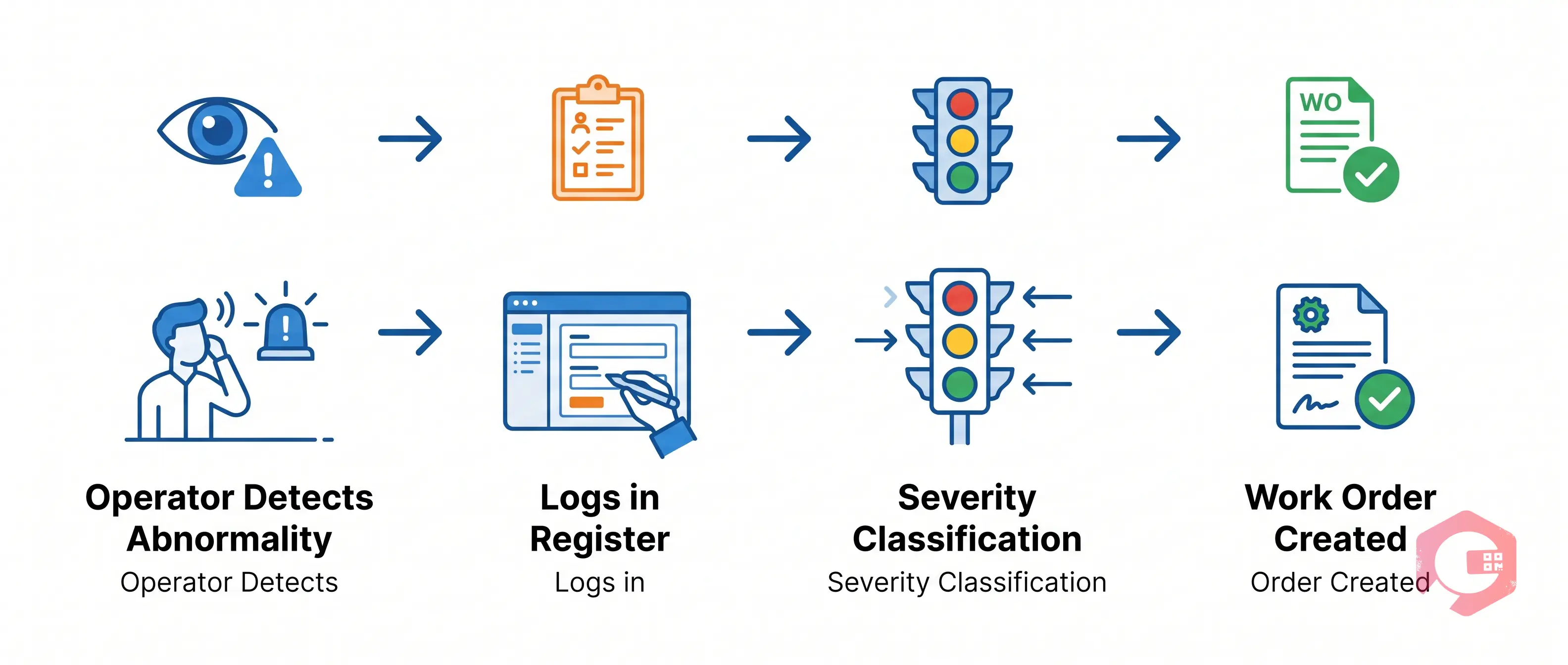
The Abnormality Register is a formal document — or digital module — where operators record every equipment irregularity they detect during their daily autonomous maintenance activities. Think of it as the bridge between "something seems off" and "here's a tracked, assigned, and resolved maintenance task."
Every entry in the register captures a specific abnormality observation, ties it to an asset, assigns a severity level, and tracks it to resolution. The register also creates an audit trail that supervisors, maintenance teams, and auditors can review to measure how well the autonomous maintenance program is working on the shop floor.
A well-maintained register directly supports preventive maintenance goals — because abnormalities caught early are almost always cheaper and faster to fix than failures caught late.

Whether it's a paper form or a digital entry, an effective Abnormality Register must capture these core data points:
Together, these fields give maintenance managers a complete picture of equipment health trends — not just a list of incidents, but a living dataset for predictive maintenance decisions.
Automotive manufacturing runs on precision and speed. A single unplanned stoppage on a body-in-white line or a paint booth can ripple into thousands of lost units per day. The Jishu Hozen Abnormality Register directly addresses this vulnerability by converting operator awareness into structured maintenance action.
In automotive plants, operators interact with the same machines for hours every shift. They notice when a conveyor starts jerking, when a welding gun takes a fraction longer to cycle, or when a robot arm moves slightly out of tolerance. These are not alarms — they are early signals that only experienced operators detect. The Abnormality Register gives those signals a home.
Key use cases across major automotive production zones:
Automotive OEMs that integrate the register with their asset management software can correlate abnormality frequency with asset age, shift patterns, and maintenance history — enabling smarter overhaul schedules.
In pharmaceutical manufacturing, equipment reliability is not just a productivity issue — it's a regulatory requirement. FDA 21 CFR Part 211, EU GMP guidelines, and WHO standards all require documented evidence that equipment is maintained in a state of control. The Jishu Hozen Abnormality Register becomes a compliance asset in this environment.
When a filling line operator notices a sealing jaw temperature fluctuation, or a blending tank agitator sounds different than usual, that observation must be documented. In a pharma context, undocumented abnormalities that later contribute to a batch failure can result in recalls, 483 observations, or warning letters. The register creates the traceable evidence that regulators expect to see during audits.
How the register strengthens GMP and audit posture:
General and heavy manufacturing — from steel rolling mills to food processing plants to chemical facilities — deals with equipment that runs in harsh, demanding conditions. The Jishu Hozen Abnormality Register is one of the most practical tools available to bridge the gap between what operators see and what maintenance teams know.
In many manufacturing environments, operators and maintenance technicians work different schedules, communicate through supervisors, and rarely sit in the same room together. This creates a dangerous information gap. Abnormalities that operators spotted at 6 AM often never reach the maintenance planner by the afternoon shift — and the machine breaks down at midnight.
A structured register eliminates this gap. Every observation becomes a record. Every record gets reviewed. Every critical record triggers a work order. The communication chain that used to depend on memory and word-of-mouth becomes a reliable, documented workflow.
For plants tracking OEE (Overall Equipment Effectiveness), abnormality data from the register feeds directly into the quality and availability components — helping maintenance planners understand which assets are generating the most operator-detected issues before those issues become performance losses on the OEE dashboard.
Automobile assembly plants — distinct from the broader automotive sector's stamping and fabrication operations — are high-mix environments where hundreds of assembly stations need to stay synchronized. A single station going down can halt an entire production line. Jishu Hozen, backed by a rigorous Abnormality Register, is a core reason that lean assembly plants consistently outperform plants that rely solely on reactive maintenance.
At the assembly level, abnormalities are often subtle: a torque tool that's slightly off, a conveyor pallet that takes a second longer to index, a vision system that occasionally flags good parts. These aren't failures — they're warning signals. The register captures them at the source before they accumulate into stoppages or quality escapes that reach end-of-line inspection.
Automobile plants using digital registers integrated with their downtime tracking software can also correlate abnormality rates with line balancing data — identifying bottleneck stations that need more maintenance attention before they become throughput constraints.

Paper-based registers were the standard for decades — and they still work better than nothing. But they come with real limitations that compound over time: entries get lost, data can't be searched or analyzed, escalation depends on someone physically reviewing the clipboard, and paper doesn't integrate with maintenance planning systems.
Digital registers solve all of these problems and unlock capabilities that paper never could:
Cryotos CMMS is built for exactly the kind of structured, operator-driven maintenance intelligence that Jishu Hozen demands. When your team logs an abnormality in Cryotos, it doesn't just sit in a database — it flows into a live maintenance ecosystem.
Operators can submit abnormalities directly from the Cryotos mobile app — complete with photos, asset tags scanned via QR code, and severity classification. The platform's workflow automation engine routes each entry to the right team member based on the asset, abnormality category, and priority level — instantly, without manual intervention. Critical abnormalities trigger immediate work orders with all the context attached.
Maintenance managers get a real-time dashboard showing open abnormalities by machine, shift, and category. The built-in BI reporting module lets you track abnormality closure rates, average resolution times, and recurring issue patterns — the exact metrics that tell you whether your Jishu Hozen program is working. When integrated with IoT sensor data from SCADA and PLC systems, Cryotos can even correlate operator-detected abnormalities with machine telemetry to build a richer picture of asset health.
For automotive, pharma, automobile, and manufacturing teams ready to move beyond clipboards and spreadsheets, Cryotos provides the digital backbone that makes Jishu Hozen scalable, auditable, and genuinely effective at preventing the failures that cost you most.
The register captures equipment abnormalities detected by operators during autonomous maintenance activities and tracks them from observation through resolution. Its main purpose is to prevent small issues from escalating into unplanned breakdowns by ensuring every detected irregularity is formally logged, assigned, and closed.
Common categories include lubrication issues (seeps, leaks, dry contact points), contamination (dust, coolant, foreign material), mechanical wear (cracks, loose fasteners, damaged seals), noise and vibration anomalies, electrical irregularities, and safety concerns like exposed wiring or missing guards. The categories are usually customized to fit each plant's equipment and risk profile.
The register is the operational foundation of Jishu Hozen, which is one of TPM's eight pillars. It creates a formal feedback loop between operator observations and maintenance actions — turning informal observations into structured, trackable maintenance intelligence that drives continuous equipment improvement over time.
Yes — and integration is highly recommended. A CMMS like Cryotos can automatically convert high-priority abnormalities into work orders, send notifications to maintenance teams, track resolution times, and generate trend reports. This removes the manual handoff that causes delays in paper-based systems and gives managers real-time visibility into abnormality status across the plant.
While ISO 55001 and GMP guidelines don't mandate a register by name, they do require documented evidence of equipment monitoring, condition assessments, and maintenance actions taken. A well-maintained Abnormality Register satisfies these documentation requirements and strengthens your audit position by demonstrating a proactive, operator-led equipment care culture.



Cryotos AI predicts failures, automates work orders, and simplifies maintenance—before problems slow you down.



