Kaizen culture in maintenance operations is the practice of embedding continuous, incremental improvement into the daily habits of every technician, planner, and manager — not as a one-time initiative, but as the default way work gets done. A CMMS that tracks every work order, failure, and improvement idea turns that philosophy into measurable progress. Studies by the Kaizen Institute show that organisations applying structured Kaizen practices to their maintenance programmes reduce unplanned failures by 25–40% within 18 months — not through large capital investment, but through small, daily improvements that compound over time.
Key Takeaways
In maintenance, Kaizen means applying small, structured improvements to work processes, equipment conditions, and maintenance systems on a continuous basis. It is not a lean transformation project, a capital programme, or a once-a-quarter reliability review. Kaizen improvements are typically low-cost, fast to implement, and proposed by the technicians and planners closest to the equipment.
The contrast with conventional improvement programmes is stark. A traditional reliability project might take 6 months, involve an external consultant, and produce a detailed report that gets filed and forgotten. A Kaizen improvement might take an afternoon — one technician rearranges a lubrication route to match physical machine layout rather than asset number order — and saves three hours of travel time every week indefinitely. Multiplied across a team of 20 technicians submitting two ideas each per month, the compounding effect becomes transformational within a single year.
Kaizen also differs from reactive maintenance in its relationship to failure. Reactive maintenance treats every breakdown as a one-off event to close as quickly as possible. Kaizen treats every breakdown as a signal that something in the process, the equipment, or the PM programme can be improved. That mindset shift — from closing tickets to preventing recurrence — is what turns a competent maintenance team into a high-performing one. Good maintenance management software makes that shift practical by giving teams the data to identify patterns and track improvements.
The table above shows why organisations that rely solely on periodic improvement projects struggle to sustain their gains. Kaizen builds the improvement habit into how the team operates every day — so the gains never stop.
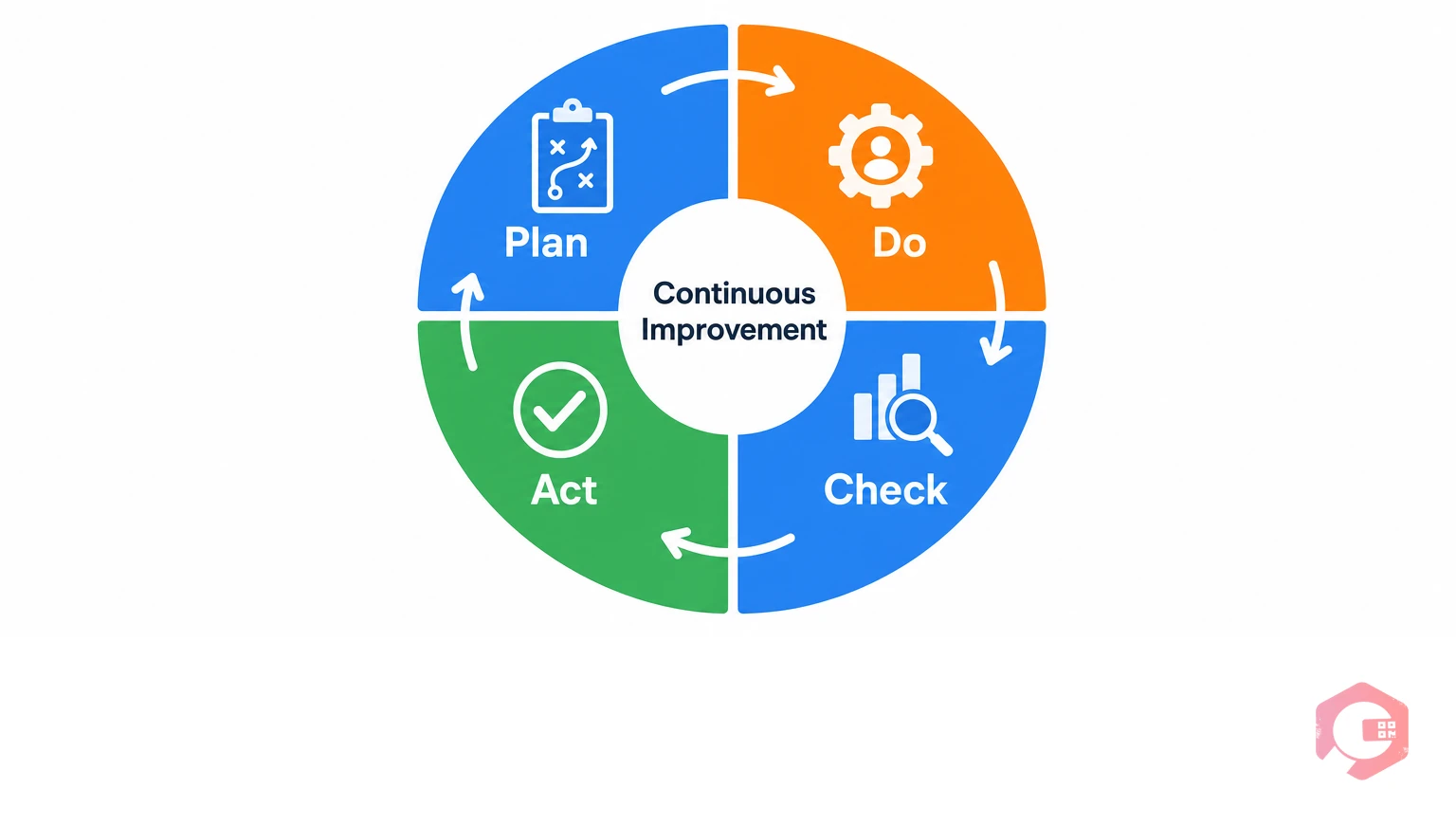
Kaizen operates on the PDCA cycle — the four-step improvement engine that turns every problem into a learning opportunity. In a maintenance context, each phase has a specific meaning.
Plan: identify the exact problem or improvement opportunity. Be specific — "the pump bearing on Line 3 fails every 6 weeks" is a plannable problem; "reliability is poor" is not. Define the expected outcome and how you will measure it. Planned downtime analysis from your CMMS data is often the starting point for identifying which assets and processes are worth targeting first.
Do: implement the change at small scale. Resist the urge to fix everything at once. Run the improvement on one machine, one shift, or one process route before expanding. This limits the cost of a wrong hypothesis and makes measurement clean.
Check: measure the result against the target you set in the Plan phase. If you predicted a 2-hour weekly time saving, measure whether you actually achieved it. Use real data from your work orders and maintenance logs — not subjective feedback. This is where work order management data becomes essential: closed work orders carry the timestamps, technician time, and parts cost that make measurement objective.
Act: if the result is positive, standardise the change across the whole fleet and document it in your PM checklists and SOPs. If the result is negative or mixed, treat it as new information and run the cycle again with a revised hypothesis. The key insight is that a failed experiment is not a failure — it is a faster path to the right answer than no experiment at all.
According to the Society for Maintenance and Reliability Professionals (SMRP), maintenance teams that apply a structured improvement cycle to their top five chronic failure modes achieve 30–40% reductions in those failure rates within 12 months — without any capital investment in new equipment.

The four improvements shown above come directly from maintenance teams that applied Kaizen thinking to their daily operations. Each one required no capital, took less than a day to implement, and delivered a measurable result that persists every week indefinitely.
Lubrication route reorganisation. A plant maintenance team reorganised their lubrication rounds by physical machine location rather than asset number. The change saved 3 hours per week by eliminating backtracking between machines in different areas of the facility. Annualised, that is 156 technician-hours recovered — equivalent to nearly four full working weeks — at zero cost.
Tool shadow board. A workshop team installed a shadow board — a labelled pegboard outline showing exactly where each tool belongs. Finding tools that were previously left wherever they last got used had been consuming an average of 12 minutes per shift. The shadow board eliminated that search entirely. A team of 10 technicians across two shifts recovers over 700 hours per year from this single five-minute installation job.
Checklist standardisation. A maintenance team noticed technicians were following PM checklists in asset-number order while the physical machines were arranged completely differently. Resequencing the checklist to match physical layout reduced inspection errors by 40% and cut average PM completion time by 18 minutes per round. The improvement required one afternoon of checklist revision and one approval from the maintenance manager. The maintenance checklists module lets you update and republish a checklist instantly — the improvement reaches every technician on every shift the same day.
Parts bin labelling. A storeroom team added part number, storage location, and min/max quantity to the face of every parts bin. Technicians previously spent an average of 8 minutes per visit searching for the right part. After labelling, that time dropped to under 90 seconds. For a storeroom visited 40 times per day, the time saving across the team exceeds 150 hours per month.
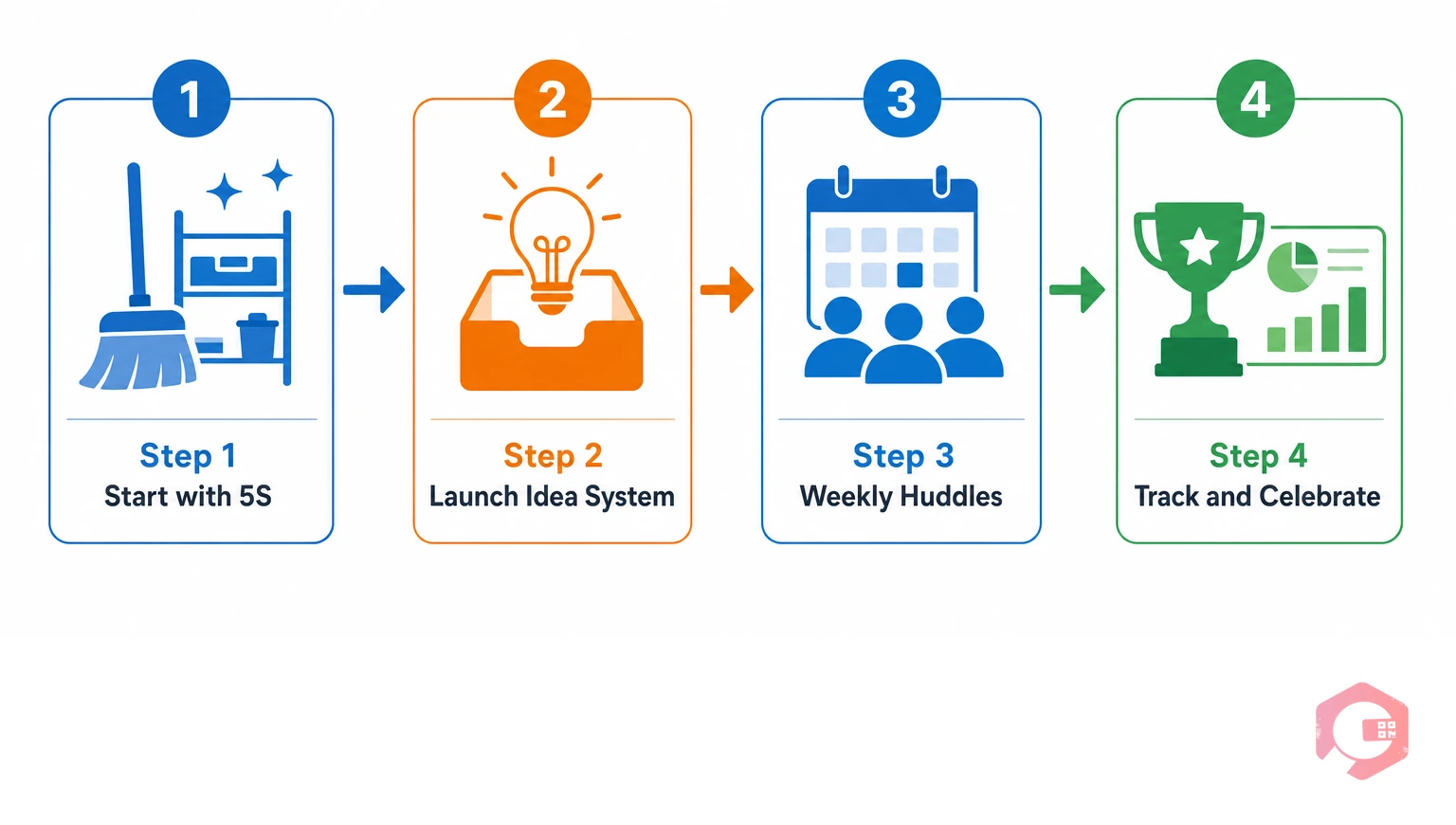
The four-step roadmap above shows how leading maintenance teams move from an idea to a sustained Kaizen culture. Each step builds the foundation for the next — skipping steps is the most common reason Kaizen programmes fail to take root.
Step 1: Start with 5S. A clean, organised workplace is not just good housekeeping — it is the Kaizen prerequisite. When tools are in their places, floors are clear, and equipment surfaces are clean, abnormal conditions become immediately visible. A leaking seal, a vibrating panel, or a worn belt is obvious in a 5S workplace; it disappears in a cluttered one. 5S gives every technician the visual management baseline that makes improvement opportunities visible without any analysis.
Step 2: Launch a simple idea capture system. The most common Kaizen culture failure is giving people no mechanism to record improvement ideas at the moment they have them. A mobile improvement log in your CMMS, a physical whiteboard in the workshop, or a dedicated work request category labelled "improvement idea" — any of these works. The key requirement is that submitting an idea must take less than two minutes. Complexity kills participation. The preventive maintenance software in Cryotos includes a structured improvement log that technicians can access from the same mobile app they use for PM tasks.
Step 3: Run weekly CI huddles. A 10-minute standing meeting held at the start of each week does three things that sustain the Kaizen culture. It gives every submitted idea a visible review — technicians see their ideas taken seriously, not disappear into a manager's inbox. It gives in-progress improvements a status update — the team can see that ideas become actions, not just promises. And it gives the week a continuous improvement frame — the first 10 minutes of the week are dedicated to making this week slightly better than last week.
Step 4: Track and celebrate wins publicly. A physical board or digital dashboard showing ideas submitted, ideas in progress, and ideas completed closes the improvement loop visibly. Recognising the technician behind each completed improvement — even informally — builds the social proof that makes others want to participate. McKinsey's research on lean maintenance programmes consistently identifies public recognition of small wins as the highest-leverage activity for sustaining CI culture beyond the initial implementation phase.
A Kaizen culture runs on information — and a CMMS is what turns raw maintenance activity into the structured information that makes improvement visible, measurable, and standardisable. Cryotos supports every stage of the Kaizen cycle in maintenance.
Repeat failure identification. The BI dashboard surfaces assets with recurring failure patterns — the top candidates for Kaizen improvement. Without this visibility, teams spend their energy on the loudest problems rather than the highest-impact ones.
5-Why root cause analysis. Every corrective work order in Cryotos includes a built-in 5 Whys analysis field. When a technician closes a breakdown, they record not just what failed, but why — creating an institutional knowledge base that prevents the same failure recurring on other assets in the fleet.
Instant PM checklist updates. When a Kaizen improvement changes how a PM should be done, the updated checklist publishes to every technician on every shift immediately. No paper round, no retraining session, no version control problem.
Downtime trend tracking. The downtime tracking module lets you measure whether a Kaizen improvement actually reduced failure frequency — closing the Check phase of the PDCA cycle with objective data rather than subjective impression.
According to Plant Maintenance Resource Center research on Kaizen in industrial maintenance, organisations that combine structured CI practices with a CMMS reduce their cost per maintenance event by 18–24% over three years — with the largest gains coming in years two and three as the improvement habit compounds. Schedule a free demo to see how Cryotos builds the Kaizen infrastructure into your daily maintenance workflow.
Kaizen focuses on small, continuous, low-cost improvements driven by frontline workers on a daily basis. Six Sigma focuses on eliminating specific high-impact defects using statistical analysis, typically led by trained specialists over weeks or months. Kaizen builds a culture of continuous improvement across the whole team; Six Sigma solves specific chronic problems with precision. High-performing maintenance organisations use both — Kaizen as the daily operating rhythm and Six Sigma as the deep-dive tool for the most complex failure patterns.
Initial, measurable results typically appear within 30–60 days of implementing a structured idea capture system and weekly huddle. Individual improvements like tool shadow boards or checklist resequencing deliver immediate time savings from day one. Sustained cultural embedding — where every technician naturally thinks in improvement terms — takes 12–18 months of consistent leadership reinforcement and visible recognition of wins.
Yes, and it is particularly valuable there. Teams running primarily reactive maintenance often feel they have no time for improvement — but that is exactly the problem Kaizen solves. Starting with the top five most-repeated failures and applying PDCA to each one systematically converts reactive hours into planned hours. Most teams find that after 90 days of Kaizen focus on repeat failures, the reactive workload has fallen enough to create the capacity for more planned improvement work. This is the improvement spiral — each small gain creates bandwidth for the next one.
Track four metrics: number of improvement ideas submitted per technician per month (engagement), number of ideas implemented per month (velocity), MTBF trend for the assets targeted by Kaizen improvements (reliability impact), and ratio of planned to unplanned maintenance hours (strategic direction). A rising planned-to-unplanned ratio is the clearest signal that Kaizen is shifting your maintenance programme from reactive to proactive. Your CMMS should generate all four metrics automatically from existing work order data — no manual calculation required.
The most durable Kaizen cultures are those where the improvement system is embedded in the daily workflow rather than dependent on management attention. Three structural elements sustain the culture independently: a visible idea tracking board that technicians own, a weekly huddle that is run by a rotating frontline facilitator rather than always by the manager, and a CMMS that makes improvement progress visible in data rather than relying on verbal updates. When the system produces its own evidence of progress, it sustains itself.



Cryotos AI predicts failures, automates work orders, and simplifies maintenance—before problems slow you down.