

Achieving LEED certification for a building is a design and construction milestone. Keeping it is an operations and maintenance discipline. The U.S. Green Building Council’s LEED Operations and Maintenance (O+M) framework requires certified buildings to demonstrate ongoing performance compliance across energy, indoor air quality, water efficiency, and sustainable site management — with documented evidence updated through a recertification cycle that typically runs every three years. According to the USGBC, there are now more than 100,000 LEED-certified commercial projects globally, and the documentation burden for maintaining that certification grows with every credit category the building has claimed.
A CMMS reduces that burden from a manual evidence-gathering exercise into an automated compliance record. This guide covers which LEED O+M credit categories require ongoing maintenance documentation, how CMMS task types map to each requirement, and how to use CMMS reports to satisfy recertification evidence standards without a last-minute scramble.
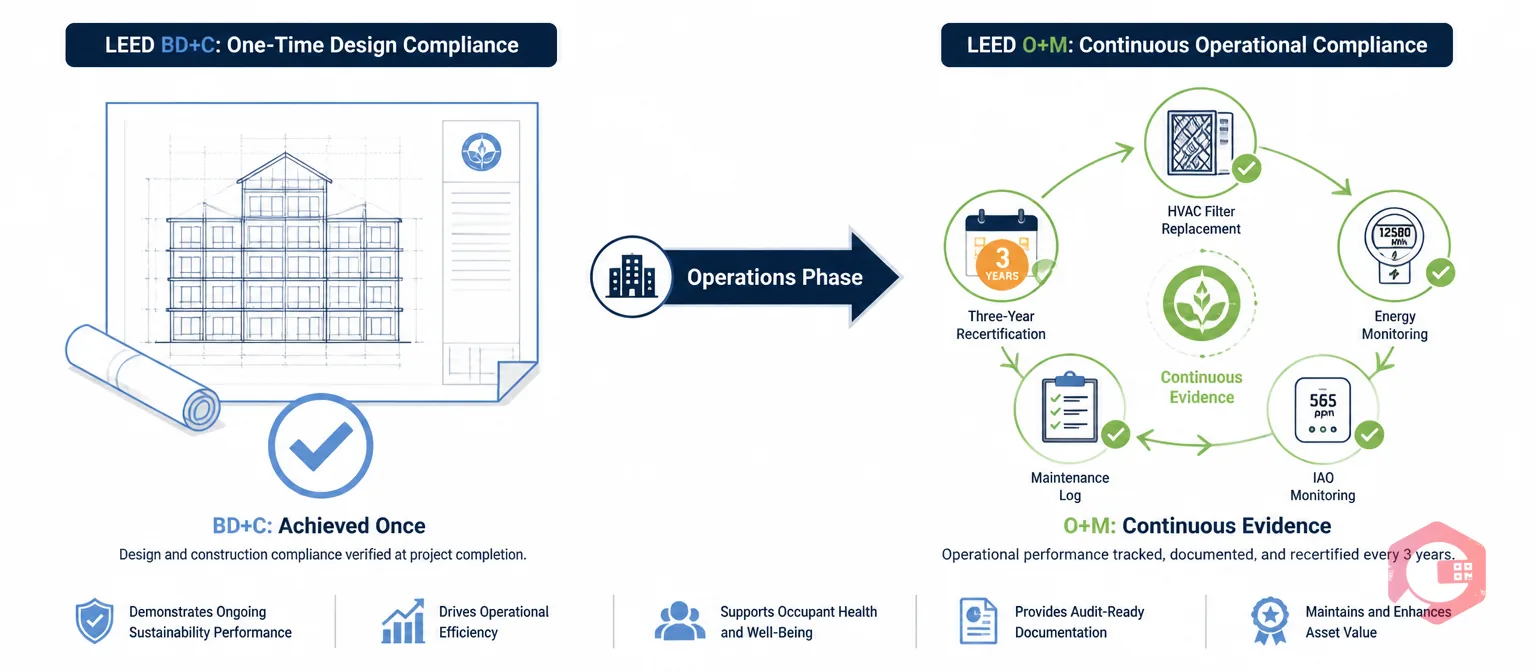
LEED O+M is the certification pathway for existing buildings that are already in operation — as distinct from LEED BD+C (Building Design and Construction), which applies at the design and construction phase. While BD+C credits are largely achieved through design decisions, O+M credits are earned and maintained through documented operational performance over time. The distinction is fundamental: BD+C compliance is demonstrated once at project completion; O+M compliance must be demonstrated continuously, and re-demonstrated at each recertification cycle.
A building that achieved LEED Silver under BD+C carries no automatic O+M credit. The operational team must independently document that the building continues to perform at the standard required for each credit category — and that ongoing performance is evidenced through maintenance records, consumption data, inspection logs, and contractor documentation that the CMMS is uniquely positioned to generate automatically.
Many FM teams managing LEED-certified buildings underestimate this distinction. They assume that a building designed to LEED standards will passively maintain compliance. In practice, LEED O+M credits are lost when HVAC maintenance lapses, when IAQ monitoring gaps appear, when filter replacement intervals are exceeded, or when energy performance drifts above the baseline established at certification. Each of these failures is detectable in CMMS data — and each is preventable through CMMS-driven PM scheduling.
LEED O+M recertification requires buildings to submit performance data covering a minimum 12-month performance period, with documentation demonstrating that all claimed credits have been maintained throughout that period. The recertification submission is reviewed against the credit requirements current at the time of submission under LEED O+M v4.1. For each credit claimed, the building must provide evidence — typically including maintenance logs, energy consumption data, water consumption data, IAQ measurement results, and grounds maintenance records.
In a building managed without a CMMS, assembling this evidence is a retrospective exercise that takes weeks — pulling records from spreadsheets, paper logs, contractor invoices, and utility bills into a format that USGBC reviewers can assess. In a building managed with a properly configured CMMS, the evidence is the CMMS record: timestamped, attributed to named operatives, cross-referenced to assets, and retrievable for any period by any credit category in minutes.
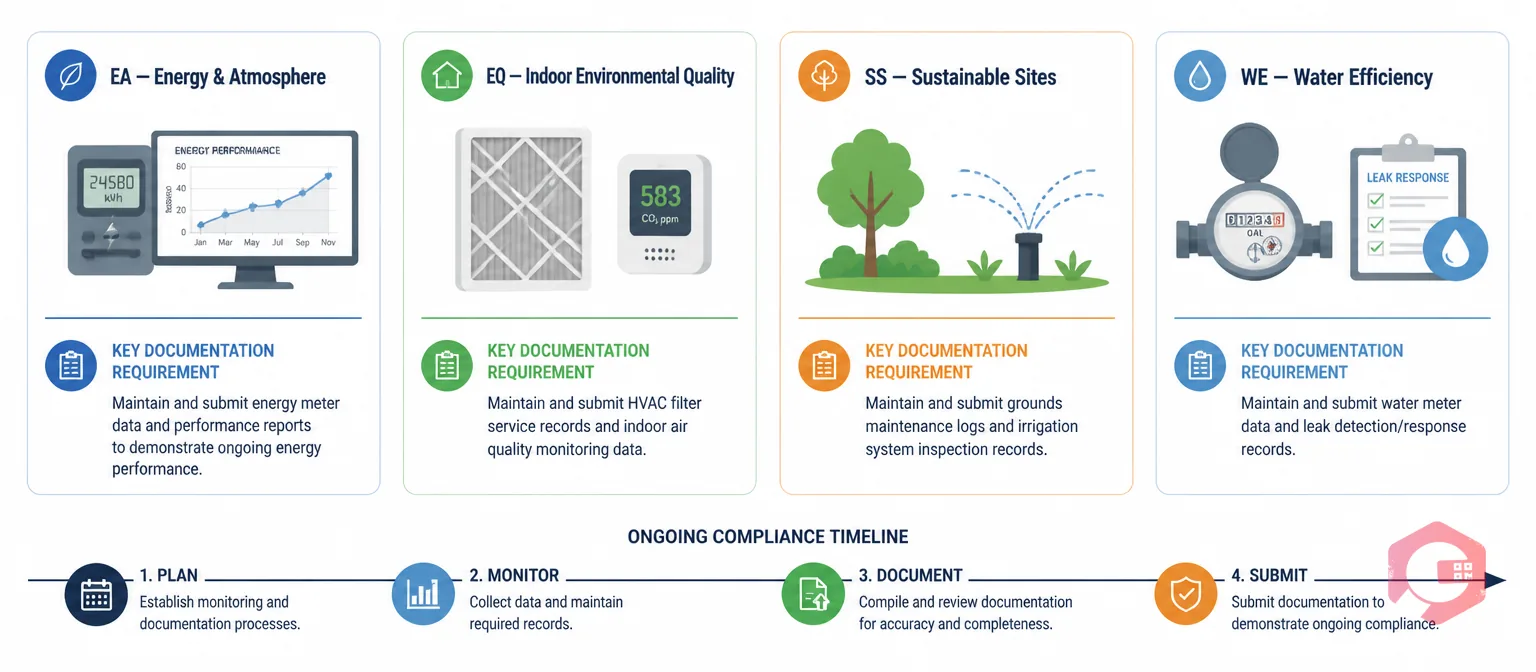
Four LEED O+M credit categories generate the most significant ongoing maintenance documentation requirements. These are where CMMS automation delivers the highest compliance value.
The EA credit category requires buildings to demonstrate ongoing energy performance at or above the level established at certification, typically benchmarked against ASHRAE 90.1 or the EPA’s ENERGY STAR Portfolio Manager. Ongoing documentation requirements include: continuous energy consumption metering (whole building and key sub-meters), documentation of energy-reducing maintenance interventions (recommissioning, controls optimisation, equipment upgrades), and — for the Enhanced Commissioning credit — evidence that building systems are operating within their designed parameters.
CMMS meter reading tasks generate the consumption record. PM completion reports document the maintenance interventions. Work order records for controls calibration and recommissioning tasks provide the evidence of parameter compliance. Together, these constitute the EA operational evidence package — assembled continuously rather than reconstructed at recertification.
The EQ credit category is the most maintenance-intensive for building operations teams. Credits under EQ require evidence of: HVAC PM completion at code-compliant intervals (filter replacement, coil cleaning, drain pan servicing, AHU inspection), IAQ monitoring results demonstrating CO2, particulate matter, and TVOC levels within ASHRAE 62.1 thresholds, green cleaning programme compliance (cleaning products meeting USGBC-approved standards, cleaning schedules and completion records), and occupant comfort survey results for thermal comfort and lighting quality credits.
A CMMS preventive maintenance software module schedules all HVAC maintenance tasks at the required intervals — filter replacement triggered by either time or differential pressure sensor data, coil cleaning on an annual PM cycle, AHU inspection quarterly. Each completion generates a timestamped record with the operative’s name, the asset serviced, the materials used, and the condition found. That record is the EQ maintenance evidence.
The SS credit category covers the building’s impact on its surrounding site — including stormwater management, heat island reduction, light pollution reduction, and exterior grounds maintenance. For operational buildings, SS credits require documentation of: grounds maintenance practices (pesticide and fertiliser application records, irrigation management logs, vegetation health records) and exterior lighting management (control systems verified operational, light pollution measurements within thresholds).
CMMS recurring tasks for grounds inspection, irrigation system PM, and exterior lighting checks generate the SS operations evidence. Pesticide and fertiliser application records captured as custom fields on grounds maintenance work orders provide the chemical management documentation required for the Integrated Pest Management and Green Cleaning credits where they extend to exterior areas.
The WE credit category requires buildings to demonstrate water consumption performance relative to a baseline, with ongoing monitoring evidence. Key documentation requirements include: water meter readings at the whole-building level and for significant sub-systems (irrigation, cooling tower, process water), leak response records demonstrating that identified leaks were rectified within defined timeframes, and cooling tower water management logs for buildings with evaporative cooling systems.
CMMS meter reading tasks cover water consumption capture. Reactive work orders for plumbing and leak repair, with their close timestamps, constitute the leak response record. Cooling tower PM schedules, with their water treatment chemical dosing records, satisfy the cooling tower management documentation requirement.
The following mapping translates LEED O+M v4.1 documentation requirements into CMMS task types and the evidence each generates. Use this as a configuration reference for setting up LEED-aligned maintenance schedules in your CMMS:
| LEED Credit Category | Specific Requirement | CMMS Task Type | Evidence Generated |
|---|---|---|---|
| EA — Energy Performance | Continuous energy metering; performance vs. baseline | Recurring meter reading task (monthly) | Timestamped consumption record by meter and period |
| EA — Enhanced Commissioning | Systems operating within design parameters | Controls calibration and recommissioning work orders | Parameter check record with before/after readings |
| EQ — HVAC Maintenance | Filter replacement, coil cleaning, AHU inspection at code intervals | Recurring PM tasks (time or condition-triggered) | PM completion record with materials, condition, and operative |
| EQ — IAQ Monitoring | CO2, PM2.5, TVOC within ASHRAE 62.1 thresholds | Sensor-triggered corrective work order + meter reading task | Alert log, work order, and post-resolution reading |
| EQ — Green Cleaning | Approved cleaning products; documented cleaning schedules | Recurring cleaning PM task with product field | Completion record with product used and zone covered |
| SS — Grounds Maintenance | Pesticide/fertiliser records; IPM compliance | Grounds maintenance work order with chemical field | Application record with product, quantity, and zone |
| WE — Water Monitoring | Whole-building water metering; sub-system monitoring | Recurring water meter reading task (monthly) | Timestamped consumption record by meter and period |
| WE — Leak Response | Leaks rectified within defined response window | Reactive plumbing work order with SLA close timestamp | Work order with response time, repair record, and closure |
Each row maps to a configuration step in the CMMS. Building the task library against this table at CMMS implementation — rather than retrofitting it at recertification time — means the evidence accumulates throughout the performance period without any additional effort from the FM team.
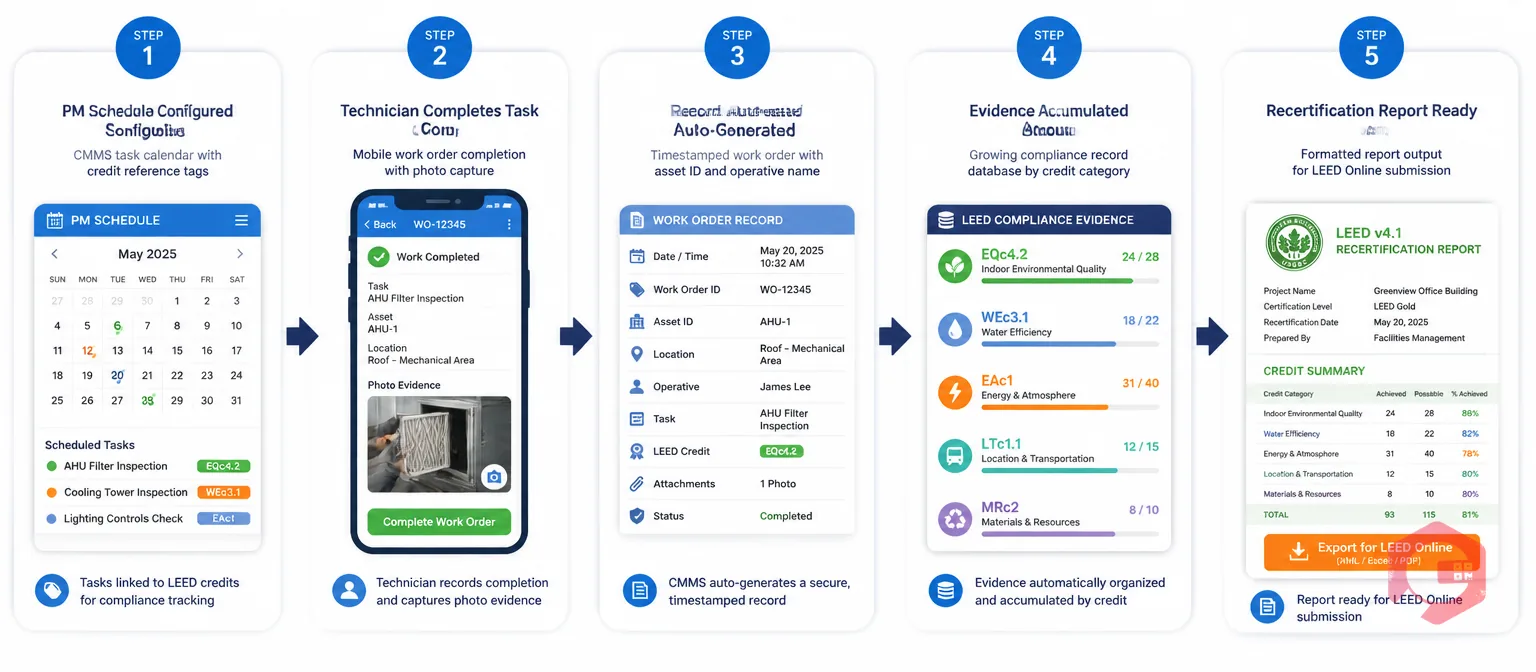
The core value of CMMS for LEED compliance is not that it replaces human judgement about what maintenance to perform — it’s that it makes every maintenance action auditable automatically. When a technician completes a filter replacement PM task, the CMMS record contains: the date and time of completion, the technician’s name, the asset serviced (with its asset ID and location), the filter specification used, the condition found, and a photograph if required by the task template. That record exists permanently in the system, retrievable by asset, by period, by credit category, or by operative — without any manual logging, filing, or data entry beyond the task completion itself.
LEED O+M credit prerequisites define the minimum maintenance intervals for key building systems. HVAC filter replacement intervals, for example, must meet ASHRAE 62.1 minimum requirements for the filter efficiency class specified in the credit documentation. If the CMMS PM schedule is configured with intervals that meet or exceed these prerequisites, every PM completion creates a record that confirms ongoing credit eligibility — and every overdue PM generates an alert that flags a potential credit risk before it becomes a recertification failure.
The work order management software module enforces PM schedules through automated task generation — tasks are created at the scheduled interval whether or not the FM manager remembers to create them manually. Overdue tasks appear in the dashboard as compliance risks, not as administrative oversights. For LEED-credited systems, the PM task template can be configured to include the relevant credit reference, making it clear to the technician and the reviewer that the task carries compliance significance beyond routine maintenance.
LEED recertification reviewers examine evidence to confirm two things: that the required activity occurred, and that it occurred within the required timeframe. The CMMS provides both. A filter replacement work order with a close timestamp within the required interval confirms both the activity and its timing. A meter reading record with a monthly timestamp confirms both the measurement and its regularity. An IAQ corrective work order with an alert trigger time and a resolution time confirms both that the breach was detected and that it was resolved.
The audit trail in the CMMS is not reconstructed at recertification — it is accumulated throughout the performance period, with each record created at the moment of the maintenance event. This is the evidence quality that LEED reviewers and third-party assurance providers require. The Report Builder generates credit-category summaries — all HVAC PM completions for the performance period, all water meter readings, all IAQ corrective work orders — formatted for the recertification submission without manual data compilation.
The recertification preparation process in a CMMS-managed building is a reporting exercise, not an evidence-gathering exercise. Three to four months before the recertification submission deadline, the FM manager runs the following report sequence against the 12-month performance period:
First, the PM completion report by asset category — confirming that all HVAC, plumbing, and grounds maintenance tasks were completed within their scheduled intervals, and identifying any overdue or missed tasks that need documentation of remediation. Second, the meter reading summary by utility and period — confirming that energy and water consumption data is complete for the full performance period and identifying any gaps that need to be filled from utility bill data. Third, the IAQ alert and resolution report — confirming that every sensor-triggered air quality event was responded to with a work order within the required timeframe and resolved to within acceptable parameters. Fourth, the corrective work order log for plumbing — confirming leak response times against the LEED-required window.
According to the USGBC LEED O+M checklist, documentation gaps discovered during recertification preparation — rather than during the performance period — typically require additional evidence gathering or credit re-evaluation that could result in a lower certification level at recertification. The CMMS eliminates this risk by making gaps visible in real time, as they occur, rather than at submission time.
Cryotos CMMS gives FM teams managing LEED-certified buildings the PM scheduling, evidence capture, and reporting infrastructure needed to maintain credit compliance without treating recertification as an annual emergency. LEED-aligned PM task templates are configured once — with credit references, required intervals, mandatory evidence fields, and asset linkages — and then generate automatically throughout the recertification cycle. Technicians complete tasks on mobile, capturing the condition, materials, and photographs that constitute the LEED maintenance record at the point of the maintenance event.
The BI Dashboard gives building managers a real-time LEED compliance view: PM completion rates by credit category, overdue tasks flagged against their LEED credit reference, meter reading completeness by utility, and open IAQ corrective work orders. This live view means compliance gaps are visible throughout the year — not discovered three months before recertification when remediation time is limited.
For the EQ credit categories specifically, Cryotos integrates IAQ sensor data with the work order workflow — sensor alerts above LEED-required thresholds automatically generate corrective work orders with the alert parameters pre-populated, creating the complete alert-to-resolution evidence chain that EQ Indoor Air Quality Monitoring credits require. The workflow automation software ensures the escalation chain fires correctly for high-priority IAQ events — no manual intervention required between alert and work order creation.
For multi-building LEED portfolios, Cryotos provides consolidated compliance reporting across all certified properties from a single dashboard — showing which buildings are on track for recertification, which have emerging compliance gaps, and which credit categories are at risk across the portfolio. Teams using Cryotos report a 30% reduction in unplanned downtime, with improved PM completion rates cited as a direct contributor to sustained LEED credit eligibility across certified building portfolios.
LEED O+M requires maintenance records that demonstrate ongoing performance across the credit categories claimed. At minimum, this includes: HVAC PM completion logs with dates, assets, and work performed (for EQ credits); energy and water meter readings covering the full performance period (for EA and WE credits); IAQ monitoring data and corrective action records (for EQ IAQ credits); cleaning records with product documentation for green cleaning credits; and grounds maintenance records with pesticide and fertiliser application logs where applicable. The specific records required depend on which credits the building has claimed — the LEED O+M project scorecard defines the credit list, and each credit’s reference guide specifies the evidence format.
LEED O+M recertification is required every five years at maximum, but the USGBC recommends a three-year cycle to maintain the most current certification and take advantage of performance improvements. Each recertification submission must include a minimum 12-month performance period of documented operational data. Buildings that do not recertify within the required cycle lose their LEED certification status — meaning the building can no longer be marketed or reported as LEED-certified, which has significant implications for asset valuation, tenant attraction, and sustainability reporting. The CMMS performance period record is the primary input to the recertification submission.
CMMS-generated reports constitute the operational evidence that supports LEED recertification documentation, but they are typically submitted as supporting evidence alongside the formal LEED project documentation — not as the primary submission format. The USGBC requires evidence to be submitted through the LEED Online project platform in specified formats. CMMS reports — PM completion summaries, meter reading logs, work order histories — are exported and attached as supporting evidence to the relevant credit submissions. The CMMS record is what LEED reviewers and third-party certifiers examine during evidence review; the formal submission is the structured presentation of that evidence through the LEED Online interface.
The EQ and EA credit categories generate the highest volume of ongoing maintenance documentation requirements and benefit most from CMMS automation. EQ credits for HVAC maintenance, IAQ monitoring, and green cleaning require monthly or more frequent maintenance records across multiple asset types — exactly the high-frequency, high-volume documentation where manual record-keeping is most prone to gaps. EA credits for energy performance monitoring require continuous metering data that a CMMS meter reading module captures systematically. WE credits for water monitoring and leak response also benefit significantly, particularly where water sub-metering covers multiple systems. SS grounds maintenance credits benefit from CMMS task tracking where grounds maintenance is complex enough to require multi-zone scheduling and chemical application logging.
LEED certification is earned at construction and maintained through operations. The FM team responsible for a LEED-certified building carries a continuous documentation obligation that compounds with every credit category claimed and every recertification cycle completed. A CMMS doesn’t change what maintenance is required — it changes how that maintenance is recorded, retrievable, and reported. When every PM task completion, every meter reading, every IAQ corrective work order is captured automatically in a timestamped, attributed, asset-linked record, the recertification evidence exists before anyone thinks to look for it.
For building operations teams managing LEED-certified properties and looking to take the manual effort out of compliance documentation, Cryotos CMMS provides the PM scheduling, evidence capture workflow, and credit-category reporting to keep certification current without treating every recertification as a documentation project. Book a free demo today and see how your LEED maintenance records look when the CMMS builds them automatically.




Cryotos AI predicts failures, automates work orders, and simplifies maintenance—before problems slow you down.



