

LEV inspection is the routine checking, testing and recording of local exhaust ventilation systems. In chemical and pharmaceutical facilities, a sound program has three parts: daily user checks, scheduled thorough examinations and tests, and tracked repairs. Together they keep every system capturing dust, fume and vapor at the source.
In the UK, the COSHH Regulations require a thorough examination and test of LEV at least every 14 months. This guide shows what that means in practice. It also covers what a good test includes and how a maintenance system helps you prove the work was done.
Key Takeaways

Local exhaust ventilation (LEV) is a system that captures contaminants at the source and removes them from the air. A typical system has a hood or enclosure, ducting, an air cleaner, a fan and a discharge point.
LEV inspection shows whether that whole chain still works. In plants that handle solvents, powders and potent compounds, a hood can look fine while a blocked filter quietly cuts extraction. HSE’s LEV guidance exists because these failures are easy to miss without testing.
A common mistake is waiting for an air-monitoring result or an operator complaint to reveal these faults. A scheduled inspection finds them first.
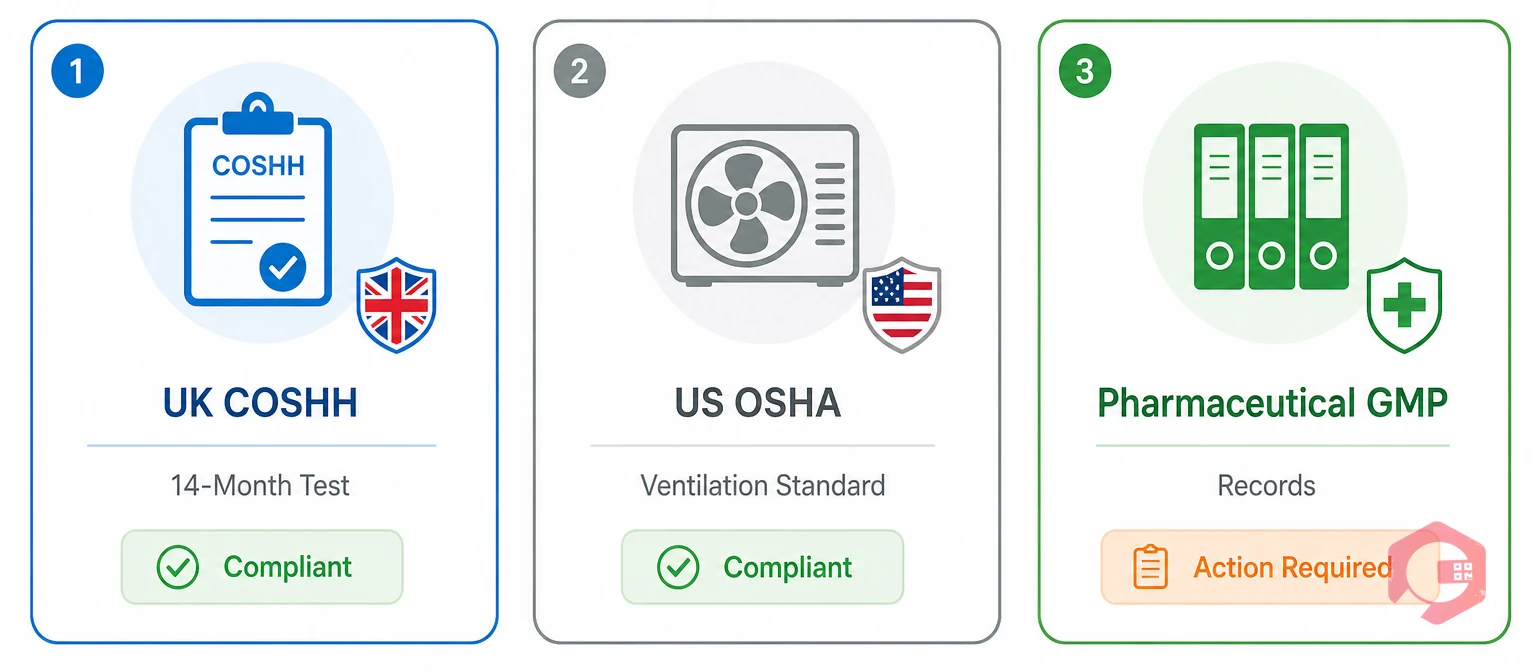
Requirements differ by country, but most share one duty: keep the system working, test it at fixed intervals and keep the records.
Local rules vary, so confirm the exact duties for each site with your EHS lead.
Build your LEV user-check and inspection forms with Cryotos maintenance checklists, so every check leaves a signed record.
An effective LEV inspection program works at four levels, from the operator’s quick look to a full examination by a competent person.
| Level | Who does it | How often | What it covers | Record |
|---|---|---|---|---|
| User check | Trained operator | Each shift | Damage, hood position, gauge reading | Signed checklist |
| Maintenance inspection | Maintenance technician | Weekly or monthly | Fan, belts, filter pressure drop, duct leaks | Work order with readings |
| Thorough examination and test | Competent person | At least every 14 months in the UK | Hood, ducting, air cleaner, fan, discharge, airflow and pressure against commissioning data | Formal report with defects and actions |
| Commissioning test | Installer or competent person | New or modified systems | Design airflow and hood pressure, kept as the baseline | Commissioning report and logbook |
A thorough examination and test is a documented check of every LEV component against its original performance. The tester also uses a dust lamp or smoke to check if contaminant escapes the hood. This finds leaks that airflow readings can miss.
Without the commissioning baseline, a tester can only report a number. With it, they can say whether the system still performs as designed.

The strongest programs in chemical and pharmaceutical plants follow six habits. Each one closes a common gap.
The ASSURE LEV Inspection Framework:
Treat the legal interval as a ceiling, not a target. Shorten it when any of these apply:
A common mistake is testing every system on the same date. Stagger dates by risk, and set each one in preventive maintenance software so it raises its own work order.
A defects register is a log that links each LEV finding to its cause, risk, fix and priority. Use these examples as a starting point, and set priorities with your EHS team.
| Finding | Likely cause | Risk | Typical fix | Priority |
|---|---|---|---|---|
| Low airflow at the hood | Blocked filter, closed damper, worn fan | Contaminant reaches the breathing zone | Change filter, reset damper, service fan | High |
| Excess pressure drop across the filter | Loaded filter media | Falling extraction, fan strain | Change filter, check spare stock | Medium |
| Damaged or open ducting | Impact, corrosion, vibration | Leaks and lost capture | Repair duct, reseal joints | High |
| Hood moved or modified | Process change without review | Release point not covered | Reposition hood, retest, update drawings | High |
| Missing or faulty airflow indicator | Damaged gauge, blocked tubing | Users cannot see LEV failure | Repair, calibrate, add to PM schedule | Medium |
| HEPA filter fails integrity test | Seal leak, damaged media | Potent dust reaches the exhaust | Replace filter or seals, retest before use | High |
Each row should end as a work order with an owner, a due date and proof of retest.
This is an illustrative scenario built from common patterns, not a named customer. A multi-product chemical and pharmaceutical site runs dozens of LEV systems. They serve dispensing booths, charging points, sampling stations and laboratory fume cupboards.
The major challenge: no single record connected the test, the defect and the repair.
At the next audit, the team could not quickly show that every system was inside its test interval. Nor could it show that earlier defects were closed.
A Computerized Maintenance Management System (CMMS) can close those gaps. In Cryotos, the setup looks like this:
Cryotos does not measure airflow or replace the competent person. It makes sure the test happens, the defect gets fixed, and the proof is on file. Maintenance teams using Cryotos have reported up to 30% reduction in unplanned downtime and 25% faster repair turnaround. Those figures reflect wider maintenance programs, not LEV work alone.
In the UK, a thorough examination and test is required at least every 14 months. Some listed processes need it sooner. Operators should check each system every shift, and maintenance should inspect it weekly or monthly. Elsewhere, follow local rules and the system’s design data.
A competent person with the right knowledge, training and test equipment must do it. Many sites use an external specialist, and in the UK a qualification such as BOHS P601 is common.
Keep the commissioning report, the logbook, user-check records, examination reports and repair records. In the UK, examination and test records must be kept for at least five years.
Rate each defect by risk, and restrict or stop the work if exposure is not under control. Repair the fault, retest the system and record who fixed it and when.
Yes. HSE treats fume cupboards as a type of LEV, so they need regular examination and testing. Check their airflow against the maker’s data and the standards that apply to your site.
No. A CMMS schedules the work, stores the records and tracks repairs, but the competent person measures and judges performance. Software proves the process happened; it cannot replace the test.
A well-run LEV inspection program protects workers and gives you proof when an auditor asks. Schedule a free demo to see how Cryotos turns LEV examination dates, checks and repairs into scheduled, tracked work.


Cryotos AI predicts failures, automates work orders, and simplifies maintenance—before problems slow you down.



