

Lift station pump maintenance is the routine inspection and repair that keeps wastewater pumps running. It starts with correct installation, because a well-set pump holds its performance baseline for years.
Most stations run unattended for days, so a clogged pump or failed seal can cause a sanitary sewer overflow before anyone notices. This guide covers lift station pump maintenance and installation, including pump types, a service schedule, troubleshooting, safety rules, and the software that keeps the program on track.
Key Takeaways
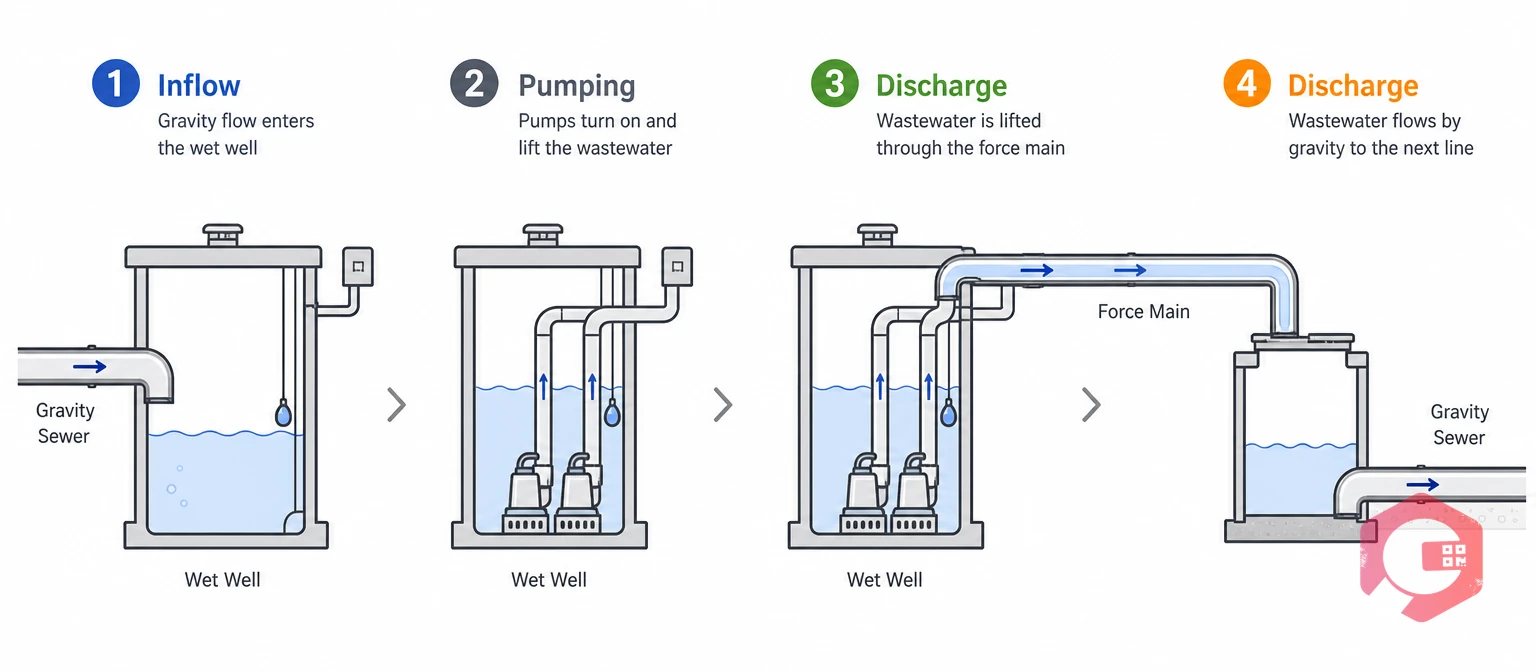
A lift station is a pumping facility that raises wastewater to a higher elevation. Gravity sewers feed a wet well, and pumps push the flow through a force main to the next gravity line or treatment plant.
Most maintenance teams cover dozens of stations with a small crew, so every visit has to count. The EPA treats sanitary sewer overflows as Clean Water Act violations, and its CMOM framework expects documented maintenance.
Most states also build on the Ten States Standards, which expect duty and standby pumps. Lift stations, also called pumping stations, protect homes and waterways only when every pump is ready to run.
A submersible pump is a sealed pump and motor unit that operates underwater inside the wet well. Submersibles suit most small and mid-size stations, while dry-pit pumps suit large or older stations that need easy service access.
| Feature | Submersible pump | Dry-pit pump |
|---|---|---|
| Location | Inside the wet well, under the water | In a separate dry well beside the wet well |
| Service access | Pulled on guide rails, often without entry | Crew enters the dry well |
| Cost and footprint | Smaller structure, lower cost | Larger structure, higher cost |
| Main risks | Seal failure, cable damage, poor cooling if uncovered | Flooding, ventilation, confined-space entry |
| Best fit | Small and mid-size stations | Large or older stations with big pumps |
Whichever type you choose, size it against the system curve and aim for operation near the best efficiency point. Non-clog and vortex impellers pass rags better than standard designs, and duty and standby pumps should each meet peak flow. The right match cuts wear and energy use for years.
Track reliability from day one: use the Cryotos MTBF calculator to turn repair history into a failure baseline.
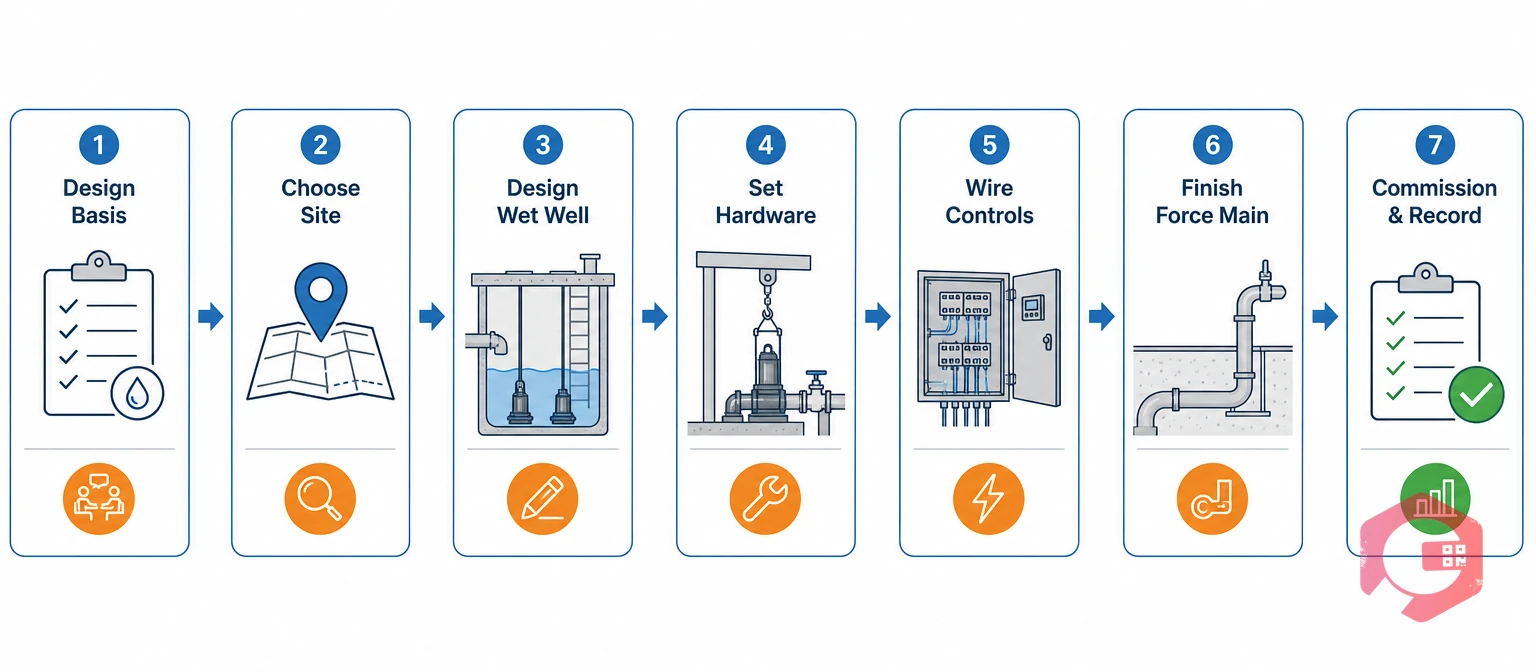
A sound installation follows seven steps, and the last one, commissioning, creates the baseline that every later inspection compares against.
A drawdown test multiplies wet well area by the drop in level, then divides by run time to give real pump flow. Compare it with the pump curve and save the result. Register each pump as an asset with its serial number and commissioning data so its lift station pump maintenance history starts on day one.
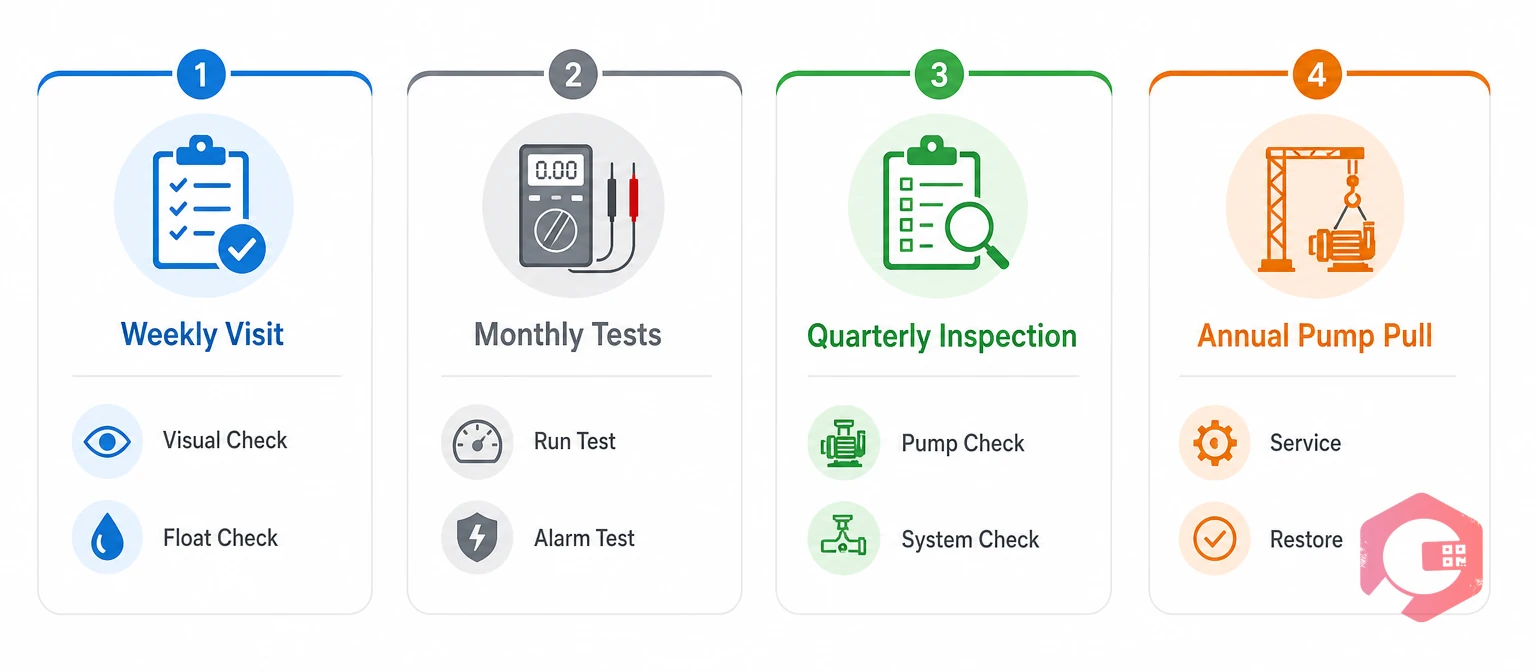
A workable lift station pump maintenance schedule combines quick visit checks with deeper quarterly and annual work, and the manufacturer manual sets the final intervals.
| Frequency | Key tasks | What it catches | Who does it |
|---|---|---|---|
| Each visit (weekly or biweekly) | Check alarms, log amps and run hours, listen for noise, inspect the wet well for grease and rags | Early drift in current and run time | Operator or technician |
| Monthly | Test pump alternation, high-level alarm, telemetry, and valves; run the generator under load | Dead standby pumps and alarm failures | Technician |
| Quarterly | Inspect guide rails, chains, and hatches; scan the panel for hot spots; clean floats | Corrosion and loose connections | Technician |
| Annually | Pull pumps; check impellers, wear rings, seals, and bearings; test insulation; run a drawdown test; clean the wet well | Hidden wear and lost capacity | Technician or contractor |
| Every 3 to 5 years (per OEM) | Rebuild pumps, replace seals and bearings, inspect coatings and the force main | End-of-life wear | Contractor or OEM |
Automate the calendar with preventive maintenance software so each task becomes a work order with a checklist. Base pump service on run hours, because a pump that runs twice as long as its twin needs service sooner.
The strongest programs track a few signals per pump and act before an alarm fires. Most facilities that cut emergency callouts start by recording the same readings at every visit.
The Four-Layer Pump Reliability Framework:
With IoT meter reading from SCADA or edge devices, a rising amp trend can open a work order before the pump trips.

Clogging from wipes, rags, and grease leads the list of lift station pump problems, followed by seal failure, overheating, and level control faults.
For repeat failures, log the cause on the work order and run a 5 Whys review. Replacing the same seal three times without finding the cause wastes labor and risks an overflow.
Wet wells are usually permit-required confined spaces, so crews need air testing, ventilation, an attendant, and a rescue plan before any entry under OSHA 29 CFR 1910.146.
Regulators and insurers ask for proof of inspections, permits, and closed alarms. Link each permit to its job with permit-to-work software so the safety record and the repair record stay together.
A Computerized Maintenance Management System (CMMS) gives every station and pump one record, one schedule, and one history for lift station pump maintenance.
Maintenance teams using Cryotos have reported up to 30% reduction in unplanned downtime and 25% faster repair turnaround. Most teams start with their most critical stations, then expand.
Most stations get a visit every week or two, plus deeper checks each quarter and a full pump pull each year. Follow the manufacturer manual and your discharge permit, which can require more.
Clogging from wipes, rags, and grease is the most common cause. It raises amp draw, cuts flow, and trips the pump, so screening, cleaning, and public outreach all help.
Service life depends on solids, duty, and upkeep. Many operators plan seal and bearing work every few years and replace pumps after one or two decades.
Only under a permit-required confined space program with air testing, ventilation, an attendant, and a rescue plan. Pulling the pump on guide rails avoids entry.
Software turns each task into a scheduled, tracked work order with a checklist and sign-off. It also keeps pump history, parts, and permits in one searchable record.
Reliable pumps start with a plan that crews can follow at every station. Schedule a free demo to see how Cryotos turns your lift station pump maintenance schedule into tracked, auditable work.

Cryotos AI predicts failures, automates work orders, and simplifies maintenance—before problems slow you down.



