Line of fire hazards are situations where a worker's body is in the path of moving equipment, released energy, falling objects or flying debris. During maintenance, these hazards grow because guards come off, systems get opened and technicians work close to parts that can move, spring, spray or drop without warning.
The answer is not more PPE. It's controlling the energy, keeping the body out of the path and planning both steps into the work order before the job starts. This guide covers the main types of line of fire hazards, why maintenance work is so exposed, and a simple framework to control them on every job.
Key Takeaways

A line of fire hazard is any spot where a person could be struck, caught, crushed or sprayed by moving energy. The hazard is not the machine alone. It's the overlap between an energy path and a human body.
Many safety programs rank line of fire as a leading cause of serious injuries and fatalities. The IOGP Life-Saving Rules list line of fire as one of nine core rules for oil and gas work, and OSHA's struck-by and caught-in categories cover the same ground.
OSHA's lockout standard, 29 CFR 1910.147, exists largely because servicing equipment puts people in these paths. OSHA estimates that following the standard prevents about 120 deaths and 50,000 injuries each year.
The short version: line of fire hazards exist wherever energy and a body can meet.
Maintenance is one of the most exposed jobs for line of fire hazards because the work happens inside the safeguards that protect operators. Production staff work behind guards. Technicians take them off.
Most maintenance teams also work under time pressure, on non-routine tasks and on equipment that may still hold energy after shutdown. That mix creates exposures that a standard job hazard analysis can miss.
A common mistake is assuming a stopped machine is a safe machine. Equipment can be switched off and still hold enough energy to injure someone, so maintenance needs its own line of fire controls.

Line of fire hazards during maintenance usually fall into six groups. Each group has a different energy source, so each one needs a different control.
Stored energy is energy that stays in a system after its main power source is switched off. Examples include compressed air, hydraulic pressure, compressed springs, raised counterweights, capacitors and hot fluids. When a technician cracks a fitting or pulls a pin, that energy goes somewhere fast.
A loose hose under pressure can whip hard enough to cause serious injury. Flange breaks, bleed valves and failed gaskets can also spray hot or toxic fluid straight at the face and hands.
Shafts, couplings, belts, rollers and conveyors can catch clothing, gloves or hair in a split second. Machine guarding rules under OSHA 1910.212 exist because these caught-in points are hard to see and impossible to outrun.
A drop zone is the area below and around overhead work where a falling tool, part or load could land. Tools left on beams, loose bolts and loads hanging from slings all create drop zones.
Crush points form between a moving part and a fixed structure, such as a closing press, a lowering table or a shifting load. Hands placed to steady a part during alignment are a frequent injury point.
Forklifts, cranes and service vehicles moving near a work area create struck-by risks. Technicians focused on a task often don't hear or see them coming.
Knowing which of these six groups applies to a job is the first step in choosing the right controls.
Still planning isolations and high-risk jobs on paper? See how digital permit-to-work software ties energy isolation, approvals and line of fire checks to every maintenance job.
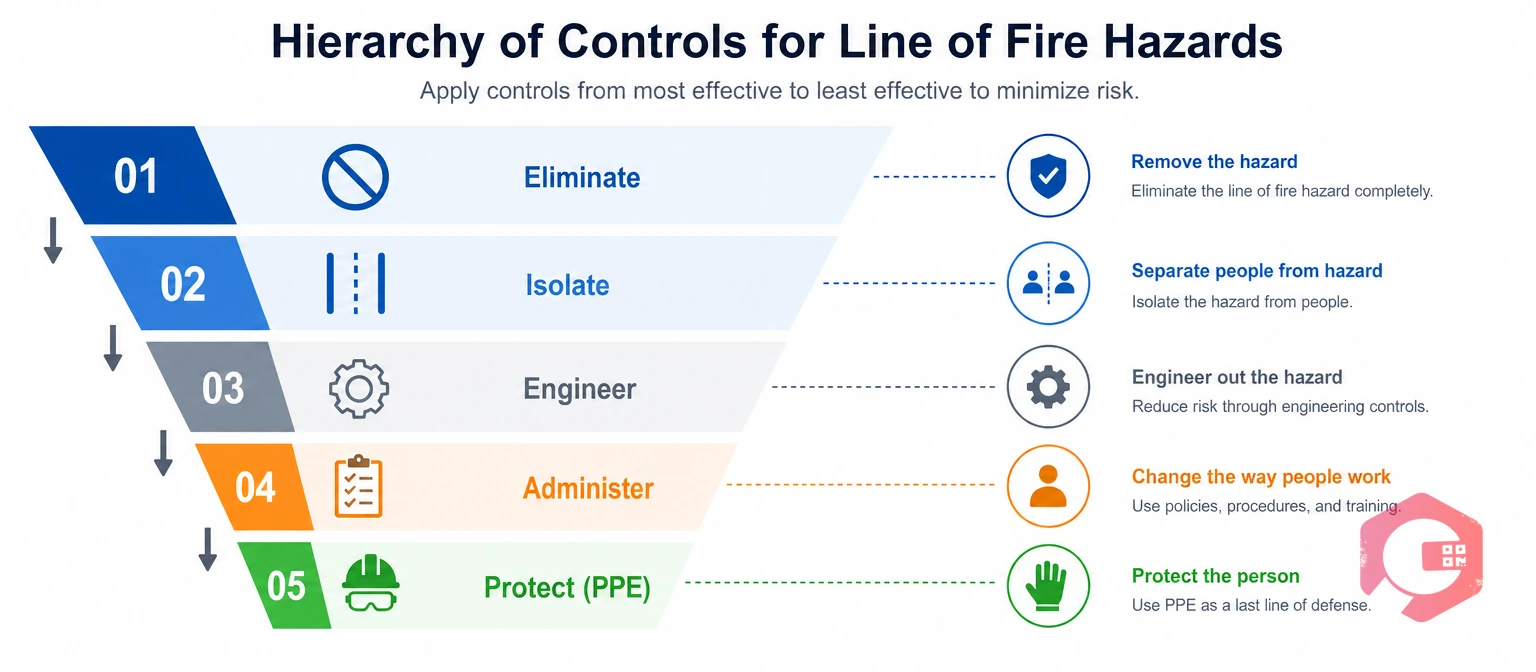
You control line of fire hazards during maintenance by removing the energy first, then keeping the body out of any path that remains. Tips like "stay alert" help, but only after the hierarchy of controls has done its job.
Work down this list from the most effective control to the least.
Ask one question at the job site: if this moves, where does it go, and where am I? Then put your body outside that path.
Mark drop zones and exclusion zones with barriers and signs, and assign a spotter for lifts and vehicle movement. Brief everyone on the plan, including contractors and the next shift.
Anyone who sees a person in the line of fire should be able to stop the job without blame. Operations that successfully cut line of fire injuries treat a stop-work call as a good catch, not a delay.
The rule of thumb: control the energy first, then control the position.

Maintenance teams need a simple way to check line of fire hazards on every job, not just the big ones. The EP3 framework gives technicians four questions to answer before they touch the equipment.
The EP3 Line of Fire Framework:
Build the four questions into the work order as a pre-task check. The technician answers each one on site and signs off, and a supervisor reviews it for high-risk tasks.
Here's how EP3 looks when replacing a hydraulic cylinder on a lift:
EP3 turns line of fire awareness into a repeatable step that leaves a record.
A line of fire hazard register links routine maintenance tasks to their energy sources and controls. Use this example as a starting point and adapt it to your own assets.
| Maintenance Task | Line of Fire Hazard | Energy Source | Key Controls |
|---|---|---|---|
| Replacing a conveyor belt | Caught between belt and pulley | Belt tension, drive motor | Lockout, release tension, guard check before restart |
| Breaking a pipe flange | Spray of fluid or gas | Line pressure, heat | Isolate, drain and vent, loosen far-side bolts first, face shield |
| Changing a hydraulic hose | Hose whip, fluid injection | Hydraulic pressure, accumulator | Bleed pressure, confirm gauge at zero, whip restraints |
| Removing a motor or gearbox | Struck or crushed by a suspended load | Gravity | Rated rigging, tag lines, nobody under the load |
| Repairing a spring-loaded brake or valve | Struck by a released spring | Spring tension | Spring compressor, OEM steps, stand clear of the spring axis |
| Working on a press or die | Crushed between platens | Gravity, hydraulics, flywheel | Lockout, die blocks, verify the ram is blocked |
| Overhead valve or light repair | Dropped tools or parts | Gravity | Tool lanyards, barricaded drop zone |
| Clearing a jammed machine | Caught in rollers or blades | Stored motion, air pressure | Full lockout, clearing tools, never reach in while running |
Review the register whenever you add an asset, change a procedure or investigate a near miss. A register that matches your real equipment is far more useful than a generic list.
Most line of fire injuries during maintenance trace back to a short list of repeat mistakes. Spotting them in your own plant is the fastest way to cut exposure.
Fixing these mistakes is about process, not effort. When the right steps live inside the job itself, they get done.
A Computerized Maintenance Management System (CMMS) helps control line of fire hazards by putting isolation steps, safety checks and approvals inside the work order. Technicians see the hazards before they start, and supervisors get proof that each step happened.
Maintenance teams using Cryotos have reported up to 30% reduction in unplanned downtime and 25% faster repair turnaround. Planned jobs are also safer jobs, because fewer rushed breakdown repairs mean fewer people working near live energy under pressure.
Use a safety compliance checklist to audit whether your current job plans cover line of fire hazards.
Line of fire means the path that moving equipment, released energy or a falling object would take. A worker is in the line of fire when any part of their body sits in that path. Line of fire hazards cover struck-by, caught-between and released-energy risks.
The most common ones are released stored energy, pressurized hoses and lines, rotating parts, dropped objects, crush points and nearby vehicles. They show up most often when guards are removed, systems are opened or loads are lifted.
A lockout procedure is essential, but it isn't enough on its own. It must cover every energy source, including gravity, springs and accumulators, and it must be verified. Body position, barricades and safe tools still matter for any energy that can't be fully removed.
Walk the job and ask what can move, where it would go and where people will stand. The EP3 framework (Energy, Path, Position, Protection) turns those questions into a short pre-task check you can add to every work order.
Face shields, safety glasses, hard hats, cut-resistant gloves and safety boots reduce injury severity. PPE is the last layer of protection, though, so it should never replace isolation, blocking or good body position.
A CMMS puts hazard notes, isolation steps and pre-task checks inside each work order, so technicians see them every time. It also records sign-offs and near misses, which helps supervisors find assets where line of fire controls keep failing.
Line of fire hazards don't disappear when a machine stops, but you can plan them out of every maintenance job. Schedule a free demo to see how Cryotos builds isolation steps, pre-task checks and permit approvals into every work order.


Cryotos AI predicts failures, automates work orders, and simplifies maintenance—before problems slow you down.