Maintenance automation in manufacturing is the use of software, sensors, and predefined rules to automatically schedule, assign, trigger, and track maintenance tasks — without relying on manual intervention. According to McKinsey & Company, unplanned equipment downtime costs industrial manufacturers an estimated $50 billion annually. Maintenance automation closes that gap by turning reactive habits into a proactive, data-driven system.
Maintenance automation in manufacturing refers to using a CMMS or Industrial IoT platform to automatically execute maintenance workflows — from generating work orders and dispatching technicians to ordering spare parts and logging completion data. Unlike traditional maintenance, which depends on a planner manually triggering each task, an automated system works continuously in the background based on rules, thresholds, or time intervals you configure once.
Research from Plant Engineering shows that manufacturers spend an average of 40 cents of every maintenance dollar on reactive, unplanned repairs — work that consistently costs 3 to 5 times more than planned work.

A CMMS automatically generates work orders based on predefined triggers — a scheduled PM date, a failed inspection checklist item, or an IoT sensor alert. The system routes the work order to the right technician based on skill, shift, and location, and tracks completion in real time.
PM automation replaces manual calendar entries with a rules engine that fires tasks based on time, meter readings, or usage cycles. A compressor requiring oil changes every 500 operating hours automatically generates a work order at hour 480. The Cryotos preventive maintenance module supports meter-based, calendar-based, and condition-based scheduling in a single workflow.
When IoT sensors feed live asset data into your CMMS, you can set thresholds that automatically trigger maintenance actions. A bearing temperature above 85°C creates an urgent work order. This eliminates both over-maintenance and under-maintenance.
An automated inventory system sets reorder points for every critical spare part. When stock drops below the threshold, a purchase request is automatically created and routed for approval — removing the guesswork from stock management.
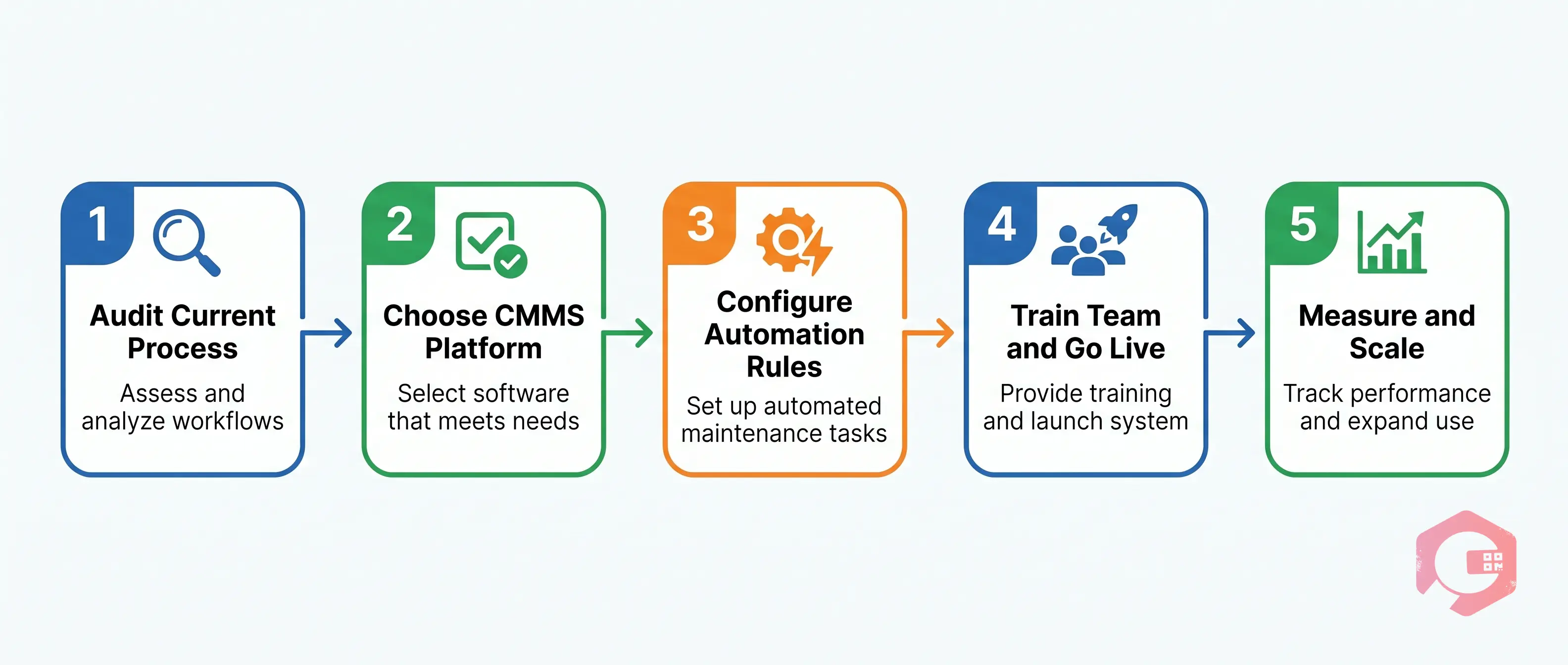
Map every maintenance workflow: How are work orders created? How are PMs tracked? How are parts ordered? Identify the three to five processes that consume the most manual time or produce the most failures.
Cryotos CMMS is built specifically for manufacturing environments, with pre-built automation templates for PM scheduling, work order routing, and inventory reordering.
For each asset class, set what triggers a work order (time, meter, condition), who receives the assignment, what priority level it carries, and what escalation happens if it goes unaddressed. Start with your 10 most critical assets.
Run hands-on training sessions focused on how the mobile app works in the field. Automation does not replace maintenance staff — it removes the paperwork burden and gives skilled workers more time to do skilled work.
After 60 to 90 days of live operation, review your key metrics. Identify where automation is working well and where rules need adjustment, then expand to more assets and eventually integrate predictive maintenance signals from IoT sensors.

Maintenance automation handles the workflow layer — scheduling, assigning, notifying, and documenting tasks automatically. Predictive maintenance uses sensor data to forecast when a failure will occur. The two work together.
Most manufacturing teams see measurable results within 60 to 90 days of going live. Full financial ROI generally becomes clear within six to twelve months.
No. A CMMS alone can automate significant value through time-based and usage-based PM scheduling, automated work order routing, and inventory reordering — without any IoT hardware.
Yes. Cloud-based CMMS platforms like Cryotos are scalable and affordable for facilities of any size. Even a 20-person maintenance team managing 100 assets benefits from automated PM scheduling and work order routing.
If your manufacturing facility is ready to move beyond spreadsheets and reactive firefighting, Cryotos CMMS gives your team a complete maintenance automation platform. Book a free demo today and see how leading manufacturers are cutting downtime and improving equipment reliability with Cryotos.




Cryotos AI predicts failures, automates work orders, and simplifies maintenance—before problems slow you down.