

Maintenance resource allocation is the process of assigning the right technicians, tools, and materials to the right work orders at the right time — based on equipment criticality, technician availability, workload, and breakdown priority.
Done well, it reduces machine downtime, prevents technician burnout, and ensures that your most critical equipment always gets attended to first. Done manually — through calls, whiteboards, and gut feel — it creates delays, uneven workloads, and missed priorities.
This guide covers the full lifecycle of maintenance resource allocation: from how availability is tracked, to how work gets queued and dispatched, to how modern CMMS software automates the entire process.

Most plant and facility maintenance teams start with simple methods: a coordinator takes calls, checks who is free, and assigns the job. This works when the team is small. As operations grow, the same approach creates compounding problems:
The Titan SS Case Plant implementation documented in Cryotos' Breakdown Allocation specification directly addresses these failures. The solution defines a full resource allocation workflow covering attendance tracking, intelligent assignment, queue management, and audit logging — replacing ad hoc dispatch with a structured engine.
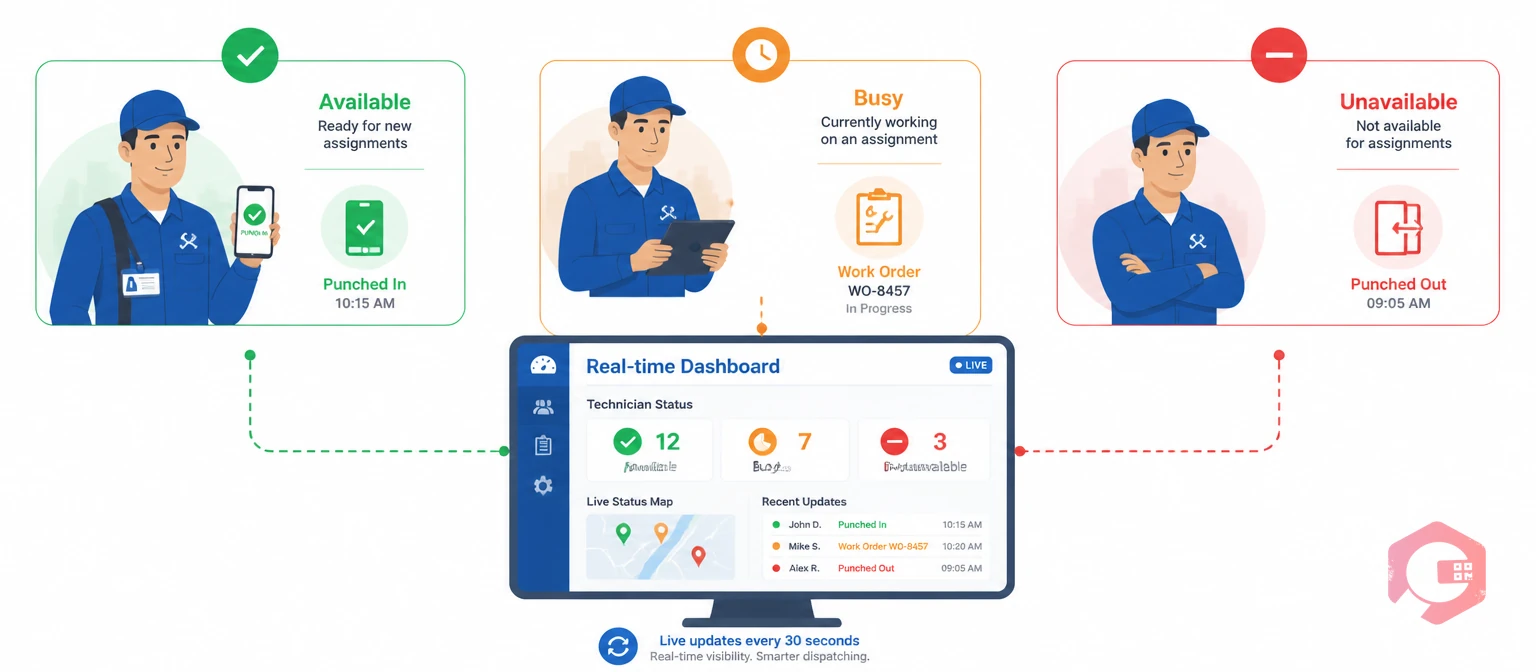
You cannot allocate resources you cannot see. Technician availability tracking is the prerequisite for every other step in the allocation process.
A proper availability engine derives status automatically from two inputs: attendance (punch-in/punch-out via mobile app) and active work order assignment. This produces three clean status types:
These statuses update in real time as technicians punch in, accept jobs, complete work orders, and punch out. Supervisors and the allocation engine can both read this data — supervisors for oversight, the engine for automated dispatch decisions.
Mobile attendance through the mobile CMMS is essential here. Without a mobile punch-in system, availability data is always stale — and stale availability data leads to wasted assignments and delayed responses.
Equipment criticality ranking is a structured way of scoring how much production impact a machine breakdown causes. It determines which work orders take priority when multiple breakdowns occur simultaneously and which assignments carry the most weight in workload calculations.
A practical criticality model uses four categories, ordered from highest to lowest impact:
Within each category, individual machines carry a ranking number (1, 2, 3, etc.) based on their specific production impact, replacement difficulty, and maintenance history. A furnace ranked 1 in Category Z carries the highest overall priority in the entire plant.
These rankings are maintained through the front-end configuration screens and can be updated by authorised users as asset risk profiles change. Changes to ranking feed immediately into the allocation engine's scoring logic.
The asset tracking system connects individual equipment records to their criticality profiles — so every work order created for a ranked asset automatically carries that ranking into the assignment calculation.
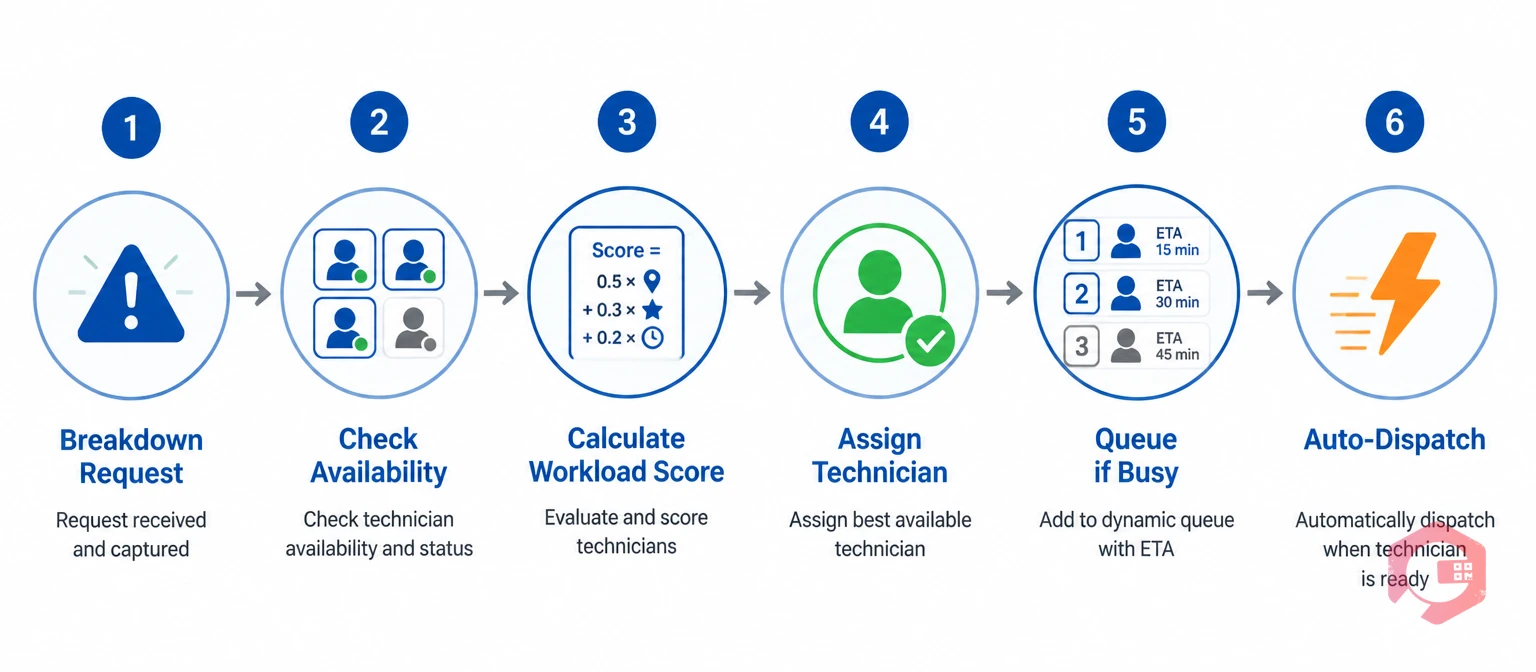
When a breakdown request arrives and an available technician exists, the allocation engine runs automatically:
The system identifies all technicians with Available status and calculates a workload score for each. The score is a weighted sum of active assignments — each active work order contributes a weight of 1 divided by its equipment's ranking number. Higher-criticality machines add more weight.
The technician with the lowest total score receives the new assignment. If scores are tied, the engine applies a four-stage tie-break: lowest active work order count → earliest last-assignment timestamp → round-robin cycling → random selection.
When no technician is available, the work order enters the Queue Management System automatically. The queue is not a simple first-in-first-out list — it is dynamically sorted and re-sorted every time a new breakdown arrives or a technician completes a job. Queue position is determined by equipment category, equipment ranking, people ranking, and breakdown timestamp.
The moment a technician completes their current job and their status changes to Available, the engine immediately fetches the highest-priority queued work order and assigns it — without any manual intervention.
When two machines of identical ranking experience simultaneous breakdowns, the machine with the earlier breakdown timestamp receives the higher assignment priority. This is a transparent, auditable rule that removes subjectivity from triage decisions.

A well-designed queue is not a waiting room — it is an active priority engine. Every time the state changes (new breakdown, completed job, updated ranking), the queue re-sorts to reflect current priorities.
Effective queue management requires four things:
The work requests module in Cryotos feeds directly into this queue workflow — ensuring that every request raised through the client portal follows the same prioritisation logic rather than going directly to a coordinator's inbox.
Automated allocation does not remove supervisor control — it changes the nature of it. Instead of making every assignment manually, supervisors focus on exceptions: assignments that need to change due to skill requirements, safety constraints, or organisational priorities.
The manual reassignment interface shows each technician's current status in real time. Supervisors can select a different technician, record a reason in the mandatory comment field, and complete the reassignment. Every change is written to the audit log with the user's name, timestamp, previous assignee, new assignee, and comments.
Super Admin users can additionally:
This combination — automated allocation for routine volume with manual override for exceptions — is what makes resource allocation both scalable and controllable.
Resource allocation only works if the right people are told at the right time. A complete notification engine covers six trigger events:
Notifications are delivered through mobile push notifications and in-app alerts, with optional email or SMS where enabled. This removes the need for coordinators to manually communicate every assignment — the system handles the messaging automatically.
A complete audit trail is not optional in maintenance management — it is the foundation of accountability and continuous improvement.
Every allocation decision, manual reassignment, shift handover, ranking change, queue movement, and technician status change is logged. Each log entry captures the user or system responsible, the timestamp, the previous value, the updated value, and any associated comments.
This data serves multiple purposes:
The BI dashboard in Cryotos surfaces this audit data as operational metrics — giving maintenance managers a live view of resource utilisation, response performance, and queue health without needing to export reports manually.

The Cryotos breakdown management and resource allocation solution combines all the components described in this guide into a single integrated workflow:
The downtime tracking layer connects directly to this workflow, recording every breakdown event from request creation through work order closure — giving operations teams the data they need to reduce mean time to respond over time.
Work order assignment is the final step of resource allocation — the moment a specific technician is matched to a specific job. Resource allocation is the broader process: tracking availability, evaluating criticality, managing the queue, and making or automating the assignment decision. A good CMMS handles all of it, not just the final assignment step.
Criticality ranking determines two things: which queued work orders get processed first when a technician becomes available, and how much each active work order contributes to a technician's workload score. A technician handling a Category Z breakdown carries a heavier workload score than one handling a Category C task — so the system preferentially routes the next critical job to someone with a lighter load.
Yes. The Cryotos mobile app shows each technician their assigned work orders, queue position, and status — and delivers push notifications for new assignments, reassignments, and queue changes. Technicians can accept, update status, and close work orders directly from the app.
Open work orders assigned to the outgoing shift can be manually reassigned to incoming technicians. The system prompts for mandatory comments and logs the handover in the audit trail. Notifications are automatically sent to the technician receiving the work.
Key metrics include mean time to assign (time from breakdown raised to technician assigned), mean time to respond (technician arrival at the asset), first-time fix rate, technician utilisation rate, and queue wait time. The Cryotos BI dashboard tracks all of these in real time.
If your maintenance team is still managing resource allocation through calls and spreadsheets, there is a better way. Schedule a free demo to see how Cryotos automates breakdown allocation and technician dispatch from request to closure.


Cryotos AI predicts failures, automates work orders, and simplifies maintenance—before problems slow you down.



