

Safety stock for spare parts is the extra quantity of critical components you keep on hand to cover unexpected demand spikes, supplier delays, or sudden equipment failures. Without a calculated buffer, maintenance teams face two costly problems: stockouts that halt production, or overstock that ties up working capital in parts that sit unused for months. Getting the buffer right is not guesswork — it follows a formula, a criticality assessment, and a regular review process. This guide walks you through five practical steps to calculate and manage the right safety stock level for your spare parts inventory.
Key Takeaways

Safety stock for spare parts is a planned inventory buffer that protects maintenance operations from supply disruptions and demand variability. Unlike the cycle stock you use in normal operations, safety stock sits as a reserve that you draw from only when something unexpected happens — a surge in breakdowns, a late delivery from your supplier, or a quality rejection on incoming parts.
This concept is well-established in inventory management theory, but applying it to spare parts has specific challenges. Demand for spare parts is irregular — a motor bearing might sit untouched for six months, then three are needed in a single week. Lead times vary by supplier and part category. Some parts are locally sourced; others arrive by air freight from overseas.
The goal is not to stock everything heavily. The goal is to stock the right parts at the right level — and know exactly which parts warrant a large buffer versus which ones can run thin.
A single missing spare part can stop a production line for hours or days. According to SMRP benchmarks, unplanned downtime costs manufacturers an average of $260,000 per hour — and parts unavailability is one of the top contributing factors. Maintenance teams that rely on reactive purchasing spend more on emergency orders, air freight premiums, and expediting fees than those with a well-managed buffer.
Poor spare parts planning creates two distinct problems:
A proper safety stock calculation addresses both. It sets a floor that prevents stockouts while giving you the data to challenge unnecessary over-purchasing. Preventive maintenance software that links work orders to parts consumption gives you the usage history you need to make these calculations accurately.
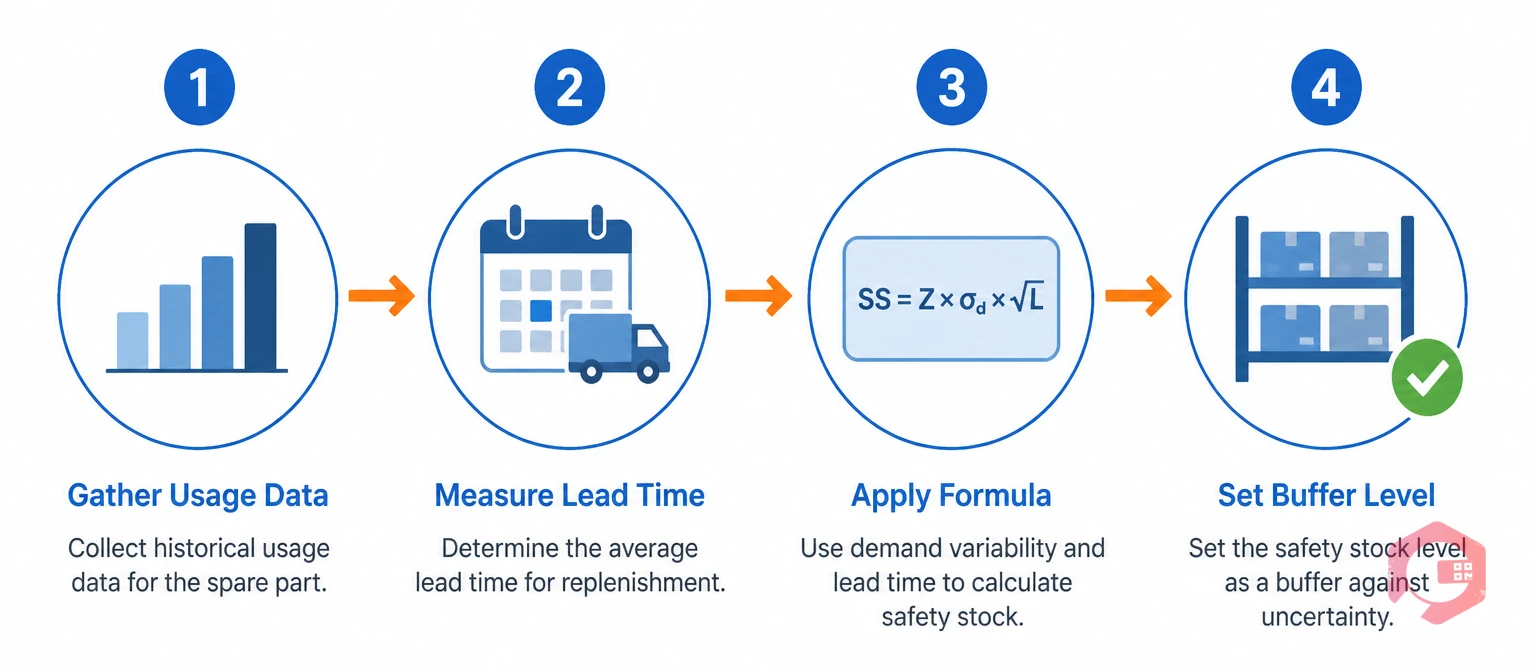
The standard safety stock formula is: Safety Stock = Z × σ(lead time) × Average Daily Demand. Here, Z is the service level factor (a number from a statistical table based on how often you want to avoid a stockout), σ(lead time) is the standard deviation of lead time in days, and Average Daily Demand is how many units of the part you use per day on average.
For maintenance spare parts, a simpler and widely used version works well for most facilities:
Suppose a pump seal has an average daily usage of 0.2 units (roughly 6 per month), a maximum daily usage of 0.5 units (during breakdown surges), and a maximum supplier lead time of 14 days:
Maintenance teams using Cryotos have reported up to 30% reduction in unplanned downtime and 25% faster repair turnaround — in large part because parts are available when technicians need them, without waiting for emergency procurement.
Explore Cryotos spare parts inventory software to see how real-time stock tracking and min-threshold alerts support accurate safety stock management.

Not all spare parts need the same buffer. Treating a common filter cartridge the same as a custom-machined shaft bearing wastes money in one direction and creates risk in the other. The key is to classify your parts by the criticality of the assets they support and the consequence of a stockout.
The Spare Parts Criticality Buffer (SPCB) Framework:
| Tier | Part Type | Asset Criticality | Recommended Buffer | Review Frequency |
|---|---|---|---|---|
| Tier 1 — Critical | Unique / long lead time parts | Production-critical / safety-critical | Formula × 1.3 (30% premium) | Monthly |
| Tier 2 — Important | Commonly used, standard parts | Affects output but has workaround | Formula × 1.0 (standard) | Quarterly |
| Tier 3 — Routine | Consumables, filters, fasteners | Non-critical, multiple suppliers | Low buffer or just-in-time | Semi-annual |
Use this framework to assign every spare part in your inventory to a tier before setting its buffer level. Most facilities find that 10–15% of their parts catalog is Tier 1, 30–40% is Tier 2, and the remainder are Tier 3 consumables that can be managed with simple min/max levels.
Warehouse management tools in Cryotos let teams organize spare parts by bin, shelf, zone, and asset location — making it straightforward to tag parts by criticality tier and monitor them separately.
A reorder point is the stock level at which you trigger a replenishment order — it is not the same as safety stock. The reorder point sits above your safety stock buffer and accounts for the lead time needed to receive the order before you dip into your reserve.
The formula is straightforward:
Setting these levels manually for hundreds of parts is impractical. Most maintenance teams set the minimum threshold in their inventory system, which then triggers an alert or auto-purchase request when stock hits that level. ISO 55000, the international standard for asset management, specifically recommends integrating inventory management into the broader asset management system to ensure parts availability aligns with maintenance planning.
The practical outcome: your team stops relying on memory or spreadsheets to catch low stock. The system does it automatically, and procurement gets advance notice before a stockout occurs.

Overstock is a silent cost that many maintenance managers underestimate. Holding excess spare parts consumes storage space, locks up working capital, and creates risk of expiry or obsolescence when assets are retired or upgraded. Industry estimates suggest that 15–30% of MRO inventory in a typical facility is dead stock — parts with no usage in the past 12–24 months.
Three common causes of overstock in spare parts:
Inventory management in Cryotos tracks available stock, issued stock, and spare parts movement — giving teams the visibility to spot slow-moving parts before they become a dead stock problem. Expiration reminders flag time-sensitive items like lubricants, seals, and chemicals before they become unusable.

A safety stock calculation is not a one-time exercise. The variables that feed into it change continuously — asset usage patterns shift, supplier lead times lengthen or shorten, maintenance frequencies change after reliability improvements, and new assets create demand for parts that did not exist in your inventory last year.
Most operations that successfully manage spare parts buffers schedule a formal review at three levels:
The MRO inventory checklist from Cryotos gives maintenance and stores teams a structured framework for running these periodic reviews. Scheduled report delivery means managers receive inventory performance summaries automatically — no manual data extraction required.
Managing safety stock manually — across spreadsheets, WhatsApp messages, and memory — works until it does not. A single high-criticality part being out of stock at the wrong moment can cost more than a year of software investment. Cryotos spare parts inventory software gives maintenance and stores teams a connected system for tracking stock levels, usage, and replenishment triggers in real time.
Key capabilities that directly support safety stock management:
A Computerized Maintenance Management System that integrates spare parts inventory with work orders, asset records, and preventive maintenance schedules gives you the complete picture needed to calculate and maintain the right buffer — not just a static spreadsheet.
Safety stock is the minimum reserve you keep to absorb unexpected demand or supply delays — it is the floor you should never fall below. The reorder point is the stock level at which you trigger a new purchase order. The reorder point sits above safety stock and is calculated as average daily demand multiplied by average lead time, plus your safety stock value.
For parts with highly irregular demand — used once a year or less — the standard formula can overestimate safety stock. In these cases, maintenance teams typically hold one or two units based on asset criticality and lead time rather than a statistical calculation. For long-lead-time critical spares, even a single unit kept in stock can prevent weeks of downtime if the supplier takes four to six weeks to deliver.
A CMMS captures actual parts consumption from work orders, tracks current stock levels, and alerts the team when stock falls below the set minimum threshold. This gives you accurate historical usage data to calculate safety stock properly, and automated alerts ensure replenishment happens before stock runs out — rather than after a stockout forces an emergency order.
Industry benchmarks suggest that 15–30% of MRO inventory in typical industrial facilities is dead stock — parts that have seen no usage in the past one to two years. Regular inventory reviews tied to asset retirement, maintenance plan changes, and consumption tracking are the most effective way to reduce this figure and free up capital tied up in slow-moving stock.
Calculating the right safety stock for spare parts is one of the most practical steps a maintenance team can take to reduce unplanned downtime without over-investing in inventory. Schedule a free demo to see how Cryotos spare parts inventory management, min-threshold alerts, and work order integration help you maintain the right buffer across every asset in your facility.




Cryotos AI predicts failures, automates work orders, and simplifies maintenance—before problems slow you down.



