
Metal detector testing at a critical control point (CCP) is the scheduled process of running known metal test pieces through an operating metal detector, confirming that it detects and rejects each one, and recording the result as verification evidence for HACCP compliance. Food manufacturers rely on metal detector testing at start-up, during production, after every product changeover, and at shift-end — because a single missed metal fragment can trigger recalls, consumer injury claims, and regulator action. This guide covers the full metal detector testing procedure, maintenance schedule, documentation requirements, and the common failures that trip up even mature food safety programs.
Key Takeaways
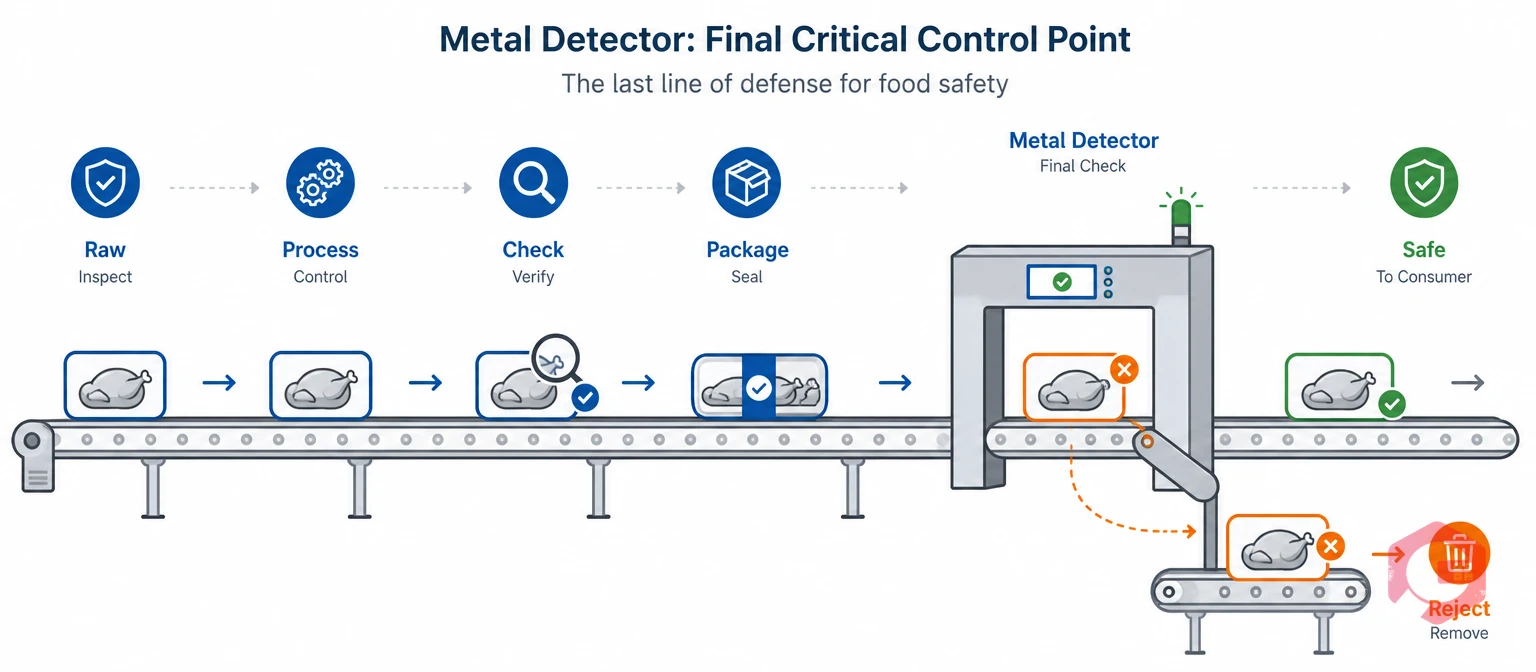
A critical control point is any step in food production where a hazard can be prevented, eliminated, or reduced to an acceptable level. Metal detectors qualify because they are the final physical-hazard control before a product reaches the consumer — if metal passes the detector, nothing downstream will catch it.
Physical contamination remains one of the top three causes of food recalls globally. The FDA's reportable food registry data consistently shows metal fragments among the leading contamination reasons for Class I and Class II recalls, with fragments originating from worn processing equipment, broken sieves, maintenance tools, and raw-material sources.
The common thread across all five frameworks is the same: a metal detector without a documented testing and maintenance program is not a control — it is unmonitored equipment. Computerized Maintenance Management System platforms give food plants the structure to prove every test happened, every result was reviewed, and every corrective action closed the loop.

A reliable metal detector testing program rests on four interlocking elements. Skip any one and your audit defence weakens regardless of how good your detector hardware is.
The Four-Pillar Metal Detector Testing Framework:
Each pillar maps to a specific question an auditor will ask: Can you detect it? Do you check often enough? Do you know what to do when it fails? Can you prove it?
Test piece size is set by your hazard analysis, not by detector capability. Most food plants use 1.5–2.0 mm ferrous, 2.0–2.5 mm non-ferrous, and 2.5–3.0 mm stainless-steel spheres embedded in certified carrier sticks. Products with higher moisture or salt content — "wet products" in detector terminology — require larger test pieces because the product itself generates a signal that masks small contaminants.
Minimum test frequency comes from your standard, but most food and beverage manufacturers operate well above the floor. Typical practice is start-up, every 30 minutes during production, at every changeover, and at shift-end — with an additional test triggered by any unplanned line stop longer than 15 minutes.
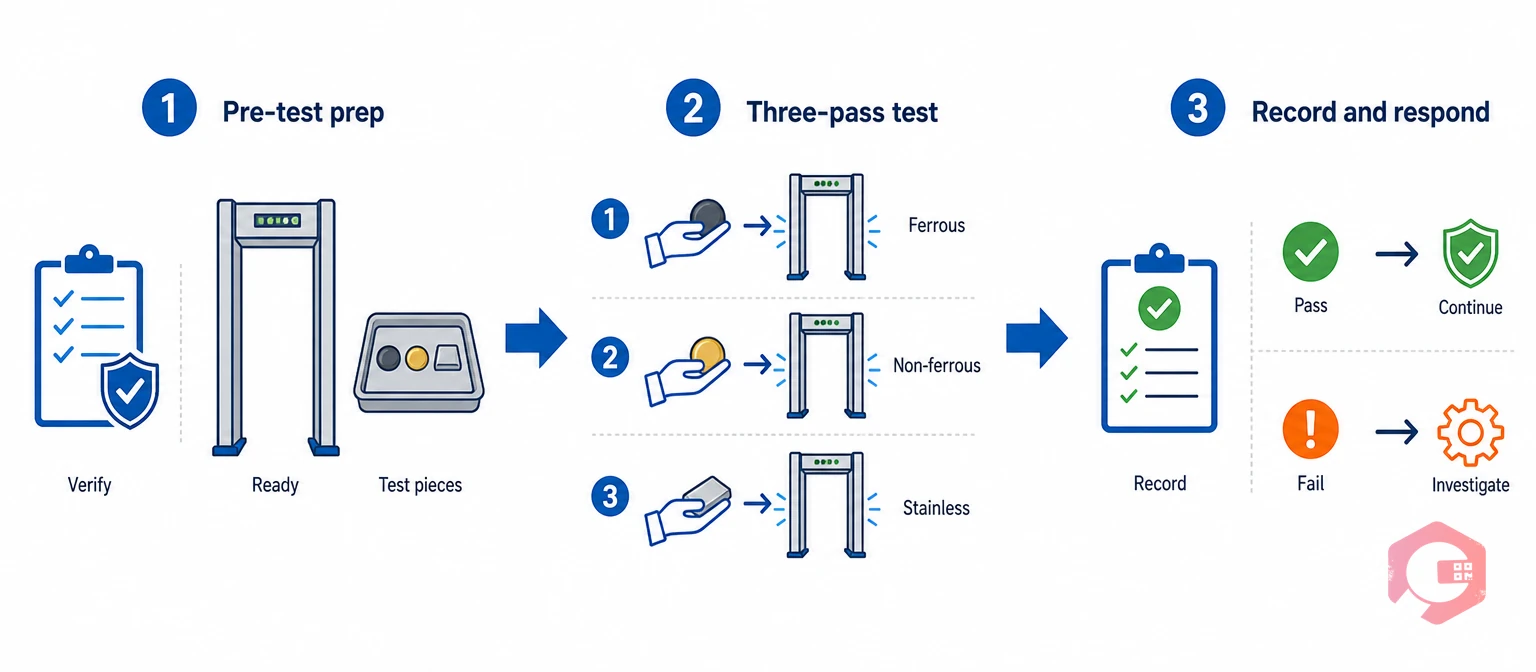
The three-pass method is the baseline for metal detector testing accepted by BRCGS, SQF, and most retailer audit schemes. It confirms detection across all three metal types and verifies the detector's rejection mechanism actually diverts the contaminated product.
Every metal detector testing result — pass or fail — is logged immediately with time, operator ID, test piece sizes, SKU, and detector ID. A failed test triggers the pre-defined corrective action: hold all product since the last successful test, recalibrate or repair the detector, and re-test before resuming.
Build this entire metal detector testing procedure into digital maintenance checklists so operators cannot skip steps and supervisors get real-time alerts on failures. For a complete audit-ready checklist template covering FSMA, BRCGS, and SQF requirements, download the regulatory compliance checklist.
Metal detector maintenance is preventive, not reactive. Sensitivity drifts long before the unit fails outright, and most drift comes from mechanical wear — belts, bearings, mounting bolts, and grounding straps — rather than the electronics themselves.
Use this frequency register as your maintenance baseline and adjust upward for harsh environments (wash-down, high humidity, heavy vibration):
| Frequency | Task | Owner | Evidence Required |
|---|---|---|---|
| Daily (start-up) | Visual inspection, belt condition, reject bin lock, sensitivity test | Line operator | Signed start-up log + test result |
| Daily (shift-end) | Sensitivity test, wipe-down, reject bin empty and reconciled | Line operator | Shift-end log, reject reconciliation |
| Weekly | Full wash-down, grounding strap continuity, belt tracking check, reject timing calibration | Maintenance technician | PM work order with photos |
| Monthly | Bearing check, drive motor inspection, aperture seal condition, software log review | Maintenance technician | Signed PM checklist |
| Quarterly | Vibration survey, phase-angle check, product memory review across SKUs | Maintenance engineer | Diagnostic report |
| Annual | Full OEM service, sensitivity recertification, control board diagnostics, backup of all product memories | OEM service engineer | OEM service report + certificate |
A structured preventive maintenance program ensures every row of that register becomes a scheduled, assigned, and tracked task — with no reliance on anyone's memory.
Most detector failures are caused by the environment around the detector, not the detector itself. Field experience across food plants shows the same five issues account for the vast majority of unplanned reject events and sensitivity complaints.
Moisture, salt, and temperature changes alter how a product interacts with the detector's electromagnetic field. A memory programmed for cold product will under-perform on warm product from the same recipe. Reprogramme product memories whenever a recipe, pack size, or storage condition changes, and review them quarterly.
Nearby packaging machinery, forklifts, or loose mounting bolts induce false rejects and mask real contamination signals. Every monthly PM should include a torque-check on the detector frame bolts and a quick walk-around during live production to confirm the detector is not resonating with adjacent equipment.
Conveyor belts carrying the product through the aperture pick up staples, stitching wire, and worn lacing over time. A belt with metal in it will either generate a continuous false signal or desensitise the memory when the operator "learns it out." Inspect belts weekly and replace at the first sign of lacing damage.
The detector may find the contamination but the air blast or diverter fires late, letting the contaminated pack reach the downstream buffer. Reject timing drifts as air pressure, line speed, and belt wear change. Verify the reject timing weekly by observing which pack lands in the reject bin after a test piece.
A loose ground strap, nearby VFD, or shared power circuit introduces electrical noise that the detector interprets as a signal. Grounding checks are quick, cheap, and often overlooked — a continuity test on the earth strap belongs in every weekly PM.
Documentation is the only evidence an auditor has that your CCP works. A perfect operational program with incomplete records will fail an audit; an average program with complete records will usually pass.
FSMA requires records to be retained for a minimum of two years. BRCGS and SQF require them to be retrievable within a defined window during an audit — typically 15 minutes for recent records and 24 hours for archives. Paper records in filing cabinets consistently fail this retrieval test, which is why most mature food plants have moved metal detector records into their work order management system.
Paper-based metal detector testing programs have three recurring failure modes: missed tests that nobody notices until an audit, illegible or incomplete logs, and corrective actions that never close out. A purpose-built food and beverage CMMS addresses all three.
Cryotos gives food manufacturers the digital spine for every element of a metal detector CCP program:
Maintenance teams using Cryotos have reported up to 30% reduction in unplanned downtime and 25% faster repair turnaround — a direct contribution to CCP uptime and audit readiness.
Most food manufacturers schedule metal detector testing at start-up, every 30 to 60 minutes during production, at every product changeover, and at shift-end, plus after any unplanned stop. The exact frequency is set by your HACCP plan, regulatory standard, and risk assessment, but these four triggers are the common baseline across BRCGS, SQF, and FSMA programs.
Typical sizes are 1.5–2.0 mm ferrous, 2.0–2.5 mm non-ferrous, and 2.5–3.0 mm stainless steel, with larger sizes for wet, salty, or bulk products that generate stronger product effect. Your test piece sizes must match the detectable limits established during your initial validation and be certified annually by the test piece supplier.
You must immediately hold all product produced since the last successful test, investigate the root cause, repair or recalibrate the detector, run a successful re-test, and document every step in your corrective action log. Released product cannot be shipped until the detector passes the full three-pass challenge again and a supervisor approves the resumption.
Metal detection is almost always classified as a CCP in a HACCP plan because it is the last point where a physical hazard can be eliminated before the product reaches the consumer. The verification testing itself is a monitoring activity for that CCP, not a separate prerequisite program.
FSMA requires a minimum two-year retention period for all preventive control records, including metal detector challenge tests. BRCGS and SQF expect records to be retrievable within a defined window during an audit, and most retailer schemes expect at least three years of accessible history to support trend analysis.
Yes — provided the CMMS captures the same data points your HACCP plan specifies and provides tamper-evident audit trails. Regulators and third-party auditors accept electronic records when the system shows who entered each result, when, and whether it was later edited, which is standard functionality in modern CMMS platforms designed for food manufacturing.
Metal detector testing and maintenance for critical control points is not a paperwork exercise — it is the final defence between physical contamination and the consumer. Schedule a free demo to see how Cryotos digitises every metal detector testing event, every PM, and every corrective action for a fully audit-ready program.



Cryotos AI predicts failures, automates work orders, and simplifies maintenance—before problems slow you down.