CFR Part 113 is the FDA regulation governing thermal processing of low-acid canned foods and retort compliance. The retort maintenance requirements it mandates include specific calibration intervals, instrument accuracy standards, and documentation obligations for every thermally processed low-acid food facility in the United States. 21 CFR Part 113 — Thermally Processed Low-Acid Foods Packaged in Hermetically Sealed Containers — is the FDA regulation that governs canneries, ready-meal manufacturers, shelf-stable pet food producers, and any facility producing low-acid canned food distributed in US interstate commerce. Compliance is not optional: an undermaintained retort creates both a food safety risk and a regulatory liability that can result in mandatory recalls, FDA Warning Letters, and criminal enforcement.
This guide breaks down what 21 CFR 113 actually requires for retort maintenance, organized by retort component, with the specific regulatory sections behind each obligation.
Key Takeaways

21 CFR 113 applies to any commercial processor of thermally processed low-acid foods — defined as foods with a pH above 4.6 and a water activity above 0.85 — packaged in hermetically sealed containers. The regulation exists because Clostridium botulinum, the organism that produces botulinum toxin, can survive and grow in these conditions unless the thermal process is sufficient to achieve commercial sterility.
A retort is the pressurized vessel used to achieve that commercial sterility. Four retort system types fall under 21 CFR 113: still retorts (batch steam, water immersion, or water spray), continuous rotary retorts, hydrostatic retorts, and flame sterilization systems. Each has specific maintenance requirements, but all share the same core obligations for temperature instruments, pressure gauges, and process records.
A scheduled process is the thermal treatment selected by a process authority to achieve commercial sterility. The critical concept in 21 CFR 113 is the scheduled process — the thermal treatment selected by a process authority to deliver commercial sterility for a specific product in a specific container in a specific retort. Every maintenance requirement in 21 CFR 113 exists to ensure the scheduled process is actually delivered, every batch, without deviation.
The FDA Low-Acid Canned Food guidance provides additional compliance context. Build your retort compliance programme into a food and beverage CMMS to generate calibration work orders automatically, capture signed records against each retort, and produce the audit trail FDA investigators expect to see on arrival.
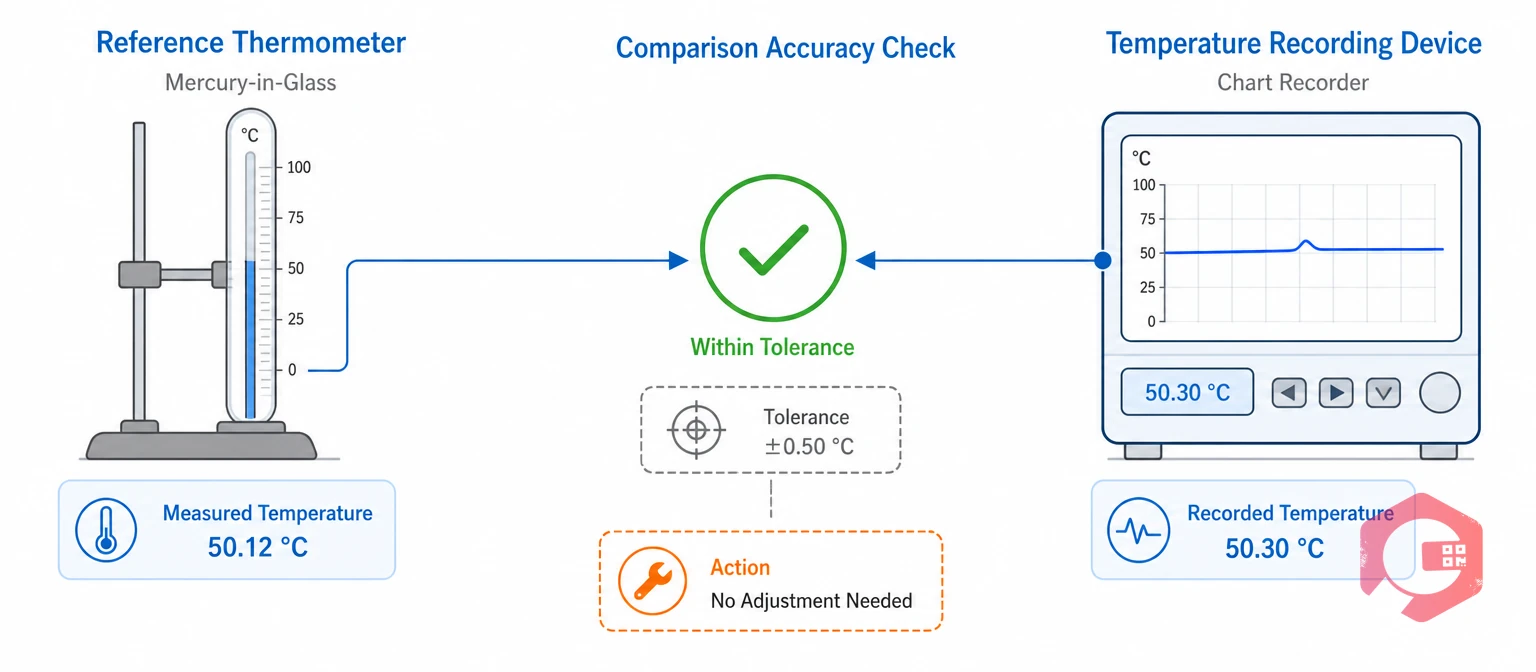
Temperature instruments are the most strictly regulated maintenance item in 21 CFR 113 because they are the primary evidence that the scheduled process was delivered. Two instruments are required in every retort: a mercury-in-glass (MIG) reference thermometer and a temperature recording device (TRD) that produces a continuous chart or digital record of the process.
The MIG thermometer must have a graduation no greater than 2°F (1°C) and must be accurate to ±0.5°F (±0.28°C) or better. The maintenance obligation is explicit: test the thermometer against a NIST-traceable reference standard at minimum every three months, and before any new thermometer is put into service. Any thermometer that fails accuracy testing must be replaced immediately — it cannot be adjusted or used with a correction factor.
The practical consequence is significant: if a MIG thermometer is found to be inaccurate at a quarterly test, all product produced since the last valid calibration may be considered process-deviated. Every batch produced during that period requires process authority evaluation before it can be distributed. This is why calibration records are not administrative paperwork — they are the evidence that protects product from recall.
The TRD must be calibrated at operating temperatures at intervals sufficient to ensure accuracy, and its reading must agree with the MIG thermometer within 1°F (0.6°C) during processing. Before each production shift, the retort operator must verify chart paper, ink, and clock mechanism are functioning. If the TRD reading diverges from the MIG by more than 1°F, the TRD must be recalibrated before the next production run.
All calibration tests — date, result, tolerance, and action taken — must be recorded and retained for three years under 21 CFR 113.100. Use Cryotos maintenance checklists to capture MIG and TRD calibration results digitally at the point of test, with technician signature, timestamp, and pass/fail status — records stored against each instrument's asset record and available for FDA inspection without manual compilation.
The table below maps every major 21 CFR 113 maintenance obligation to its frequency, responsible party, and regulatory basis. This is the minimum schedule — your process authority or HACCP plan may specify more frequent intervals for specific instruments or equipment.
| Task | Frequency | Responsible | Method | Regulatory Basis |
|---|---|---|---|---|
| MIG thermometer calibration | Quarterly + before each new thermometer | QA / Calibration tech | Test vs. NIST-traceable reference at operating temperature | 21 CFR 113.40(a)(1) |
| TRD calibration (vs. MIG) | Quarterly + whenever MIG/TRD diverges >1°F | QA / Calibration tech | Compare TRD vs. MIG at operating temperature; adjust if needed | 21 CFR 113.40(a)(2) |
| TRD chart, ink, and clock check | Before each shift or production run | Retort operator | Visual check; replace chart; verify clock speed | 21 CFR 113.40(a)(2) |
| Pressure gauge calibration | Quarterly (or per pressure vessel code) | QA / Instrumentation | Test vs. calibrated reference gauge; replace if outside ±2 psi | 21 CFR 113.40 (pressure retorts) |
| Vent valve operational check | Before each production run | Retort operator | Open/close check; confirm unobstructed flow | 21 CFR 113.40(a)(7) |
| Steam spreader / distributor inspection | Monthly minimum | Maintenance tech | Remove and inspect for blockage, corrosion; clean or replace | 21 CFR 113.40(a)(2)(iv) |
| Bleeder valve operational check | Before each production run | Retort operator | Verify bleeders open and venting continuously during processing | 21 CFR 113.40 |
| Conveyor speed calibration (continuous retorts) | Start of each run + at defined intervals | Maintenance / QA | Verify speed indicator vs. timed physical measurement | 21 CFR 113.40(d) |
| Rotation RPM calibration (rotary retorts) | Start of each run + defined intervals | Maintenance / QA | Verify RPM indicator accuracy; inspect drive mechanism | 21 CFR 113.40(e) |
| Safety relief valve certification | Annually (per ASME code) | Licensed inspector | Certified pop test; lift certification documented | ASME BPVC + applicable state codes |
| Process deviation log review | After every deviation + weekly summary | Food safety manager / QA | Review deviation records; confirm disposition decisions made | 21 CFR 113.89 + 113.100 |
| Full retort interior inspection | Annually | Maintenance team | Internal inspection for corrosion, blocked drains, steam distribution integrity | GMP / process authority |
Configure this schedule as recurring PM work orders in your preventive maintenance software — quarterly calibrations generate automatically so overdue tasks are visible before the next production run. View a ready-to-use regulatory compliance checklist to get started.
A process deviation is any departure from the scheduled process, including temperature drops or instrument malfunction. Process deviations are the direct regulatory consequence of maintenance failures, which is why the two disciplines cannot be separated in a retort-operating facility.
Any of these maintenance failures create a process deviation requiring immediate action:
When a 21 CFR 113 process deviation occurs, no affected product may be distributed until a process authority evaluates it and makes one of three disposition decisions: reprocess, destroy, or release with documentation of why the received process was adequate. All deviation records — the deviation description, affected lot numbers, corrective action taken, process authority notification, and disposition decision — must be documented and retained under 21 CFR 113.100.
Use Cryotos work order management to create a process deviation corrective work order the moment a deviation is detected — capturing the deviation description, affected product lot, retort ID, and timestamp automatically, and tracking the process authority notification and disposition decision to closure.

Food processors that maintain consistent 21 CFR 113 compliance follow four interconnected practices. The CALIBRATE-INSPECT-DOCUMENT-VERIFY framework organises those practices into a programme that produces both safe product and audit-ready records simultaneously.
The CALIBRATE-INSPECT-DOCUMENT-VERIFY Framework:
Maintaining 21 CFR 113 compliance requires a system that generates calibration tasks on schedule, captures signed records at the point of task completion, and produces the audit trail that FDA investigators expect on arrival. A Computerized Maintenance Management System converts your retort maintenance programme from a manual, paper-dependent process into an automated, auditable system.
Most facilities operating under 21 CFR 113 that adopt a maintenance management system as their compliance backbone do not encounter audit failures from genuine maintenance problems — they encounter them from record gaps. A system that makes every task visible, every record retrievable, and every overdue calibration impossible to miss eliminates most of that risk.
21 CFR 113.40(a)(1) requires mercury-in-glass thermometers to be tested against a NIST-traceable reference standard at minimum every three months (quarterly) and before any new thermometer is placed into service. If a thermometer is found to be out of tolerance at a quarterly test, it must be replaced immediately, and all product produced since the last valid calibration may need to be evaluated for process deviation. The quarterly minimum is a floor — your process authority or HACCP plan may specify more frequent testing for high-risk applications.
Under 21 CFR 113.89, no product involved in a process deviation may be distributed until a process authority evaluates the deviation and makes a formal disposition decision: reprocess, destroy, or document why the received process was sufficient. The entire evaluation — deviation description, affected lots, process authority contact, and final disposition — must be documented and retained for three years. The facility must also identify and correct the root cause of the deviation (the maintenance failure) before resuming production.
21 CFR 113.100 requires all processing and production records, including all instrument calibration records and process deviation records, be retained for three years from the date of manufacture. Records must be legible, stored securely, and available for FDA inspection on request. Electronic records in a CMMS are acceptable as long as they include the required data fields, are attributable to a named individual, and are retrievable in a format FDA investigators can review.
Yes — a CMMS can serve as the primary documentation system for 21 CFR 113 retort maintenance and calibration records, provided it captures the required data fields (instrument ID, calibration date, reference standard used, result, technician name, and action taken for out-of-tolerance findings), produces records that are timestamped and attributable to a named individual, and retains records for the required three-year period. What FDA investigators look for is completeness, traceability, and retrievability — all of which a properly configured CMMS provides by design.
21 CFR 113 retort maintenance compliance is not primarily a technical challenge — it is a documentation and scheduling discipline. Schedule a free demo to see how Cryotos automates your retort calibration schedule, captures signed records in the field, and produces a complete FDA audit trail from a single system.



Cryotos AI predicts failures, automates work orders, and simplifies maintenance—before problems slow you down.