Meter reading in maintenance workflows is the practice of capturing asset measurements — run hours, pressure, temperature, cycle counts, flow rates — directly inside a work order at the moment a technician is performing a task. Instead of clipboard rounds that happen separately from maintenance work, readings are embedded into PM checklists and breakdown tasks, tied to a timestamp, and stored against the specific asset or location. Cryotos CMMS meter reading goes further by letting those readings automatically trigger follow-up maintenance tasks when values fall outside accepted thresholds — closing the loop between data capture and action.
If your team still walks the floor with a paper log, transfers readings into a spreadsheet later, and manually cross-references them against work orders, this guide will show you a better way. You'll learn the types of meter readings that matter, how to embed them in your PM and breakdown workflows, how they trigger condition-based maintenance automatically, and how to report on the data you collect.

A meter reading is a measured value recorded from an asset at a specific point in time. The measurement type depends on the asset and what you're monitoring:
The key principle is context. A pressure reading means more when it's attached to a work order, a technician name, a timestamp, and the specific asset being serviced — rather than sitting in a standalone spreadsheet with none of that context.
Many maintenance teams treat meter readings as a standalone activity — a separate "round" that happens independently of work orders. This creates three recurring problems that compound over time.
When readings are captured outside of a work order, you lose the link between what was measured and what was done. You can see that pressure was 87 PSI on Tuesday morning, but not whether that reading was taken before or after the service, who took it, or whether anything was adjusted. Contextless data is hard to act on and almost impossible to audit.
Paper forms get transferred to spreadsheets. Spreadsheets get exported to reports. Each step introduces transcription errors and time delays. A UK facilities management study found that manual data re-entry has an average error rate of 1–2% per field — which adds up quickly across hundreds of assets and thousands of readings per year.
When monitoring rounds run independently of maintenance tasks, readings can be skipped during busy periods without any record that the skip happened. There's no system alert, no escalation, and no audit trail. With embedded workflow readings, a skipped step is visible immediately — the work order shows incomplete data before it can be closed.
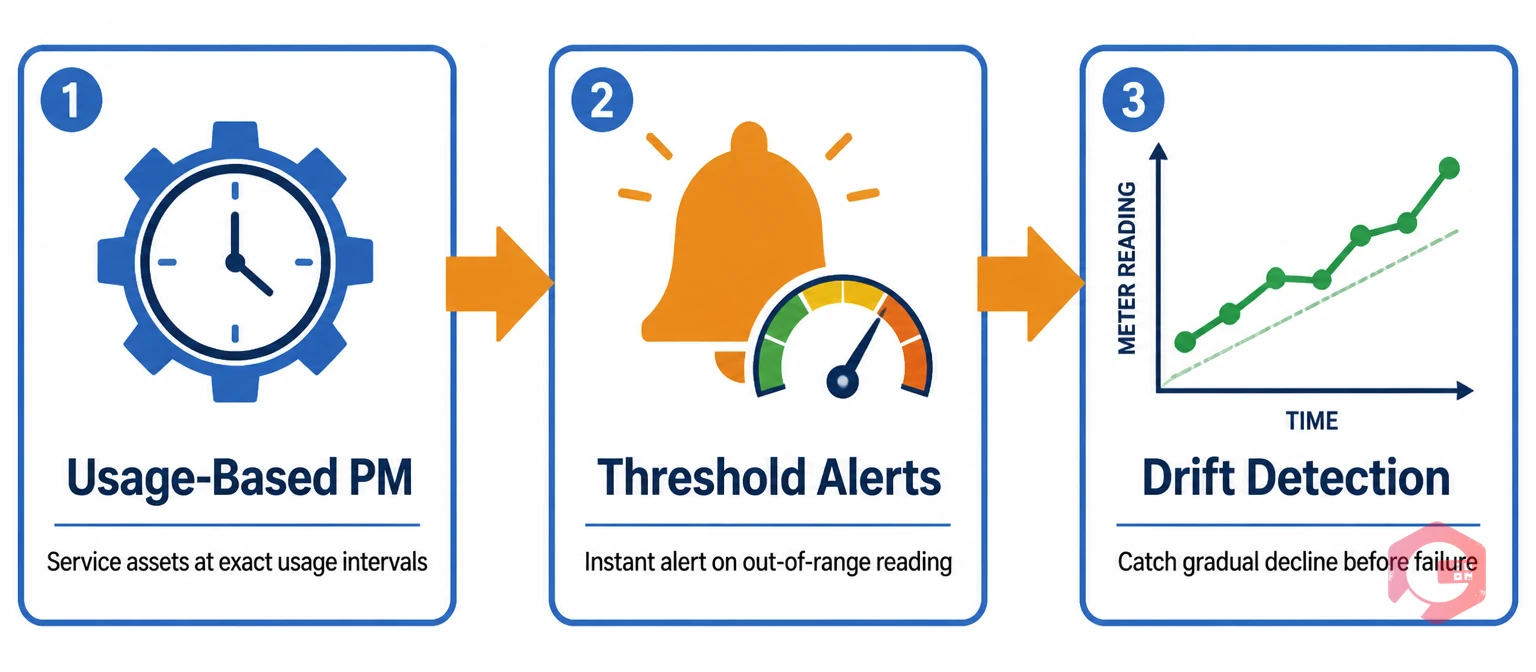
One of the most powerful uses of embedded meter reading is using captured values to automatically schedule or trigger maintenance tasks. This is called meter-based or usage-based preventive maintenance, and it's significantly more accurate than fixed-interval scheduling for assets with variable workloads.
Instead of servicing a compressor every 30 days regardless of how much it ran, you service it every 500 operating hours. Cryotos tracks cumulative run hours as technicians log readings during regular tasks. When the hour count crosses the threshold, a new PM work order is created automatically. A plant running double shifts services equipment twice as often; a line running minimal hours isn't over-serviced.
When a technician logs a reading that falls outside the acceptable range — say, a bearing temperature above 85°C or a hydraulic pressure below 150 PSI — Cryotos flags it immediately. Supervisors receive an alert, and a corrective work order can be created automatically without waiting for the next scheduled review. This is the foundation of condition-based maintenance.
Individual readings in isolation don't always tell the full story. Trend analysis across multiple readings over time can reveal gradual drift — a pump pressure that's slowly declining month over month, for example — before it crosses a hard threshold. Cryotos's Report Builder surfaces these trends across assets so maintenance managers can intervene proactively rather than reactively.

Setting up meter reading capture in Cryotos takes minutes. Here's how it works end to end.
In the Cryotos workflow builder, supervisors can insert a meter reading step at any point in a task sequence — before work begins, after a specific sub-task, or at job completion. Each field is labeled (e.g., "Record compressor outlet pressure (PSI)"), assigned a unit type, and optionally configured with upper and lower threshold values. The workflow supports multiple reading fields in a single task for assets that require several measurements.
The meter reading workflow can be attached to any preventive maintenance schedule — daily, weekly, monthly, by hours, or by cycles — or to reactive breakdown work orders. When a technician is assigned the task, they see the full checklist including the reading fields in their mobile app.
On the Cryotos mobile app, the meter reading step appears as a clearly labeled input field within the task checklist. The technician enters the value and progresses to the next step. If the value is out of range, they see an immediate on-screen alert. The app works in offline mode — readings captured in low-connectivity areas sync automatically when the connection is restored.
Every submitted reading is stored against the work order, timestamped, and linked to the asset or location. Supervisors see the data in real time as jobs are closed. Out-of-range values appear as flagged items in the dashboard. All historical readings are available in the Report Builder for trend analysis and compliance documentation.

Cryotos supports meter reading capture in two workflow models, each suited to different monitoring needs.
Both models feed into the same reporting layer, so maintenance managers can analyse asset-level and location-level data side by side without switching systems.
In regulated industries, the ability to prove that readings were taken, by whom, and when is as important as the readings themselves. Manual systems fail this test — a spreadsheet can be edited after the fact with no record of the change.
Cryotos creates an immutable audit trail for every meter reading: the value, the user ID of the technician who entered it, the timestamp, the work order it belongs to, and the asset or location it was recorded against. For industries operating under ISO 45001, GMP, or local regulatory requirements, this documentation is available on demand via the Report Builder — no manual compilation required. The Report Builder lets maintenance managers schedule automated delivery of meter reading reports to email, reducing the effort of audit preparation to near zero.
Embedded meter reading adds value across industries, but the specific measurements and trigger logic vary by sector.
For high-frequency monitoring where manual capture isn't practical — a pump logging pressure every five minutes, for example — Cryotos integrates with IoT sensors, SCADA systems, and PLC edge devices. Sensor data flows into Cryotos in real time, and threshold alerts and PM triggers fire automatically without a technician needing to log anything manually.
This creates a tiered monitoring model: IoT handles continuous, high-frequency readings on critical assets; technicians capture point-in-time readings during PM and inspection tasks. Both data streams converge in the same BI dashboard, giving maintenance managers a unified view of asset health without managing multiple platforms.
Here's how manual meter reading processes stack up against an embedded CMMS approach:
| Feature | Manual Process | CMMS (Cryotos) |
|---|---|---|
| Data capture method | Paper forms or separate digital log | Inline field inside work order checklist |
| Context linkage | Reading exists in isolation | Tied to work order, asset, technician, and timestamp |
| Threshold alerts | Supervisor reviews manually | Automatic alert on out-of-range value submission |
| PM triggering | Calendar-based only | Usage-based PMs triggered by cumulative meter values |
| Audit trail | Editable spreadsheet, no change log | Immutable record with user ID and timestamp |
| Offline capability | Always available (paper) | Mobile offline sync with automatic upload on reconnection |
| Reporting | Manual export and aggregation | Automated trend reports and scheduled delivery |
| Error rate | 1–2% transcription error per field | Zero transcription — reading goes directly to database |
Cryotos supports any numeric measurement that can be entered by a technician or pushed via IoT integration. Common types include runtime hours, cycle counts, pressure (PSI/bar), temperature (°C/°F), flow rates, energy consumption (kWh), and vibration levels. Each reading field is labeled and unit-typed when the workflow is configured.
Yes. Cryotos supports both usage-based PM triggers (a new work order fires when cumulative hours or cycles cross a threshold) and condition-based alerts (a corrective work order is created automatically when a reading falls outside the configured acceptable range). This eliminates the need for a supervisor to manually review readings before acting.
Yes. Meter reading fields can be embedded in any workflow type — scheduled preventive maintenance, reactive breakdown tasks, or inspection rounds. The same reading field configuration can be reused across multiple workflow templates.
No. The Cryotos mobile app includes offline mode that stores all inputs locally. When connectivity is restored, readings sync automatically to the server with their original timestamps preserved.
All readings are stored in a structured, queryable format and feed directly into Cryotos's Report Builder. You can generate asset-level trend reports, compare readings across locations, filter by date range or technician, and schedule automated reports for daily or weekly email delivery — no manual export or aggregation required.
Every reading is stored with the technician's user ID, timestamp, work order reference, and asset or location tag. This record is immutable — it cannot be edited after submission. Compliance reports can be generated and scheduled automatically via the Report Builder, covering ISO 45001, GMP, and other regulatory requirements.
Treating meter readings as a separate monitoring activity creates data without context, multiplies manual handling errors, and leaves coverage gaps that no one can see. Embedding readings directly into PM and breakdown workflows solves all three problems: every measurement is tied to a work order, a technician, and a timestamp; out-of-range values trigger immediate alerts; and cumulative readings automatically schedule the next maintenance task before the asset degrades.
If your team is ready to move beyond clipboard rounds and manual spreadsheets, Cryotos CMMS brings meter reading, preventive maintenance, and condition-based alerts into a single platform — with IoT integration for high-frequency monitoring and automated reports for compliance. Book a free demo today to see how it works in your facility.


Cryotos AI predicts failures, automates work orders, and simplifies maintenance—before problems slow you down.