

Lubrication frequency for industrial equipment usually falls somewhere between daily checks on fast-running machines and quarterly service on slow, lightly loaded parts. But there is no single correct number. The right lubrication frequency for any one asset depends on several things. It depends on how hard the machine runs, where it sits, what lubricant it uses, and what the manufacturer's manual says as a starting point. Get the interval wrong in either direction and the machine pays for it. Too little grease speeds up wear and heat. Too much grease blows out seals and pulls in dirt.
Key Takeaways
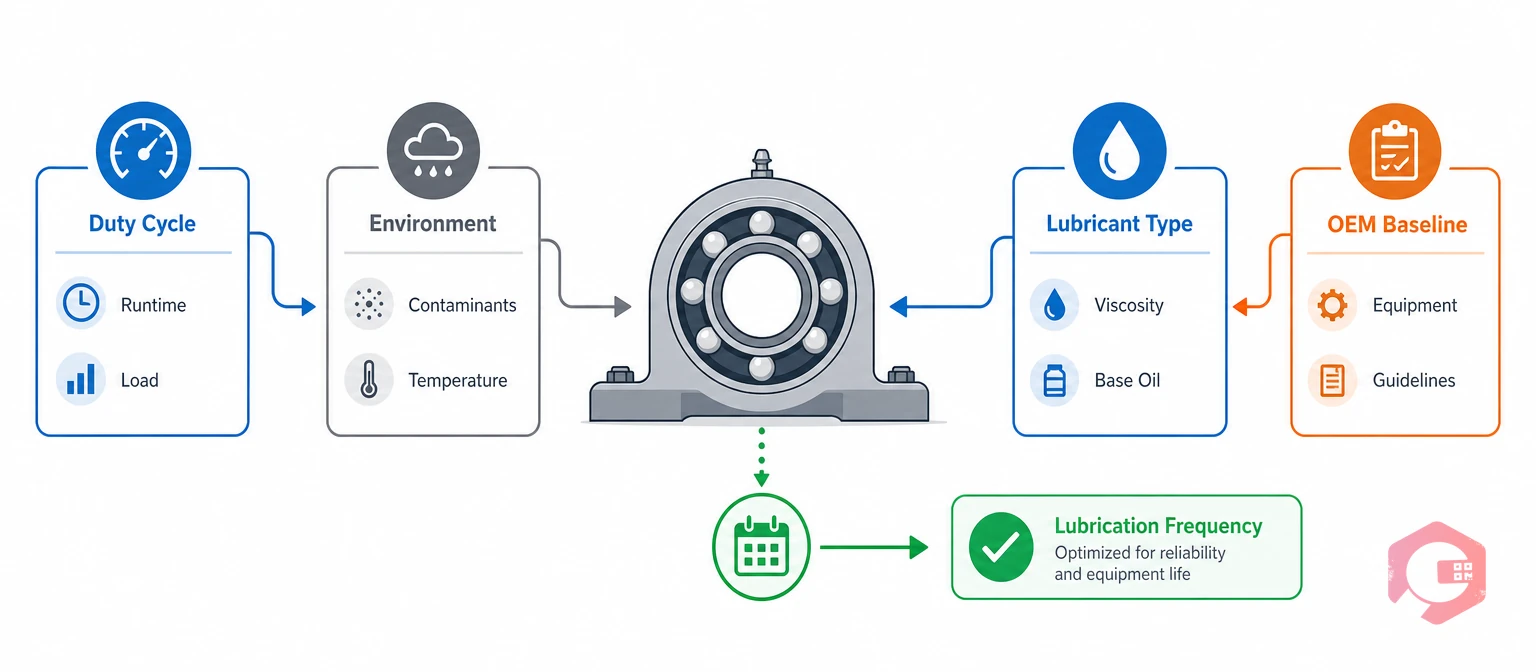
Lubrication frequency is how often equipment needs fresh grease or oil to prevent wear and heat buildup. Four things set that number for any one machine: duty cycle, environment, lubricant type, and the maker's own baseline. No single rule from a manual can cover all four at once.
A slow conveyor bearing wears differently than a fast electric motor. A machine that runs three shifts a day burns through its lubricant film much faster than one that runs a single shift. Two identical machines on different schedules often need two different lubrication intervals, even if they came off the same factory line. The basic idea behind lubrication is simple: a thin film of oil or grease keeps two moving surfaces from touching directly. What changes from plant to plant is how fast that film wears thin, and that speed is exactly what sets lubrication frequency.
Without a clear system, lubrication schedules end up on whiteboards, sticky notes, or a technician's memory. Intervals slip the moment someone goes on leave or the shift gets busy. A missed lubrication cycle rarely causes an immediate failure. Instead, it causes a slow decline in bearing life that shows up months later as a surprise breakdown, and by then the real cause is hard to trace.
Most teams that skip this step just use whatever interval was written on an old sticky note years earlier. That number rarely matches how the plant actually runs today. Getting the lubrication frequency right the first time stops slow, hidden bearing wear long before it turns into an unplanned breakdown.

Instead of guessing at one number, most well-run plants build their lubrication frequency from four factors. Each factor pushes the interval tighter or looser than the maker's default.
The Four-Factor Lubrication Interval Framework:
Running an asset class through all four factors usually gives a range, not one fixed number. A pump bearing might land anywhere from once a month to once a quarter, depending on its shift pattern and its environment. Cryotos lets teams set lubrication frequency at the asset-class level and then override it for any single machine that runs a non-standard shift pattern. That way, one plant-wide default never gets blindly applied to a machine that clearly needs closer attention.
See how Cryotos structures every lubrication visit with configurable maintenance checklists that record grease type, amount used, and condition at each stop.
A sample lubrication frequency schedule gives planners a starting range by equipment type. That range should then shift, tighter or looser, once the Four-Factor Framework is applied to the specific asset and site. Think of this table as a first draft, not a final answer.
| Equipment Type | Typical Duty Cycle | Baseline Lubrication Frequency | Tighten If |
|---|---|---|---|
| Electric motor bearings | Single to double shift | Every 3–6 months | Continuous run or high heat |
| Conveyor and pillow block bearings | Continuous | Every 1–3 months | Dusty or foundry setting |
| Hydraulic pump gearboxes | Continuous, high load | Monthly to quarterly | Vibration or oil test flags a problem |
| Chain drives | Continuous | Weekly to monthly | Washdown or wet setting |
| Overhead crane and hoist parts | Intermittent | Every 3–12 months | Outdoor use or heavy lifting |
Cryotos stores the OEM baseline on each asset record. It then layers real condition data on top. The interval in this table becomes a starting point that shifts as new data comes in, rather than a number frozen in time.
Both too little and too much lubricant show warning signs before a bearing fully fails. Catching either sign early costs far less than replacing the part later. Most teams can spot these signs during a normal walk-through, once they know what to look for.
Most facilities that catch these signs early find the root cause fast: a fixed calendar interval that never changed when the shift schedule or the environment did. A machine that ran one shift when the plan was written, but now runs around the clock, will show under-lubrication signs even if the technician followed the old plan exactly. Studies of bearing failure modes across industry consistently point to lubrication problems as one of the largest single causes of early bearing loss. That cause ranks ahead of manufacturing defects or normal fatigue.
Most of these signs build up slowly, which is exactly why they get missed. A bearing that runs three degrees hotter than last month rarely triggers alarm on its own. It only becomes obvious once it sits next to a dozen similar readings on a trend chart. That is one reason walk-through inspections alone tend to miss early lubrication problems. Pairing a visual check with a logged reading catches issues that a glance alone would not.
A Computerized Maintenance Management System ties the right interval, the right lubricant, and the right amount to the right asset. It then links every lubrication task into the wider preventive maintenance plan. Without this structure, schedules live on whiteboards or in someone's memory, and they slip the moment that person goes on leave.
Cryotos builds recurring lubrication work orders on its own. It can trigger by calendar date, by meter reading, or by both together. Every asset carries a QR or barcode label. A technician walking a lubrication route scans each asset in order, and the system loads the right lubricant type, the right amount, and the last service date right away. That confirms the route was actually walked, not just logged after the fact.
Some equipment wears out based on use, not on the calendar. For that gear, Cryotos ties lubrication tasks to meter-based maintenance triggers, such as operating hours, cycle counts, or output volume. A pump running two shifts triggers its next lubrication task sooner than an identical pump running one shift, and no planner has to track that gap by hand.
Every lubrication event links back to the asset's full history: past failures, vibration readings, and oil test results. When bearing failures start showing up soon after a lubrication visit, that pattern surfaces on its own. Planners can then tighten the schedule before the next failure happens. This is the same logic behind condition-based maintenance programs in general.
If a scheduled lubrication task is not finished in its time window, Cryotos sends an alert to the technician right away. If it stays open past a set limit, the alert escalates to the supervisor. A missed task that would once have quietly fallen off the schedule instead spawns a follow-up work order automatically.

Most plants moving off paper tracking do better with a staged rollout than trying to digitize every asset at once.
Start with the 10 to 20 machines that show up most in breakdown reports, or cost the most to replace. These are the assets where a missed lubrication cycle hurts the budget the most.
Pull the maker's suggested interval, grease type, and amount for each asset. Store that number on the asset record. Treat it as a starting point, not the final word on lubrication frequency.
Tag each asset with its duty cycle and its environment. Then adjust the baseline interval tighter or looser to match. A pump running non-stop in a dusty plant should never sit on the same schedule as an identical pump running one shift indoors.
On your highest-value assets, add vibration or temperature sensors if budget allows. That lets the lubrication frequency shift on its own as real wear signals appear, instead of staying locked to a fixed date. Cryotos ties these signals into condition monitoring data, right alongside the meter-based triggers already driving the schedule.
Watch which assets use more lubricant than expected. That is often an early sign of a seal or bearing problem developing well before it shows up as a breakdown. Also track whether the scheduled tasks are actually finished on time, not just logged as done after the fact by a technician catching up on paperwork at the end of a shift.
Even teams that try hard to stay on schedule run into a short list of repeat problems. These mistakes quietly undo the benefit of a good lubrication frequency plan, and most of them trace back to a gap between what the schedule says on paper and what actually happens on the floor.
Maintenance teams using Cryotos have reported up to 30% reduction in unplanned downtime. They also report 25% faster repair turnaround. Both gains showed up once lubrication moved from informal tracking into a structured system tied to asset history.
Industry and setting change lubrication frequency as much as the equipment itself does. The same bearing can need very different care depending on where it sits, what it's exposed to, and how the plant runs its shifts.
Washdown cycles and food-grade lubricant rules push lubrication frequency tighter. Water and cleaning chemicals strip protective film fast, so many food plants service exposed bearings weekly instead of monthly.
Extreme heat, dust, and heavy loads shorten lubricant life. Equipment running near a furnace or in an open yard often needs a tighter lubrication frequency than the same part running indoors in a controlled space.
Compliance rules add a documentation layer on top of the interval itself. Every lubrication task needs a clean, time-stamped record, since regulators expect proof that the schedule was actually followed, not just written down.
Mixed equipment ages and duty cycles mean lubrication frequency often varies asset by asset rather than plant-wide. A facility running older motors alongside new ones usually needs two different schedules, not one blanket rule.
Once lubrication tasks turn into structured data instead of a checked box, they become a reliability data set. That data feeds directly into the bigger maintenance metrics a plant already tracks. Most teams that mature their reliability program treat lubrication compliance as an early warning sign, not an afterthought.
Cryotos compares lubrication task compliance against Mean Time Between Failures and Mean Time To Repair, both by asset and by equipment class. That gives managers direct proof of whether good lubrication habits are actually cutting down failures, or whether the schedule needs another look.
Sometimes a bearing or gearbox fails, and the cause traces back to a missed or late lubrication task. When that happens, the system tags the downtime, the cost, and the affected line on its own. A missed preventive task turns into a clear, numbers-backed case for staying on schedule.
Want to see where your own reliability numbers stand? Run your asset data through Cryotos's MTBF calculator to get a first read before you adjust lubrication frequency across the plant. This kind of asset-level tracking lines up with reliability-centered maintenance programs, which call for decisions built on real condition evidence rather than a fixed calendar alone.
Structured lubrication frequency data feeds planned downtime reports. Teams can then weigh the cost of a scheduled lubrication stop against the cost of the failure it prevents. For plants under audit — food and beverage, pharma, aerospace, utilities — every lubrication task carries a timestamp. It also carries a linked asset and the name of the technician who did the work.
That turns compliance reporting into a quick pull from real system data, instead of a rebuild from memory. This kind of technician-verified record also supports Total Productive Maintenance programs, which lean on operator-level checks as a first line of defense against equipment loss.
The same data set also helps justify capital spending. A machine with a long history of lubrication-related failures makes a much stronger case for replacement or redesign than a gut feeling ever could. The cost of repeated small failures sits right there in the record, asset by asset.
The type of lubricant on an asset changes how often that asset needs service, not just the interval itself. Two identical bearings running the same hours can need very different lubrication frequency. One might use a basic mineral grease. The other might use a synthetic formula built for heat, and that difference alone can double the safe interval between visits.
Grease stays in place better and needs less frequent attention on slow, enclosed parts like pillow block bearings. Oil drains away and needs constant flow on fast, high-load gear like large gearboxes, so it depends more on regular level checks and less on a fixed refill schedule.
Synthetic lubricants resist heat and oxidation better than mineral-based ones. A synthetic grease might stretch a three-month interval out to six months on the same machine. That longer interval can offset a higher unit cost through fewer service visits and less downtime.
Not all greases are compatible. Mixing an incompatible thickener type into a bearing can break down the grease structure. It can cause the grease to separate or leak, even if both products looked similar on the shelf. Structured lubrication records that store the exact grade, brand, and quantity per asset prevent the common shop-floor habit of topping up with whatever grease gun happens to be closest.
Most industrial bearings need lubrication somewhere between once a month and once a quarter. The exact lubrication frequency depends on duty cycle, heat, and how much dirt or moisture the bearing is exposed to. A bearing running around the clock in a dusty plant may need monthly service, while the same bearing running one shift indoors could go a full quarter between visits.
Over-lubrication packs a bearing with extra grease, which raises internal pressure, pushes grease past the seals, and pulls in dirt that then works its way back inside. It causes just as much damage as under-lubrication, even though it feels like the safer mistake to make.
The maker's schedule is a reasonable place to start, but it assumes average conditions. Real duty cycle, real environment, and real condition data almost always shift the correct lubrication frequency tighter or looser within the first few months of use.
Calendar-based scheduling triggers a task on a fixed date, no matter how much the machine has actually run. Meter-based scheduling triggers the task from real operating hours, cycles, or output. Meter-based scheduling tends to be more accurate for equipment where use swings a lot between shifts or seasons.
Check the lubrication history against the date of failure. A bearing that failed soon after a missed or late lubrication task points to a lubrication problem. So does one that shows dry, dark, or dirty grease during teardown. Either sign points away from a bad part and toward the schedule itself.
A CMMS does not change the physics of how grease breaks down, but it does remove the human error that lets a schedule slip. Automated scheduling, QR-verified routes, and missed-task alerts mean a lubrication point rarely falls off the plan the way it can with a whiteboard or a memory-based system.
Both cost real money, but over-lubrication often costs more in the long run. A blown seal usually needs a full teardown to fix. A slightly under-lubricated bearing caught early can often be corrected with one extra service visit before real damage sets in.
No. Even identical machines can need different lubrication frequency if they sit in different plants. A motor running in a hot, dusty yard needs closer attention than the same motor running in a clean, climate-controlled building, even though the equipment itself is unchanged.
Start by pulling the lubrication history for your worst-performing assets and lining it up against their failure dates. If failures cluster right after a lubrication visit, the grease or oil may be wrong for the job. If failures cluster right before the next scheduled visit, the interval itself is too long. That one comparison usually points straight at the fix.
Getting lubrication frequency right is one of the cheapest, highest-payoff steps a maintenance team can take. It only works when the interval matches what is actually happening on the floor, not a number copied from a manual years ago. Plants that treat lubrication as tracked data, rather than a habit, tend to see the payoff show up first in fewer surprise breakdowns and later in a much cleaner audit trail. Schedule a free demo to see how Cryotos turns lubrication scheduling into a tracked, adjustable part of your reliability program.




Cryotos AI predicts failures, automates work orders, and simplifies maintenance—before problems slow you down.



