A mine emergency puts lives at risk within minutes. Maintenance teams prepare for it by keeping life-safety equipment ready, planning emergency repairs, staging critical spares, and rehearsing their role. Most of that work happens long before an alarm sounds.
Operations and rescue teams usually own the response plan. Maintenance owns the readiness of everything the plan depends on. That includes ventilation fans, self-rescuers, refuge chambers, gas detectors, communication links, pumps, and fire suppression. This guide explains what to inspect, stock, practise, and record so equipment works the first time it is needed.
Key Takeaways

A mine emergency is a sudden event such as fire, explosion, flooding, or gas release that threatens miners' lives. It forces an immediate shift from production to protection and rescue.
Regulators treat readiness as a legal duty. In the United States, the MINER Act of 2006 pushed underground coal mines to keep emergency response plans. These plans cover communications, tracking, and breathable air, and MSHA enforces the rules. In India, the Directorate General of Mines Safety (DGMS) sets similar expectations. ISO 55000 asset management principles support the same idea: know which assets are critical and keep them fit for purpose.
Most mine maintenance teams are not part of the rescue crew, but they hold the keys to the tools rescue depends on. A fan that does not restart can turn a manageable event into a major one. So can a communication link that has been down for weeks.
Maintenance does not run the response, but it decides whether the response has working equipment.

A readiness ladder gives maintenance teams five rungs to climb in order. It runs from knowing which assets matter to learning from every drill and event.
The Mine Emergency Readiness Ladder:
Without the first rung, inspections cover the wrong equipment. Without the fourth, spares sit in a store that nobody can find in the dark. Each rung protects the one above it.
Teams usually stall at the second rung. Writing a list is easy, but keeping inspection tasks scheduled, completed, and recorded takes a system.
A life-safety asset is any equipment that protects miners or supports their escape and rescue. Start with the equipment your emergency response plan names. Then add what those systems need to run, such as power, cabling, and compressed air.
Log each one as an asset in a Computerized Maintenance Management System with a criticality rating, a location, and linked inspection tasks. Sites that want one place for all of this can look at maintenance software built for drilling and mining operations.
A clear asset list turns a vague promise of readiness into a checkable set of equipment.
Wondering what a sudden stop costs your site? Try the unplanned downtime calculator to put a number on it.
A mine emergency inspection schedule ranks each life-safety asset by criticality. It then sets check types and frequencies from the manufacturer, the regulator, and your failure history.
The table shows typical checks. Treat the frequencies as a starting point and confirm them against your regulator and each manufacturer's instructions.
| Equipment | What to Check | Typical Frequency | Record to Keep |
|---|---|---|---|
| Self-contained self-rescuers | Seals, indicators, condition, and shelf-life dates | Per manufacturer and regulator | Inspection log with serial numbers |
| Refuge chambers | Air supply, batteries, seals, and supplies | Monthly to quarterly | Checklist with sign-off |
| Main and backup ventilation fans | Vibration, motor condition, and backup changeover | Weekly, with a full test each year | Test results and vibration trend |
| Gas detectors | Bump test, calibration, and sensor condition | Before use, and per manufacturer | Calibration certificate |
| Communication and tracking | Battery levels, signal strength, and coverage gaps | Weekly | Coverage and fault log |
| Fire suppression and extinguishers | Pressure, discharge points, and tags | Monthly visual, yearly service | Service record |
| Dewatering pumps | Run test, level switches, and discharge flow | Weekly | Run hours and fault history |
| Emergency lighting and backup power | Load test and battery condition | Monthly | Load test report |
Fans and gas detectors usually deserve the closest attention, because a failure in either can change conditions underground very quickly.
Pair each task with a safety compliance checklist so every inspector checks the same points the same way.
Maintenance teams keep spares ready for a mine emergency by stocking the few parts that restore life-safety systems fastest. They store those parts where crews can reach them quickly.
Remote sites make this harder. A part that takes six weeks to arrive is not an emergency spare.
Set minimum levels from lead time and consequence of failure, label storage by system, and check shelf-life dates on batteries and sensors. A short kit at each main access point saves the trip to the central store.
An emergency work order is a pre-authorized repair request that skips normal approval to restore a safety system fast. Define the form in advance: asset, symptom, priority, who may approve, and which checks can never be skipped.
A crisis does not remove the need for controlled work. A mine emergency often involves damaged cables, energized equipment, and unknown gas conditions. Agree a short-form emergency permit ahead of time, and keep a permit to work system ready to issue and track it.
Isolation still applies. Lockout tagout keeps energy sources off while crews work, and it should be on every emergency repair that touches powered equipment.
Digital work orders on mobile devices let crews log emergency repairs as they happen, with offline mode for areas where signal drops.
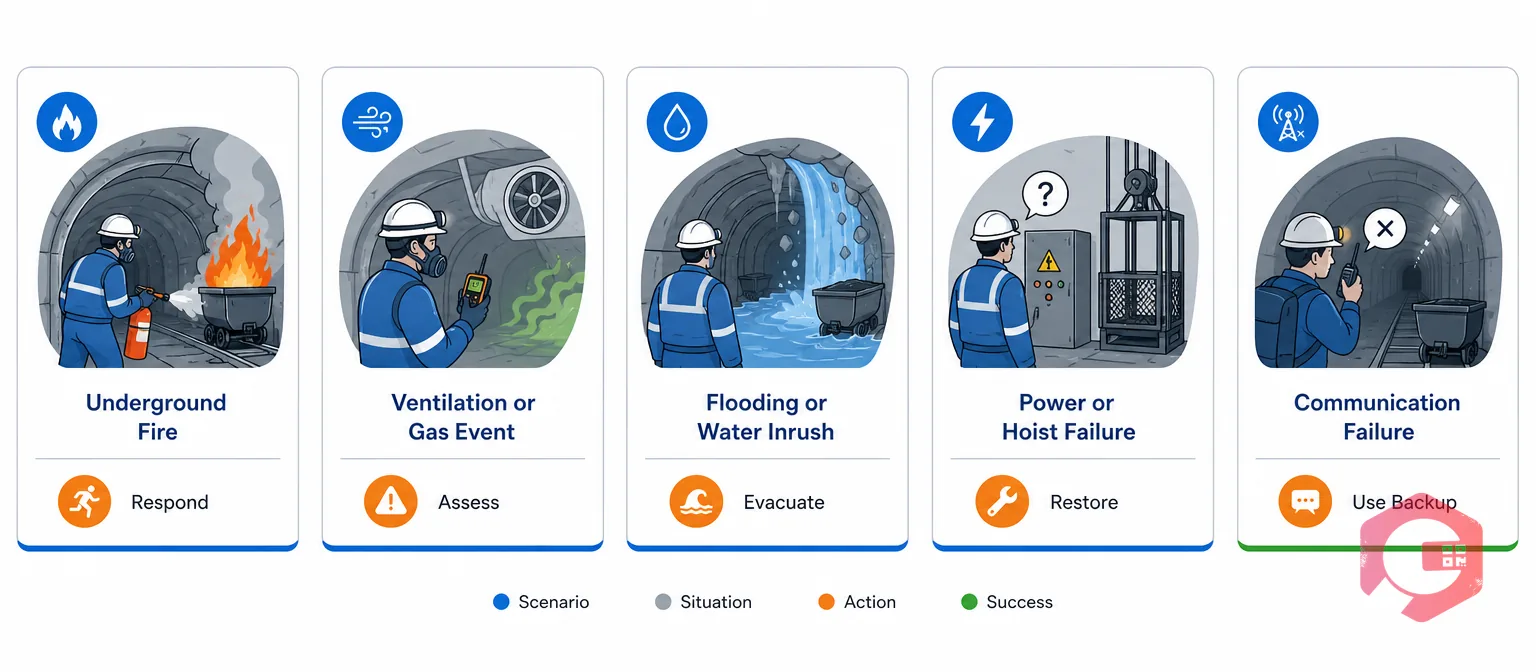
A mine emergency response matrix lists, for each scenario, what maintenance checks first. It also shows which assets matter most and which records support the response.
Use the matrix to support your approved emergency response plan, not to replace it. The incident commander always sets priorities.
| Scenario | Maintenance Priority | First Actions | Critical Assets and Records |
|---|---|---|---|
| Underground fire | Keep fire water and suppression running | Confirm fire pumps and suppression are operating; isolate circuits when instructed | Fire pumps, suppression systems, electrical single-line drawings |
| Ventilation or gas event | Keep air moving as directed | Check fan status and backup changeover; support ventilation changes on command | Main and backup fans, gas detectors, fan test history |
| Flooding or water inrush | Keep pumps running | Start standby pumps; check power feeds and discharge lines | Dewatering pumps, sump sensors, pump curves |
| Power loss or hoist failure | Restore backup power and evacuation routes | Start backup power; check emergency lighting and hoist controls | Backup generators, batteries, hoist inspection records |
| Communication failure | Restore contact and tracking | Check base stations and batteries; switch to backup channels | Communication nodes, tracking readers, coverage maps |
Keep printed copies of the matrix with the emergency kits. The system that holds the digital copy may be the one that failed.
Maintenance teams should drill for a mine emergency at least as often as their regulator and plan require. Many add a short maintenance-only drill each quarter.
Time every task and log each gap as a work order. A drill that finds a flat battery is a success, because the battery was found before the emergency.
After a mine emergency, maintenance teams restore safety systems first and record every repair. They preserve evidence as directed and run a root cause review with the whole team.
Regulators and investigators often ask for inspection and repair history. Complete records make that request routine instead of stressful.
A CMMS supports mine emergency preparedness by keeping inspection schedules, spares, permits, and repair history in one place. Crews can reach it on any device.
Maintenance teams using Cryotos have reported up to 30% reduction in unplanned downtime and 25% faster repair turnaround. Fewer unplanned failures also means fewer weak points when something goes wrong.
Software does not replace judgment or drills. It makes sure the plan the team wrote is the plan the team can prove it followed.
Maintenance keeps life-safety equipment ready before an event and restores it quickly during one. That includes fans, pumps, communication, refuge chambers, and fire systems. The team supports the incident commander and does not set response priorities.
Follow the approved emergency response plan and report to the incident commander. Carry out only the tasks you are assigned. Use the pre-agreed emergency work order and permit, and keep isolation rules in place for powered equipment.
Ventilation fans, self-rescuers, refuge chambers, gas detectors, communication and tracking systems, fire suppression, and dewatering pumps usually rank highest. Rank your own list by what protects or helps rescue miners.
Inspect at the frequency your regulator and the manufacturer require, and more often for equipment with a history of faults. Many sites check fans and communication weekly and refuge chambers monthly or quarterly.
No. Use a short-form emergency permit that was agreed in advance, and keep lockout tagout in place. Damaged cables, energized equipment, and gas can all be present, so controlled work protects repair crews too.
Stock the parts that restore life-safety systems fastest, set minimum levels from lead time, and store kits near main access points. Check shelf-life dates on batteries and sensors during regular inspections.
Run drills at least as often as the regulator and your emergency response plan require. Many sites add a short maintenance-only drill each quarter to practise repairs, permits, and isolation.
Yes. It schedules inspections, tracks spares, issues permits, and records every repair. It does not replace drills or judgment, but it gives you the evidence that your equipment was checked and ready.
Mine emergency readiness is built one inspection, one spare part, and one drill at a time. Schedule a free demo to see how Cryotos keeps life-safety equipment, spares, and permits connected in one place.



Cryotos AI predicts failures, automates work orders, and simplifies maintenance—before problems slow you down.