Drones are used for industrial inspections during shutdowns to capture visual, thermal, and 3D data from tanks, boilers, stacks, and structures without building scaffolding or sending people into confined spaces. A single flight can cover in minutes what a rope-access team needs hours to reach, and the footage is ready for review before the crew leaves the site.
Most maintenance teams plan a shutdown around a fixed window and a long list of industrial inspection tasks. Drones shrink the slowest and riskiest part of that list. This guide explains where drones fit, how a shutdown flight plan works, and how to turn the images into tracked work orders.
Key Takeaways

Drone inspection is the use of unmanned aircraft to capture visual and thermal data on equipment. These aircraft are also called unmanned aerial vehicles, or UAVs. During a shutdown, the drone surveys idle assets that have been isolated, cleaned, and cleared for work. Industrial inspection in this window differs from routine rounds because crews can reach interior surfaces that stay hidden while the plant runs.
A shutdown is a planned period when a plant stops production to inspect, repair, and upgrade equipment. Some sites call it a turnaround or an outage. The window is short, and every day offline carries a cost.
Pressure vessels, piping, and tanks are usually inspected under codes such as API 510, API 570, and API 653, and entry into enclosed equipment falls under OSHA's permit-required confined space standard. Drones support these inspections with a fast first look, but they do not replace measurements that codes require from qualified inspectors.
Drones handle three groups of industrial inspection tasks during a shutdown: internal surveys, external surveys, and thermal surveys. Each group solves a different access problem that slows a shutdown crew.
Small caged drones fly inside storage tanks, boilers, furnaces, and vessels once the equipment is open, cleaned, and ventilated. They record coatings, weld seams, roof plates, and corrosion patterns without scaffolding or rope access.
Inspectors review the footage to decide where a person still needs to enter for measurements.
Standard multirotor drones fly up stacks, flare tips, cooling towers, pipe racks, and roofs. Crews skip the crane, scaffold, or rope team for the first look, then send people only to the spots that need repair. Close-up images show cracks, coating failure, loose cladding, and corroded supports.
Thermal imaging is the capture of surface heat patterns to reveal hidden faults. Heat contrast needs a hot asset, so most teams fly thermal surveys in the final days before the shutdown to scope insulation and refractory work, then again after restart to confirm the repairs.
The right job for a drone is any inspection where a fast first look matters more than a contact measurement.
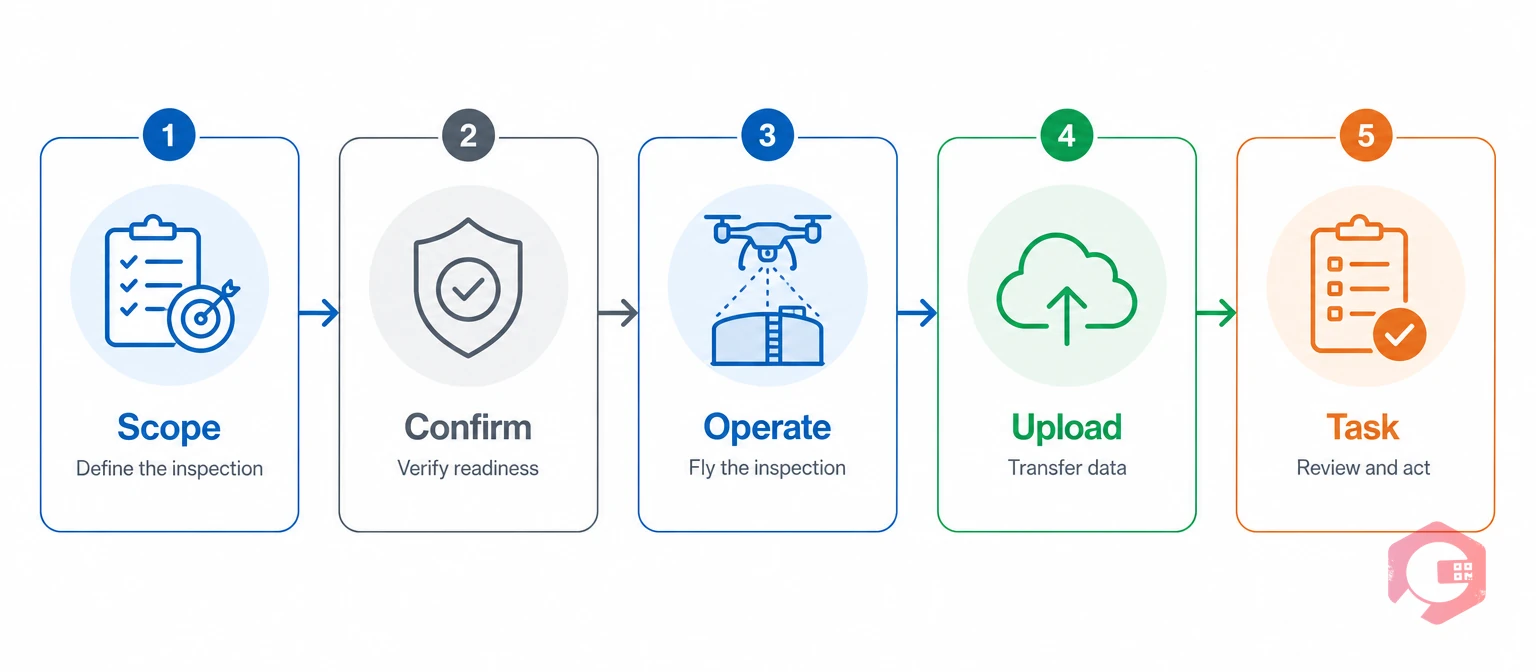
A shutdown drone inspection works in five steps: scope the targets, confirm permits, fly a scripted route, upload and review the data, and turn findings into tasks. Teams that follow a fixed sequence finish each industrial inspection flight faster and lose fewer images to poor planning.
The SCOUT Framework for Shutdown Drone Inspections:
Scripted routes make flights repeatable, so a crew can fly the same path at the next shutdown and compare images frame by frame. Most facilities start with one asset type, such as a storage tank, and expand after the first shutdown proves the workflow.
Need a place to track every SCOUT task? See how Cryotos handles digital maintenance checklists for shutdown crews.
Drone inspection is faster and safer for first-look surveys, while scaffolding, rope access, and confined space entry remain necessary for contact measurements. The table compares the two approaches on the factors that matter most inside a shutdown window.
| Factor | Drone inspection | Scaffolding, rope access, or entry |
|---|---|---|
| Setup time | Minutes to hours | Hours to days for scaffold build and permits |
| Worker exposure | Pilot and spotter stay on the ground | Workers at height or inside confined spaces |
| Coverage | Full surface imagery in one pass | Spot checks limited by reach |
| Data record | Geotagged images and video that can be repeated | Handwritten notes and photos |
| Contact measurements | Not possible with most drones | Ultrasonic thickness and hammer tests |
| Primary use | First look, scoping, and repeat comparison | Verification and code-required measurements |
Most teams use both methods. The strongest approach to industrial inspection in a shutdown uses drones to find problems and people to verify them.
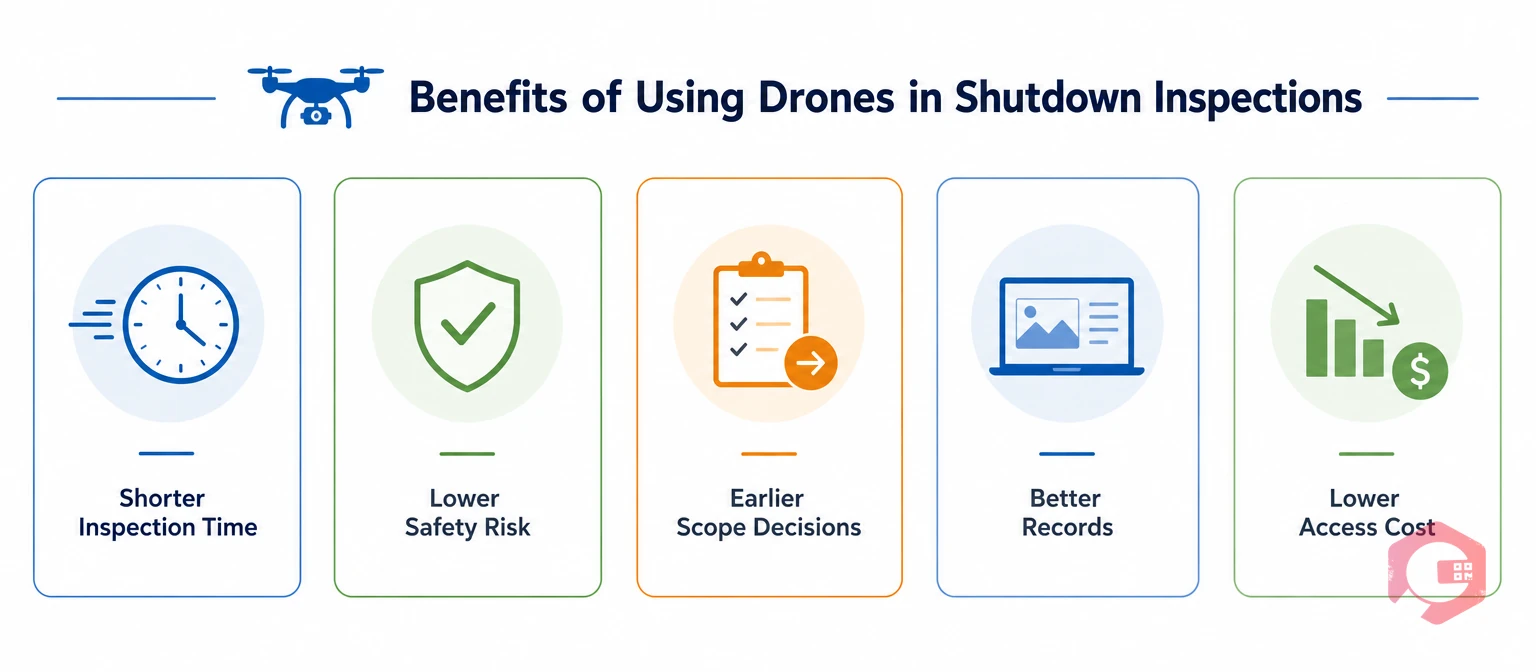
Drones cut inspection time, lower safety risk, and improve the quality of industrial inspection records during a shutdown. Five benefits show up most often on site.
Maintenance teams that fly early in the shutdown usually find hidden work while there is still time to order parts. Early flights turn surprises into planned tasks.
Drone flights for industrial inspection in plants must follow aviation rules, site permits, and hazardous-area requirements, like any other shutdown work.
Confined space entry is work inside an enclosed area that was not built for people to occupy. A drone flight removes many entries, yet the space still needs isolation, ventilation, and gas testing before anything flies inside.
Clear rules and a named spotter keep drone flights from becoming a new hazard during a busy shutdown.
Prepare for an industrial inspection flight by defining targets, checking site access, and agreeing on data rules several weeks before the shutdown begins. Use this pre-flight checklist.
Maintenance teams that skip this plan often collect hours of footage with no clear answers. A written plan keeps flights short and findings traceable.
The most common mistakes are flying without a defined goal, skipping the review step, and treating images as the final record. Most teams learn these lessons during their first shutdown.
Naming a review owner and an image naming rule before the first flight prevents most of these problems.
Turn drone findings into shutdown work orders by tagging each defect to an asset, ranking it by risk, and creating a task before the planning cutoff. A drone industrial inspection only pays off when every confirmed defect has an owner, a due date, and a place in the shutdown plan.
Drone platforms capture the data, but a Computerized Maintenance Management System is where that data becomes tracked work. With Cryotos, teams manage each repair through work order management, create work orders from photos on the mobile app, and keep the repair history on the asset record.
Maintenance teams using Cryotos have reported up to 30% reduction in unplanned downtime and 25% faster repair turnaround. After the shutdown, run a maintenance audit checklist to confirm every drone finding was closed or deferred on purpose.
Drones fly over and inside idle equipment to capture photos, video, thermal images, and 3D data. Teams use the results to scope repairs early, avoid unnecessary scaffolding, and reduce the number of people working at height or in confined spaces.
Drones replace many entries but not all of them. They give inspectors a first look, while people still enter for contact measurements, cleaning checks, and repairs.
Inside enclosed equipment, teams use small caged drones that can bump into walls without damage and carry bright lights and cameras. Outdoor surveys of stacks and structures use standard multirotor drones with zoom or thermal cameras.
Drone images support inspections but do not by themselves meet code rules that call for thickness readings or certified inspector sign-off. Confirm the requirement with your authorized inspector before replacing any code-required method.
Drones are accurate enough to find and locate visible defects such as coating failure, cracks, and corrosion. They do not measure wall thickness, so teams use the images to decide where inspectors take readings.
Flight time per asset ranges from minutes to a few hours, depending on size and complexity. Planning, permits, and data review often take longer than the flight itself, so build them into the shutdown plan.
Store images by equipment tag and link each defect to a work order in your CMMS. That keeps the history with the asset and makes the next shutdown comparison easy.
Drones shorten the inspection window, but the real gain comes when findings move straight into planned work. Schedule a free demo to see how Cryotos turns inspection findings into prioritized work orders your shutdown crew can track in real time.


Cryotos AI predicts failures, automates work orders, and simplifies maintenance—before problems slow you down.