

Mining compliance and safety audits are systematic inspections that verify a mine site meets regulatory standards — covering equipment condition, hazardous energy controls, worker certifications, and incident records. A CMMS (Computerized Maintenance Management System) makes these audits significantly easier by replacing paper logs and spreadsheet checklists with a centralized digital platform that captures every maintenance action, work order, inspection, and safety procedure in a timestamped, audit-ready record.
According to the Mine Safety and Health Administration (MSHA), the mining industry reports more than 5,000 non-fatal injuries annually in the United States alone — and a large proportion trace back to equipment failures that a structured maintenance and compliance system would have caught. The financial stakes are just as serious: MSHA fines for serious violations can exceed $70,000 per citation, while unplanned equipment downtime in a large mining operation can cost $50,000 or more per hour in lost production. For mine operators, passing audits consistently isn't just a regulatory obligation — it's a direct financial performance issue.
This guide covers everything you need to know about running mining compliance and safety audits efficiently — what auditors look for, the biggest compliance pain points, and exactly how CMMS software closes the gaps that paper-based systems leave open.
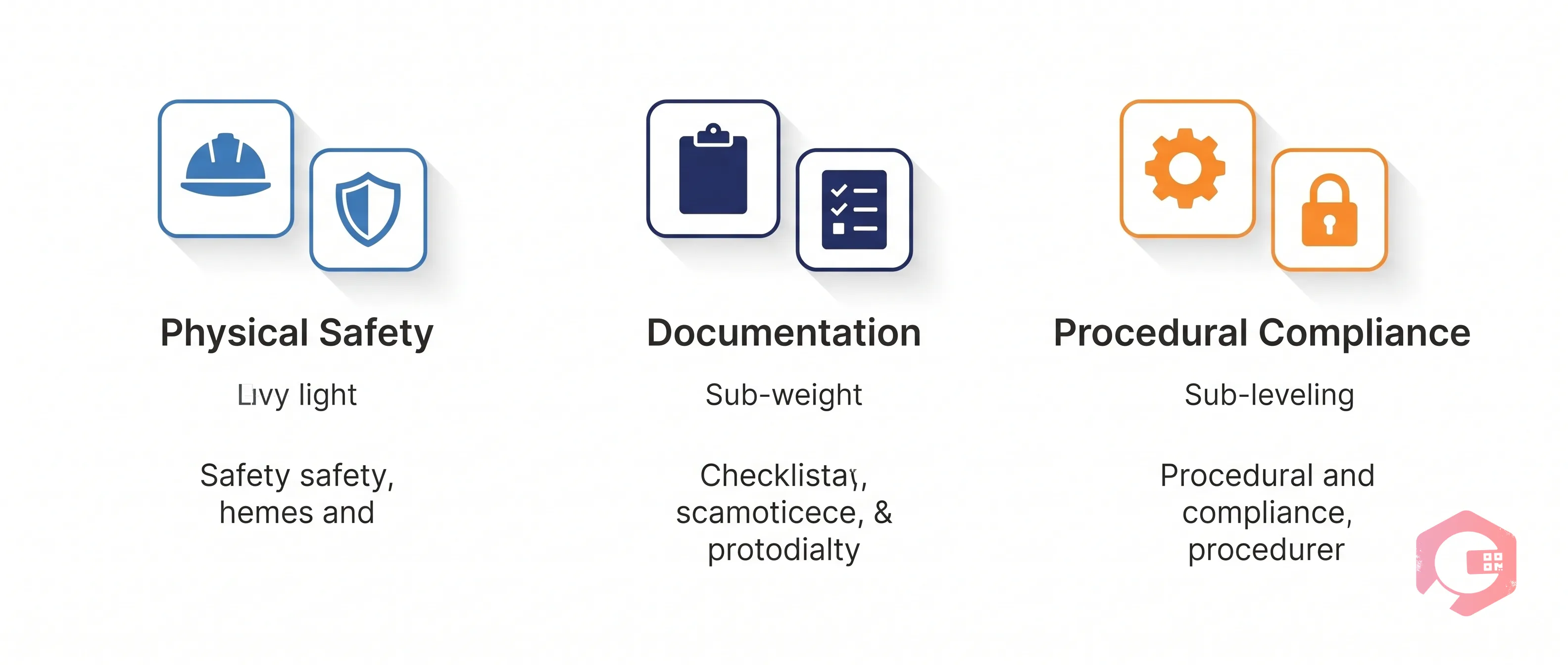
A mining compliance and safety audit is a structured review of a mine site's adherence to regulatory standards, internal safety policies, and equipment maintenance requirements. Audits assess whether the operation is meeting its obligations across three broad areas: physical safety (equipment condition, hazard controls, personal protective equipment), documentation (maintenance logs, inspection records, training certifications), and procedural compliance (lockout/tagout protocols, permit-to-work systems, emergency response plans).
Audits happen in two forms. External audits are conducted by government inspectors — primarily MSHA in the United States, or equivalent agencies internationally — who arrive unannounced or on a scheduled basis to verify compliance with applicable mining safety standards. Internal audits are self-assessments that mine operators run between external inspections to identify gaps and fix them proactively. Both types rely on the same evidence: maintenance records, work orders, inspection logs, and certification documentation.
Mining operations face several distinct categories of compliance review, and each targets a different layer of the operation.
Experienced MSHA inspectors and ISO auditors focus on the same fundamental question: can you prove that your operation is being maintained safely, and can you prove it with documented evidence? Specifically, they look for:
The most common citation reason in mining audits isn't a lack of safe practices — it's a lack of documented evidence that safe practices were followed. A mine site that does everything right but records it on paper that gets lost or damaged is just as exposed as one that doesn't follow the procedures at all.
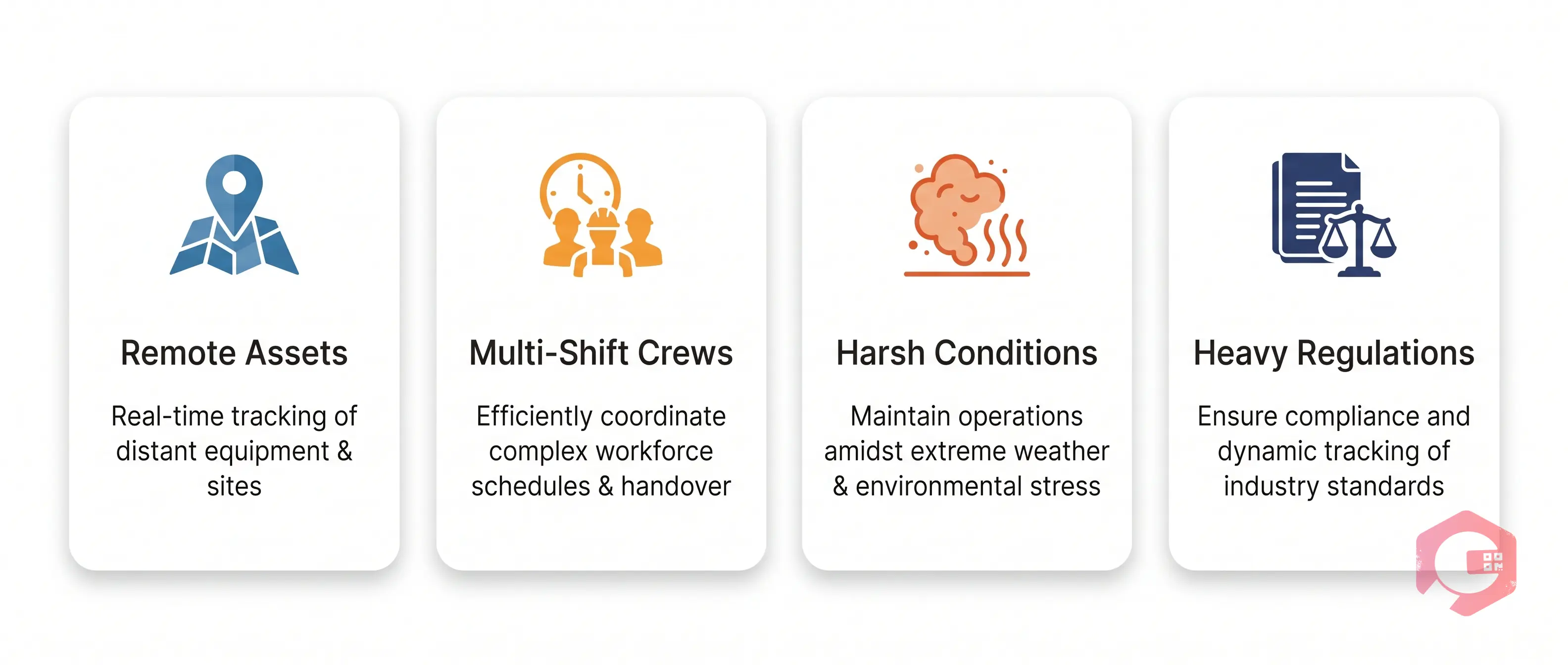
Mining operations are uniquely challenging environments for compliance management. Assets are spread across vast, often remote terrain. Crews work multiple shifts around the clock, creating handover gaps where critical information gets lost between teams. Equipment operates under extreme conditions — dust, vibration, chemical exposure, and temperature swings — that accelerate wear and create compliance risks that need to be caught early. And the regulatory burden is substantial: a single mine site may need to demonstrate compliance with dozens of separate standards simultaneously.
Non-compliance in mining carries consequences that go beyond regulatory fines. MSHA can issue a "withdrawal order" that shuts down part or all of a mine until a violation is corrected — a direct production loss that can dwarf the fine itself. Repeat violations trigger enhanced enforcement under MSHA's pattern-of-violations rules, which can result in mandatory program changes and heightened inspector scrutiny. And when a compliance failure contributes to a worker injury or fatality, the operational, legal, and reputational costs become catastrophic.
The National Institute for Occupational Safety and Health (NIOSH) estimates that equipment-related incidents account for approximately 40% of mining fatalities. A complete review of OSHA's control of hazardous energy standard also confirms that inadequate energy isolation procedures are among the leading causes of serious maintenance-related injuries across all industrial sectors including mining. Many of those incidents involve equipment that wasn't inspected on schedule, hazardous energy that wasn't properly isolated, or maintenance that wasn't completed as documented. All three are precisely what a CMMS is designed to prevent.
Paper-based compliance management fails mining operations in four critical ways:
These aren't minor inconveniences. They represent real operational risk, and they're the primary reason mining companies that operate without dedicated maintenance management software consistently underperform in compliance audits.
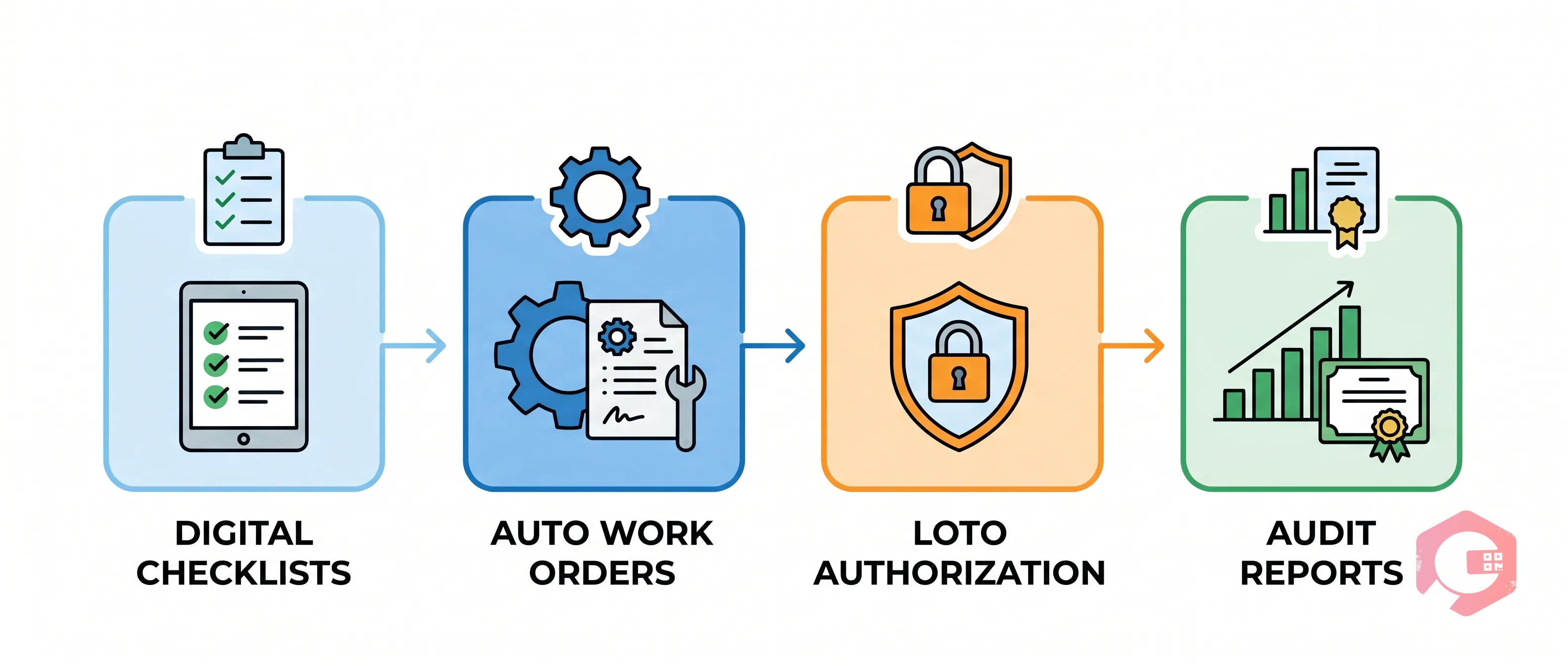
A CMMS transforms mining safety audits by creating an unbroken, searchable, digital record of every maintenance activity, safety check, and compliance action — automatically, as the work happens, without relying on anyone remembering to fill out the right form at the right time. When an auditor asks for 12 months of pre-shift inspection records for your haul trucks, a well-configured CMMS produces that report in under a minute. When an inspector asks whether the confined space entry permit for last Thursday's repair was properly authorized, every approval timestamp and digital signature is right there in the work order record.
The pre-shift inspection is the bedrock of MSHA compliance for mining equipment. Under 30 CFR standards, equipment including haul trucks, drill rigs, conveyor systems, and hoists must be inspected before each shift, with deficiencies recorded and corrected before operation. A CMMS replaces paper pre-shift forms with mobile digital checklists that technicians complete on their phones or tablets directly at the asset. Each checklist submission is timestamped and logged against the specific piece of equipment — creating an inspection record that is immutable, searchable, and immediately available for compliance review.
When a technician identifies a deficiency during a pre-shift check, the CMMS can automatically generate a corrective work order, assign it to the appropriate technician, and track it through to resolution. The auditor doesn't just see that a defect was found — they see exactly how quickly it was addressed and what was done to fix it.
Every work order created in a CMMS carries an automatic audit trail that includes who created the work order, when it was created, who it was assigned to, when work began, what was found, what was done, what parts were used, and when the job was closed. This level of documentation is exactly what auditors need to verify that maintenance is being performed as required — and it's generated automatically as part of the normal maintenance workflow, without any additional effort from the maintenance team.
For mining operations specifically, this audit trail extends to asset-level maintenance history. An inspector asking about the service history of a specific blast-hole drill can see every work order closed against that asset, every scheduled PM completed or deferred, and every part replaced — going back as far as the CMMS has been in use. This kind of transparency is simply not achievable with paper records.
Hazardous energy control — lockout/tagout (LOTO) — is one of the most heavily scrutinized areas in mining compliance audits. Any maintenance work on energized equipment requires formal energy isolation procedures, and MSHA inspectors will ask to see documentation proving that those procedures were followed for every relevant maintenance job. A CMMS with integrated Permit-to-Work (PTW) and LOTO workflows embeds the safety authorization process directly into the work order — a technician cannot mark a work order as complete without confirming that all LOTO steps were executed and documented.
This integration creates a compliance record that is far stronger than a paper sign-off, because the timestamps prove that the authorization happened before work began — not retroactively when an auditor asked for the records.
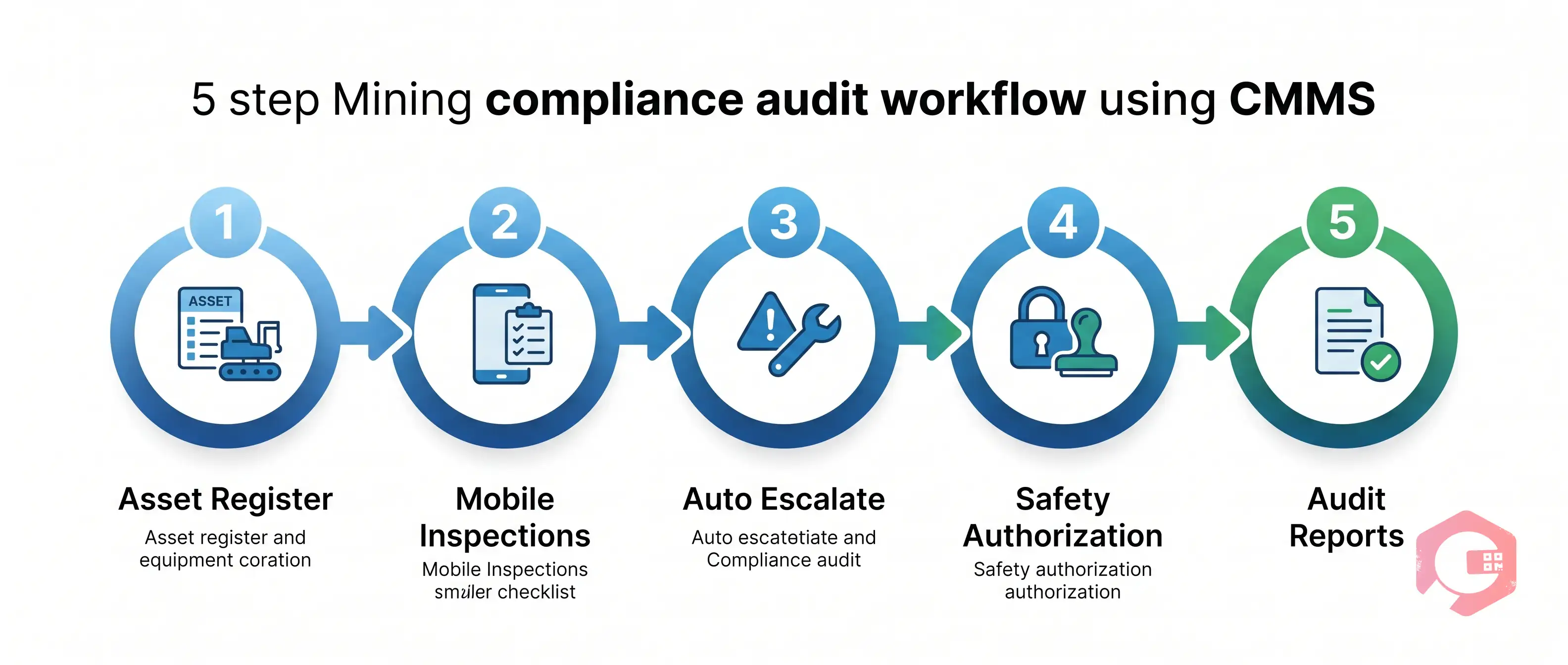
A CMMS doesn't just store compliance data — it actively structures the workflow that generates compliant operations in the first place. Here is how a mining operation uses CMMS software to stay audit-ready year-round, without scrambling before every inspection.
Start by registering every piece of mining equipment in the CMMS with its unique ID, location, manufacturer details, and applicable inspection requirements. Configure PM schedules that reflect the mandatory inspection intervals for each asset class — daily pre-shift checks for mobile equipment, weekly lubrication and structural checks for conveyors, monthly or quarterly deeper inspections for fixed plant. The CMMS automatically generates work orders for every scheduled task, so the compliance calendar runs itself and nothing is missed because someone forgot to schedule it.
Technicians receive inspection assignments on their mobile devices with step-by-step digital checklists tied to the specific asset and task. They complete the inspection at the machine — recording findings, attaching photos of any deficiencies, and confirming each checklist item — without leaving the field to fill in paper forms later. The CMMS captures a GPS-verified timestamp and the technician's digital signature at completion, creating proof that the inspection happened in the right place at the right time.
When an inspection flags a deficiency — a brake system anomaly, a structural crack on a bucket, a ventilation fan running below spec — the CMMS automatically generates a corrective work order, assigns it based on technician skill and availability, and tracks the deficiency from identification through resolution. The link between the inspection finding and the corrective action is permanent and searchable: an auditor can follow the chain from "defect found" to "defect corrected" in a single record.
For any work order involving hazardous energy, confined space entry, or other high-risk activities, the CMMS routes the job through the required safety authorization workflow — PTW approval, LOTO confirmation, gas testing results, or whatever the specific task requires. The system prevents the work order from being accepted by a technician until all authorizations are in place, and prevents it from being closed until all sign-offs are recorded. Every step is timestamped and tied to the authenticated identity of the person who completed it.
When an auditor arrives — or when your safety manager wants to run an internal compliance review — the CMMS generates filtered reports covering any asset, date range, inspection type, or compliance area in under a minute. Instead of spending days assembling evidence from multiple filing systems, your compliance team can produce a complete, professionally formatted evidence package almost instantly. This changes the audit experience from a stressful scramble to a confident demonstration of your operation's systematic compliance.

Mining operations navigate a complex regulatory landscape that varies by country, commodity type, and mine classification. Across all jurisdictions, however, the documentation requirements follow the same pattern: prove that hazards were identified, controls were implemented, maintenance was performed, and safety procedures were followed — every time, for every relevant task. A CMMS provides that proof automatically as part of normal operations.
The Mine Safety and Health Administration enforces mine safety standards under Title 30 of the Code of Federal Regulations. Key maintenance and compliance requirements include:
A CMMS supports MSHA compliance by maintaining the examination records that 30 CFR explicitly requires — timestamped, employee-identified, and tied to the specific equipment examined. When MSHA inspectors request examination records under 30 CFR 56.18002 or equivalent provisions, the CMMS produces them in a verifiable digital format that satisfies the record-keeping standards.
ISO 45001 requires organizations to establish, implement, and maintain processes for hazard identification, risk assessment, and control of operational activities — including maintenance activities. Specifically, it requires documented procedures for hazardous energy control, formal processes for managing contractors and their safety requirements, and evidence of management review of safety performance data. A CMMS provides the documented procedures through its PTW and LOTO workflows, manages contractor safety through work order assignment and authorization rules, and supports management review through its KPI dashboards and compliance reports.
Environmental audits at mine sites cover the maintenance of environmental control equipment including dust suppression systems, water treatment equipment, tailings storage facility monitoring instruments, and air quality monitoring stations. A CMMS tracks PM schedules and maintenance histories for these assets with the same rigor it applies to production equipment — ensuring that the maintenance records auditors need for environmental compliance are complete, accurate, and accessible.
The following checklist covers the core categories that MSHA inspectors and ISO 45001 auditors review most frequently. In a CMMS, each item becomes a configurable checklist field assigned to the relevant asset and inspection frequency. Use this as your baseline template and adjust for your specific mine type and applicable regulatory standards.
Cryotos CMMS is built for the operational demands of asset-heavy industries like mining — where equipment operates continuously, compliance requirements are stringent, and maintenance data needs to be both accurate and instantly accessible. Here is how the platform's core capabilities map directly to mining compliance audit requirements.
The work order management module creates a complete, timestamped record of every maintenance action — from initial request through technician assignment, parts usage, and final sign-off. Every work order is linked to a specific asset, so the maintenance history for any piece of mine equipment is complete and searchable at any time. When an MSHA inspector asks for the examination records for a specific haul truck over the past six months, Cryotos generates that report in seconds.
The preventive maintenance scheduling module supports both calendar-based and usage-based PM triggers — critical for mining equipment where wear rates depend on actual operating hours and production cycles, not just elapsed time. Cryotos supports complex "Either/Or" and "And" scheduling conditions so a haul truck can be scheduled for inspection both at 250-hour intervals and on the first of each month — whichever comes first — without anyone manually tracking the trigger conditions.
Built-in Permit to Work and LOTO workflows embed safety authorization directly into the work order lifecycle. A technician working on an energized conveyor drive cannot accept the work order, or close it, without completing the LOTO confirmation steps and attaching the required digital signatures. This makes compliance with MSHA's hazardous energy control standards a designed outcome, not a hoped-for one.
The Cryotos mobile app works fully offline — essential for underground mines and remote surface operations where cellular coverage is unreliable. Technicians can complete inspection checklists, log findings, attach photos, and confirm work order completions in dead zones, with all data syncing automatically when connectivity is restored. The inspection record is complete and unbroken regardless of where the work happened.
The asset management module maintains a full maintenance history for every asset, including warranty status, part replacement records, and failure patterns. Over time, this history enables predictive maintenance decisions — catching deteriorating components before they fail and create a compliance problem, rather than after. Mining companies using Cryotos report up to a 30% reduction in unplanned downtime and 25% faster repair times, which means fewer emergency breakdowns that disrupt compliance schedules and more time for planned, documented maintenance work.
Cryotos also integrates with IoT sensors, SCADA systems, and PLCs — allowing real-time condition data from mining equipment to flow directly into the maintenance workflow. When a vibration sensor on a crusher bearing crosses a threshold, Cryotos automatically generates a work order, assigns it to the relevant technician, and creates a documented response chain. This sensor-to-work-order trail is exactly the kind of evidence that demonstrates proactive compliance management to both MSHA inspectors and ISO auditors.
MSHA inspectors look for evidence that equipment has been examined before each shift and that deficiencies have been recorded and corrected. They also review training records for workers in safety-critical roles, hazardous energy control documentation (LOTO records), ventilation logs for underground operations, and evidence of corrective action on any previously cited violations. The most common citation reason is incomplete or missing documentation — not a lack of safe practices.
A CMMS helps with MSHA compliance by automatically capturing and storing the maintenance and inspection records that MSHA requires — timestamped, employee-identified, and tied to specific equipment. It enforces pre-shift inspection workflows via digital checklists, generates corrective work orders automatically when deficiencies are found, embeds LOTO authorization into work order workflows, and produces audit-ready reports on demand. This eliminates the documentation gaps that cause citations and turns compliance from a reactive scramble into a continuous operational standard.
Yes — and it improves on paper logs in every meaningful way. Digital inspection records are tamper-proof, timestamped, searchable, and accessible from anywhere with an internet connection. They can't be lost, damaged by water or dust, or retroactively altered. A CMMS with offline capability means technicians can complete digital inspections even in remote areas without network access, with records syncing automatically when connectivity is restored. Most mining operations find that digital inspection logs reduce compliance preparation time by 60–80% compared to paper-based systems.
A Permit to Work (PTW) in mining is a formal authorization that must be issued before any high-risk maintenance task begins — such as work on energized equipment, confined space entry, hot work in hazardous areas, or work at height on mine structures. A CMMS manages PTW by building the authorization workflow directly into the work order: the permit must be approved by the designated authority before a technician can start work, and the permit must be formally closed before the work order can be completed. Every approval, gas test result, LOTO confirmation, and sign-off is recorded with a timestamp, creating a compliance record that meets MSHA and ISO 45001 requirements.
Most mining safety management systems recommend monthly internal audits at a minimum, with targeted spot audits between formal reviews. Monthly audits give operations enough time to identify and correct deficiencies before the next MSHA inspection cycle, and provide a consistent data stream for tracking compliance trends. A CMMS makes monthly internal audits practical by automating the evidence collection — instead of spending a week gathering records, the audit team can focus on reviewing a CMMS-generated compliance report and conducting on-site verification of specific findings.
Mining compliance isn't a once-a-year event for your annual MSHA inspection — it's a daily operational discipline that either holds up under scrutiny or doesn't. Cryotos CMMS gives mining operations the digital infrastructure to make compliance the automatic result of good maintenance practice, not a separate project that competes for your team's time. From pre-shift inspection checklists on mobile to automated PTW workflows and on-demand audit reports, Cryotos keeps your compliance records complete, accurate, and ready whenever an inspector arrives. Explore Cryotos CMMS and see how mining teams are using it to cut downtime, pass audits confidently, and build a maintenance program that regulators can't fault.




Cryotos AI predicts failures, automates work orders, and simplifies maintenance—before problems slow you down.



