

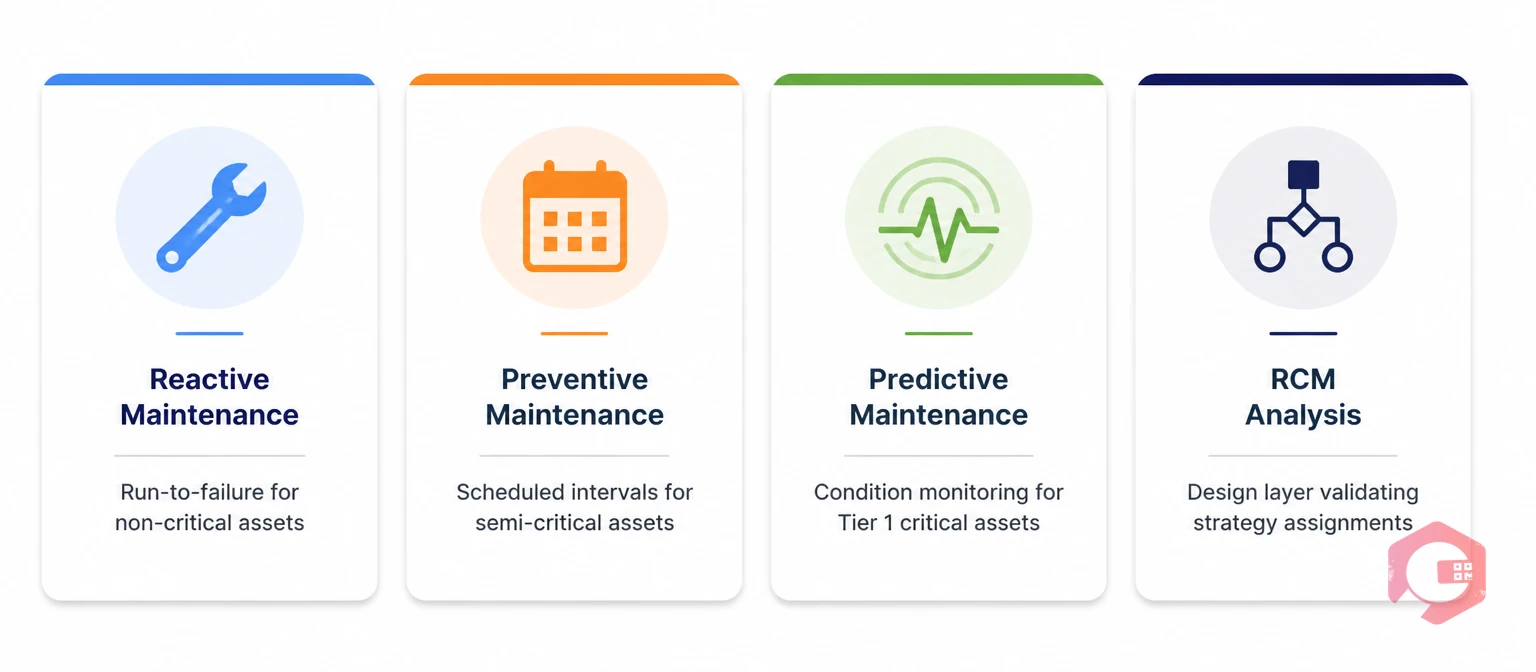
A mixed maintenance strategy is a deliberate combination of reactive, preventive, predictive, and reliability-centered maintenance (RCM) approaches applied across different assets based on their criticality, failure behavior, and cost profile. Rather than locking an entire facility into one methodology, a mixed strategy assigns the most cost-effective approach to each asset class — which is how the most efficient maintenance organizations in the world operate.
The case for blending is compelling. A McKinsey analysis found that companies using a hybrid maintenance model reduce overall maintenance costs by 10–25% while cutting unplanned downtime by up to 50%. No single strategy achieves this alone — reactive maintenance leaves critical assets unprotected, while applying predictive maintenance to every asset is economically unjustifiable.
The challenge most facilities face isn't knowing that a mixed strategy exists — it's knowing how to design one. This guide breaks down each strategy's role in the mix, when to use each one, and how to build a practical implementation roadmap your team can execute.
Each strategy in a mixed maintenance model serves a specific purpose. Understanding what each one does — and where it breaks down — is the starting point for building a blend that actually works.
Reactive maintenance means you repair an asset after it fails. In a mixed strategy, reactive maintenance is not a failure of planning — it's a deliberate choice for non-critical assets where failure has no safety consequence, production impact is negligible, and replacement or repair is fast and inexpensive. Examples include office equipment, backup lighting, and redundant hand tools. Attempting preventive maintenance on these assets wastes technician time without measurable return.
Time-based or usage-based preventive maintenance forms the operational backbone of most mixed strategies. It applies to semi-critical assets with predictable failure patterns — assets where OEM service intervals are well-established and where failure, while not catastrophic, disrupts production. HVAC systems, conveyor motors, lubrication schedules, and filter replacements all fit here. PM is cost-effective, schedulable, and manageable with existing technician skills.
Predictive maintenance uses real-time condition data — vibration analysis, thermal imaging, oil sampling, ultrasound — to detect developing failures before they occur. In a mixed strategy, PdM is reserved for Tier 1 critical assets where failure costs are high and failure modes are gradual and detectable. It delivers the highest ROI when layered on assets that already have PM schedules, adding early-warning capability without replacing the underlying scheduled maintenance. Cryotos supports this through IoT meter reading via SCADA and PLC integration, enabling real-time threshold monitoring across connected assets.
Reliability-centered maintenance (RCM) is not a day-to-day maintenance tactic — it's a structured analysis methodology used to determine the most appropriate maintenance strategy for each asset based on its failure modes, consequences, and detectability. In a mixed strategy, RCM analysis informs which assets belong in each tier and which specific PM tasks or monitoring points to prioritize. Think of RCM as the engineering logic that validates your strategy assignments rather than a separate operational track.
Understanding the trade-offs of each approach helps you make confident tier assignments and defend strategy decisions to leadership and operations teams.
| Strategy | Best For | Advantages | Disadvantages | Typical % of Asset Base |
|---|---|---|---|---|
| Reactive | Non-critical, easily replaced assets | Zero labor cost until failure; simple execution | Unpredictable timing; dangerous if misapplied to critical assets | 30–40% |
| Preventive | Semi-critical assets with predictable wear | Reduces unexpected failures; schedulable; well-understood by teams | Risk of over-maintenance; time-based intervals may not match actual wear | 40–50% |
| Predictive | Critical assets with detectable failure modes | Maximizes uptime; lowest lifecycle cost on high-value assets | High setup cost; requires sensor infrastructure and data maturity | 10–20% |
| RCM | Complex, high-consequence assets or systems | Scientifically validates strategy choices; reduces both over- and under-maintenance | Resource-intensive analysis; requires cross-functional expertise | 5–15% (analysis layer) |
These percentage ranges are industry benchmarks, not hard rules. Asset-heavy industries like oil and gas or power generation typically push more assets into the predictive tier, while facilities-heavy organizations may have a larger reactive base.
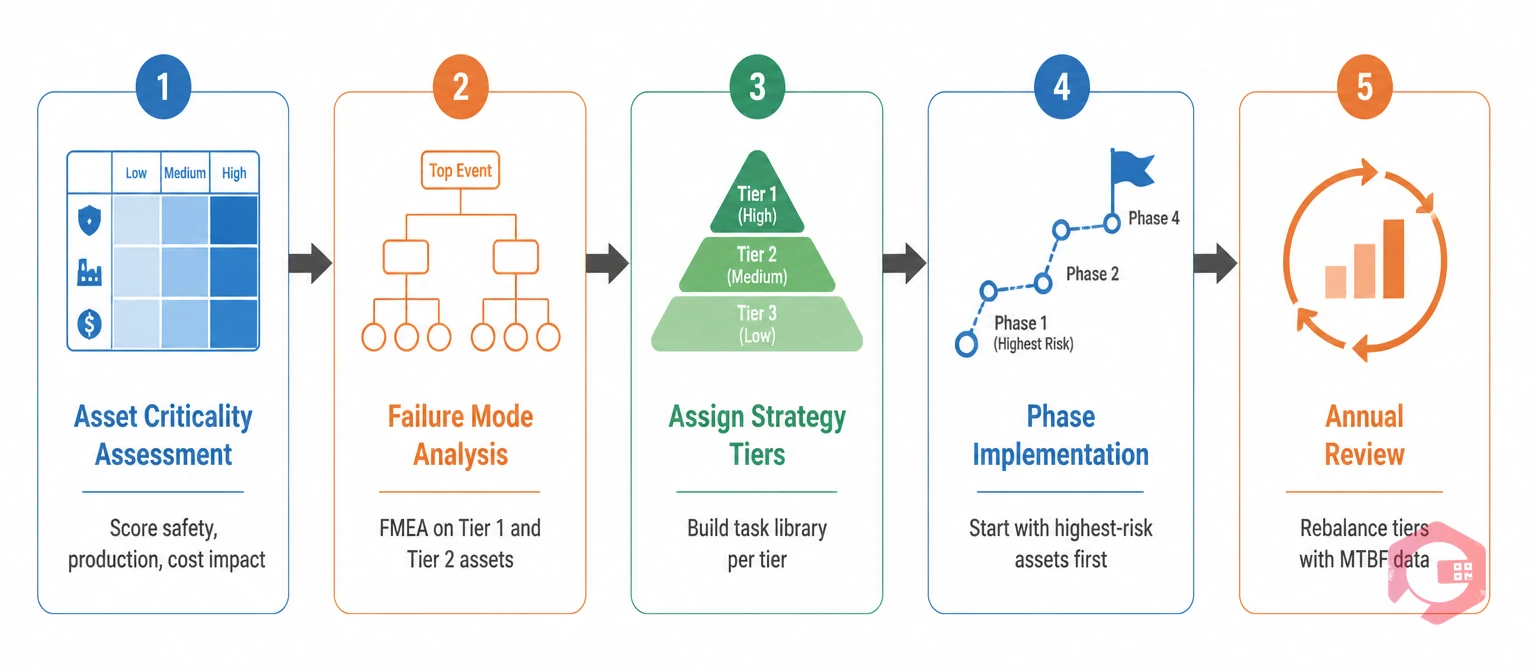
Building a mixed strategy is a structured process, not a one-time decision. Here's how to move from a default single-strategy approach to a deliberate, tiered model.
Every asset gets a criticality score based on its safety impact, production impact, quality consequence, regulatory exposure, and repair cost. This score determines which strategy tier the asset belongs in. Assets scoring high across multiple dimensions move to the predictive or RCM tier. Mid-range assets go to preventive. Low-scoring assets are candidates for intentional reactive. Use a consistent 1–5 scoring scale across all dimensions so comparisons are objective. Connect your asset data to a centralized asset tracking system so scores are visible and auditable.
For your critical and semi-critical assets, conduct a simplified FMEA (Failure Mode and Effects Analysis). Identify the top three to five failure modes per asset, their likelihood, their detectability, and their consequences. This analysis determines whether the right tool for each asset is a time-based PM interval, a condition monitoring trigger, or a deeper RCM study. Assets with age-related, predictable failure modes suit PM. Assets with sudden or gradual failure modes that are detectable by sensors suit CBM or PdM.
Map each asset to a strategy tier and build the corresponding maintenance task library. For PM assets, this means documented task lists with intervals, tools, and technician skill requirements. For PdM assets, it means defined sensor thresholds, alert protocols, and response procedures. For reactive assets, it means stocked spare parts and clear response workflows. Document everything in your maintenance checklists system so tasks are executable from day one without tribal knowledge dependency.
Don't try to overhaul your entire maintenance program at once. Start with Tier 1 assets — the ones where a failure event would cause the most damage. Get your predictive monitoring infrastructure in place for those assets first, then cascade PM schedule optimization down to Tier 2. Tier 3 reactive assignments can be formalized last, since they require the least implementation effort. A phased rollout allows your team to build competency and prove ROI before expanding scope.
A mixed strategy is a living document. Asset criticality changes as production volumes shift, equipment ages, and regulations evolve. Schedule an annual review to re-score assets, examine MTBF trends, and validate that each tier assignment is still delivering expected results. Assets that are generating repeat failures in the reactive tier likely need to move up to preventive. PdM assets generating no alerts over multiple years may be candidates for PM downgrade.
Use this reference table to quickly map your asset inventory to the correct strategy tier when building or reviewing your mixed maintenance program.
| Tier | Strategy | Criticality Score | Key Trigger | CMMS Action |
|---|---|---|---|---|
| Tier 1 — Critical | Predictive + RCM validation | 18–25 | Sensor threshold breach or RCM task due | Auto work order from IoT alert |
| Tier 2 — Semi-Critical | Preventive (time/usage-based) | 11–17 | Calendar interval or meter reading | Scheduled PM work order |
| Tier 3 — Non-Critical | Reactive (run-to-failure) | 5–10 | Operator-reported failure | QR code work request |
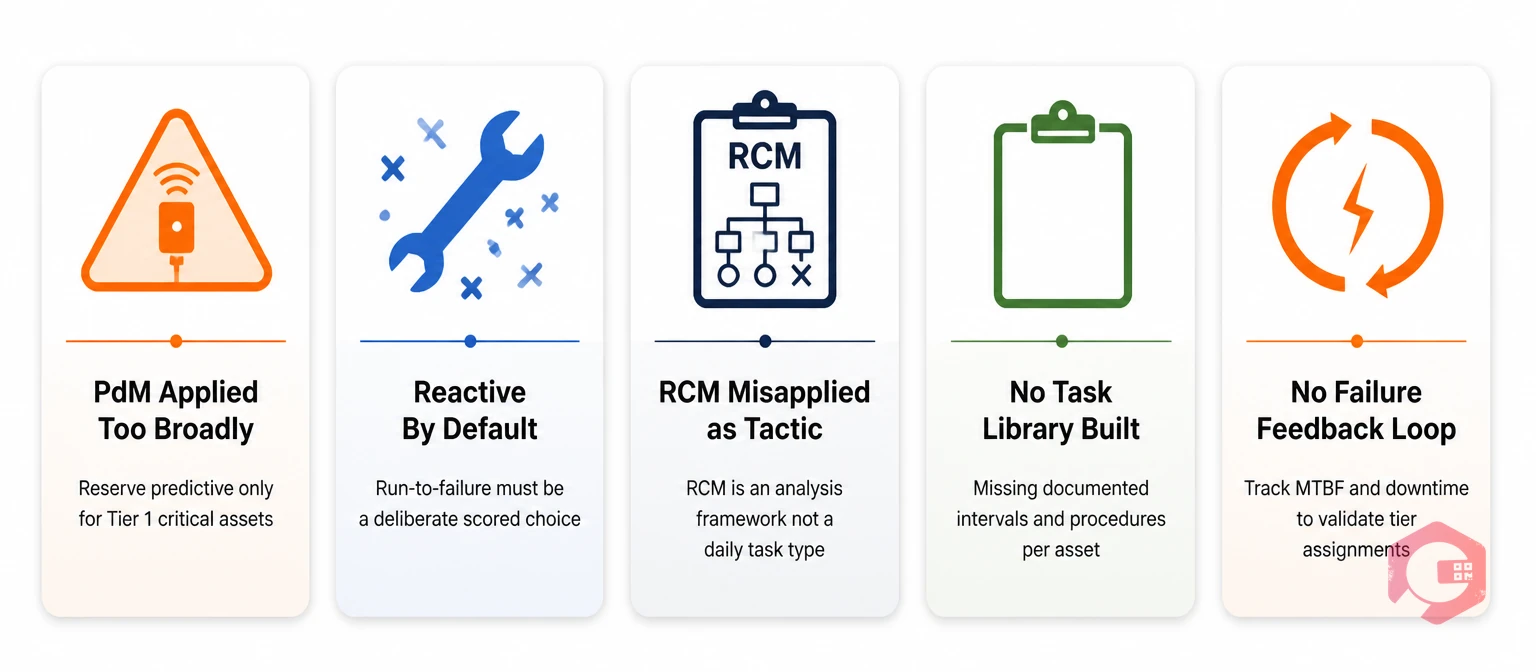
Most facilities that attempt a mixed strategy make predictable errors in the transition. Knowing these in advance prevents costly backtracking.
The hardest part of running a mixed maintenance strategy isn't designing it — it's executing four different maintenance approaches in parallel without letting any tier fall through the cracks. Cryotos CMMS is built to support all tiers simultaneously from a single platform.
For Tier 1 predictive assets, Cryotos connects to IoT sensors via SCADA and PLC integration, triggering automated work orders the moment a monitored value crosses a defined threshold. Technicians receive real-time alerts via mobile, email, or WhatsApp — no manual monitoring required. For Tier 2 preventive assets, the preventive maintenance scheduler handles both calendar-based and usage-based triggers, with drag-and-drop rescheduling and automatic escalation for overdue tasks. For Tier 3 reactive assets, QR-code work requests let any operator report a failure from the floor in seconds, routing it instantly to the right technician.
The BI dashboard gives maintenance managers a live view of performance across all tiers — tracking MTBF, MTTR, OEE, and downtime by asset, department, or facility. This is the feedback loop that keeps your mixed strategy calibrated over time. Teams using Cryotos report 30% downtime reduction and 25% faster repair times — results that come directly from having the right strategy applied to the right asset, consistently executed.
See how this works in a real manufacturing environment at Metro Tyres' Cryotos implementation, where a tiered maintenance approach across critical and semi-critical assets drove measurable reliability improvements across their production lines.
Industry benchmarks suggest 30–40% reactive, 40–50% preventive, 10–20% predictive, and 5–15% under active RCM analysis. These are starting points, not fixed targets — the right split depends on your industry, asset complexity, and how critical uptime is to your operations.
Yes. Even a two-tier approach — intentional reactive for low-criticality assets and scheduled PM for everything else — is a mixed strategy. You don't need IoT infrastructure or RCM studies to start blending. Assign criticality scores to your top 20 assets and apply PM schedules to those that matter most. That alone outperforms a uniform approach.
RCM is the analytical layer that validates strategy assignments. Run RCM analysis on your most complex, highest-consequence assets to confirm that your PM intervals and PdM monitoring points are targeting the right failure modes. For the majority of your asset base, a simplified criticality assessment and FMEA achieves the same outcome faster.
The biggest risk is inconsistent execution — having a well-designed mixed strategy on paper that breaks down operationally because technicians don't know which tasks apply to which assets, or because no system tracks compliance across all tiers. A CMMS that supports all strategy types from a single platform is essential for making blending work at scale.
Trigger a tier reassessment when: an asset generates repeat failures in the reactive tier, when production volumes increase an asset's criticality, when OEM warranty or compliance requirements change, or when annual MTBF data shows a trend diverging from the expected failure pattern. Tier assignments should always reflect current operating reality, not the initial scoring from years ago.
Building a mixed maintenance strategy is the highest-leverage move a maintenance leader can make — it stops the waste of over-maintaining low-risk assets and the risk of under-protecting critical ones. With the right criticality framework, clear tier assignments, and a CMMS that executes all four strategy types in parallel, your team can deliver more reliability with less reactive firefighting. Cryotos asset maintenance management software gives you the platform to design, execute, and continuously improve your mixed maintenance strategy — across every asset, every shift, every site.



Cryotos AI predicts failures, automates work orders, and simplifies maintenance—before problems slow you down.



