
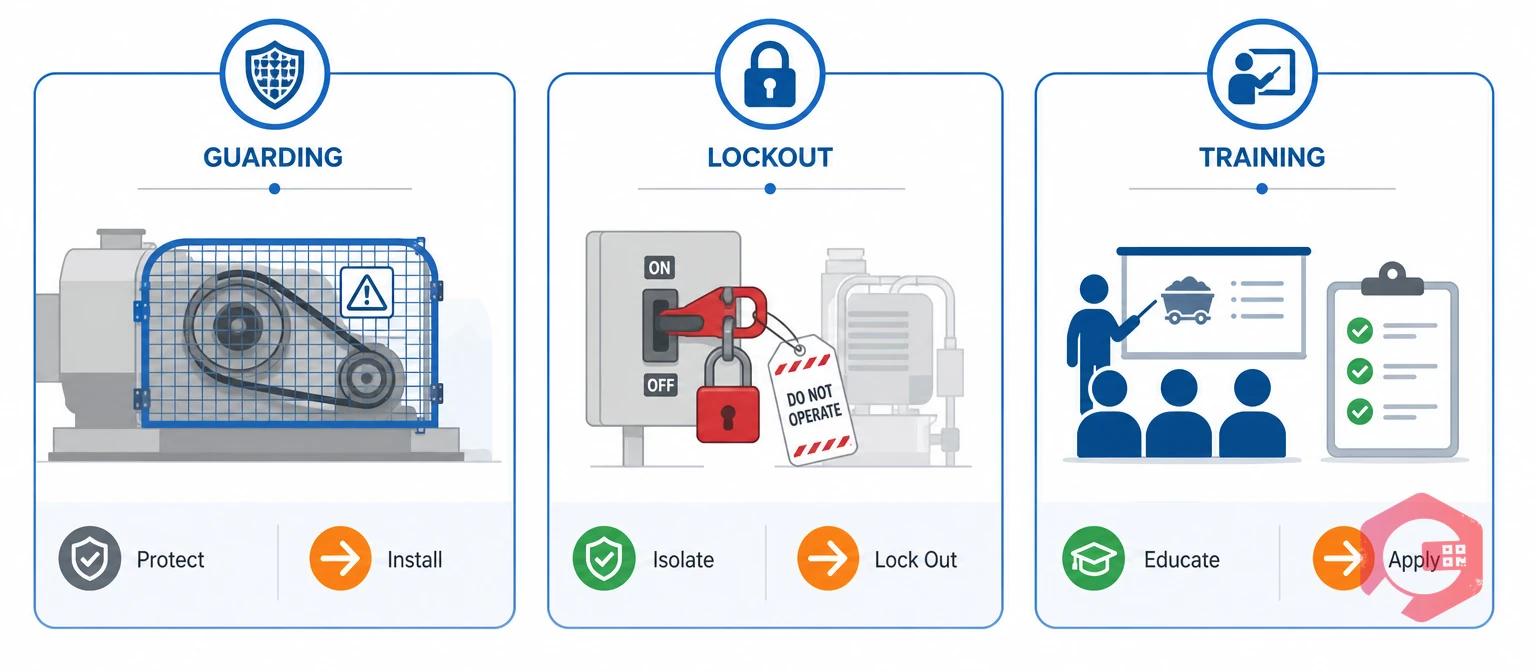
MSHA requirements for mine maintenance fall into three groups: guarding, lockout and training. Moving parts must be guarded and the guards kept in place. Repairs start only after power is off and the machine is blocked against hazardous motion. Everyone doing the work needs the training that 30 CFR Part 46 or Part 48 requires.
Which of these MSHA requirements applies depends on the mine type. This guide maps each rule to the maintenance job it governs, shows where MSHA differs from OSHA, and explains how a maintenance team can prove compliance on every work order.
Key Takeaways
MSHA requirements for mine maintenance are the federal rules in Title 30 of the Code of Federal Regulations that govern how repairs and servicing are done at a mine. Mine sites answer to MSHA rather than OSHA, so the OSHA lockout standard, 29 CFR 1910.147, is not the rule an MSHA inspector cites.
The part that applies depends on the mine:
Most maintenance teams will not find one "maintenance standard" in these parts. The rules sit in separate sections for guarding, electrical work, mechanical repairs and training. The matrix below pulls these MSHA requirements together.
Use this matrix to match each task to the rule behind it. It shows surface metal and nonmetal (Part 56) and underground coal (Part 75). Part 57 carries matching sections for many of the Part 56 rules.
| Maintenance task | What the rule requires | Surface metal/nonmetal | Underground coal |
|---|---|---|---|
| Repair or service a machine | Power off and equipment blocked against hazardous motion | §56.14105 | §75.1725(c) |
| Work near moving parts | Guard gears, pulleys, shafts, couplings and fan blades | §56.14107 | §75.1722(a) |
| Run a machine after repair | Guards secured in place, except for testing or adjusting | §56.14112(b) | §75.1722(c) |
| Electrical work | De-energize and lock out; only the installer or authorized person removes locks | §56.12016, §56.12017 | §75.511 |
| Work under raised equipment | Block or mechanically secure before anyone works under it | §56.14211 | - |
| Equipment with a safety defect | Correct defects promptly and remove hazardous items from service | §56.14100 | §75.1725(a) |
Always read the current text for your mine type before you write a procedure around it.
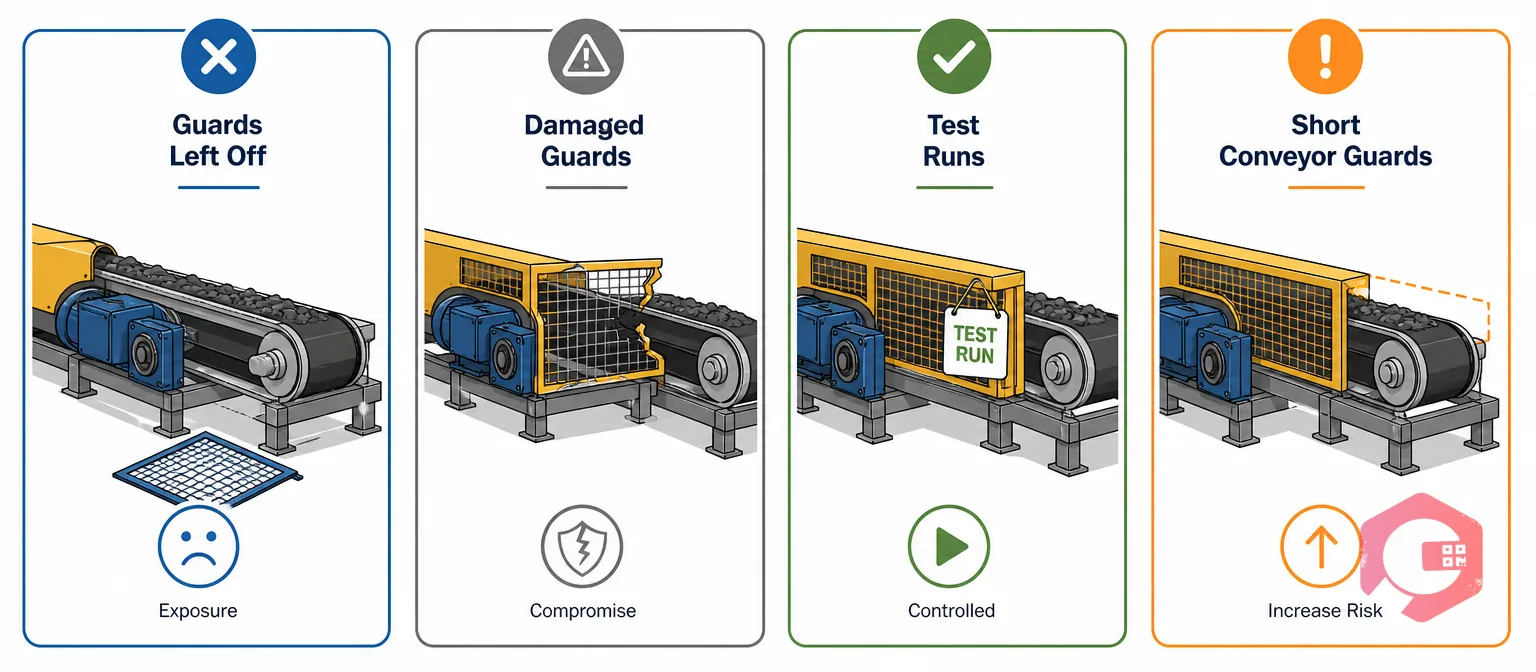
A guard is a physical barrier that keeps a person from touching moving machine parts. 30 CFR 56.14107 requires guards on gears, sprockets, chains, drive, head, tail and takeup pulleys, flywheels, couplings, shafts and fan blades. Guards are not required where exposed parts are at least seven feet from walking or working surfaces.
Section 56.14112 adds two rules. Guards must withstand vibration, shock and wear without creating a hazard. They must also be securely in place while the machine runs, except for testing or adjusting that cannot be done with the guard on.
Guarding fails at handback, so a job is not closed until someone verifies the guards.
Build that check into every job close-out with the free safety compliance checklist.
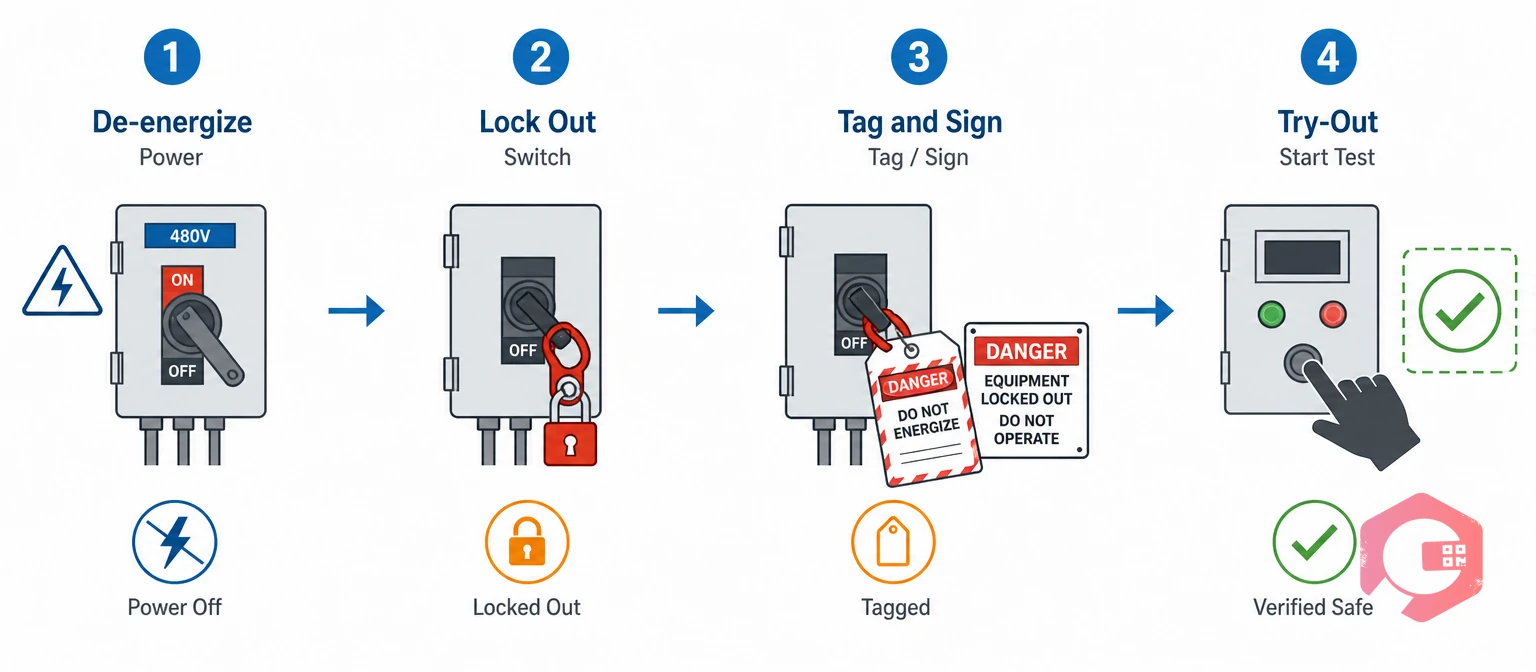
Hazardous motion is any movement of machinery that could injure a person working on or near it. Under 30 CFR 56.14105, repairs happen only after power is off and the machine is blocked against hazardous motion. Motion for testing or adjusting is allowed only when people are effectively protected.
Not as a single standard. The MSHA requirements cited here do not spell out personal locks for every worker or a written energy-control program. Those are best practice. MSHA's Lock-Tag-Try hazard alert lists them, and it reports that 28 metal and nonmetal miners had died since 2005 in electrical and machinery accidents where power was not locked out first.
Maintenance teams usually adopt personal locks and written procedures anyway, because both make the rules easy to prove. Add a try-out: with everyone clear, attempt a start. A lockout tagout step is not finished until the try-out fails.
Block as well as lock. Section 56.14211 requires raised equipment and components to be blocked or mechanically secured before anyone works on top of or under them.
MSHA requirements for training follow the mine, not the trade. Part 46 covers shell dredging, sand, gravel, surface stone, surface clay, colloidal phosphate and surface limestone mines. Part 48 covers underground mines and other surface mines. Part 46 defines mining operations to include maintenance and repair of mining equipment.
| Training | Part 46 mines | Part 48 surface mines | Part 48 underground mines |
|---|---|---|---|
| New miner | 24 hours (§46.5) | 24 hours (§48.25) | 40 hours (§48.5) |
| Annual refresher | 8 hours (§46.8) | 8 hours (§48.28) | 8 hours (§48.8) |
| Training certificate | MSHA Form 5000-23 or equivalent (§46.9) | MSHA Form 5000-23 (§48.29) | MSHA Form 5000-23 |
New task training is instruction in the health and safety aspects of a job a miner has not done before. Part 46 requires it before the miner starts the task. It is not required when the miner has done a similar task and can show safe performance.
MSHA's training pages explain the rules and the training plan each operator must keep.
The rules are clear on paper. The hard part is proving, job after job and shift after shift, that power was off, guards went back and trained people did the work. Paper permits, separate lockout logs and spreadsheets of certificates leave gaps between systems.
South Jeddah Solar Plant, a Cryotos customer, shows the pattern. Its major safety challenge was managing high-risk work such as electrical tasks, excavation, hot work and work at height, while keeping lockout, PPE use and hazard identification consistent on every job. A solar plant is not a mine and MSHA does not regulate it, but the control-of-work problem is the same one mine maintenance teams face.
The plant runs its permits in Cryotos, a Computerized Maintenance Management System (CMMS):
Cryotos reports improved safety and compliance at the plant but has not published figures, so treat the result as qualitative.
A permit to work is a written or digital sign-off that sets the hazards, controls and people for one high-risk job. Picture one for a conveyor idler change. This is an illustrative scenario, not a client story. The technician scans the asset QR code, and the work order opens a permit and lockout checklist through permit to work software. The permit cannot activate until isolation is confirmed. Photos of the lockout points stay on the job for the next shift, and the guard check is a required close-out step in work order management.
The mobile app works offline in poor coverage and syncs later, which suits a CMMS for drilling and mining operation. Maintenance teams using Cryotos have reported up to 30% reduction in unplanned downtime and 25% faster repair turnaround.
Cryotos supports the records. It does not replace your MSHA training plan, your Form 5000-23 certificates or a competent person's judgment.
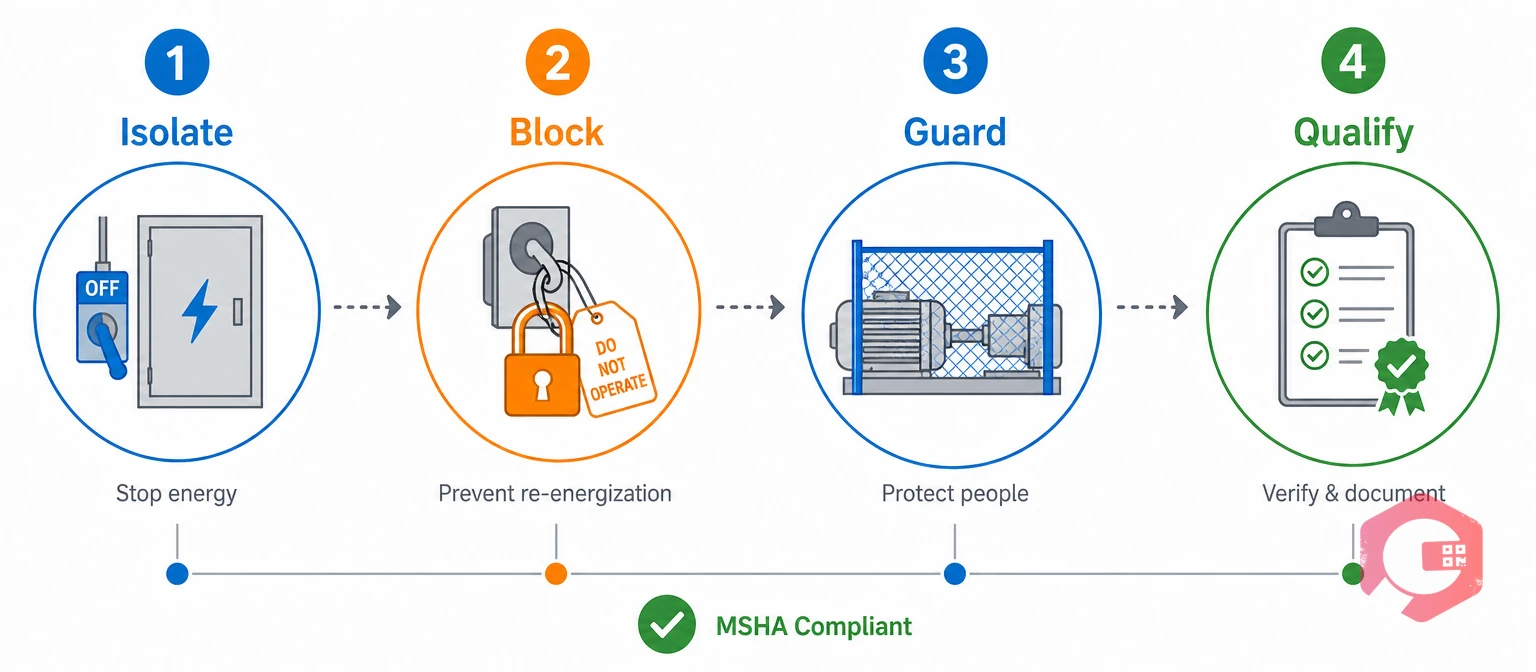
The Four-Rung MSHA Maintenance Compliance Ladder:
Climb the rungs in order and record each one on the work order. A missed rung is how a routine repair becomes a citation or an injury.
No. MSHA regulates mines, so inspectors cite MSHA standards such as 30 CFR 56.14105 and 56.12016 instead of 29 CFR 1910.147. The OSHA standard is still a useful model for writing procedures.
Yes, when they work at the site regularly. Part 46 counts them as miners. Occasional service workers need site-specific hazard awareness training before exposure. Check your training plan for Part 48 mines.
Yes. Guards can come off for repairs once power is off and the machine is blocked. While the machine runs, guards must be in place, except for testing or adjusting that cannot be done with the guard on.
At Part 46 mines, keep records during employment, keep refresher records for two years, and keep records at least 60 days after a miner leaves. Part 48 has its own retention rule in §48.29.
Compliance holds when every job can prove it. Schedule a free demo to see how Cryotos links permits, lockout checks and records to each work order, so your team can show it meets MSHA requirements.


Cryotos AI predicts failures, automates work orders, and simplifies maintenance—before problems slow you down.



