

Multi-location facility management is the practice of overseeing buildings, assets, maintenance teams, and compliance across two or more physical sites from a single system. Done well, it gives you real-time visibility across your entire portfolio — without relying on end-of-day reports, phone calls, or on-site visits to know what's actually happening. According to the International Facility Management Association (IFMA), organizations that centralize facility data report up to 40% faster response times and significantly lower reactive maintenance costs compared to those managing sites independently.
Managing one facility is demanding. Managing ten is a different challenge entirely — data lives in silos, processes vary from site to site, compliance gaps go unnoticed until an auditor arrives, and most teams are held together by tools that were never built for this scale. This guide breaks down those challenges and shows you exactly what it takes to run a consistent, visible operation across every location you manage.
Key Takeaways

Managing multiple facilities isn't just the same job multiplied — the challenges are qualitatively different. When you run a single building, you're close to everything: you know the assets, the team, and you can walk to the floor. Problems surface quickly. Scale that to ten or twenty locations and every part of that breaks down.
You can't walk the floor anymore. You depend on other people to flag issues — and they don't always do that consistently. One site manager logs everything meticulously. Another treats the system like optional paperwork. A third uses their own shorthand that no one outside that building understands. The result is a portfolio that looks fine on the surface but has no real visibility underneath.
You can't compare maintenance costs across buildings because the data isn't collected the same way. Compliance gaps accumulate quietly until an auditor or a breakdown forces them into the open. The problem isn't effort — it's the absence of a common system tying everything together. Most facility management software teams face three structural problems at scale: inconsistent processes, fragmented data, and no cross-site visibility.
Before deciding how to structure your operations, it helps to understand what you're choosing between. Most multi-site portfolios fall somewhere on a spectrum between fully centralised control and fully decentralised autonomy.
Most high-performing multi-site portfolios choose a hybrid: centralised standards and reporting with enough local flexibility for site-specific conditions. A multiple organization management platform makes this practical — you set the rules once at the portfolio level, and each site operates within that framework.

Before any centralized system is in place, getting a clear picture of the portfolio means gathering reports from individual site managers, chasing follow-ups, and manually stitching together data from tools that don't talk to each other. By the time you have a complete view, it's already out of date.
The right CMMS changes that. Every work order, asset, and scheduled maintenance task — across all sites — lives on one platform. The dashboard is live, not a compiled report. You can filter by location, asset type, or priority and instantly see which sites have work orders ageing past SLA and which assets are generating the most unplanned calls. For a facility manager responsible for multiple buildings, this alone changes how the job feels: instead of spending mornings chasing updates, you already have them.
Real-time visibility also changes how you handle escalations. Instead of waiting for a site manager to flag a problem, the system surfaces it automatically — open work orders past due, PM tasks slipping, assets approaching service thresholds. You can act before the situation becomes critical.
One of the biggest hidden costs in multi-location facility management is inconsistency. When every site raises work orders differently, classifies assets differently, and logs maintenance differently, the data looks like it belongs to ten separate companies — not one portfolio.
A centralized platform lets you set the standard once and apply it everywhere. Preventive maintenance schedules become templates pushed across all sites at once. Your HVAC inspection checklist is the same in every building. Fire safety walkthroughs follow the same steps whether they're happening in Chennai or Bengaluru. Technicians all work from the same work order management format and close tasks the same way.
This isn't just about cleaner reports. It's about ensuring the quality of your maintenance program doesn't vary depending on which building you walk into. Tenants, leadership, and auditors should experience the same operational standard at every location. Consistency also makes training faster — new technicians at any site learn one system, not a local variation.
In a multi-location setup, preventive maintenance is the first thing to slip when things get busy. A site gets short-staffed. A reactive breakdown pulls the team away from scheduled work. A PM task gets pushed back a week — then another — until it simply doesn't happen. Scale that across ten locations and you start accumulating deferred maintenance: work that should have been done but wasn't.
Deferred maintenance accelerates asset wear, raises failure probability, and creates compliance risk. According to a Facilities Net industry analysis, deferred maintenance costs organizations 3 to 5 times more when addressed reactively than when caught on schedule.
With Cryotos preventive maintenance software, PM tasks are scheduled in the system and automatically generate work orders when due. If a task isn't completed on time, it stays visible, escalates, and the manager sees it — nothing gets quietly buried. You know which sites are keeping up with their PM schedules and which are falling behind before a breakdown tells you.
You can also use the facility inspection checklist templates to standardize what gets inspected at each site and ensure nothing is missed during routine walkthroughs.
Compliance obligations don't pause because you're stretched across multiple sites. Fire safety inspections, electrical certifications, lift maintenance records — each asset has its own schedule, and keeping track across buildings is genuinely hard without a dedicated system.
In Cryotos, every compliance task is tied to a specific asset at a specific site — with a due date, a responsible technician, and a complete record of what was done. The system flags upcoming renewals in advance, not after they've lapsed. When an auditor walks in, your records are already organized and timestamped. You're not compiling them under pressure.
The same logic applies to asset tracking across a large portfolio. Buildings can involve thousands of assets — HVAC units, elevators, generators, pumps, electrical panels — each with its own service history and warranty. Without a centralized system, that information lives in spreadsheets, in the memory of a senior technician, or in a filing cabinet nobody opens until something breaks. A digital asset register puts all of it in one place, accessible to anyone on the team, at any site, at any time.
It also surfaces patterns. If a particular pump type generates a disproportionate number of work orders across three sites, that shows up in your data. You can act proactively — not reactively.
One of the most underrated benefits of running all your locations on a single platform is what it does for decision-making — both day-to-day and long-term. When data is unified, reports are actually meaningful.
You can compare maintenance costs per site year over year. You can identify assets approaching end of useful life based on repair frequency. You can track which locations have the strongest PM compliance rates and understand what they're doing differently. And you can build a credible case for capital investment backed by real numbers — not estimates. The BI dashboard in Cryotos gives portfolio managers exactly this: OEE, availability, PM compliance, and work order trends across every site, filterable by location or asset type.
According to McKinsey's operational efficiency research, companies that apply structured facility data management see a 10–25% reduction in overall maintenance costs and a 20–30% improvement in asset uptime. The data was always there — the right system just makes it legible and actionable.
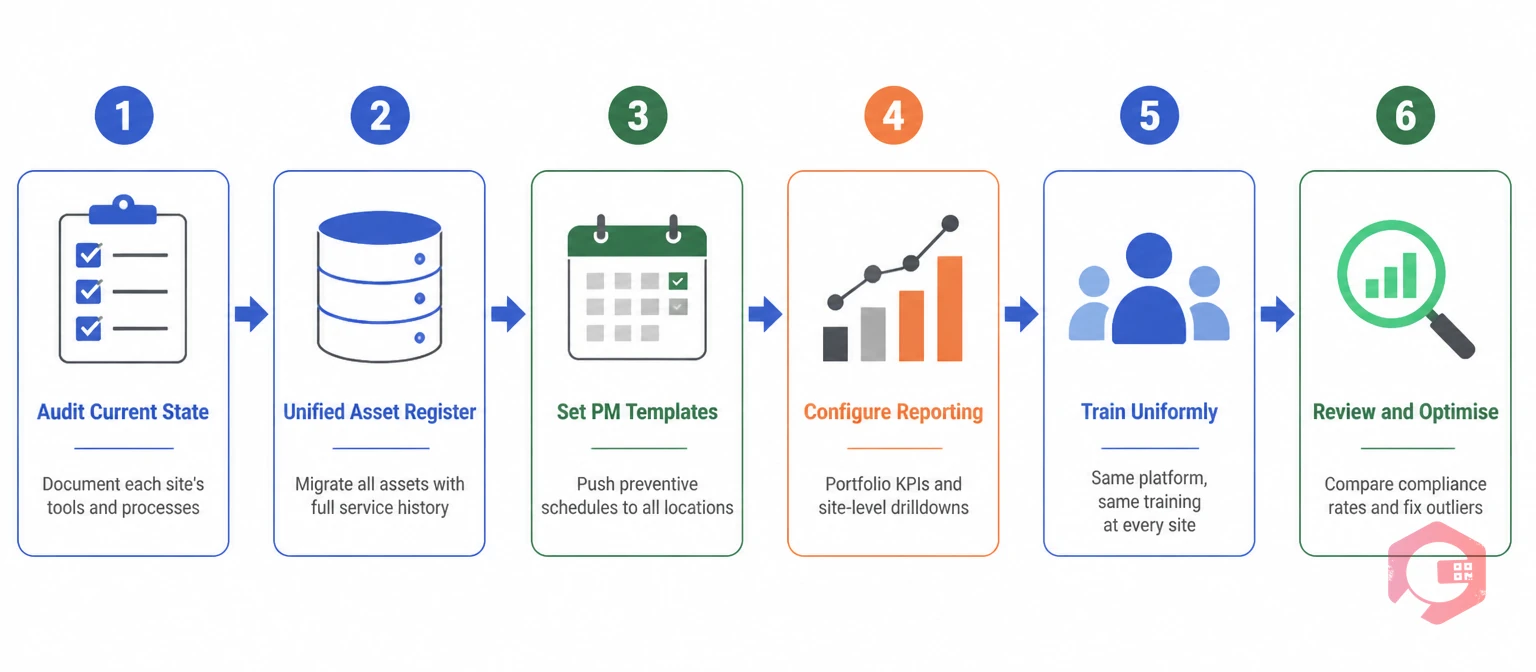
If you're starting from scratch or consolidating disconnected site tools, here's a practical sequence that works for portfolios of any size:
It's the practice of overseeing buildings, assets, maintenance teams, and compliance across two or more physical sites. The central challenge is maintaining consistent standards and real-time visibility when your team and responsibilities are spread across different locations — often with different legacy tools and processes at each site.
Inconsistent processes across sites, lack of real-time visibility, difficulty tracking compliance across different assets and schedules, and fragmented data that makes meaningful reporting impossible. These are structural problems that spreadsheets and disconnected tools can't solve on their own.
A CAFM software platform centralizes work orders, asset records, preventive maintenance schedules, and compliance documentation across all your sites on one platform. Instead of managing separate systems per location, everything is visible from a single dashboard in real time — and your team follows the same processes everywhere.
Tie every compliance task to a specific asset at a specific site, with due dates, responsible technicians, and a full audit trail. The system should alert you to upcoming renewals before they lapse — not after. Cryotos handles this automatically, so your records are always audit-ready without last-minute scrambles.
At minimum: PM compliance rate per site, open and overdue work orders by location, asset downtime frequency, and maintenance cost per building. These four metrics together give you a clear picture of where each site stands — and where to focus attention next. The facility maintenance software in Cryotos surfaces all of these in real time without manual compilation.
Managing facilities across multiple locations will always be demanding — but it doesn't have to feel like controlled chaos. When your teams work from one system, follow the same processes, and produce data you can actually act on, the job shifts from reactive firefighting to running a real operation. Schedule a free demo with Cryotos and let's start with your most complex site.


Cryotos AI predicts failures, automates work orders, and simplifies maintenance—before problems slow you down.



