

A near miss is an unplanned event that did not cause injury or damage but had the potential to do so. An incident is any unplanned event that disrupts normal operations or results in a minor injury, illness, or property damage. An accident is an unplanned event that causes actual injury, fatality, or significant property damage. Understanding where each event falls on this spectrum — and knowing exactly when each must be reported — is the foundation of any effective workplace safety programme. Organisations that track all three correctly give themselves the earliest possible warning of systemic hazards before they escalate into serious harm. A Computerized Maintenance Management System that captures these events digitally and links them directly to corrective work orders turns raw safety data into measurable risk reduction. This guide covers the full near miss vs incident vs accident spectrum — definitions, real-world examples, and the exact reporting thresholds that apply to each.
Key Takeaways
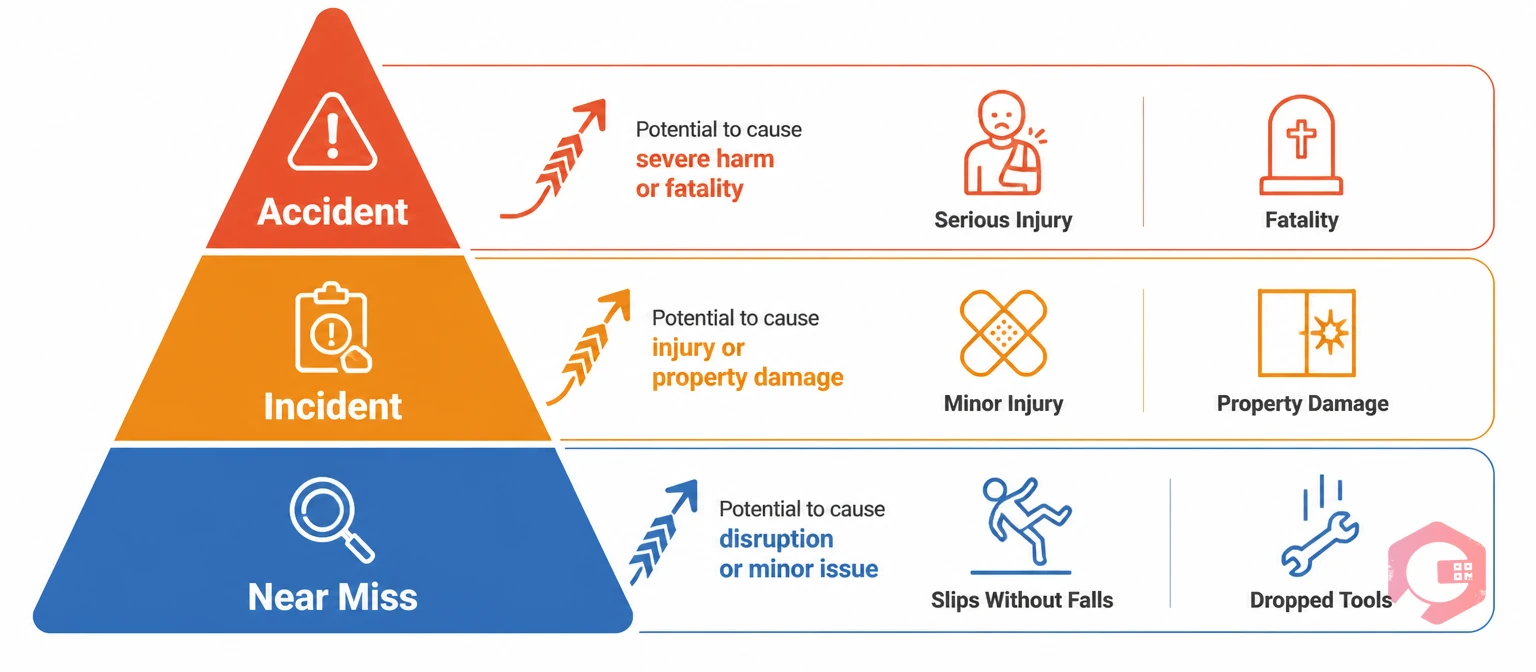
A near miss is an unplanned, undesired event that, under slightly different circumstances, could have resulted in injury, illness, or damage — but did not. The term is sometimes written as "near-miss" or "close call", and the meaning is identical. Safety professionals treat near misses as free lessons: the hazard revealed itself without costing anyone harm.
According to OSHA's guidelines on near misses, these events are significantly underreported because workers often dismiss them as "lucky breaks" rather than warning signals. That culture of dismissal is precisely what makes near-miss reporting programmes so critical — and so difficult to sustain without a structured system.
Near miss definition: an unplanned event with no injury, illness, or property damage outcome, but with the realistic potential for such harm if conditions had been even slightly different. The key criterion is potential, not outcome. A forklift that passes within inches of a pedestrian who was not in the designated walkway is a near miss — no one was hurt, but the hazard was real.
Understanding the distinction in near miss vs incident vs accident reporting starts with understanding why near misses go unreported in the first place. Research consistently shows that workers fear blame, don't believe reporting will lead to change, or simply don't recognise the event as reportable. A 2019 study found that facilities with anonymous or no-blame near-miss reporting systems captured up to 8x more near-miss events than those with traditional supervisor-based reporting. Volume matters: the more near misses you capture, the more leading-indicator data you have to act on before an incident or accident occurs.
Herbert William Heinrich's foundational research — commonly presented as Heinrich's Triangle — showed that for every major injury in the workplace, there are approximately 29 minor injuries and 300 near misses sharing the same root causes. This ratio, while debated in its precise numbers by modern researchers, has been validated in direction by decades of industrial safety data: near misses vastly outnumber serious accidents, and they share the same systemic failures.
Maintenance teams that capture near-miss data systematically gain a leading indicator — a signal of risk before harm occurs. Reactive safety programmes, by contrast, learn only from the 1 serious injury, ignoring the 299 warnings that preceded it.

A safety incident is any unplanned event in the workplace that results in, or has the potential to result in, injury, illness, or property damage. Under this broad definition, incidents include near misses — though in everyday operations, most safety teams use "incident" to refer specifically to events where some minor harm or disruption has already occurred. ISO 45001:2018, the international standard for occupational health and safety management systems, defines an incident as a "work-related event(s) in which injury or ill health (regardless of severity) occurs or could have occurred."
Incident definition: an unplanned workplace event that has already caused a disruption, minor injury, illness, or property damage — or that met the conditions where such harm could realistically occur. The distinction from a near miss is outcome: a near miss produces no harm; an incident produces at least some measurable disruption, physical harm, or property loss, even if minor.
Under OSHA's recordkeeping standard (29 CFR 1904), not every incident is a "recordable" incident. An incident becomes OSHA-recordable if it results in days away from work, restricted work or job transfer, medical treatment beyond first aid, loss of consciousness, or a diagnosis of a significant injury or illness by a healthcare professional.
Non-recordable incidents — those requiring first aid only, with no lost time or restricted duty — still warrant internal documentation. Most safety management systems maintain separate logs for recordable and non-recordable incidents to distinguish regulatory obligations from internal learning opportunities.
A workplace accident is an unplanned event that causes actual, significant harm — including serious injury, fatality, or substantial property damage. Accidents sit at the top of the severity spectrum. Unlike incidents, which may involve minor harm or disruption, accidents typically involve outcomes that require immediate emergency response, regulatory notification, and formal investigation. Understanding lockout tagout procedures is one key prevention measure, as many serious accidents involve energised equipment that was not properly isolated before maintenance.
Accident definition: an unplanned workplace event that produces serious physical injury, death, or significant property damage — an outcome that crosses from "disruption" into "serious harm." The threshold between an incident and an accident is not always precise in colloquial usage, but regulatory frameworks make the distinction operational: OSHA's Severe Injury Reporting programme, for instance, requires employers to report hospitalisations, amputations, and eye losses, which are accident-level outcomes.
OSHA's Severe Injury Reporting rule (29 CFR 1904.39) requires employers to report fatalities within 8 hours of learning of the event, and in-patient hospitalisations, amputations, or losses of an eye within 24 hours. Reports can be made by phone to the nearest OSHA Area Office, through the OSHA toll-free line (1-800-321-OSHA), or online. These are in addition to, not a substitute for, the annual OSHA 300 Log recordkeeping requirement.
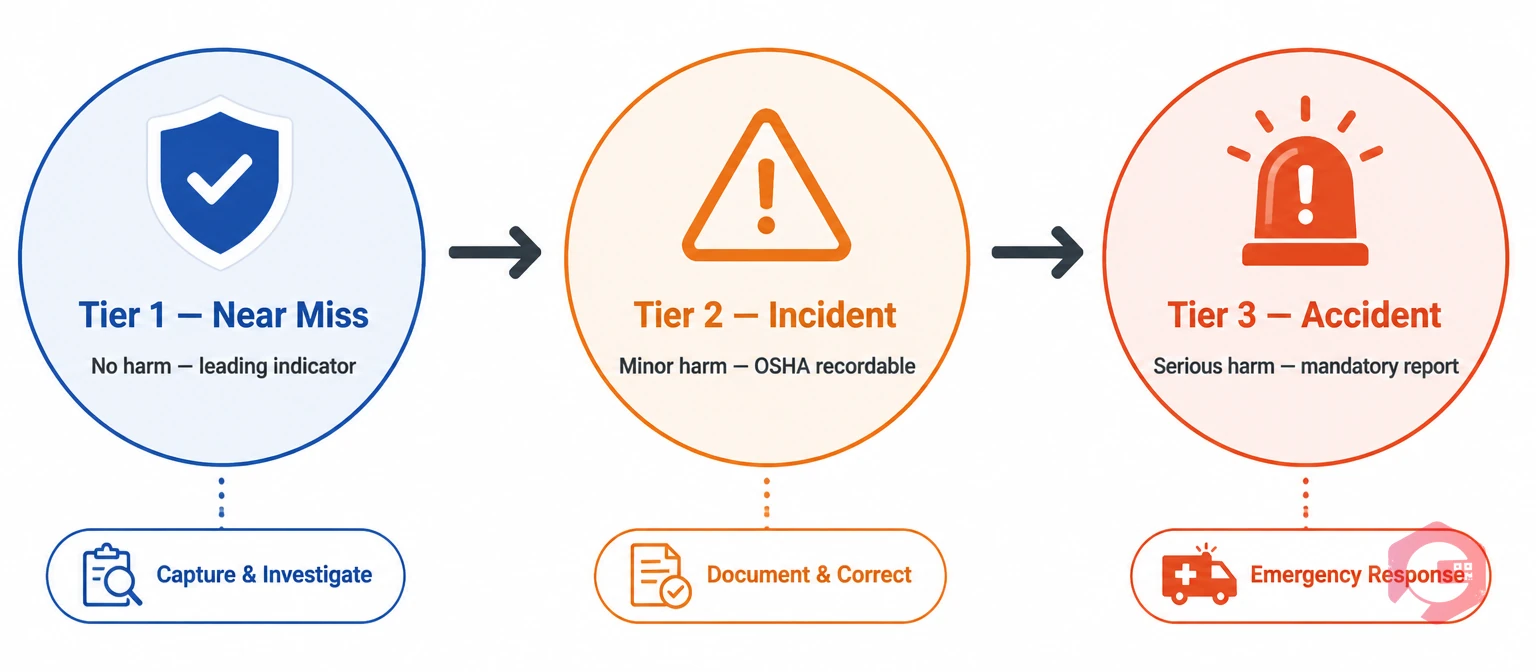
The three categories differ primarily along two axes: actual harm outcome and regulatory reporting obligation. The table below summarises the critical distinctions, followed by The 3-Tier Safety Event Classification Framework — a practical model for classifying events consistently across your organisation.
Safety professionals who clearly understand near miss vs incident vs accident distinctions avoid two common errors: under-reporting near misses (treating them as non-events) and misclassifying incidents as accidents (triggering unnecessary regulatory notifications). Consistent classification also makes trend data meaningful — if your organisation's near-miss rate is rising, that is a leading indicator worth investigating before it becomes an accident rate.
The 3-Tier Safety Event Classification Framework:
Reporting thresholds define the point at which an organisation — or a regulator — requires formal documentation of a safety event. Using a safety compliance checklist to document these thresholds for each event type prevents reporting gaps and ensures nothing slips through after a shift handover. The table below maps each event type to its internal and regulatory reporting triggers.
There is no OSHA federal mandate requiring employers to report near misses to a regulator. However, the National Safety Council strongly recommends that organisations build internal near-miss reporting systems as a core pillar of their safety management programme. Best practice is to capture all near misses within the same shift in which they occur, investigate the root cause within 24–48 hours, and assign corrective actions with specific owners and due dates.
Internal reporting should capture all incidents regardless of OSHA recordability. For OSHA purposes, a recordable incident must be entered on the OSHA 300 Log within 7 calendar days of learning of the case. Each recordable incident also requires a completed OSHA 301 Incident Report form. Employers with 10 or fewer employees, or those in certain low-hazard industries, are partially exempt from OSHA recordkeeping — but maintaining internal records remains best practice for all workplaces.
OSHA's Severe Injury Reporting requirements are firm: a work-related fatality must be reported within 8 hours, and a work-related in-patient hospitalisation, amputation, or loss of an eye must be reported within 24 hours. Reports can be submitted by calling 1-800-321-OSHA or online at osha.gov. Failure to report within these windows is itself a violation. These reports are separate from the OSHA 300 Log — both obligations apply to qualifying accidents. Organisations with multi-site operations should designate a responsible person at each location who knows these timelines and has the OSHA contact information readily available, because the 8-hour window for fatalities leaves no margin for internal routing delays.

Understanding near miss vs incident vs accident classification is only useful if your organisation has a system to act on what it learns. Most near misses go unreported not because workers choose to hide them, but because the reporting process is too cumbersome — paper forms, unclear ownership, and no feedback loop. Maintenance teams using Cryotos have reported up to 30% reduction in unplanned downtime and 25% faster repair turnaround, largely because every safety event — near miss or incident — is captured digitally and linked to a corrective work order before the shift ends. A structured four-step workflow turns a reported near miss from a data point into a closed-loop prevention action.
Using permit-to-work software alongside your near-miss reporting system adds a second layer of protection: high-risk maintenance tasks require a formal permit that documents hazard controls before work begins, reducing the conditions that create near misses in the first place.
The window for accurate near-miss capture is short — details fade within hours and witnesses move on. A mobile-first reporting tool that lets workers submit a near miss or incident report from the floor — with a photo, location, and brief description — dramatically increases capture rates compared to paper-based systems. The report should reach a supervisor or safety manager within the same shift.
Once captured, the event should be classified using the Tier 1 / Tier 2 / Tier 3 framework from this article — or your organisation's equivalent. Classification determines the investigation depth required, the regulatory reporting obligation, and the urgency of corrective action. A Tier 1 near miss may require a 24-hour investigation; a Tier 3 accident requires immediate formal investigation and regulatory notification.
Every safety event — including near misses — warrants a root cause investigation. Shallow investigations that stop at "worker error" miss the systemic conditions that created the hazard. Use a structured methodology: the root cause analysis investigation checklist covers the 5 Whys, fault tree analysis, and corrective action documentation in a single structured format. The investigation output should identify the immediate cause, contributing factors, and root cause — not just what happened, but why the system allowed it.
Root cause analysis is only valuable if it produces corrective actions that are actually implemented. Each corrective action should have a named owner, a due date, and a verification step. Work order management software closes this loop automatically: a near-miss report triggers a corrective work order, which is assigned to a technician, tracked through completion, and marked closed only when the supervisor verifies the hazard has been resolved. Nothing falls through the gap between "reported" and "fixed."
See how Cryotos work order management software turns near-miss reports into closed-loop corrective actions — from capture through investigation to verified resolution.
A near miss at work is any unplanned event that had the potential to cause injury, illness, or property damage, but did not result in actual harm. The key test is potential: if slightly different circumstances — a different position, a slightly faster speed, a shorter reaction time — would have caused harm, the event qualifies as a near miss. Common examples include slipping without falling, a dropped tool landing near (but not on) a colleague, and equipment failures caught during inspection before operation.
No — OSHA does not require employers to report near misses to a regulatory body. However, OSHA strongly encourages internal near-miss reporting programmes as a leading indicator of workplace hazards. Employers who build strong near-miss reporting cultures consistently show lower rates of recordable incidents and serious accidents over time, because they identify and correct hazardous conditions before harm occurs.
A hazard is a condition or situation with the potential to cause harm — it exists independently of whether any event has occurred. A near miss is a specific unplanned event triggered by a hazard, where harm could have occurred but did not. For example, a wet floor is a hazard; a worker slipping on that wet floor without falling is a near miss. The distinction matters for reporting: hazards are identified through inspections and risk assessments, while near misses are captured through event reporting systems.
A near miss and an incident are distinct events — one cannot "become" the other retroactively. However, an unreported or uncorrected near miss creates the conditions for a future incident or accident involving the same hazard. Heinrich's Triangle illustrates this progression: near misses at the base of the pyramid share root causes with the incidents and accidents at the top. Correcting the hazard after a near miss prevents the escalation to an incident or accident. This is why every unreported near miss represents a missed opportunity to break the chain before it leads to real harm.
The distinction between near miss vs incident vs accident becomes most important when you are building a classification system your entire workforce can use consistently — not just safety managers. Clear definitions, posted at work areas and embedded in your reporting forms, reduce the ambiguity that causes under-reporting.
There is no single universal legal definition of a workplace accident, as definitions vary by jurisdiction and regulatory framework. Under OSHA's Severe Injury Reporting rule (29 CFR 1904.39), the operative threshold is specific: work-related fatalities, in-patient hospitalisations, amputations, and losses of an eye each trigger a mandatory report. In practice, safety professionals use "accident" to mean any unplanned event causing serious injury or significant property damage — outcomes that require emergency response, regulatory notification, and formal investigation.
Effective near-miss and incident reporting is the difference between a safety programme that reacts to harm and one that prevents it. Schedule a free demo to see how Cryotos connects near-miss capture, root cause investigation, and corrective work order management in a single platform — so every reported event leads to a verified resolution.




Cryotos AI predicts failures, automates work orders, and simplifies maintenance—before problems slow you down.



