

SHE observations are records of unsafe acts, unsafe conditions, near misses, and environmental risks. They only create value when they end in a verified, closed corrective action. Most safety programs don't have a reporting problem. They have a close-out problem. A worker submits a hazard report, and it sits open for weeks with no owner, no due date, and no proof anything changed. This guide covers the full loop. You'll capture a usable SHE observation, classify it by risk, assign one owner, and verify the fix before you close it. You'll also see where a Computerized Maintenance Management System removes the friction that stalls actions.
Key Takeaways

A SHE observation is a first-hand record of a hazard, unsafe act, or near miss spotted before it causes harm. That covers unsafe acts, unsafe conditions, near misses, health concerns, environmental risks, and even good safety behaviors worth repeating. An incident report is different. It documents something that already went wrong. A SHE observation is a leading indicator. It's a chance to fix a hazard before it becomes an injury or an environmental release.
An observation only matters once it leads to a verified action. Most facilities log SHE observations through a mobile app or digital checklist, attach a photo, and route the entry straight into a work order queue instead of a static spreadsheet.
The gap between "reported" and "resolved" is what this guide is about. It's also where most SHE programs quietly lose the workforce's trust.
SHE observations stall for a simple reason. The reporting method never connects to a system that assigns, tracks, and verifies the fix. Paper forms and shared spreadsheets capture the hazard. Then the hazard sits in a folder nobody owns.
Vague descriptions make it worse. A note that says "loose guard rail near press 3" has no risk rating, no exposure estimate, and no deadline. That gives a supervisor nothing to weigh against the next ten items on their list.
Every one of these gaps chips away at trust. Workers who see their SHE observations go nowhere simply stop filing them.

The Five-Gate SHE Close-Out Framework:
Most maintenance teams that successfully cut their overdue safety backlog treat these five gates as a fixed sequence, not optional steps. Skipping a gate, especially Gate 4, is the most common reason a "closed" hazard comes back a few months later.
Cryotos supports every gate of this framework, starting with digital checklists at the point of capture, so Gate 1 never depends on someone's memory later in the day.

A SHE observation becomes actionable the moment it includes the date and time, the reporter, the location, the asset, the hazard, the exposure, any immediate control, and a risk rating. A short mobile form with required fields and no-blame language collects all of this in under two minutes.
Severity, likelihood, and exposure together set the priority. A high-severity, high-likelihood hazard needs a same-day response. A low-risk housekeeping item can wait a week without creating real exposure. OSHA's guidance on safety and health programs treats this kind of risk-based priority as a core part of an effective program, not an add-on.
Automatic routing sends the SHE observation straight to the right maintenance, SHE, facilities, or environmental team based on category and risk. That cuts out the manual triage step that usually adds a day or two of delay.
A corrective action is a task that removes or controls a hazard's root cause, not a temporary fix that only masks the symptom. "Monitor the leak" or "be careful near the conveyor" are not corrective actions. They describe a state, not a task with an end point.
Work order management turns this definition into a trackable task the moment the observation is classified. The action then gets the same due-date and escalation logic as any other maintenance job.
One accountable owner matters more than any other factor in close-out performance. Contributors and approvers can support the work. But the action needs exactly one name on it. Shared ownership is how items go stale.
When work is blocked by budget, a shutdown window, spare parts, or a contractor's schedule, the owner should escalate right away. Don't let the due date quietly slip. A documented, approved extension looks nothing like a missed deadline nobody noticed.
Check the plant's ISO 45001 occupational health and safety framework when you define what "resolved" means for higher-severity findings — it expects proof a hazard was removed or controlled, not just acknowledged. Download a root cause investigation checklist to standardize how your team documents each action before work begins.
Risk-based due dates work best when they're firm enough to drive action and realistic enough that people don't quietly ignore them. A high-risk hazard might carry a 24-hour interim control and a 7-day permanent fix. A low-risk item can run on a 30-day cycle.
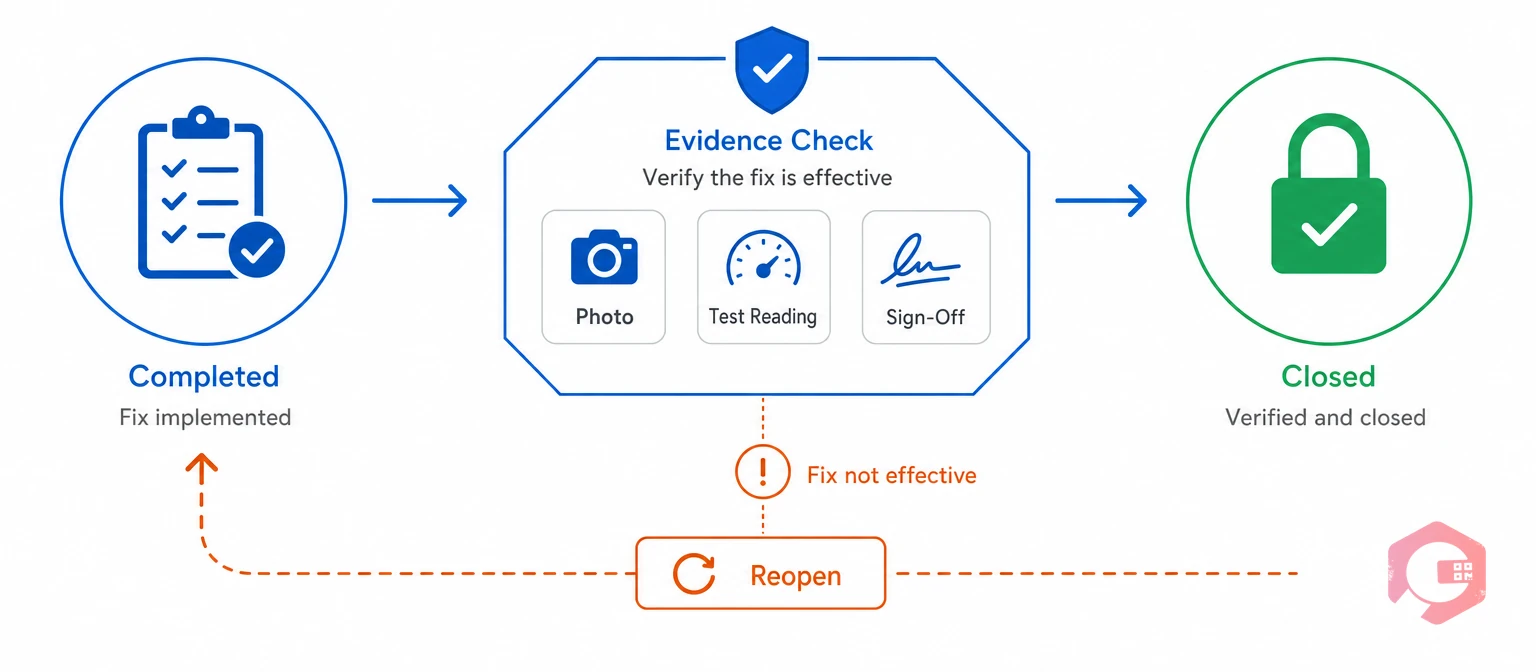
Verification of effectiveness is confirming a fix actually worked, not confirming that someone marked it done. "Completed" should never automatically mean "closed."
Before-and-after photos, checklist results, test readings, updated SOPs, training records, and a supervisor sign-off all count as evidence that the fix held. If a control turns out to be temporary or ineffective, reopen the action instead of filing a new one. That keeps the full history in one place.
Maintenance teams using Cryotos have reported up to 30% reduction in unplanned downtime and 25% faster repair turnaround, largely because verified corrective actions close the same failure paths that would otherwise trigger unplanned stops.
Root cause analysis is a structured method for finding a hazard's underlying cause, not just its symptom. A one-off, low-severity finding rarely needs it — a quick fix and verification are enough. A repeat hazard, a near miss with high potential severity, or anything tied to a serious injury does.
5 Whys works well for simple, single-cause problems. You ask "why" repeatedly until the true cause surfaces. For more complex or safety-critical SHE observations, an FMEA (Failure Mode and Effects Analysis) rates the severity, likelihood, and detectability of each potential failure mode.
A thorough root cause analysis looks at equipment condition, maintenance history, procedures, training, staffing, supervision, contractors, and procurement. Most repeat hazards trace back to more than one of these at once. Findings then link directly to CAPA, so the corrective action fixes the actual cause instead of the symptom that got reported.
The metrics that matter most for SHE observation programs are time to triage, time to assign, on-time closure rate, overdue aging, verification pass rate, reopen rate, and repeat hazard count. Reporter feedback — whether people who submit observations actually see something change — matters just as much and is easy to overlook.
Rewarding raw observation volume or closure counts alone backfires. Teams start logging low-value reports to hit a number, or close actions early to make a dashboard look good. Repeat hazard rates expose the pattern over time.
Common mistake: tracking closure speed without tracking verification pass rate hides the exact problem this framework exists to prevent — actions marked done that were never actually fixed.
A CMMS acts as the execution and evidence platform for the full loop: observe, record, classify, route, correct, verify, close, and learn. It doesn't replace leadership judgment or a supervisor walking the floor. It removes the administrative friction that causes good intentions to stall.
Most operations that successfully close out SHE observations on schedule rely on the same core capabilities: mobile capture, automated routing, work order execution, reminder-driven escalation, and an audit trail that survives a compliance review.
Cryotos brings mobile reporting, digital checklists, work order management, workflow automation, asset history, and BI dashboards into one system. An observation submitted on a phone becomes a tracked, verified, and reportable corrective action without a second data entry step.
A SHE observation records a hazard, near miss, or unsafe behavior spotted before it causes harm. An incident report documents something that already happened, such as an injury or a spill. Observations are a leading indicator; incident reports are a lagging one.
It depends on the risk rating. A high-severity hazard typically needs an interim control within 24 hours and a permanent fix within about a week. A low-risk item can reasonably run on a 30-day cycle.
One named owner with the authority and resources to do the work, supported by contributors and an approver. Shared ownership across multiple people is one of the most common reasons corrective actions stall.
No. A one-off, low-severity finding usually just needs a quick, verified fix. Save root cause analysis for repeat hazards, high-severity near misses, or findings tied to a serious injury or environmental release.
Turning SHE observations into corrective actions people actually close out comes down to one accountable owner, a realistic due date, and verified evidence before anything gets marked closed. Schedule a free demo to see how Cryotos connects observation capture, work order execution, and close-out reporting in one auditable loop.



Cryotos AI predicts failures, automates work orders, and simplifies maintenance—before problems slow you down.



