

A near-miss is an unplanned event that did not result in injury or damage but had the potential to do so. An incident is an unplanned event that disrupted normal operations or caused a minor injury, near-harm, or property damage. An accident is an unplanned event that caused a confirmed injury, fatality, or significant asset damage. These three categories sit on the same risk continuum — and understanding where each ends and the next begins is the foundation of any effective workplace safety program.
According to the U.S. Occupational Safety and Health Administration, for every serious injury, there are hundreds of near-misses that preceded it. Organizations that capture and act on near-miss data consistently reduce their incident and accident rates — those that don't keep responding to emergencies they could have prevented.
This guide defines all three event types, explains how to set reporting thresholds for each, and shows how digital EHS software closes the reporting gap that leaves most safety programs reactive.

A near-miss is any unplanned event or condition that did not result in injury, illness, or damage — but had the realistic potential to do so under slightly different circumstances. The OSHA definition is direct: a near-miss is a "close call" that reveals a hazard in the workplace before that hazard causes harm.
Common examples include a worker who slips on a wet floor but catches themselves before falling, a forklift that narrowly misses a pedestrian in a loading bay, a chemical container that was mislabeled but caught during a pre-use check, and a scaffold component that was improperly secured but noticed before workers climbed it. None of these events produced an injury. All of them should be reported and investigated.
Near-misses are not accidents waiting to happen — they are accidents that almost happened. That distinction matters, because the near-miss contains the same causal chain as a future accident, just without the harm outcome. Investigating it while the evidence is fresh and the conditions are intact gives safety teams the best possible opportunity to break that chain before it completes.
Near-misses are systematically underreported in most organizations. Workers often don't report them because they don't see why it matters — nothing happened — or because they worry about blame. Without a formal reporting threshold and a clear, low-friction reporting channel, near-miss data simply doesn't flow to the people who need it.
This underreporting is the single largest gap in workplace safety programs. National Safety Council data consistently shows that organizations with active near-miss reporting programs have significantly lower lost-time injury rates than those that only report injuries after they occur. The information is available — it just never gets captured.
A safety incident is an unplanned event that disrupts normal operations, causes a minor injury, creates potential harm, or results in property damage below the accident threshold. The key distinction from a near-miss is that something measurable happened — a person was affected, equipment was damaged, or operations were interrupted — even if no serious injury or fatality resulted.
Incidents include first-aid cases where no lost time occurred, property or equipment damage below a defined cost threshold, environmental releases that were contained without regulatory reporting triggers, and any event that required a safety response but did not rise to the level of a recordable OSHA injury.
Under ISO 45001:2018, the international occupational health and safety management standard, an "incident" explicitly includes near-misses. However, most practical EHS management frameworks separate near-misses from incidents operationally, because they require different investigation depth, different notification chains, and different corrective action protocols. Keeping them distinct in your reporting system produces better data and cleaner root cause analysis.
The operational difference between an incident and a near-miss is outcome: an incident has one, a near-miss does not. Both require reporting and investigation. Both can reveal the same underlying hazard. But incidents carry a higher likelihood of regulatory reporting obligations, insurance notification requirements, and immediate corrective action timelines.
Organizations that treat near-misses and incidents identically in their reporting system lose the ability to track leading indicators separately from lagging indicators. Near-miss frequency is a leading safety indicator — it tells you where hazards exist before harm occurs. Incident frequency is a lagging indicator — it tells you where harm already happened. Both belong in your safety dashboard, but they serve different management purposes.
A workplace accident is an unplanned event that caused a confirmed injury, occupational illness, fatality, or significant asset damage — and typically triggers mandatory regulatory reporting and formal investigation requirements. Under OSHA 29 CFR 1904, recordable accidents include work-related injuries and illnesses that result in days away from work, restricted work, transfer to another job, medical treatment beyond first aid, loss of consciousness, or diagnosis of a significant injury or illness by a healthcare professional.
Accidents sit at the top of the safety event severity scale. They require formal OSHA recording on the OSHA 300 Log, immediate notification to OSHA when they involve fatalities (within 8 hours) or hospitalizations, amputations, or loss of an eye (within 24 hours), full root cause investigation, and documented corrective and preventive actions (CAPA) with completion tracking.
The legal and financial consequences of an accident are also categorically different from a near-miss or incident. Accidents trigger workers' compensation claims, potential regulatory citations, legal liability exposure, and reputational risk. Every accident that could have been prevented through earlier near-miss reporting represents a failure of the safety information system, not just a failure of the worker or the equipment.

Understanding how these three categories differ across the dimensions that matter to safety managers — severity, reporting obligation, investigation depth, and regulatory trigger — is the starting point for building a functional event classification system.
| Dimension | Near-Miss | Incident | Accident |
|---|---|---|---|
| Outcome | No injury, no damage | Minor injury, first aid, or property damage | Recordable injury, fatality, or significant damage |
| Harm Level | Potential only | Low to moderate actual harm | Confirmed significant harm |
| OSHA Recordable | No | Not always — depends on treatment level | Yes — required on OSHA 300 Log |
| OSHA Notification | Not required | Not required | Required for fatality (8hr) or hospitalization (24hr) |
| Investigation Depth | Hazard identification + corrective action | Root cause analysis + CAPA | Full formal investigation + regulatory documentation |
| Reporting Indicator Type | Leading (predictive) | Mixed | Lagging (reactive) |
| Primary Value | Prevention intelligence | Process improvement | Corrective action and legal compliance |
The comparison above makes clear why organizations need separate reporting tracks for each event type. Treating all three the same creates data quality problems. A near-miss investigation that gets the same paperwork burden as a fatality investigation will be skipped. A minor incident that gets filed as a near-miss hides a real harm event from your lagging indicator metrics.
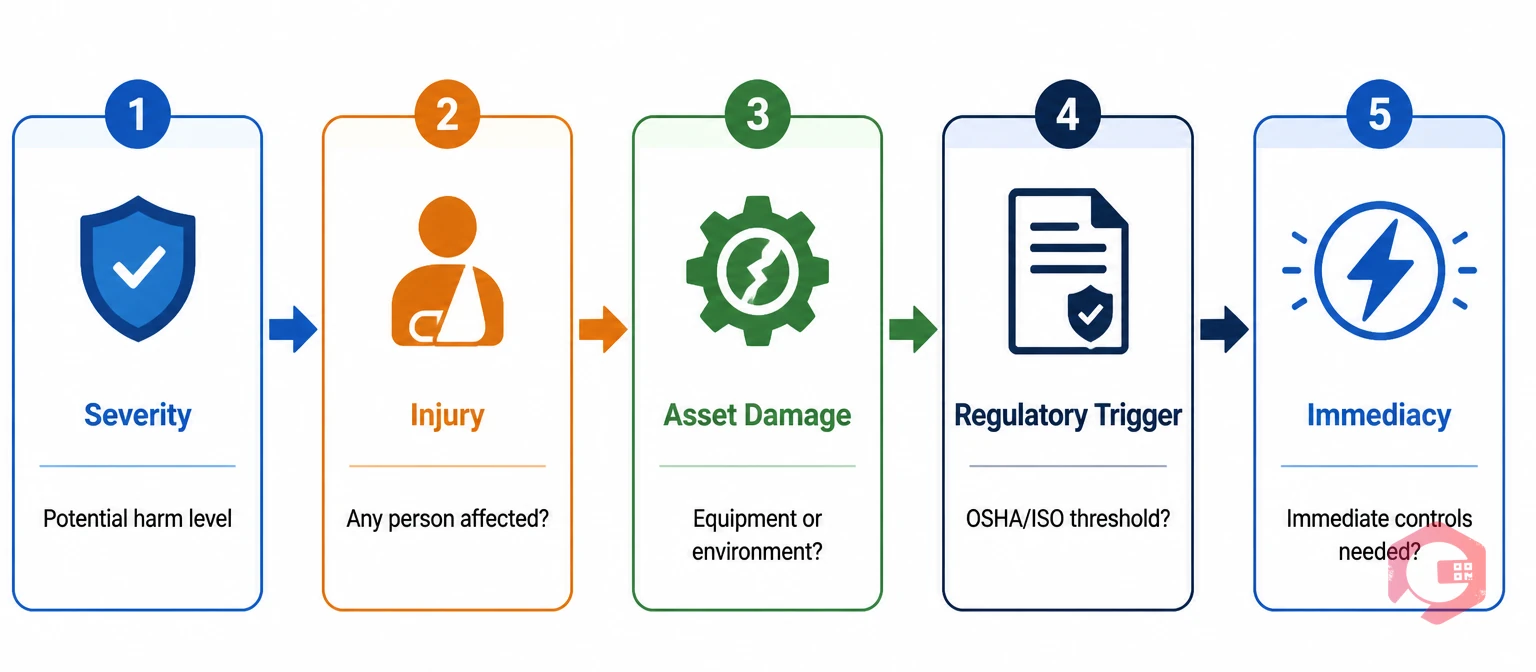
A reporting threshold defines the minimum criteria that must be met before an event is recorded in a specific category. Without written thresholds, every classification decision is a judgment call — and judgment calls are inconsistent across shifts, supervisors, and locations. Inconsistent classification produces unreliable data, which produces bad safety decisions.
Reporting thresholds must be defined in writing, communicated to all workers, and embedded in your reporting system as structured fields — not left to interpretation at the time of reporting. The goal is to make the classification decision automatic, not ambiguous.
The SIARI Event Classification Framework gives safety teams a five-point checklist to classify any workplace event consistently, regardless of who is doing the reporting. SIARI stands for: Severity of potential harm, Injury occurrence (yes/no), Asset or environmental damage, Regulatory trigger (OSHA/ISO threshold met), and Immediacy of corrective action required.
Any event that answers "yes" to two or more SIARI criteria above the current category threshold should be escalated to the next category. This prevents systematic downgrading of events — a common problem in organizations under production pressure.
Your organization's internal reporting thresholds should be set before incidents occur and documented in your EHS policy. A practical severity matrix assigns each event type a minimum reporting timeline and notification chain.

Near-miss reporting is the highest-leverage activity in any safety management program because it surfaces the causal chain of future accidents while there is still time to break it. Every accident investigation reveals contributing factors that were present before the accident — and most of those contributing factors would have been visible as near-miss conditions had they been reported.
Organizations with active near-miss reporting programs consistently outperform those without them on every lagging safety indicator: lower lost-time injury rates, lower total recordable incident rates, and lower workers' compensation costs. The mechanism is straightforward: more near-miss reports mean more corrective actions, which means more hazards eliminated before they produce harm.
H.W. Heinrich's original safety pyramid, published in 1931, proposed that for every major injury there were 29 minor injuries and 300 near-misses. Modern safety research has challenged the specific ratios, but the underlying principle remains supported by data: serious accidents do not occur in isolation — they are preceded by a larger volume of lower-severity events that share the same root causes.
The practical implication is clear. If your organization records 50 near-misses per year and 10 recordable incidents, your safety data is probably incomplete. Research from the National Safety Council suggests the ratio of near-misses to recordable incidents in most industrial environments runs 5:1 to 10:1 or higher when reporting systems are functioning correctly. If your ratio is lower than 3:1, your near-miss reporting is almost certainly underperforming.
Building a culture where near-miss reporting is expected, valued, and acted on — not punished — is the single most effective structural change most safety programs can make. The safety compliance checklist provides a framework for auditing whether your current reporting culture meets that standard.

A CMMS with integrated EHS capabilities eliminates the structural barriers that cause near-miss and incident underreporting — paper-based forms, unclear reporting channels, and corrective actions that get assigned but never tracked to completion. Cryotos gives safety teams a single platform to report, classify, investigate, and close every event type across the near-miss to accident spectrum.
Most organizations run safety reporting on paper forms, spreadsheets, or disconnected systems. The result is that near-misses get lost between the floor and the safety manager's inbox. Incidents get recorded inconsistently. Accident investigations produce corrective actions that nobody tracks. Cryotos closes every one of those gaps through three core capabilities.
Employees report near-misses, incidents, and accidents directly from mobile devices — with standardized digital forms that enforce consistent classification at the point of entry. Photo attachments, GPS location tagging, and video evidence are captured immediately from the field. Workers can submit a near-miss report in under two minutes without leaving the work area, which directly reduces the friction that causes underreporting.
The reporting form uses the SIARI classification logic to guide the worker through the correct event category based on their answers. This removes the ambiguity that produces inconsistent data across shifts and supervisors. Every event enters the system with a consistent classification, timestamp, and evidence package attached.
When a near-miss is submitted, Cryotos automatically notifies the relevant supervisor and safety manager based on the event category and severity level. High-severity incidents trigger an escalation matrix that routes notifications to senior safety leadership without any manual intervention. No event slips through a gap in the notification chain because someone was on leave or away from their desk.
Root cause analysis is embedded directly in the investigation workflow. Using the five whys methodology or FMEA for complex events, investigators capture the contributing cause chain in the same platform where the original report was filed. Corrective and preventive actions (CAPA) are assigned with named owners, due dates, and completion verification steps — so the investigation closes the loop rather than producing a report that nobody follows up on.
The workflow automation layer sends reminders before CAPA due dates and escalates to supervisors when actions pass their deadline. This is the difference between a safety program that documents events and one that actually changes conditions.
Every event reported in Cryotos generates a complete, timestamped audit trail — including who reported it, when, what was found during investigation, what corrective actions were assigned, and whether they were completed. This audit trail satisfies OSHA recordkeeping requirements and supports ISO 45001 conformance audits without any manual document preparation.
The regulatory compliance checklist built into Cryotos helps teams verify that their near-miss, incident, and accident reporting processes meet current OSHA and ISO 45001 requirements before an audit — not after one reveals a gap.
No. A near-miss is an event that had the potential to cause harm but produced no actual injury or damage. An incident is an event that did cause a measurable outcome — a minor injury, property damage, or process disruption. ISO 45001 uses "incident" as an umbrella term that includes near-misses, but most practical EHS management frameworks keep them separate because they require different investigation depth, different notification chains, and different regulatory treatment. Keeping them distinct in your reporting system produces better leading indicator data and cleaner root cause analysis.
OSHA does not have a federal regulatory requirement to record or report near-misses on OSHA forms. However, OSHA's Voluntary Protection Programs (VPP) and Process Safety Management (PSM) standard (29 CFR 1910.119) both explicitly encourage or require near-miss reporting as part of effective safety management. Many state-plan states have more specific near-miss reporting requirements. Regardless of regulatory obligation, OSHA consistently advises that near-miss investigation is one of the most effective tools for preventing serious injuries and fatalities.
The terms are sometimes used interchangeably, but in structured EHS frameworks they carry different severity implications. An incident is a broader category that covers any unplanned disruption, minor injury, or low-level harm event. An accident specifically refers to events that caused recordable injury, significant asset damage, or fatality — typically triggering formal OSHA recording and notification obligations. The distinction matters for data quality: organizations that record accidents as incidents inflate their incident metrics and understate their account severity, which distorts safety program performance measurement.
Effective near-miss reporting thresholds are set by defining the minimum potential harm level that requires a report — typically "any event that could have caused injury or damage under different circumstances." The threshold should be documented in your EHS policy, communicated to all workers during onboarding and safety training, and embedded in your reporting system as a structured classification field. Use a consistent framework — such as the SIARI classification approach — to reduce the judgment calls that lead to inconsistent reporting across shifts and departments. The threshold for near-misses should be lower than for incidents: encourage over-reporting rather than under-reporting at the near-miss level.
Every near-miss that goes unreported is a future accident waiting for the right conditions to complete itself. Schedule a free demo to see how Cryotos enables organizations to capture near-misses, incidents, and accidents on a single digital platform — with automated workflows, CAPA tracking, and audit-ready reporting that keeps your safety program proactive rather than reactive.




Cryotos AI predicts failures, automates work orders, and simplifies maintenance—before problems slow you down.



