NFC and beacon-based asset tracking for retail store equipment gives store operations teams real-time visibility into the location, status, and maintenance history of every cart, fixture, display unit, and movable asset on the floor — without manual audits or walkie-talkie searches. According to the Food Marketing Institute, a mid-size grocery retailer loses an average of 5 to 10 percent of its shopping cart fleet every year to theft, drift, and misplacement — costing $15,000 to $30,000 annually per store in replacement spend alone. NFC tags and BLE beacons eliminate that loss by making every piece of equipment findable in seconds.
This guide covers exactly how these two technologies work, which assets they track best, and how connecting location data to your CMMS turns asset tracking into a complete maintenance program — not just a location tool.
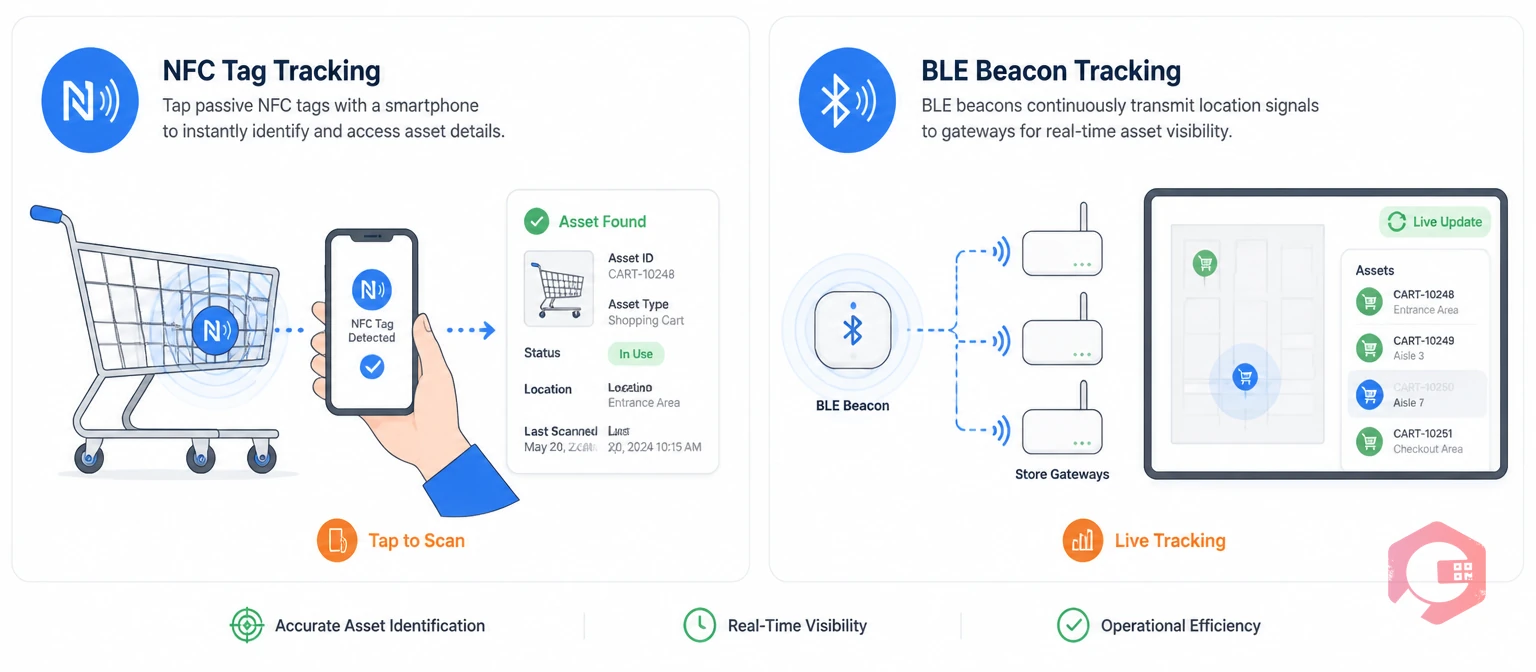
NFC and beacon-based asset tracking uses short-range radio technologies to connect physical retail equipment to a digital asset record. Each piece of equipment — a shopping cart, a gondola shelf, a clothing rack, a mannequin, a trolley — gets a small, durable tag or beacon attached to it. That tag or beacon transmits a unique identifier that your tracking system picks up and maps to the asset's location, status, and maintenance history.
Two technologies do most of the work in retail environments:
Together, these technologies give you a live map of every tracked asset in your store — with a maintenance record attached to each one.

Retail equipment loss is a quiet but persistent budget drain. Shopping carts drift to competitor parking lots. Display fixtures get moved during a floor reset and never returned. Promotional gondola units go missing between seasons. Specialty carts used for click-and-collect orders end up in the wrong zone every shift.
Most stores address this with manual counts — a weekly or monthly walk-through where a team member records what's in each zone. The problem with manual counts is that they're always a lagging indicator. By the time you discover 12 carts are missing from the bay, they've been gone for days. You've already absorbed the operational impact: longer wait times at the entrance, staff time spent searching, customer complaints, and pressure on the carts that remain.
Fixtures present a different problem. A store running 400 to 600 gondola bays, clothing racks, and specialty displays has no practical way to manually track each one across floor resets, seasonal changeovers, and remodels. Equipment that falls off the radar stops getting maintained. Wheels crack, fasteners loosen, and frames warp — all without a work order being raised because nobody knows the asset is still in use.
The cost is not just replacement spend. A study published by the Retail Loss Prevention Foundation found that operational asset mismanagement — including untracked equipment — adds between 0.2 and 0.4 percent to a retailer's cost base annually. For a store doing $20 million in revenue, that's $40,000 to $80,000 per year disappearing into lost, broken, or untracked equipment.
NFC tags are passive devices — they carry no battery and require no power source. They store a small amount of data and respond when an NFC reader comes within range (typically 1 to 4 centimeters). In a retail context, this means a staff member taps an NFC-equipped phone to the tag on a shopping cart or display fixture and immediately sees the asset's record on screen.
For maintenance teams, NFC works best in three scenarios. First, during inspections: a technician walks the floor tapping each piece of equipment, logging condition updates as they go — wheel condition, frame integrity, locking mechanism status — directly into the CMMS through the tag scan. Second, during work order creation: a staff member notices a damaged cart, taps the tag, and raises a corrective work order from the floor in 30 seconds without going to a back-office terminal. Third, during handover: at the start of a shift, a floor manager scans the tags on high-value fixtures in their zone to confirm presence and status without a manual checklist.
NFC tags suitable for retail environments are inexpensive — typically $0.50 to $2.00 per tag — and durable enough to survive years on a shopping cart frame or fixture base. For outdoor carts exposed to weather and cart-wash systems, metal-backed or epoxy-encased NFC tags maintain readability across the asset's full operational life. Connect your NFC workflow to Cryotos's asset tracking module and every tap writes back to the centralized asset record automatically.
BLE beacons are small, battery-powered transmitters that broadcast a Bluetooth signal every few seconds. Receivers — either dedicated gateways installed throughout the store or staff smartphones running the tracking app — pick up these signals and report back to the central system. The system calculates each beacon's location by triangulating the signal strength received by multiple gateways, updating the asset map continuously.
For retail, this creates genuine real-time visibility. A shopping cart fitted with a BLE beacon appears as a moving dot on your store map as it moves from the bay to the checkout lane to the loading area. If the cart hasn't moved in four hours and it's not in a bay, the system flags it as potentially misplaced. If a beacon leaves the store's geofence, you get an instant alert — not a missing cart discovered during next week's manual count.
Beacon battery life has improved significantly. Modern BLE beacons in retail environments last 2 to 5 years on a single battery at typical broadcast intervals, making them low-maintenance additions to your fleet. Gateway infrastructure for a 20,000 square foot store typically requires 8 to 15 receivers, installed above ceiling height or in structural positions where they cover overlapping zones.
The live location data doesn't just prevent loss — it feeds your maintenance scheduling. If a cart has covered the equivalent of 200 km in travel based on movement logs, that's the trigger for a wheel inspection. Cryotos's preventive maintenance software supports usage-based PM triggers, so your maintenance schedule runs on real asset activity, not calendar guesswork.
Choosing between NFC and BLE beacons depends on the asset type, how it moves, and how much automation you need. Most mature retail operations use both — NFC for stationary or semi-stationary assets requiring manual scan workflows, BLE for mobile assets where continuous location data matters most.
| Factor | NFC Tags | BLE Beacons |
|---|---|---|
| Power source | None — passive, no battery | Battery-powered (2–5 year life) |
| Range | 1–4 cm (tap to scan) | Up to 30 m per gateway |
| Location tracking | Manual — staff must scan | Continuous — automatic updates |
| Tag cost | $0.50–$2.00 per tag | $5–$20 per beacon |
| Infrastructure needed | Any NFC smartphone | Gateways throughout store |
| Best for | Display fixtures, gondola shelves, mannequins | Shopping carts, trolleys, mobile equipment |
| Maintenance workflow | Scan-to-inspect, scan-to-create work order | Usage-based PM triggers, misplacement alerts |
Any physical asset that moves, gets shared across shifts, or needs periodic maintenance is a candidate for tracking. In a typical retail environment, the most impactful assets to tag are:

Location data is only half the picture. Knowing where a cart is doesn't tell you when its wheels were last inspected, whether there's an open damage report against it, or how many hours of use it's accumulated since its last service. A CMMS with integrated asset tracking closes that gap by attaching the location feed directly to the asset's maintenance record.
Here's how the connection works in practice with Cryotos CMMS:
Retail maintenance teams using Cryotos report a 30% reduction in downtime and 25% faster repair times — outcomes that apply to in-store equipment just as directly as they do to factory machinery. When a shopping cart breaks down during peak trading, it's not just a maintenance issue — it's a customer experience problem. Connecting your NFC and beacon tracking data to retail facility management software turns reactive equipment management into a proactive, measurable operation.
The asset and equipment inspections checklist gives your team a ready-made framework for structuring NFC-triggered inspection workflows for every asset category in your store.
Ready to stop losing carts and fixtures to misplacement and untracked wear? Cryotos CMMS connects your NFC and beacon asset tracking data to a full maintenance workflow — work orders, PM scheduling, usage-based triggers, and live fleet reporting — in one platform built for retail operations. Book a demo at cryotos.com to see how your store's asset tracking data becomes a complete maintenance program.
NFC is a short-range subset of RFID technology operating at 13.56 MHz, designed for intentional, tap-to-scan interactions within 1 to 4 centimeters. Standard RFID can read tags from several meters using dedicated readers, making it faster for bulk inventory scanning but requiring more expensive hardware. NFC is the better choice for retail maintenance workflows where a staff member deliberately scans each asset during an inspection or work order creation. For automated, hands-free mass scanning of tagged products, standard RFID is more appropriate.
Most BLE beacons deployed on shopping carts and retail equipment last 2 to 5 years on a standard CR2032 or AA battery at typical broadcast intervals of 500ms to 1 second. Higher broadcast frequencies improve location accuracy but reduce battery life proportionally. Battery replacement is a maintenance task that should itself be scheduled in your CMMS — Cryotos can generate a recurring work order for beacon battery checks on a defined annual cycle.
Yes. Both technologies operate reliably in outdoor environments. BLE gateways can be installed on exterior building facades, canopy structures, or dedicated poles to cover cart bay areas and parking zones. NFC tags on outdoor carts should use weatherproof enclosures — epoxy-coated or metal-backed tags rated for outdoor exposure maintain readability through cart washes and seasonal weather exposure without degradation.
A typical 15,000 to 20,000 square foot retail store requires 8 to 15 BLE gateways to achieve full floor coverage with location accuracy to within 2 to 3 meters. Gateway placement above ceiling height in overlapping zones eliminates dead spots. Larger stores and those with outdoor cart storage areas need additional gateways to cover extended footprints. Your BLE technology vendor can generate a coverage map before installation to confirm gateway count and placement.
Look for a CMMS that supports GPS, NFC, and beacon-based real-time tracking natively — not just QR code scanning. Critical features include scan-to-work-order creation from the mobile app, usage-based PM triggers that can be configured on location or movement data, a live asset location map accessible from both desktop and mobile, and BI reporting that surfaces fleet counts, maintenance backlog, and asset loss trends in a single dashboard. Cryotos's asset tracking module supports all of these natively.




Cryotos AI predicts failures, automates work orders, and simplifies maintenance—before problems slow you down.