
OEM vs aftermarket parts is a choice between parts made by the original equipment manufacturer and parts made by third-party suppliers. Both are built to fit the same equipment. OEM parts usually cost more, but they match the original design exactly and keep warranty terms simple. Aftermarket parts often cost 20–50% less and can arrive faster. Their quality, though, ranges from equal to the original down to barely acceptable.
For most maintenance teams, the right answer is not one source or the other. It's a clear rule for each part. That rule depends on how critical the asset is, how long you can wait, and what a failure would cost. This guide compares both options side by side. It works through a real cost example. It also gives you a five-factor framework to decide which source belongs in each storeroom bin.
Key Takeaways
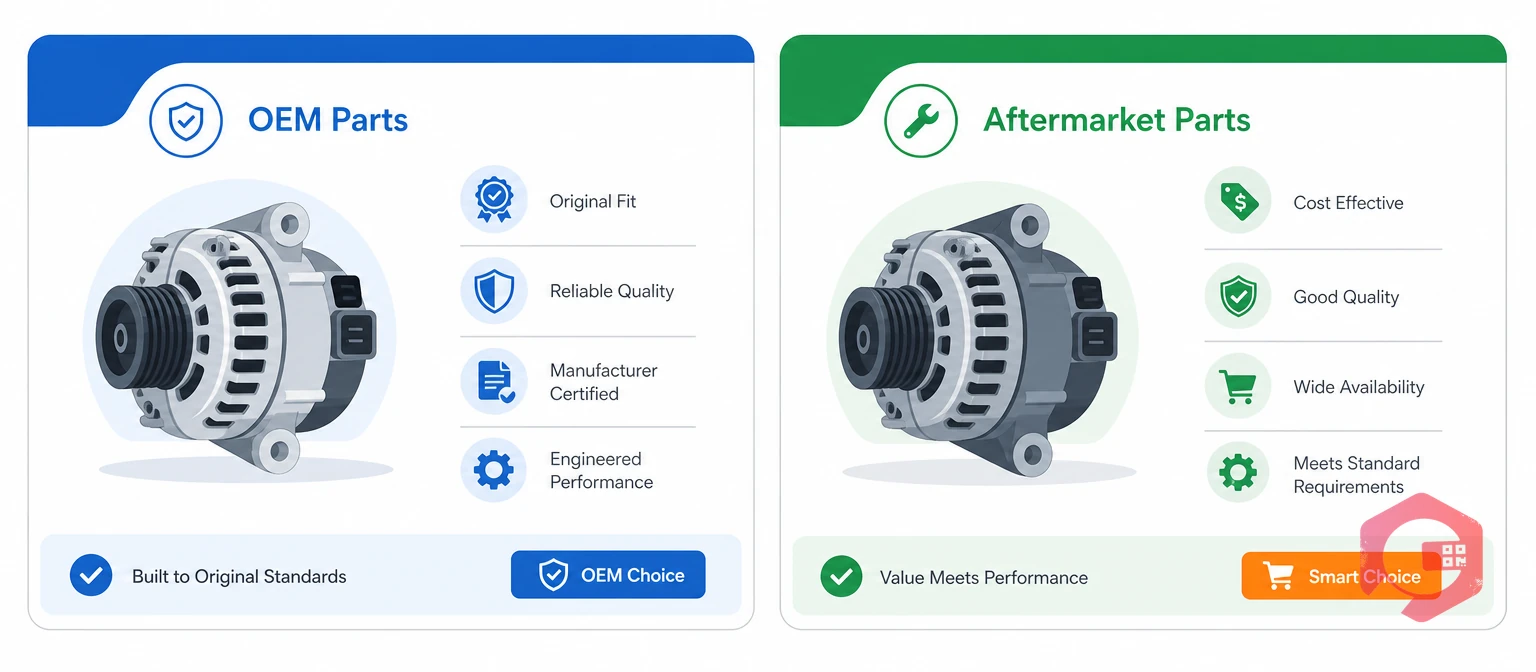
OEM parts win on guaranteed fit and simple warranty terms, while aftermarket parts win on price, choice, and often availability. The table below lines up both options against the questions storeroom and reliability teams ask before they place an order.
| Factor | OEM Parts | Aftermarket Parts |
|---|---|---|
| Who makes it | The equipment manufacturer or its contracted supplier | An independent third-party manufacturer |
| Upfront price | Highest, often with a brand premium | Typically 20–50% lower |
| Fit and specification | Exact match to the original design | Designed to fit; tolerances vary by supplier |
| Quality consistency | Predictable from batch to batch | Ranges from better than OEM to poor |
| Warranty impact | Keeps equipment warranty claims simple | May complicate claims if the part is blamed for a failure |
| Lead time | Depends on dealer network; can be weeks for rare parts | Often shorter through distributors and local suppliers |
| Paperwork | Part numbers, drawings, and certificates provided | Varies; must be requested and checked |
| Best fit | Critical, regulated, or warranty-covered assets | Commodity items, older equipment, and non-critical assets |
Neither column wins every row, which is why the decision belongs at the part level, not the plant level. The ISO 55000 asset management standard makes the same point. Asset decisions should balance cost, risk, and performance over the whole life of the asset.
A Computerized Maintenance Management System that records which source each part came from turns this table from opinion into evidence. Once source, cost, and failure data sit on one record, you can see which choice works better in your plant.

An OEM part is a component made by the original equipment manufacturer or its contracted supplier. It is built to the same design used when the machine left the factory. It carries the same part number, materials, and tolerances as the part it replaces. The term comes from the original equipment manufacturer model. One company designs the machine and controls who makes its parts.
When you buy an OEM part, you are paying for certainty. The manufacturer has tested that exact component in that exact machine, and it stands behind the result.
OEM parts make the most sense when the cost of a wrong fit or an early failure is far higher than the price difference.
An aftermarket part is a component made by a third party to fit the same equipment. The maker is not the original equipment manufacturer. The aftermarket covers a wide range of suppliers. Some specialist firms beat OEM specs. Some low-cost makers copy the shape but not the materials.
That range is the whole story. "Aftermarket" is not one quality level, so the supplier matters more than the label.
Want to know what each repair really costs before you compare sources? Run your numbers through the free mean maintenance cost calculator to set a baseline for your assets.
OEM parts and aftermarket parts differ most on four factors: upfront cost, quality consistency, warranty impact, and lead time. The table below shows what to check on each one before you approve a purchase.
| Factor | OEM Parts | Aftermarket Parts | What to Check |
|---|---|---|---|
| Upfront cost | Highest | 20–50% lower on average | Price per hour of service life, not price per unit |
| Quality consistency | High and predictable | Depends on the supplier | Material certificates, dimension reports, ISO 9001 status |
| Warranty impact | No conflict | Possible dispute if the part is blamed | Warranty wording and remaining coverage period |
| Lead time | Days to weeks, longer for rare parts | Often same-day to a few days | Supplier stock levels and delivery history |
| Service life | Known from OEM data | Must be proven in your plant | Failure history by source in your work orders |
Aftermarket parts are almost always cheaper at the point of purchase. The savings are largest on commodity items where many suppliers compete, such as bearings, V-belts, filters, gaskets, and standard fasteners. On proprietary components, like a machine-specific control board, the gap is smaller because fewer independent suppliers exist.
OEM parts give you the same result every time because one company controls the design and the supply chain. Aftermarket quality depends on who you buy from. A certified part from a specialist maker can outlast the original. A generic will-fit part might use softer steel or cheaper rubber that fails in half the time.
Warranty risk is often smaller than people assume, but it is real. In the United States, the Magnuson–Moss Warranty Act generally stops a seller from voiding a consumer warranty just because non-OEM parts were used. The exception is when the part caused the damage. Industrial equipment is usually covered by contract terms instead. Read the service agreement before you swap sources on a machine still under warranty.
Regulated industries add another layer. Food, drug, and medical plants may need material certificates for any part that touches product or affects safety. That rule applies whatever the source.
Lead time can flip the whole decision. Say a critical pump is down and the OEM seal is three weeks away. If a qualified aftermarket seal is available today, it may be the lower-risk choice. The smart move is to settle these trade-offs before the breakdown, not during it.
The takeaway: price favors aftermarket, certainty favors OEM, and lead time can push the decision either way.
Total cost of ownership is the full cost of a part over its whole service life. It adds the purchase price, the labor to fit it, the downtime while it is swapped, and the cost of any early failure. It is the only fair way to compare a cheap part with an expensive one. The purchase price is often the smallest line on the bill. Our guide to maintenance costs breaks down each of these cost buckets in more detail.
Picture a process pump with a mechanical seal that fails without warning. The OEM seal costs $1,200 and lasts about 18 months. An aftermarket seal costs $700 but, in this plant, lasts about 12 months. Each replacement takes 6 labor hours at $75 per hour and causes 3 hours of unplanned downtime at $1,500 per hour.
| Cost Element (36 Months) | OEM Seal | Aftermarket Seal |
|---|---|---|
| Replacements needed | 2 | 3 |
| Parts cost | $2,400 | $2,100 |
| Labor (6 hours at $75/hour) | $900 | $1,350 |
| Downtime (3 hours at $1,500/hour) | $9,000 | $13,500 |
| Total 36-month cost | $12,300 | $16,950 |
The aftermarket seal saves $500 per purchase but costs $4,650 more over three years, about 38% higher in total. The parts bill barely changes. The extra replacement is what drives the cost, through more labor and one more unplanned shutdown.
Now change one input. Say the aftermarket seal lasts the same 18 months as the OEM seal. The three-year total drops to $11,300, and the aftermarket option wins by $1,000. Service life is the swing factor, which is why you can't judge a part by its price tag alone.
The takeaway: compare cost per month of reliable service, not cost per part.

The SAFER Parts Sourcing Framework is a five-factor scoring method. It tells you whether to buy a part from the OEM, from an approved aftermarket supplier, or from either one. It replaces case-by-case debates with one consistent rule your planners and buyers can apply to every item in the storeroom.
The SAFER Parts Sourcing Framework:
Give each factor a score from 1 to 3, where 3 means the factor pushes strongly toward OEM. Add the five scores together for a total between 5 and 15, then apply the sourcing rule below.
Score your top 50 spend items first. That short list usually covers most of your parts budget and gives your team a clear rule where it matters most.
Use OEM parts when a failure is dangerous, regulated, or covered by warranty. Use aftermarket parts when the item is a standard commodity or the OEM can't deliver in time. The table below maps common situations to the source that usually makes the most sense.
| Situation | Recommended Source | Why |
|---|---|---|
| Equipment still under warranty | OEM | Avoids disputes if a claim is needed later |
| Safety-critical or regulated parts | OEM or certified equivalent | Inspectors and auditors expect traceable, certified components |
| Tight-tolerance proprietary parts | OEM | Few suppliers can match the original design exactly |
| Standard commodity items | Qualified aftermarket | Bearings, belts, and filters follow industry standards |
| Older equipment with obsolete parts | Aftermarket or remanufactured | The OEM may no longer supply the part at all |
| Breakdown with a long OEM lead time | Qualified aftermarket, then review | Restores production now; decide on the long-term source later |
| High-volume consumables | Qualified aftermarket | Small savings per unit add up to large yearly savings |
Most facilities end up with a mix. They buy OEM for roughly the top fifth of critical spares. They use qualified aftermarket suppliers for the long tail of standard items. The exact split depends on your asset base, but the logic stays the same.
Qualifying an aftermarket supplier means checking their quality, documentation, and track record before any of their parts go on a critical asset. Maintenance teams that skip this step are the ones who end up with horror stories about cheap parts.
A supplier that passes these checks earns a place on your approved list for that part family. A supplier that can't provide basic certificates or dimension data hasn't earned it yet, no matter how low the price.
Most sourcing problems come from process gaps, not from the parts themselves. These five mistakes show up again and again in plants that struggle with parts costs and repeat failures.
A common mistake is treating the storeroom as a purchasing problem instead of a reliability problem. Maintenance teams using Cryotos have reported up to 30% reduction in unplanned downtime and 25% faster repair turnaround. Part of the gain comes from having the right part tracked, stocked, and ready before the failure. The takeaway: good sourcing decisions depend on good parts data.
A CMMS tracks OEM and aftermarket part performance by linking each part to its source and cost. It also links the part to the work orders where it was fitted or failed. That link is what turns the OEM vs aftermarket parts debate into a data question you can actually answer.
Create separate item records for OEM and aftermarket versions of the same part, or add a source field to each item. Cryotos inventory management lets you record the supplier, cost, and minimum stock level for each version. Buyers and technicians always know which one they are using.
When a technician issues a part against a work order, the system records which part, which source, and which asset. When that part fails later, the failure is logged against the same record. Over time, this builds a service-life history for each source on each asset.
With source data in place, you can line up average life, failure count, and total cost for each version. Purpose-built spare parts tracking tools make this report easy to run. Your next sourcing review is then based on facts, not opinion.
Map OEM and aftermarket stock to different bin locations so the two never mix. Structured warehouse management with QR or barcode scanning helps technicians pick the right version the first time. You can use an MRO inventory checklist to audit bins, labels, and stock levels on a regular schedule.
The best strategy for most maintenance teams is a hybrid one. Buy OEM parts for critical, regulated, and warranty-covered items. Buy qualified aftermarket parts for standard items and older equipment. This approach captures most of the savings while keeping the highest-risk parts under tight control.
The takeaway: don't pick a side in the OEM vs aftermarket parts debate. Set clear rules, track the results, and let your own data decide.
Some are, and a few are even better, but reliability depends on the supplier rather than the label. Certified equivalents from specialist makers often match OEM service life, while generic will-fit parts can fail much sooner. The only way to know for sure is to track service life by source in your own plant.
Not automatically. For consumer products in the United States, the Magnuson–Moss Warranty Act generally stops a warranty from being voided just because non-OEM parts were used. The exception is when those parts caused the damage. Industrial equipment warranties are usually governed by the service contract, so check its wording before switching sources on a covered machine.
OEM parts are sold under the equipment maker's brand. OES parts come from the same supplier that makes the part for the OEM. OES parts are often identical in design and materials but sold under the supplier's own name at a lower price. They are one of the safest ways to save money without changing the part itself.
Aftermarket parts commonly cost 20–50% less than OEM parts, with the largest savings on standard commodity items where many suppliers compete. Proprietary components show smaller savings because fewer independent makers produce them. Always compare the total cost over the part's life, since a shorter service life can erase the upfront saving.
For critical spares, stock OEM parts or certified equivalents that have already proven themselves in your plant. The cost of an early failure on a critical asset is usually far higher than the price difference between sources. Keep qualified aftermarket parts as a backup when the OEM lead time is long.
Record the source of every part in your maintenance system. Link each part to the work orders where it was fitted and where it failed. After one or two replacement cycles, compare average service life, failure count, and total cost by source. That report shows clearly whether an aftermarket supplier is saving money or costing it.
Choosing between OEM and aftermarket parts gets much easier when every part, source, and failure is recorded in one place. Schedule a free demo to see how Cryotos tracks parts by source, cost, and service life. Your team can then make sourcing choices backed by real data.




Cryotos AI predicts failures, automates work orders, and simplifies maintenance—before problems slow you down.



