

Maintenance data retention means keeping work orders, inspection logs, calibration records and asset histories for as long as regulations, contracts and your reliability program need them. As a default, keep asset-level history for the life of the asset plus about seven years, and keep transactional records for at least seven years.
US federal minimums range from three months for OSHA crane monthly inspections to the full life of an aircraft or gas pipeline. This guide gives you the key periods by regulation, a baseline schedule you can adapt, and a five-step framework for writing your own policy.
Key Takeaways
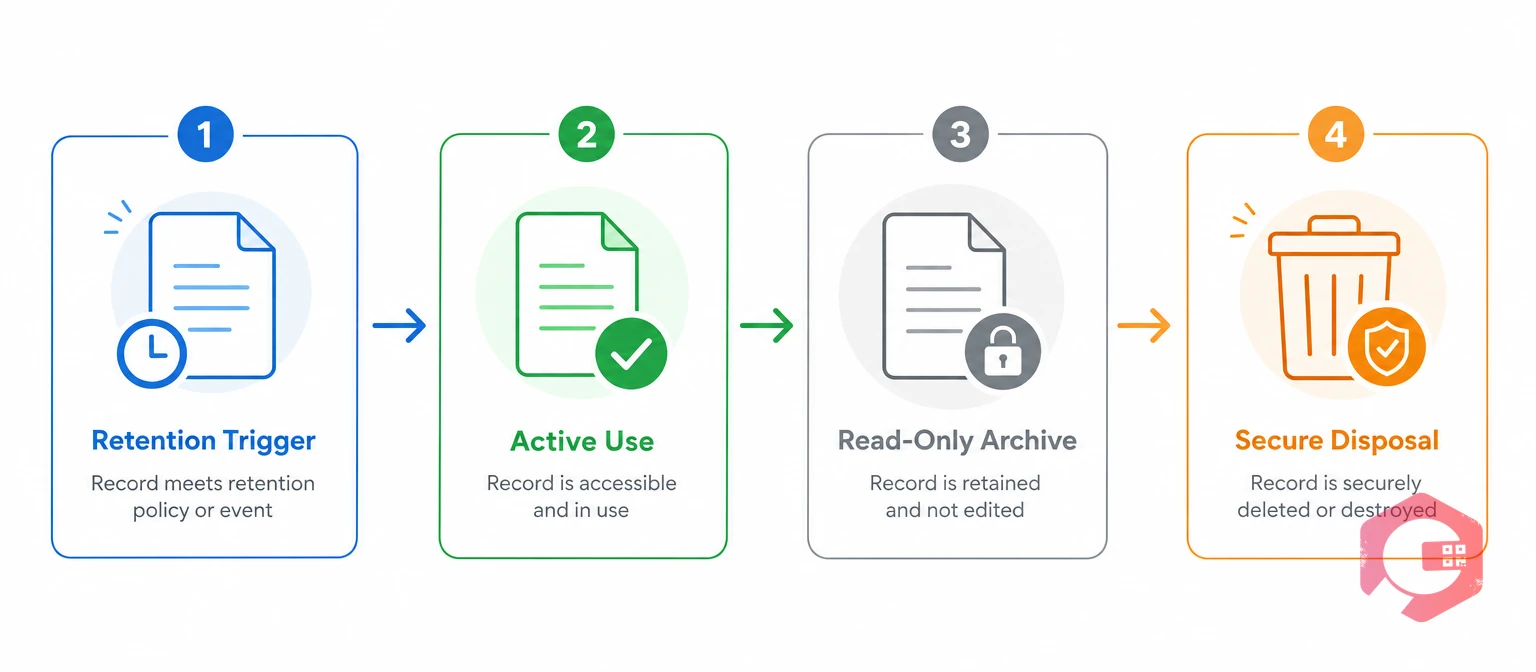
Maintenance data retention is the practice of keeping maintenance records for a defined period before archiving or deleting them. The right period depends on the record type, the industry and the country where the asset operates.
A retention trigger is the event that starts the retention clock for a record. The most common triggers are:
Regulators such as OSHA, the FAA and the FDA set minimum periods for named records. Asset management standards such as ISO 55001 require documented information but leave the period to you, so most maintenance teams need their own written rules.
Retention is a policy decision tied to record types and events, not a single number.

Every record that shows what was done to an asset, when, by whom and with what result falls under a retention policy. Most facilities hold eight core record types:
Digital work order management keeps these records linked to the asset, so the history is complete when an auditor asks for it.
Classify records first, because maintenance data retention rules attach to the record type, not to the system that stores it.
US federal retention periods for maintenance-related records range from three months to the life of the asset. The table below summarizes the most common maintenance data retention rules, checked against the regulation text.
| Regulation | Industry | Record | Minimum Retention |
|---|---|---|---|
| FAA 14 CFR 91.417 | Aviation | Maintenance and inspection records | Until the work is repeated or superseded, or 1 year |
| FAA 14 CFR 91.417 | Aviation | Status records (total time, life-limited parts, AD status) | Life of the aircraft; transferred at sale |
| FDA 21 CFR 211.180 | Pharmaceuticals | Production records, including equipment logs | 1 year after batch expiry |
| OSHA 29 CFR 1910.119 | Chemicals, oil and gas | Process hazard analyses | Life of the process |
| OSHA 29 CFR 1910.119 | Chemicals, oil and gas | Incident investigation reports | 5 years |
| OSHA 29 CFR 1926.1412 | Construction | Crane monthly / annual inspections | 3 months / 12 months |
| EPA 40 CFR 112.7(e) | Oil storage | Signed inspection and test records | 3 years |
| FMCSA 49 CFR 396.3 | Commercial fleets | Inspection, repair and maintenance records | 1 year, plus 6 months after the vehicle leaves |
| PHMSA 49 CFR 192.709 | Gas pipelines | Pipe repair records | As long as the pipe is in service |
The OSHA process safety management standard requires every mechanical integrity inspection to be documented but sets no fixed period, so most sites keep those records for the life of the process. State law, insurer terms and customer contracts can add longer periods, so apply the longest rule that fits.
Preparing for an audit? Use the free maintenance audit checklist to confirm every required record is in place.
Maintenance data retention matters because a missing record is usually treated as work that was never done. Auditors, insurers and courts all look for written proof.
Regulators can cite, fine or ground equipment when required records are missing. For example, FAA rule 14 CFR 91.417 requires aircraft status records to transfer with the aircraft when it is sold.
After an incident, maintenance history is central evidence. Under Federal Rule of Civil Procedure 37(e), losing electronic records that should have been kept can lead to court-ordered remedies, and intentional loss can end in a default judgment.
Metrics such as MTBF and failure-mode trends need several years of history. Maintenance teams that delete records after a year or two lose the data they need for root cause analysis.
OEM warranties often require proof of scheduled maintenance. Complete histories also support resale value, insurance valuation and due diligence.
Good retention turns records from a storage cost into evidence and reliability data.
Both extremes cost money. Deleting too early creates compliance and legal exposure, while keeping everything forever adds storage, discovery and privacy risk.
| Risk Area | Keeping Too Little | Keeping Too Much |
|---|---|---|
| Compliance | Citations, failed audits, grounded vehicles or aircraft | Breaches privacy limits on personal data |
| Legal | Sanctions for lost evidence; no records to defend a claim | Wider e-discovery; old records used against you |
| Operations | No failure history for RCA or MTBF | Cluttered search; outdated procedures still in use |
| Cost | Repeat failures and lost warranty claims | Storage, backup and migration costs that grow every year |
A legal hold is an instruction to preserve records linked to a dispute, overriding normal disposal. Courts and regulators generally accept routine disposal that follows a documented policy, as long as legal holds are respected.
In the EU, GDPR Article 5 also sets a ceiling: personal data such as technician names must be kept no longer than necessary. The answer is a written schedule, applied the same way every time.
A retention schedule is a table that sets how long each record type is kept and what starts the clock. Use the baseline below, extend any row a regulation covers, and confirm final periods with your legal or compliance team.
| Record Type | Suggested Baseline | Clock Starts At | Reason |
|---|---|---|---|
| Asset register and lifetime history | Life of asset + 7 years | Asset disposal | Tax periods and latent-defect claims |
| Statutory inspections and tests | Regulatory period or 2 inspection cycles, whichever is longer | Next inspection | Shows the trend between inspections |
| Corrective and emergency work orders | 7 years | Work order closure | Failure analysis and liability evidence |
| PM completions | 7 years; life of asset if safety-critical | PM completion | Proves the program ran as planned |
| Calibration records | Life of instrument + longest product retention | Instrument retirement | Supports product quality claims |
| Spare parts with lot or serial numbers | 7 years; life of asset for critical spares | Part installation | Recalls and counterfeit-part checks |
| Safety, LOTO and permit records | 5 years minimum | Permit closure | Matches OSHA incident and log periods |
| Raw sensor data | 1 to 3 years, then daily summaries | Data capture | Highest volume; trends survive as summaries |
Treat this baseline as a floor for regulated sites, not a ceiling.
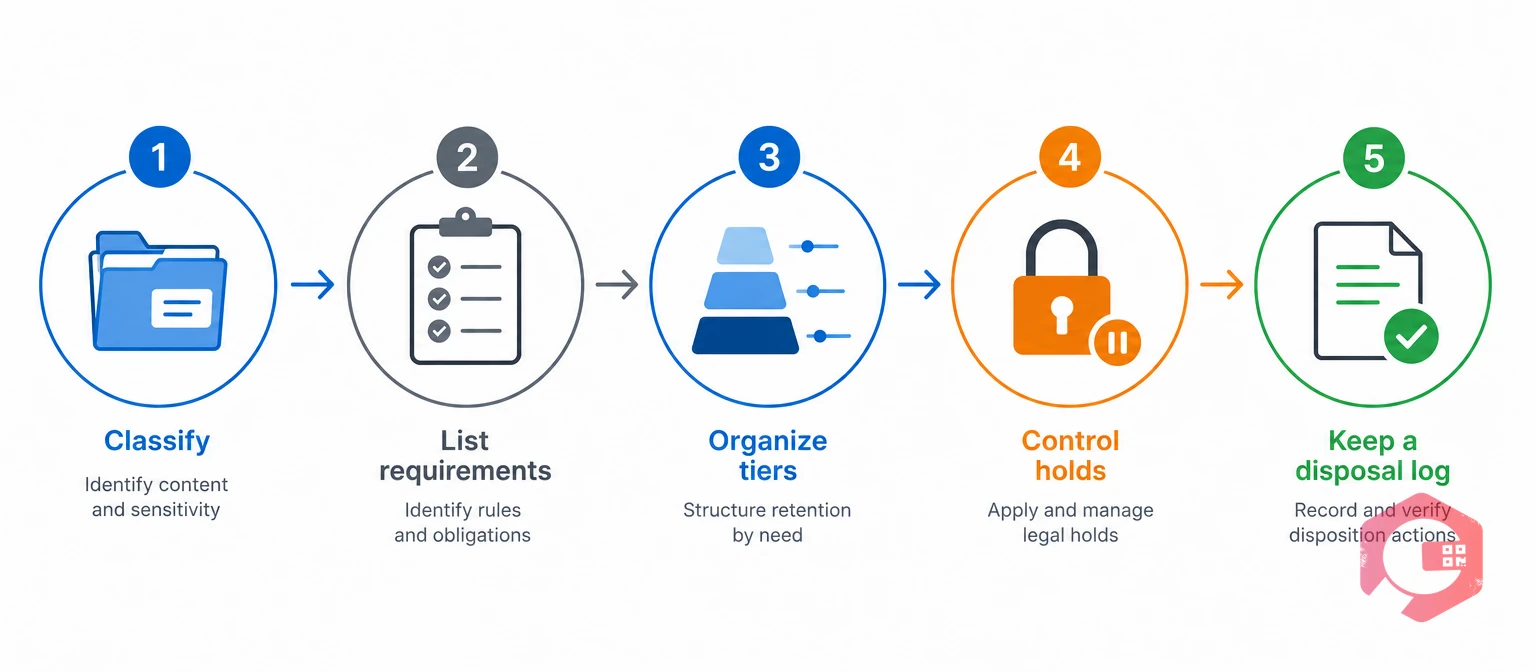
A maintenance data retention policy works when maintenance, EHS, quality, IT and legal own it together. Most teams can build one in five steps with the framework below.
The CLOCK Retention Framework:
Review the policy every year, and test that archived records can still be opened and searched.
A policy only works when your system enforces it, so the tool that stores your records matters as much as the rules.
Cryotos keeps every asset, work order and inspection in one cloud-based Computerized Maintenance Management System, with a timestamp and sign-off on each task.
Maintenance teams using Cryotos have reported up to 30% reduction in unplanned downtime and 25% faster repair turnaround. The same history that proves compliance also shows where failures repeat.
Keep asset-level history for the life of the asset plus about seven years, and keep work orders for at least seven years. That covers most tax, warranty and liability periods.
OSHA requires documentation for specific equipment, such as process safety mechanical integrity tests and crane inspections. Construction crane monthly inspection records must be kept for 3 months, and annual inspection records for 12 months.
Routine maintenance and inspection records must be kept until the work is repeated or superseded, or for one year after the work. Status records, such as total time and life-limited part status, stay with the aircraft for its whole life.
FMCSA rules require inspection, repair and maintenance records to be kept for one year where the vehicle is housed or maintained. They must also be kept for six months after the vehicle leaves the carrier's control.
Yes, in most industries, as long as records are complete, protected from unauthorized edits and retrievable on request. FDA-regulated sites must also meet 21 CFR Part 11 rules for electronic records and signatures.
Yes, once every applicable period has expired and no legal hold applies. Routine disposal under a written policy lowers storage costs and legal exposure.
Strong maintenance data retention starts with records that are complete, searchable and tied to each asset. Schedule a free demo to see how Cryotos keeps every work order, inspection and asset history audit-ready.



Cryotos AI predicts failures, automates work orders, and simplifies maintenance—before problems slow you down.



