

A maintenance quality management system is a set of standards, checks, and records that proves every maintenance job was done right, verified, and documented. You build one inside a Computerized Maintenance Management System by turning quality rules into work order steps: clear acceptance criteria, digital checklists, sign-off gates, and tracked corrective actions.
Most maintenance teams already track whether work gets done. Far fewer track whether it was done well. That gap shows up as reopened work orders, repeat failures, and painful audit findings. This guide walks through seven steps to build a maintenance quality management system in your CMMS, plus a KPI scorecard that proves it works.
Key Takeaways

A maintenance quality management system is a structured way to plan, check, and improve the quality of maintenance work itself. It covers how jobs are specified, how technicians prove they met the standard, and how the team fixes the cause when they don't.
It is not the same as a plant-wide product quality system. A product QMS asks, "Did we ship a good part?" A maintenance quality management system asks, "Did we repair, inspect, and service this asset to the standard we set?" Both matter. The second one protects the first. Several well-known standards already expect maintenance quality controls:
In practice, this means your maintenance records must stand up as quality evidence, not just a to-do list. The takeaway: a maintenance quality management system turns "we fixed it" into "we fixed it to standard, and here is the proof."
Maintenance teams need a maintenance quality management system because poor-quality work costs more than slow work. A rushed repair that fails two weeks later costs the repair twice, plus the downtime, plus any scrap the failing machine produced along the way.
Most facilities see the same warning signs before they formalize quality:
Each sign points to the same root problem: quality lives in people's heads, not in the system. Pairing quality data with downtime tracking shows the real cost, because every repeat failure also appears as lost production hours on that asset.
The takeaway: if you can't prove a job was done right, you can't stop it from being done wrong again.
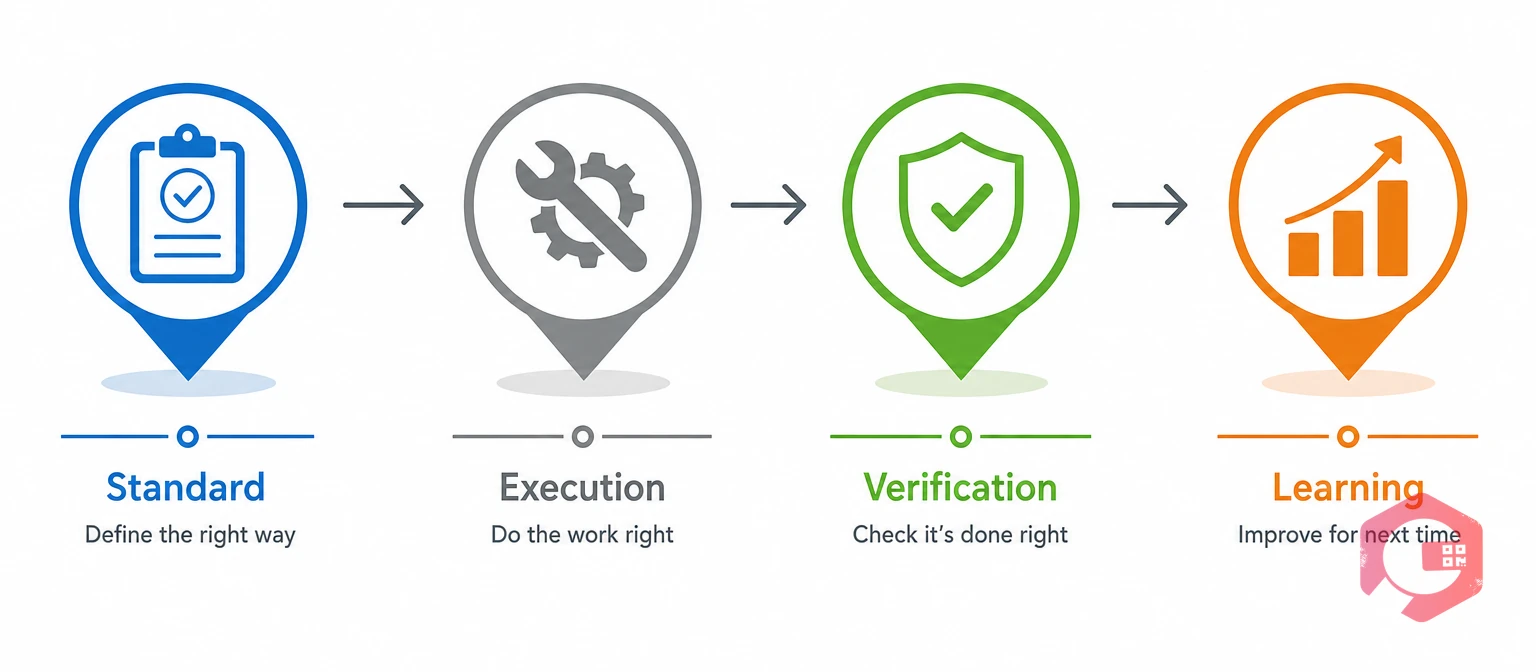
The simplest way to design a maintenance quality management system is to treat every job as passing through four gates. A quality gate is a checkpoint a job must pass before it can move to the next stage.
The Four-Gate Maintenance Quality Framework:
Gates 1 and 4 are the ones most teams skip. Without Gate 1 there is nothing to verify against, and without Gate 4 the same mistakes keep coming back. In a CMMS, each gate maps to a feature you already have: task libraries, mobile checklists, approval workflows, and reports. The takeaway: build all four gates, even if some start simple.
Want a quick baseline before you build? Score your current controls with the free maintenance audit checklist and see which gates are missing today.
Start your maintenance quality management system by defining what "done right" means for each type of maintenance work. A standard with no numbers can't be checked, so every standard needs measurable acceptance criteria.
Group your work into task types first, such as PM inspections, lubrication, electrical repairs, and calibrations. Then write one standard for each type that covers these points:
Don't try to write 300 standards in a month. Start with your critical assets and the task types behind your most frequent reopened jobs. An asset and equipment inspections checklist gives you a solid template for writing inspection criteria quickly.
Before you publish a standard, test it with two or three experienced technicians. Ask them to follow it on a real job and point out steps that are unclear or impossible in the field. Their feedback turns a desk-written document into one that works on the shop floor.
A good rule of thumb is 10 to 20 standards in the first quarter, covering the assets that cause the most downtime or safety risk. The takeaway: a short list of clear, numeric standards beats a long list of vague ones.
Turn each standard into a step-by-step procedure inside your CMMS, so technicians see the quality requirements at the moment they do the work. Paper SOPs in a binder rarely get opened on the shop floor.
Digital maintenance checklists make the standard hard to skip. Build them with these field types:
Most maintenance teams find that checklists with more than 25 items get "pencil-whipped," or ticked without real checking. Split long procedures into stages, and put the critical quality checks at the end, where they verify the finished job.
Also make sure checklists work offline on mobile devices. Technicians in basements, tank farms, and remote sites still need to record readings in real time. The takeaway: a checklist only protects quality if technicians can finish it in the field.
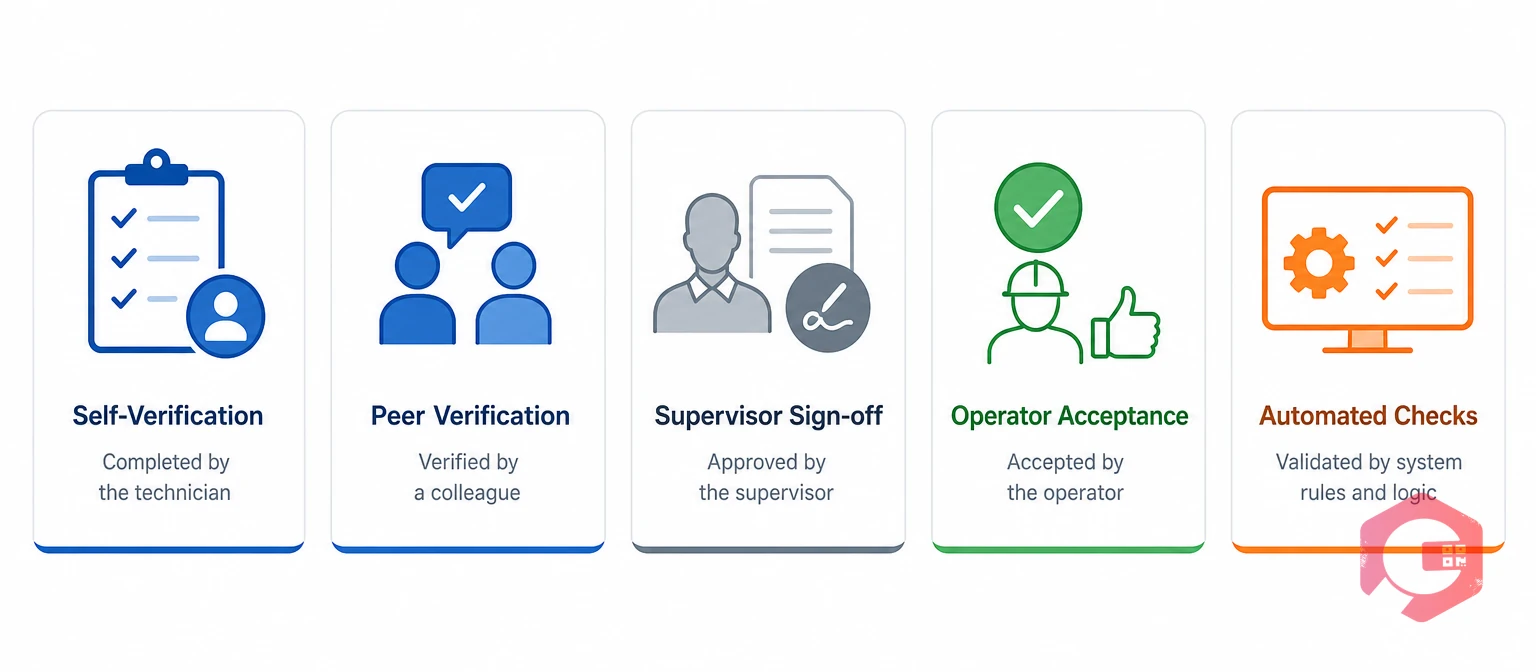
Add a verification step to every work order type that carries quality risk. Verification is the step that stops a bad job from being marked complete and forgotten.
Match the verification method to the risk of the task:
Set these rules in work order management, so each work order type carries its own approval flow. Maintenance teams using Cryotos have reported up to 30% reduction in unplanned downtime and 25% faster repair turnaround, and verified closures play a big part, because fewer jobs come back.
Keep verification proportional. If every small job needs three signatures, people start signing without looking. The takeaway: verify by risk, and let the system enforce the rule instead of relying on memory.
A maintenance quality management system only works if people use the current procedure and are qualified to follow it. ISO 9001 covers both needs, under documented information in clause 7.5 and competence in clause 7.2.
Put these controls in place inside your CMMS:
Most facilities already keep training records somewhere, often in a spreadsheet owned by HR. The gain comes from connecting those records to job assignment, so the system checks qualifications before work starts instead of an auditor checking them months later.
The takeaway: the right procedure in the hands of the right person is the foundation of quality maintenance work.
Track every quality failure as a nonconformance and run it through corrective action until the cause is removed. A maintenance nonconformance is any job, reading, or result that fails to meet its defined standard.
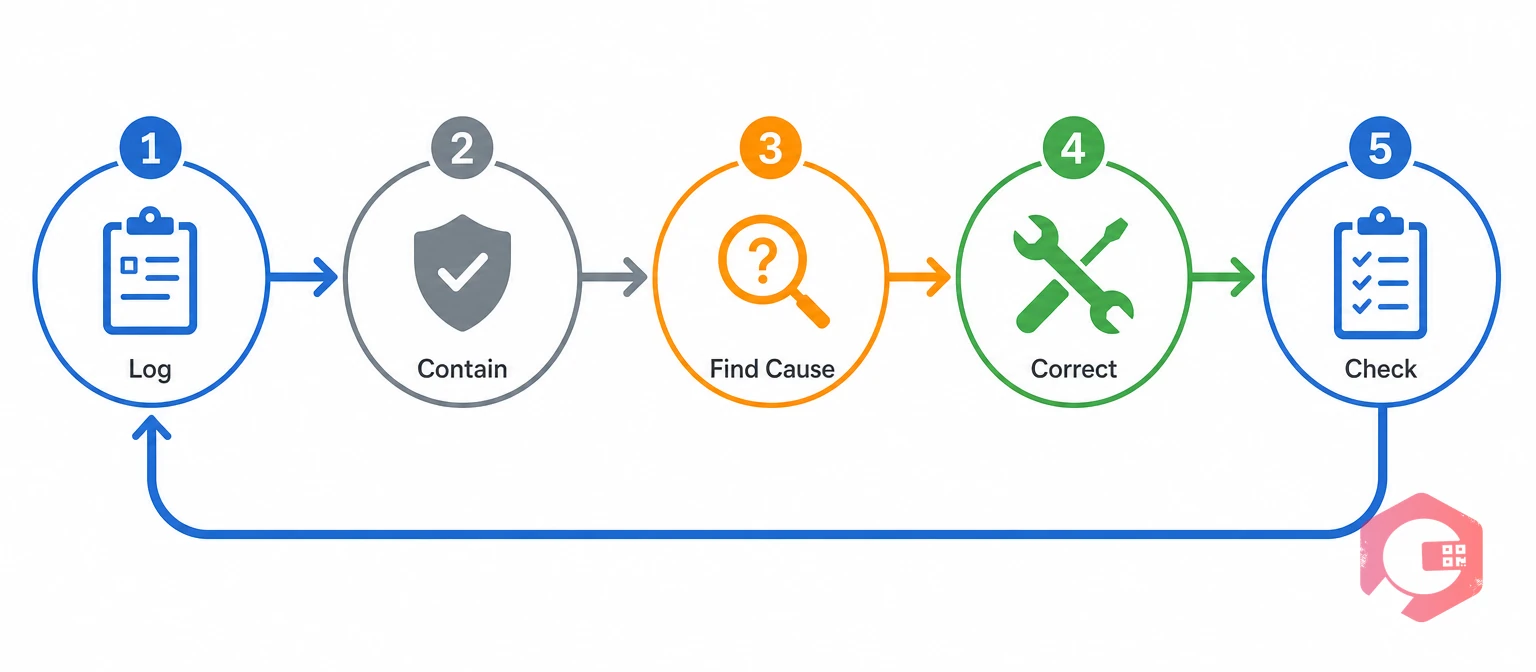
Nonconformances come from failed checklist items, reopened work orders, failed verifications, and audit findings. Handle each one with a simple corrective and preventive action (CAPA) loop:
Here is how the loop works on a real job. A cooling water pump, P-07, is reopened nine days after a mechanical seal replacement because it is leaking again. The CMMS logs the reopened job as a nonconformance against the pump and the seal replacement task type.
ISO 9001 clause 10.2 asks for this same sequence: react, find the cause, act, and review whether the action worked. A common mistake is stopping at "contain it." Fixing a loose bolt is a repair; fixing the reason the bolt was loose is corrective action.
The takeaway: every nonconformance should end with a change to the system, not just a fixed machine.
Audit your maintenance quality management system on a fixed schedule to confirm the controls work in practice, not just on paper. ISO 9001 clause 9.2 calls for planned internal audits, and maintenance should be part of that plan.
Run three types of audits, each at its own pace:
Pick samples from critical assets, newly hired technicians, and recently changed procedures, because those are where gaps usually hide. Avoid sampling only the best technicians or the easiest jobs, since that gives a false sense of security.
Log each finding as a nonconformance so it enters the CAPA loop from Step 5. The takeaway: audits are only useful when their findings change something.
Measure your maintenance quality management system with KPIs that track how well work is done, not only how fast. Speed metrics like MTTR alone can reward rushed jobs that fail again next week.
| KPI | Formula | What It Shows | CMMS Data Source | Healthy Trend |
|---|---|---|---|---|
| First-time fix rate | Jobs closed with no rework ÷ total jobs closed × 100 | Whether work is done right the first time | Work order history | Rising |
| Reopened work order rate | Jobs reopened within 30 days ÷ jobs closed × 100 | Hidden rework | Work order status log | Falling |
| Checklist compliance | Mandatory items completed ÷ mandatory items assigned × 100 | Whether standards are followed | Checklist records | Close to 100% |
| Verification pass rate | Jobs passing first verification ÷ jobs verified × 100 | Quality of execution | Approval records | Rising |
| Repeat failure rate | Repeat repairs on the same asset and failure mode within 90 days ÷ corrective jobs × 100 | Whether root causes are removed | Failure codes | Falling |
| CAPA on-time closure | CAPAs closed by due date ÷ CAPAs due × 100 | Discipline of improvement | Nonconformance log | Rising |
| Findings per audit | Audit findings ÷ audits completed | Maturity of the system | Audit records | Falling |
Build these metrics into a maintenance KPI dashboard, so supervisors see them weekly without exporting spreadsheets. Break each KPI down by asset class, site, and task type to find where quality slips.
Set a baseline in the first month, then review trends each quarter. The takeaway: a falling reopened work order rate is the clearest sign your quality system is working.
Most maintenance quality programs fail on follow-through, not design. A common mistake is building the paperwork without changing how work orders really flow.
Teams that successfully build quality into maintenance usually start small, with a handful of critical assets and one clear KPI. The takeaway: a small system that people use beats a perfect system that sits on a shelf.
TPM quality maintenance focuses on keeping equipment in the condition that produces zero product defects. A maintenance quality management system focuses on the quality of the maintenance work itself. The two support each other, because well-executed maintenance keeps equipment in the condition TPM needs.
No. You can build a maintenance quality management system without any certification. However, if your plant is ISO 9001 certified, the system helps you meet clauses on infrastructure, documented information, competence, internal audits, and corrective action.
Most teams can launch a pilot in 60 to 90 days. That covers 10 to 20 standards, digital checklists, verification rules, and a basic KPI dashboard for critical assets. Expanding to the full site usually takes another two to three quarters.
First-time fix rate, reopened work order rate, and repeat failure rate are the three strongest signals. Checklist compliance and verification pass rate show whether technicians follow the standard. Track them together, since any single metric can be gamed.
Yes. A small team can rely on the CMMS to enforce mandatory fields, reading limits, and approvals automatically. The main time cost is writing the first standards and reviewing KPIs monthly, which usually takes a few hours per month.
A maintenance quality management system works best when quality rules live inside every work order, not in a binder. Schedule a free demo to see how Cryotos builds standards, checklists, sign-offs, and quality KPIs into your daily maintenance workflow.



Cryotos AI predicts failures, automates work orders, and simplifies maintenance—before problems slow you down.



