
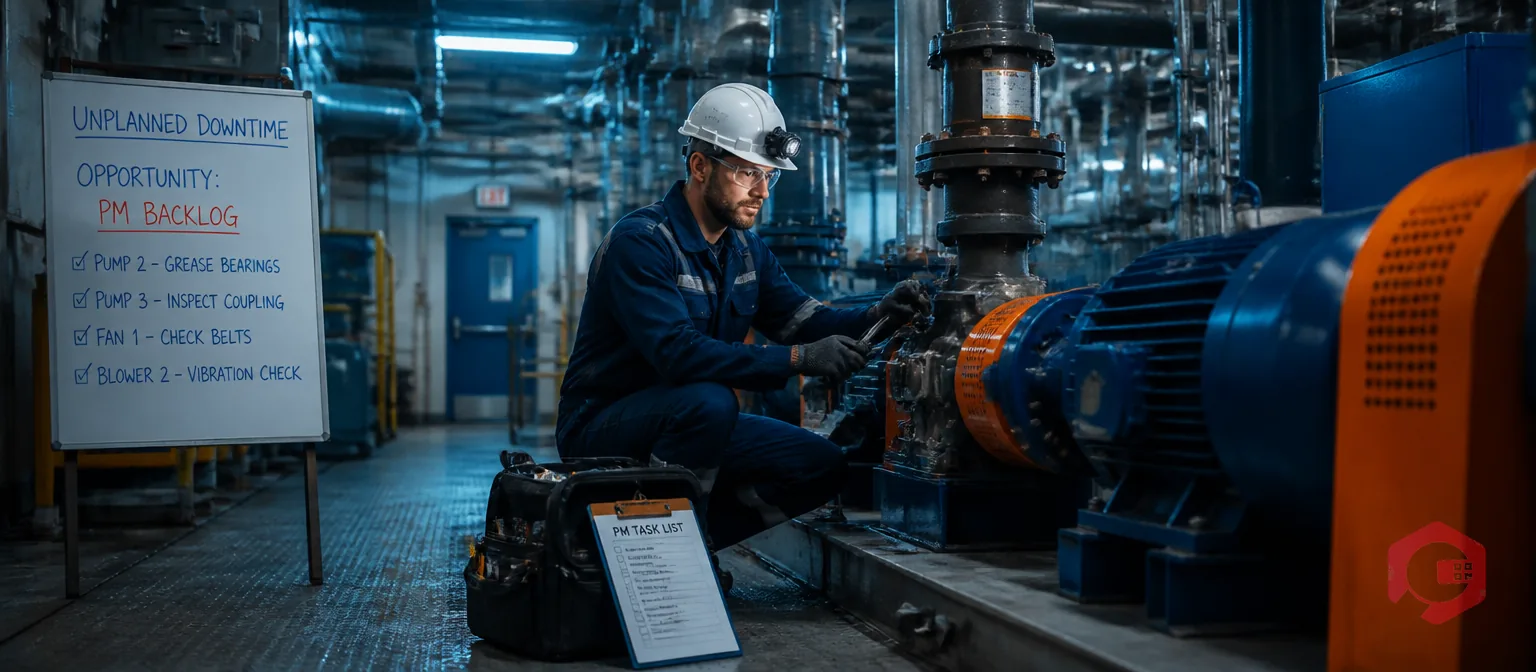
Opportunistic maintenance is a proactive maintenance strategy that uses unplanned equipment stoppages — breakdowns, material shortages, shift changeovers, or process interruptions — as windows to complete preventive maintenance tasks that would otherwise require a dedicated planned shutdown. Instead of treating every unplanned stop as pure downtime loss, opportunistic maintenance turns idle equipment time into productive maintenance time. According to Plant Engineering's annual maintenance benchmarking research, unplanned downtime accounts for 20–40% of total plant downtime in most industrial facilities — representing a significant reservoir of maintenance time that most teams never tap. Opportunistic maintenance is the discipline that changes that.
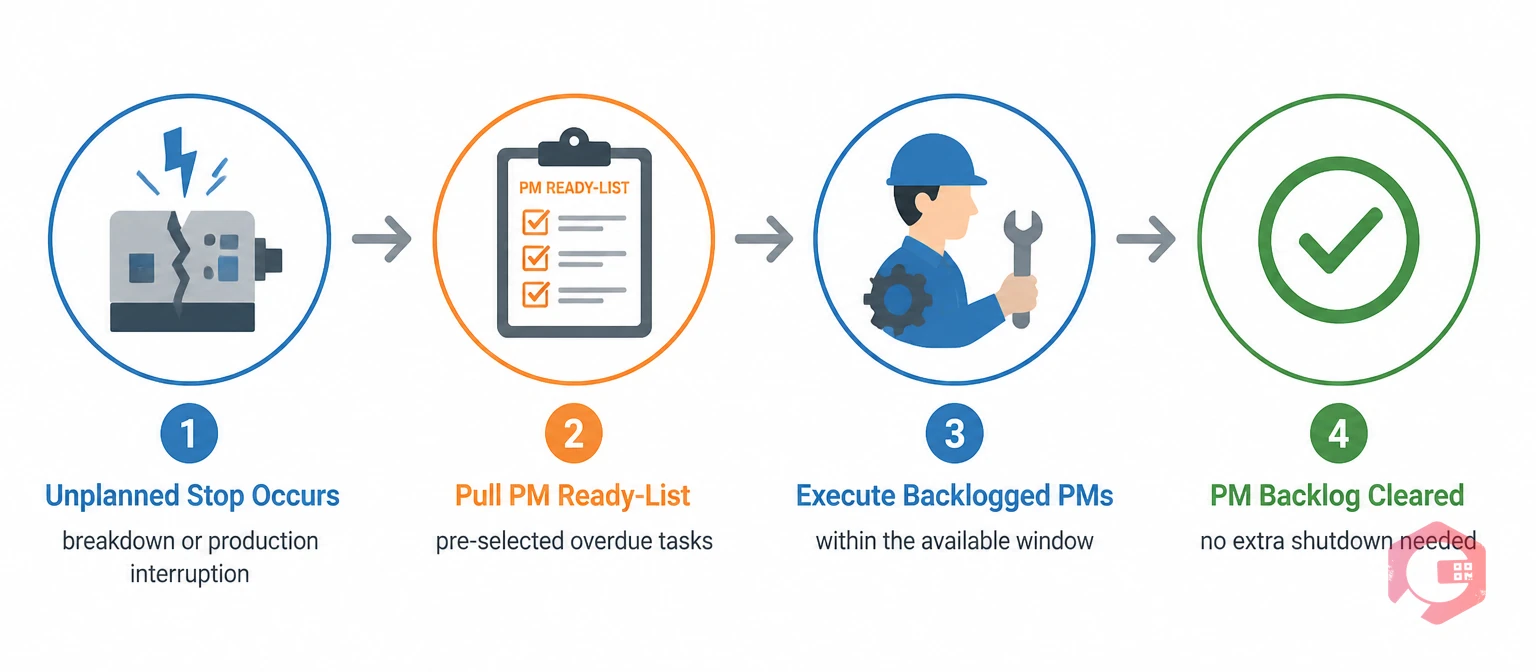
Opportunistic maintenance is the practice of performing pre-selected, ready-to-execute preventive maintenance tasks on equipment the moment that equipment becomes unexpectedly unavailable for production. The word "opportunistic" is precise: it refers to taking advantage of an opportunity — the unplanned stop — rather than waiting for the next scheduled maintenance window.
The concept originated in Reliability-Centered Maintenance (RCM) frameworks, where it was recognized that forcing maintenance work into scheduled shutdowns was inefficient when equipment occasionally became available at other times due to breakdowns, material delays, or production changes. Rather than letting technicians stand idle or redeploy to other tasks while waiting for a line restart, a well-prepared maintenance team can immediately switch to planned PM work — completing backlog items against an asset that is already stopped and isolated.
The critical prerequisite is preparation. Opportunistic maintenance only works if your team has a pre-built list of PM tasks that are ready to execute — with parts on hand, checklists prepared, and technicians trained — before the opportunity arises. A breakdown that lasts 45 minutes is useless as a maintenance window if the team spends the first 30 minutes figuring out what to do.
Understanding where opportunistic maintenance fits alongside your other strategies is essential for building a coherent maintenance program. The three approaches serve different purposes and apply to different situations.
| Aspect | Planned Maintenance | Opportunistic Maintenance | Reactive Maintenance |
|---|---|---|---|
| Trigger | Scheduled by calendar, usage hours, or condition data | Triggered by an unplanned equipment stop | Triggered by equipment failure |
| Equipment State | Stopped specifically for maintenance | Already stopped for another reason | Failed — requires immediate repair |
| Planning Level | Fully pre-planned — tasks, parts, crew | Pre-prepared tasks executed in real time | Unplanned — reactive response |
| Production Impact | Causes planned production loss | No additional production loss — uses existing downtime | Causes unplanned production loss |
| Primary Goal | Prevent failures on a predictable schedule | Clear PM backlog without extra shutdowns | Restore equipment to service |
| Cost Profile | Moderate — coordinated labor and parts | Low — labor already on site, no extra shutdown cost | High — emergency labor, expedited parts, lost production |
Most maintenance teams treat unplanned stoppages as purely negative events. The response is linear: diagnose the fault, repair it, restart the line, document the event. The time between the fault occurring and the repair being completed — which can range from 20 minutes to several hours — is treated as dead time for the maintenance team.
This is a missed opportunity at scale. Consider a manufacturing plant with five production lines, each experiencing an average of three unplanned stops per week ranging from 30 to 90 minutes each. That adds up to between 7.5 and 22.5 hours of unplanned stoppage per line per week. Across five lines, the facility has 37.5 to 112.5 hours of equipment idle time every week — time when assets are stopped, isolated, and accessible to technicians who are already on site.
Research from McKinsey's analysis of maintenance efficiency programs found that facilities with structured opportunistic maintenance programs captured 15–25% of their scheduled maintenance backlog through unplanned stops alone. That is maintenance work that gets done without requiring any additional planned shutdown — no additional production loss, no overtime, no coordination burden for scheduling.
The PM backlog problem is real in most industrial facilities. When production schedules are tight, planned maintenance windows get squeezed or deferred. Tasks fall behind. Backlog grows. The risk of failure from deferred maintenance compounds. Opportunistic maintenance is one of the most practical tools for keeping backlog under control without constantly fighting for scheduled downtime against production priorities.
The key insight is that opportunistic maintenance does not create additional downtime — it recaptures downtime that was already lost. The production loss from the unplanned stop is fixed, regardless of whether the maintenance team uses that time productively or not. Using it productively converts a pure loss into a partial gain.
The foundation of any successful opportunistic maintenance program is a pre-built ready-list: a curated, prioritized set of PM tasks that can be executed quickly within the duration of a typical unplanned stop. Without this list, the opportunity is gone before the team figures out what to do with it.
Not every PM task belongs on your ready-list. Use these five criteria to select and prioritize tasks:
Your preventive maintenance software should be able to generate a filtered list of overdue or near-due PM tasks for any asset at any moment — this is the raw material for building your ready-list. Sort by how overdue the task is, filter by estimated duration, and cross-reference with current inventory levels. The result is a prioritized ready-list that your technicians can act on immediately when an opportunity opens.
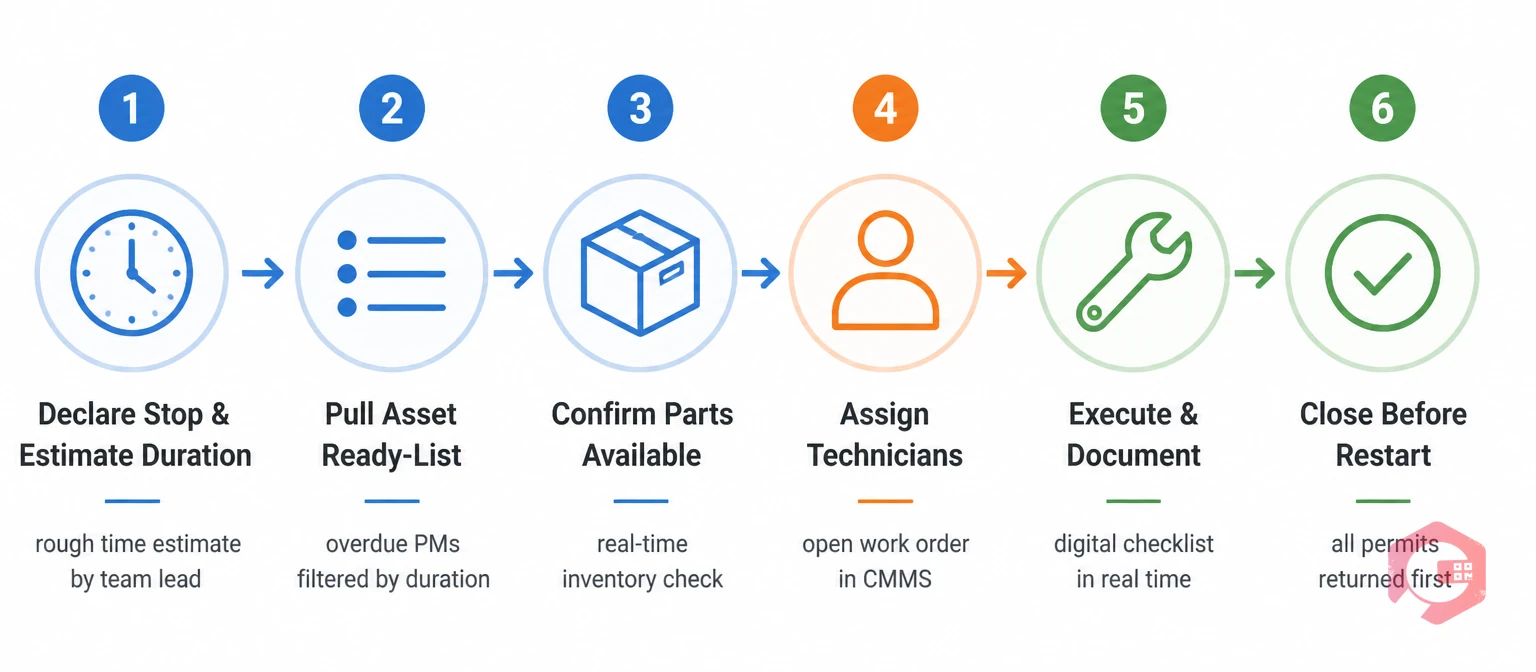
When an unplanned stop occurs, most facilities lose 5–15 minutes to the initial confusion of diagnosing the fault, notifying the team, and figuring out next steps. A structured opportunistic maintenance process compresses this to under 2 minutes. Here is a practical step-by-step flow:
Opportunistic maintenance during unplanned stops carries a specific safety risk that does not exist during planned shutdowns: the pressure to move quickly. When production is stopped unexpectedly and the clock is ticking toward a restart, there is real organizational pressure to cut corners on isolation and safety procedures. This pressure kills people.
The non-negotiable rule is this: every opportunistic maintenance task must follow the same lockout/tagout (LOTO) and permit-to-work procedures that apply during planned maintenance. The fact that the equipment is already stopped for a breakdown does not mean it is safely isolated. The breakdown may have been an electrical fault — with energy still present in the system. Or the line may be restarted unexpectedly while a technician is inside a guarded zone.
Several practical safeguards help manage this risk in an opportunistic maintenance program. First, include a safety pre-check in the ready-list selection step — every task on the ready-list should have its LOTO and permit requirements pre-documented, so there is no ambiguity about what isolation is needed before the task can start. Second, communicate clearly between the breakdown repair crew and the opportunistic PM crew — both teams need to know what the other is doing, and any restart decision must go through a single coordinator who confirms all active work orders are closed and all personnel are clear before the start command is given.
The permit-to-work module in Cryotos manages this directly. Opportunistic work orders trigger the same permit and LOTO workflows as planned work orders — the permits are issued digitally, the isolation steps are confirmed by the technician before work begins, and the system prevents premature restart until all active permits are closed and returned.

Opportunistic maintenance is conceptually simple but operationally demanding. The challenge is speed: when an unplanned stop opens a 45-minute window, the team has minutes — not hours — to identify the right tasks, confirm parts availability, assign technicians, and get to work. Without a digital system, this coordination is nearly impossible at any significant scale.
A Computerized Maintenance Management System is the operational backbone of an effective opportunistic maintenance program. Cryotos CMMS supports every step of the process in a way that makes the opportunistic window accessible rather than stressful.
The downtime tracking module records every unplanned stop in real time, creating a historical picture of where and when opportunistic windows arise most frequently. This data lets maintenance planners pre-assign ready-lists to the assets most likely to experience unplanned stops — so when a breakdown occurs, the ready-list is already waiting.
The PM scheduling module maintains a live view of every overdue and near-due PM task across all assets. Filtered by asset, by estimated duration, and by available parts, this view becomes your opportunistic ready-list — auto-generated by the system rather than manually maintained by a planner. When a stop occurs, the technician pulls up the asset in the Cryotos mobile app, taps "overdue PMs," and immediately sees a prioritized list of executable tasks.
The inventory management module shows real-time parts availability against each PM task. A technician can confirm in seconds whether the parts needed for a specific task are in stock before committing to it — preventing the frustrating scenario where a technician starts a PM only to discover a critical part is missing halfway through.
The work order management system creates, assigns, and tracks opportunistic work orders with the same rigor as planned work orders. Every opportunistic PM task has a timestamped record: who executed it, what was found, what parts were used, and how long it took. This record feeds back into your BI dashboard, where you can track how much PM backlog you are clearing through opportunistic execution versus planned shutdowns.
Over time, this data reveals which assets generate the most opportunistic opportunities, whether those opportunities are being fully utilized, and how much backlog reduction is being achieved through the program. Cryotos customers using structured opportunistic maintenance programs alongside their planned PM schedules report 30% reductions in overall downtime and 25% faster repair times — outcomes that compound as backlog clears and the condition of the asset fleet improves.
For manufacturing teams dealing with persistent PM backlog and tight production schedules, the manufacturing maintenance software in Cryotos gives you the real-time visibility to make opportunistic maintenance a systematic capability rather than an occasional lucky accident. Explore how the workflow automation features can automatically surface ready-list tasks the moment an unplanned stop is logged — so your team acts in minutes, not hours.
Opportunistic maintenance is the practice of performing pre-selected preventive maintenance tasks on equipment during unplanned stops — breakdowns, material shortages, or other production interruptions — that would otherwise require a dedicated planned shutdown. It converts downtime that was already lost into productive maintenance time, reducing PM backlog without creating additional production losses.
Reactive maintenance is a response to a failure — the equipment has broken down and needs to be repaired. Opportunistic maintenance is proactive — it uses the downtime created by a breakdown (or other stop) to complete scheduled PM tasks on equipment that is already stopped and accessible. The two types of work can happen simultaneously: one crew repairs the breakdown while another executes opportunistic PM tasks on the same or adjacent equipment.
The best candidates are tasks that can be completed within 30–60 minutes, require only the materials available in stock, do not need isolation of additional equipment beyond what is already stopped, and are overdue or approaching their due date. Lubrication tasks, visual inspections, filter changes, belt tension checks, sensor calibrations, and minor adjustments are typically good candidates. Major overhauls or tasks requiring specialized tooling brought in from off-site are not.
A CMMS provides the real-time visibility that makes opportunistic maintenance practical at scale. It generates a live list of overdue and near-due PM tasks filtered by asset and estimated duration, confirms parts availability in seconds, creates and assigns work orders quickly, and tracks all opportunistic maintenance in the same audit trail as planned work. Without a CMMS, the coordination overhead of identifying, assigning, and documenting opportunistic tasks within a 30–45 minute window is too high for most teams to manage consistently.
Yes. The primary risk is organizational pressure to skip or rush lockout/tagout and permit-to-work procedures because the stop is unplanned and everyone is focused on getting the line restarted. Every opportunistic task must follow the same safety isolation requirements as planned maintenance — no exceptions. The risk is managed by pre-documenting LOTO requirements for every task on the ready-list, clearly separating the breakdown repair team from the opportunistic PM team, and requiring all active work orders to be closed and permits returned before any restart is authorized.
If your maintenance team is losing PM backlog battles because production schedules leave no room for planned shutdowns, opportunistic maintenance is one of the most practical tools available. Cryotos CMMS gives you the real-time PM visibility, instant work order creation, parts availability confirmation, and digital checklists to turn every unplanned stop into a productive maintenance window. Explore Cryotos CMMS and see how structured opportunistic maintenance works in practice.




Cryotos AI predicts failures, automates work orders, and simplifies maintenance—before problems slow you down.



