

PDCA in maintenance means running every work order as a small Plan-Do-Check-Act cycle. You plan the job around a clear prediction, do the work and record what happened, check the result against the plan, and act by updating the standard for the next job. Most maintenance teams plan and execute well. Where they fall short is Check and Act, so the same failures and the same planning errors keep coming back.
Below you will see which fields to fill at each stage, which KPIs to review at close-out, and how one pump seal repair became a standard for every similar asset.
Key Takeaways
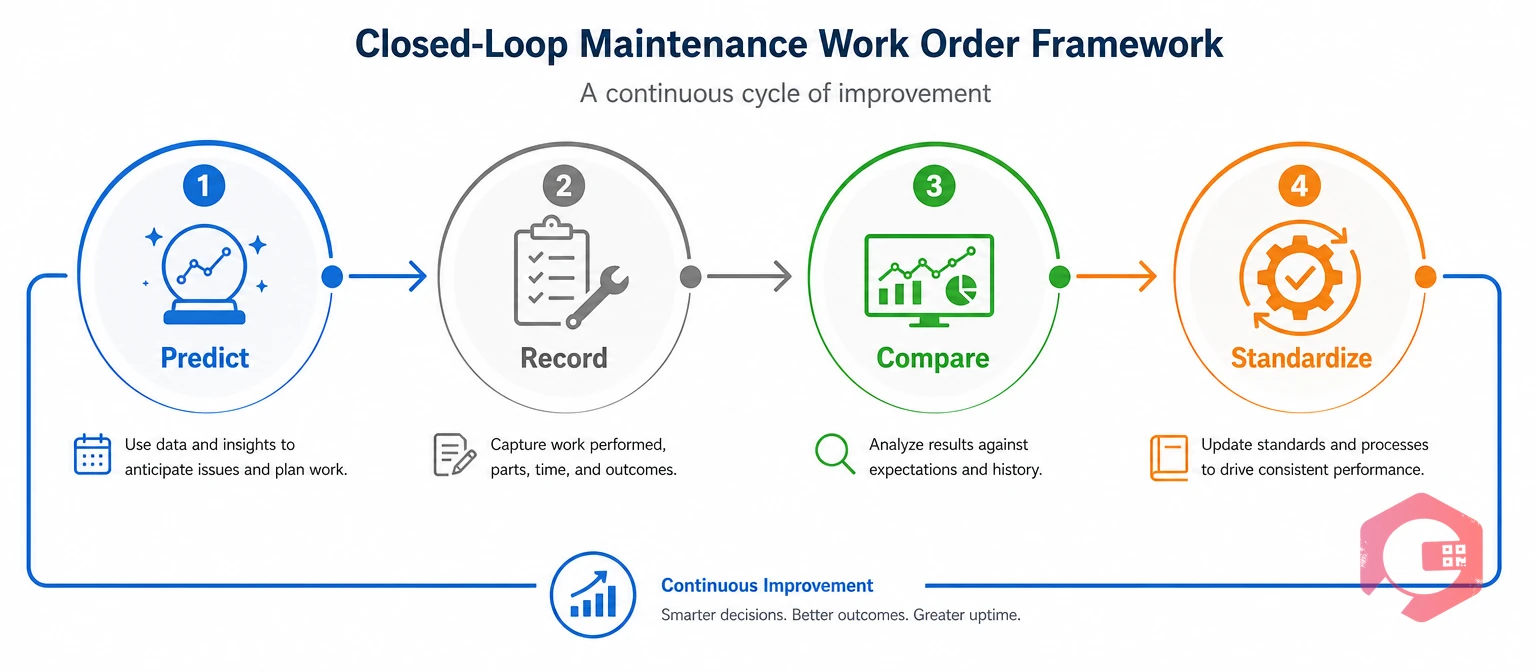
PDCA in maintenance is a four-stage loop that treats each work order as a small, testable experiment. Each job gets a prediction, a record, a review, and a change to the standard for the next job.
The cycle grew out of Walter Shewhart's work and was popularized by W. Edwards Deming. ISO 55001 for asset management is built on it, and SMRP metrics like MTBF and MTTR give the Check stage a shared language. A Computerized Maintenance Management System holds every field the loop needs in one record.
The Closed-Loop Work Order Framework:
| Work Order Step | PDCA Stage | What to Capture | Typical Owner |
|---|---|---|---|
| Request and triage | Plan | Asset, symptom, priority, repeat-failure flag | Requester, planner |
| Planning and kitting | Plan | Job plan, estimated hours, parts, permits, success criteria | Planner |
| Execution | Do | Actual steps, readings, photos, deviations | Technician |
| Close-out | Do / Check | Actual hours and parts, failure, cause and action codes | Technician, supervisor |
| Post-completion review | Check | Planned against actual, first-time fix, repeat failure | Planner, reliability engineer |
| Standard update | Act | Revised job plan, PM task, spares level, training note | Planner, maintenance manager |
If a step in this matrix has no owner, the loop stops there. In most plants, the gap sits in the last two rows.
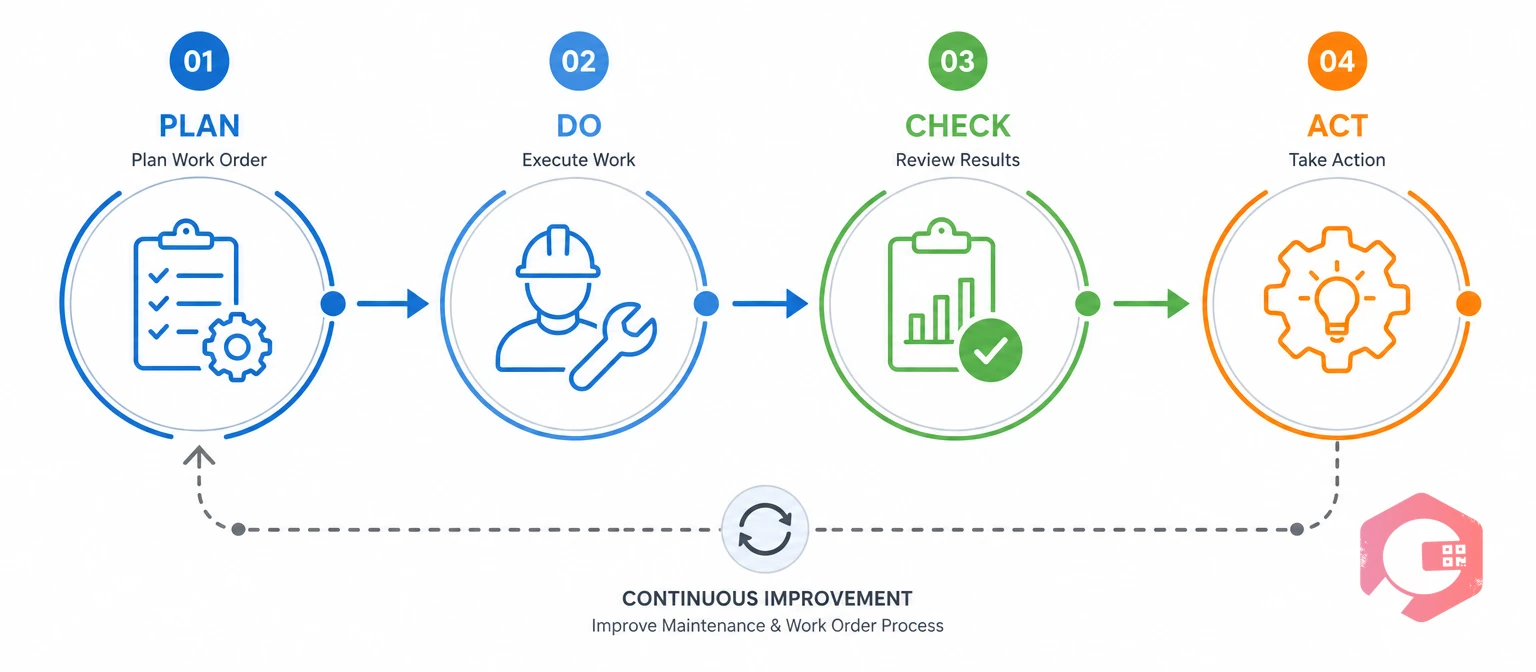
The Plan stage turns a request into a prediction you can test. For example: "If we follow these steps with these parts, the pump is back in service in four hours and the leak does not return for 90 days." Without that sentence, the Check stage has nothing to measure.
A success criterion is a measurable target set before the job starts, such as planned hours or a post-repair reading. Two or three per job is enough. A complete plan on the work order covers six items:
A plan with a prediction is the only plan you can improve.
The Do stage is execution plus recording. The technician follows the plan and notes where reality differed from it. Capture these items at execution and close-out:
Try a new method or part on one asset or crew first, so a bad change stays cheap to reverse. Digital maintenance checklists can make the key close-out fields mandatory, so a job cannot close without the data the next stage needs.
Before you start your first cycle, record a baseline. The free MTTR calculator shows your current repair time per asset in a few minutes.
The Check stage of PDCA in maintenance compares the prediction from Step 1 with the record from Step 2. It runs at two levels: the single job at close-out, and the asset over time.
First-time fix rate is the share of work orders completed without a follow-up visit for the same fault. It is the fastest signal that both diagnosis and planning were right.
Work order management software that stores planned and actual values side by side turns this review into a short report instead of a spreadsheet task. The rule for this stage is simple: no comparison, no learning.
The Act stage decides what happens to the learning: keep the change, adjust it, or drop it and plan again. Act must change a document or setting that governs the next work order, not only the technician's memory. Typical outputs include:
Use one close-the-loop rule: a work order that exposed a planning gap stays open until the standard is updated or a follow-up task has an owner and a due date. This single rule keeps PDCA in maintenance from stopping at close-out.
This scenario is illustrative, not a customer case. Centrifugal pump P-101 had three mechanical seal leaks in 60 days. Each job took about six hours against a four-hour estimate, and the seal kit was out of stock on two of the three jobs.
| PDCA Stage | What the Team Does on the Work Order | Evidence Captured | Result |
|---|---|---|---|
| Plan | Reviews history, suspects shaft misalignment after motor swaps, adds laser alignment and a vibration reading to the job plan, reserves the seal kit | Problem statement, revised job plan, success criteria: 4 h, no leak for 90 days | Testable prediction on the work order |
| Do | Replaces the seal, aligns the shaft, records as-found misalignment and post-repair vibration | Actual hours, parts, readings, cause code "misalignment" | Complete close-out record |
| Check | Compares 4.5 h actual with 4 h planned, checks for leaks at 30, 60 and 90 days | Hours variance, repeat-failure flag, first-time fix | Within tolerance, no repeat leak |
| Act | Adds laser alignment to the standard seal job plan and to every motor-swap work order, sets seal kit minimum stock to 1 | Updated job plan, PM task, spares setting | New standard for every similar pump |
One work order produced a standard that protects this pump and every other pump that uses the same job plan. That is how PDCA in maintenance scales without a separate improvement program.
Maintenance teams using Cryotos have reported up to 30% reduction in unplanned downtime and 25% faster repair turnaround when close-out data feeds directly back into job plans and PM tasks.
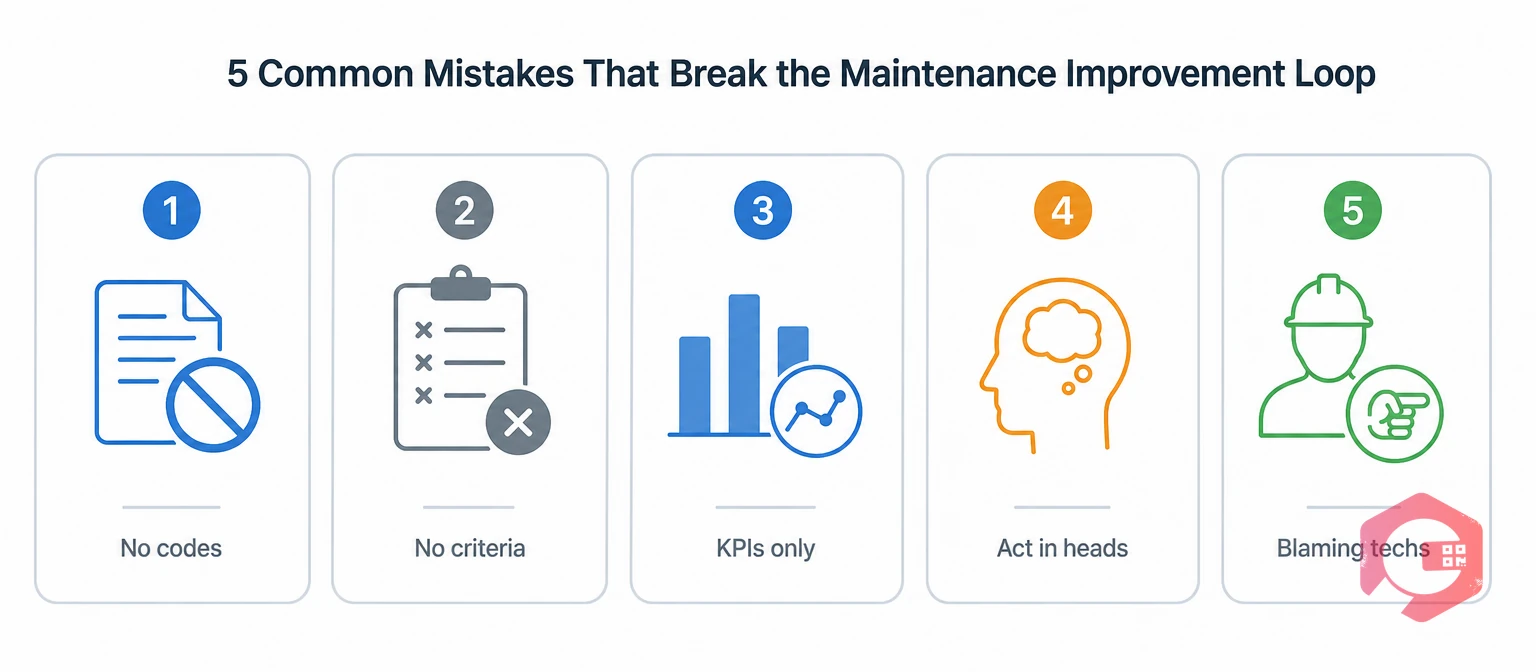
Most improvement efforts break at Check or Act, not at Plan or Do. Maintenance teams that keep the loop running avoid these five mistakes:
Fix these five habits and PDCA in maintenance becomes part of normal planner and supervisor work, not a side project.
PDCA in maintenance is a loop of Plan, Do, Check, and Act applied to maintenance jobs. You plan with clear targets, record what happened, compare results with the targets, and update the standard so the next job starts better.
Root cause analysis is a technique used inside the Plan stage to find why a failure happened. PDCA is the wider loop that also tests the fix, measures the result, and turns it into a standard. Without Check and Act, a good root cause often goes unused.
Plan and Do usually take hours to days. Check often needs 30 to 90 days, because you are waiting to see whether the failure returns. Test one change per cycle so you know which change worked.
At close-out, check hours and parts variance, downtime, post-repair readings, and first-time fix. Over time, track MTBF, MTTR, repeat failure rate, and estimate accuracy by asset.
You can run the loop on paper, but it rarely lasts beyond a few cycles. A CMMS keeps the plan, the close-out record, and the updated standard in one place, which makes Check and Act routine instead of optional.
Every closed work order is a chance to make the next one better. Schedule a free demo to see how Cryotos links job plans, close-out data, and PM updates so each work order feeds your next improvement cycle.



Cryotos AI predicts failures, automates work orders, and simplifies maintenance—before problems slow you down.



