

Plant emergency maintenance is the unplanned, safety-critical repair and isolation work that keeps a chemical plant under control when equipment fails. How well maintenance teams prepare decides whether a failed pump or leaking line stays a minor stop or becomes a reportable incident.
OSHA’s Process Safety Management standard treats emergency planning and equipment integrity as separate duties. In practice, maintenance teams stand where those duties meet. You will find what the work involves, a five-step readiness framework and a register you can copy. You will also see a real example from Resil Chemical, a Cryotos client.
Key Takeaways

Plant emergency maintenance is urgent, unplanned work that makes a failing asset safe or restores a critical function. In a chemical plant, the jobs look like this:
This work differs from routine corrective maintenance because the hazard is live. Maintenance teams must isolate energy, control the release and repair the fault without creating a second incident.
Emergency work also touches other PSM elements:
Mechanical integrity is the part of OSHA’s PSM standard that keeps critical equipment fit for service. Under 29 CFR 1910.119, it covers pressure vessels, storage tanks and piping. It also covers relief and vent systems, emergency shutdown systems, controls and pumps. Employers must also correct equipment outside acceptable limits before further use, or put safe measures in place first. Emergency repair is where that rule is tested.
Operators shut down the process, but maintenance teams do the hands-on work of plant emergency maintenance. They isolate equipment, replace failed parts and confirm that systems are safe to restart.
OSHA’s emergency action plan rule, 29 CFR 1910.38, requires written procedures for reporting emergencies, evacuating, accounting for employees and rescue duties. It also covers employees who stay behind to run critical plant functions before they leave. In many plants, that group includes maintenance technicians.
In an emergency, maintenance teams usually own three jobs:
The U.S. Chemical Safety Board investigates serious chemical incidents, and its reports often point to equipment integrity and maintenance gaps. Teams that rehearse their roles, rather than learning them mid-incident, keep decisions calm. A Computerized Maintenance Management System (CMMS) supports that calm by holding asset history, spares and permits in one place. Preparedness is a maintenance job as much as an operations job.
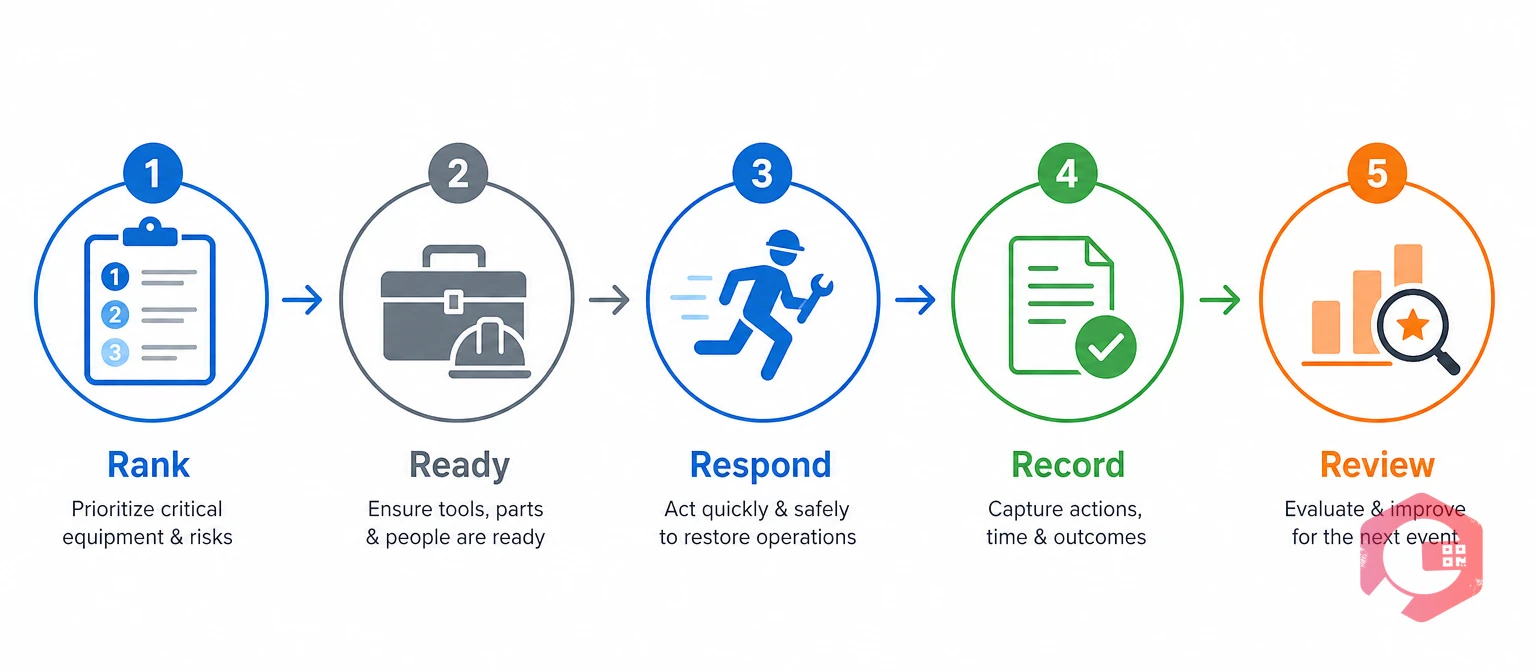
Most maintenance teams prepare informally, and informal plans fail under stress. A named, repeatable framework gives every shift the same plant emergency maintenance playbook.
The Plant Emergency Maintenance 5R Framework:
A critical asset is any equipment whose failure could cause a release, fire, injury or shutdown. Start your list with assets in PSM-covered processes. Check that FMEA or reliability-centered maintenance studies exist for the top tier. Include utilities such as cooling water, nitrogen and power, because a utility loss can trigger several failures at once.
Readiness means parts, tools, permits and people. Pre-stage gasket sets, clamps, valve kits and PPE, then test that the on-call list reaches a real person.
Named roles remove debate at the worst moment. An emergency work order is a high-priority job ticket that jumps the queue and records every action. Review it afterward, because the review is where the next failure gets prevented.
Want to see what unplanned stops cost your site? Try the unplanned downtime calculator.
A readiness register turns the framework into a document every shift can read. The five entries below are examples. Set your own assets and review cycles from your PSM inspection plan.
| Asset | Failure scenario | Pre-staged items | Owner | Review cycle |
|---|---|---|---|---|
| Reactor cooling pump | Loss of cooling flow | Seal kit, standby pump | Mechanical lead | Quarterly |
| Vessel relief valve | Valve sticks or leaks | Certified spare, gasket set | Inspection lead | Per inspection plan |
| Scrubber discharge piping | Corrosion leak | Clamps, spool piece | Piping lead | Monthly |
| Shutdown interlock | Sensor or interlock fault | Spare transmitter, bypass log | Instrument lead | Each test cycle |
| Effluent treatment pump | Pump trip | Spare pump, level switch | Utilities lead | Monthly |
Keep the register in your CMMS so owners, spares and review dates update in one place. A register that lives in a binder goes stale quickly. Review it after every incident and every management of change.
Emergencies create pressure to skip steps, and that is when controls matter most. PSM requires a hot work permit for hot work on or near a covered process. The permit must show that fire prevention requirements are met before work begins.
PSM also requires a compliance audit at least every three years, so clear plant emergency maintenance records save effort later. Maintenance teams that succeed here treat the paper trail as part of the repair.
Resil Chemical runs reactors, scrubbers and an effluent treatment plant (ETP). Its Cryotos case study covers daily breakdown control rather than one major incident. That matters, because plant emergency maintenance readiness is built from daily discipline.
Resil’s core problem was late detection. Manual meter reading was slow and difficult, so the team set acceptable limits too wide. Equipment problems went unnoticed until they became failures.
Four more gaps made response harder:
Resil reports faster issue resolution, stronger operational control and better equipment reliability. The case study does not publish downtime percentages, so this post does not invent any.
Across the wider Cryotos base, maintenance teams using Cryotos have reported up to 30% reduction in unplanned downtime and 25% faster repair turnaround. Results vary by site. Resil’s experience shows the pattern: detect earlier, assign clearly and record everything.
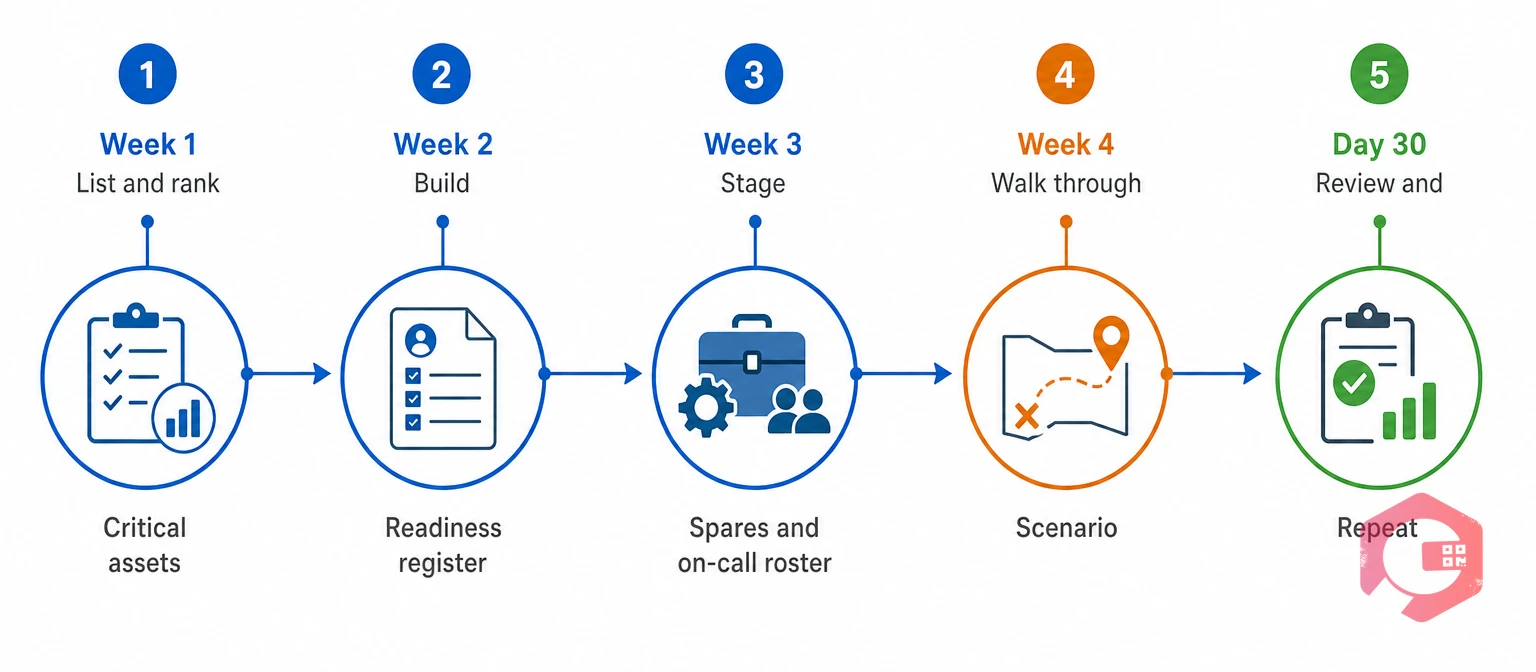
Most operations do not need a new program to improve plant emergency maintenance. They need a small, dated plan that the team owns.
Small, repeatable steps beat a large plan that nobody rehearses.
It is urgent, unplanned work that makes a failing asset safe or restores a critical function. Examples include stopping a leak or replacing a stuck relief valve. It requires isolation, permits and clear records.
PSM, 29 CFR 1910.119, covers mechanical integrity, hot work permits, emergency planning and compliance audits. The emergency action plan rule, 1910.38, also applies. EPA’s Risk Management Program may apply, depending on the chemicals and quantities on site.
A CMMS gives crews asset history, spare parts locations, permits and work orders in one place. It also timestamps every action, which supports reviews and audits afterward.
Set the interval from your own risk assessment and PSM review cycle. Rehearse key scenarios, such as cooling loss, after any significant change, near miss or incident.
Preventive maintenance finds degrading equipment before it fails, which means fewer emergencies. Missed inspections were one of Resil Chemical’s gaps. Safety equipment such as eyewash stations also needs regular checks so it works when needed.
Emergency readiness is built long before the alarm sounds. Schedule a free demo to see how Cryotos helps plant teams log breakdowns, track preventive maintenance and record every emergency job.


Cryotos AI predicts failures, automates work orders, and simplifies maintenance—before problems slow you down.



