
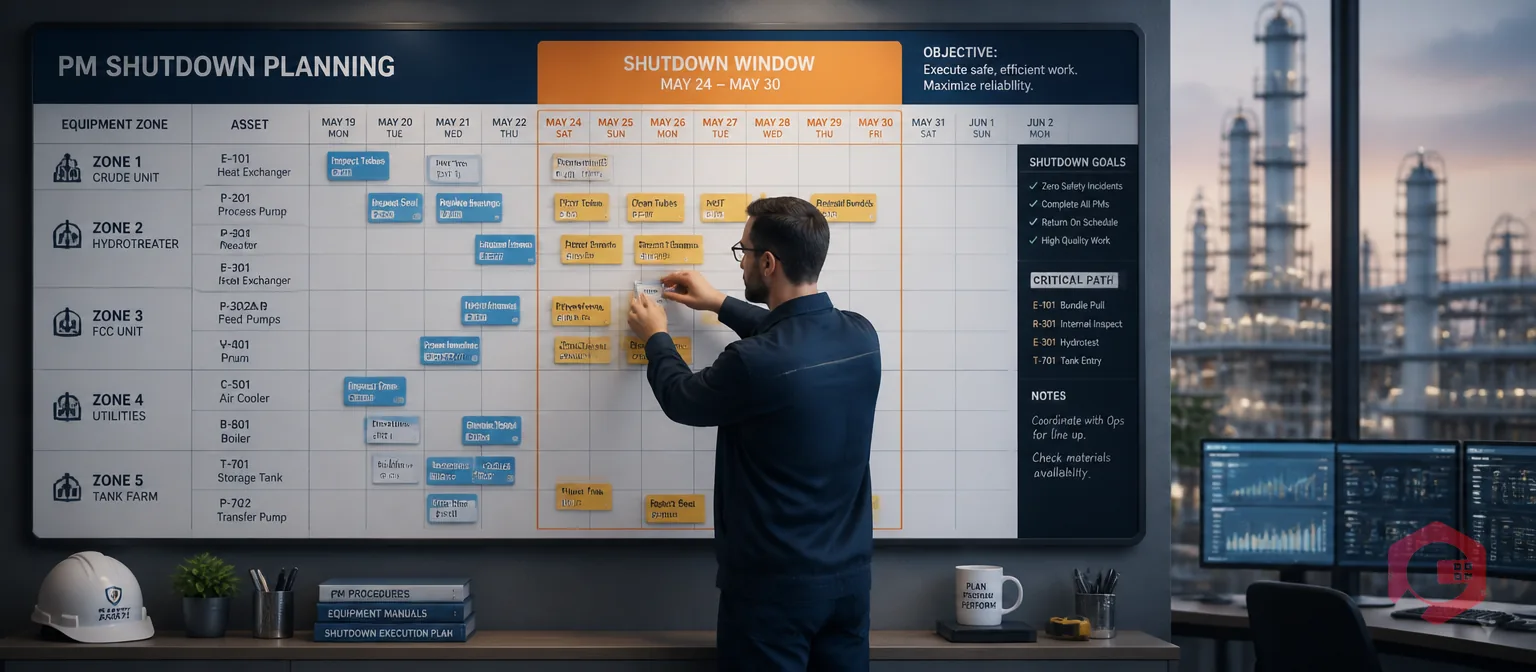
PM task bundling is the practice of grouping multiple preventive maintenance tasks on the same asset — or on assets within the same area — into a single planned shutdown window instead of executing them as separate events. The goal is straightforward: every time you take a machine offline for maintenance, you incur a fixed cost in lost production and technician setup time. If you can complete five tasks in one window rather than five separate windows, you pay that fixed cost once instead of five times. According to the Society for Maintenance and Reliability Professionals (SMRP), facilities that systematically bundle PM tasks reduce total planned downtime hours by 20–35% without any reduction in maintenance coverage — purely by eliminating redundant shutdown events. This guide explains how bundling works, when to apply it, and how to implement it inside a CMMS.
Key Takeaways

Most PM programmes are built task by task rather than asset by asset. A lubrication task gets its own work order. A belt inspection gets another. A filter replacement gets a third. Each fires on its own trigger and generates its own work order — which means each one also requires its own shutdown, its own LOTO procedure, its own technician travel, and its own setup time.
On a single low-criticality asset this might seem minor. Multiply it across a 300-asset plant and the overhead becomes substantial. Consider a packaging line with eight PM tasks at varying but overlapping intervals: if each fires independently, the line might be taken offline 14 times per quarter for maintenance. Bundle the overlapping tasks correctly and that number drops to 5 or 6 windows — with identical maintenance coverage and significantly less production disruption.
The hidden cost of unbundled scheduling is not the maintenance itself — it is the shutdown overhead attached to each separate event. Isolation time, lockout, technician mobilisation, restart and recommission checks — these non-productive minutes accumulate invisibly across every individual work order. Bundling removes the overhead, not the work.
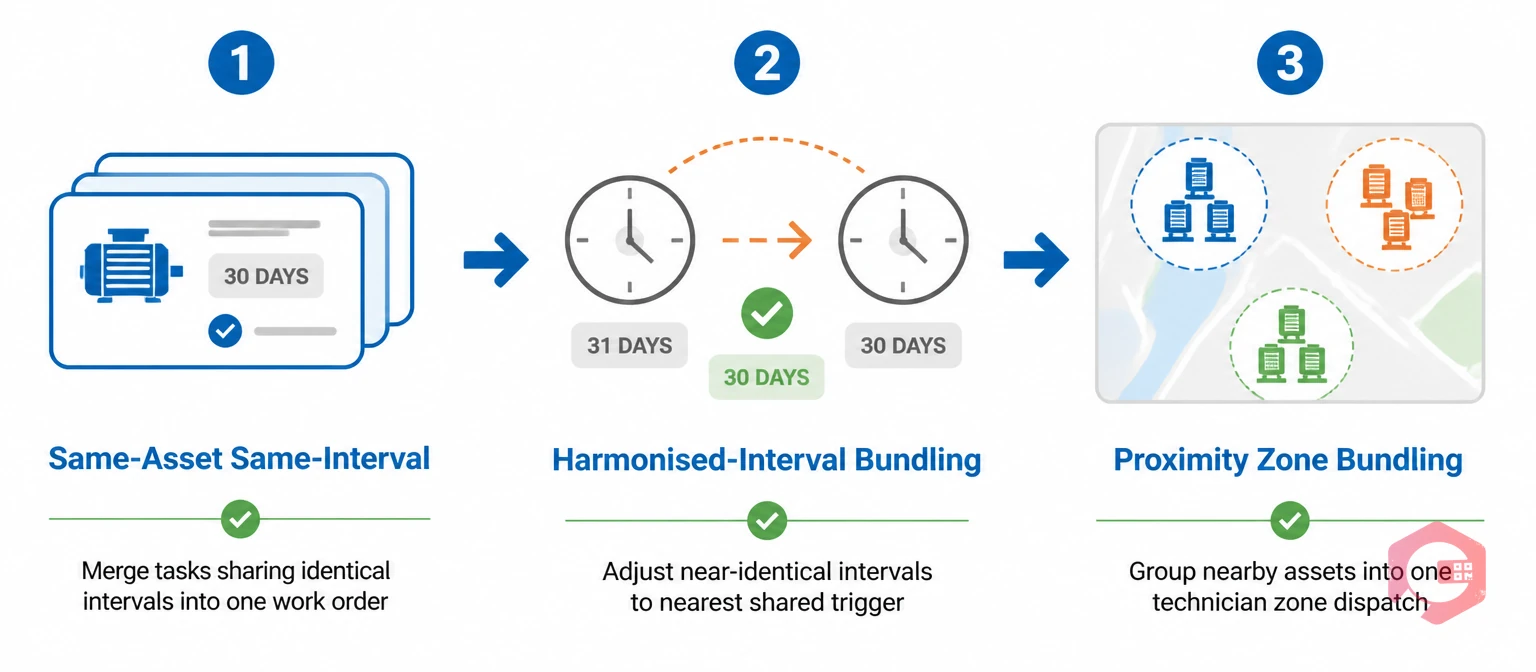
Effective bundling uses three distinct grouping strategies depending on what the tasks share. Applying the right type to the right situation determines how much downtime reduction you actually achieve.
These three types are not mutually exclusive. A well-designed bundling strategy typically applies all three simultaneously — same-interval consolidation within each asset, interval harmonisation where adjacent tasks allow, and zone-based grouping across nearby assets.
| Factor | Unbundled PM | Bundled PM |
|---|---|---|
| Shutdown events per asset per quarter | One per task — 5 tasks = 5 shutdowns | One per interval group — 5 tasks = 1–2 shutdowns |
| LOTO and isolation overhead | Paid on every separate work order | Paid once per bundled window |
| Technician travel time | Multiple trips to same asset or zone | Single trip covers all tasks in the window |
| Work order volume | High — inflated by individual task orders | Lower — consolidated multi-task orders |
| Production disruption | Frequent short interruptions | Less frequent, slightly longer planned windows |
| Maintenance coverage | Full — all tasks completed | Full — all tasks completed in fewer events |
| Compliance reporting | Complex — many orders to track per asset | Simpler — fewer orders with richer checklists |
The key insight from the comparison: bundling does not reduce maintenance coverage — it reduces the overhead cost of delivering that coverage. Every task still gets done; they just share a shutdown window instead of each requiring their own.
The quickest way to find bundling opportunities is to run a task-interval audit across your asset register. For each asset, list every active PM task alongside its trigger interval. Tasks sharing the same interval on the same asset are immediate consolidation candidates — no interval adjustment needed, just a work order merge.
For cross-interval bundling candidates, group tasks by the closest shared interval. A task at 30 days and a task at 42 days can be evaluated for harmonisation: if tightening the 42-day task to 30 days is within a safe tolerance (typically ±15–20% of the OEM interval for non-critical tasks), the merge is justified by the downtime savings. For critical tasks, always consult your failure history before tightening — interval tightening is safe only when MTBF data shows the current interval already has a significant safety buffer.
Use the MTBF calculator to check whether any task's current interval is already well inside the failure pattern boundary. If MTBF significantly exceeds your current PM interval, you have room to harmonise without reliability risk.
For proximity bundling, map your assets by physical location and identify clusters — all assets in a production cell, all equipment on a single floor, all pumps in a utility room. Cross-reference the PM calendars for assets in each cluster and identify weeks where multiple tasks land within the same 5–7 day window. Those are your proximity bundling candidates: group them into a single zone work order rather than dispatching separately. According to Plant Maintenance Resource Center, proximity-based task grouping is one of the most underused optimisation levers in PM programme design, with potential labour savings of 15–25% on facilities where technician travel time constitutes more than 20% of total maintenance hours.
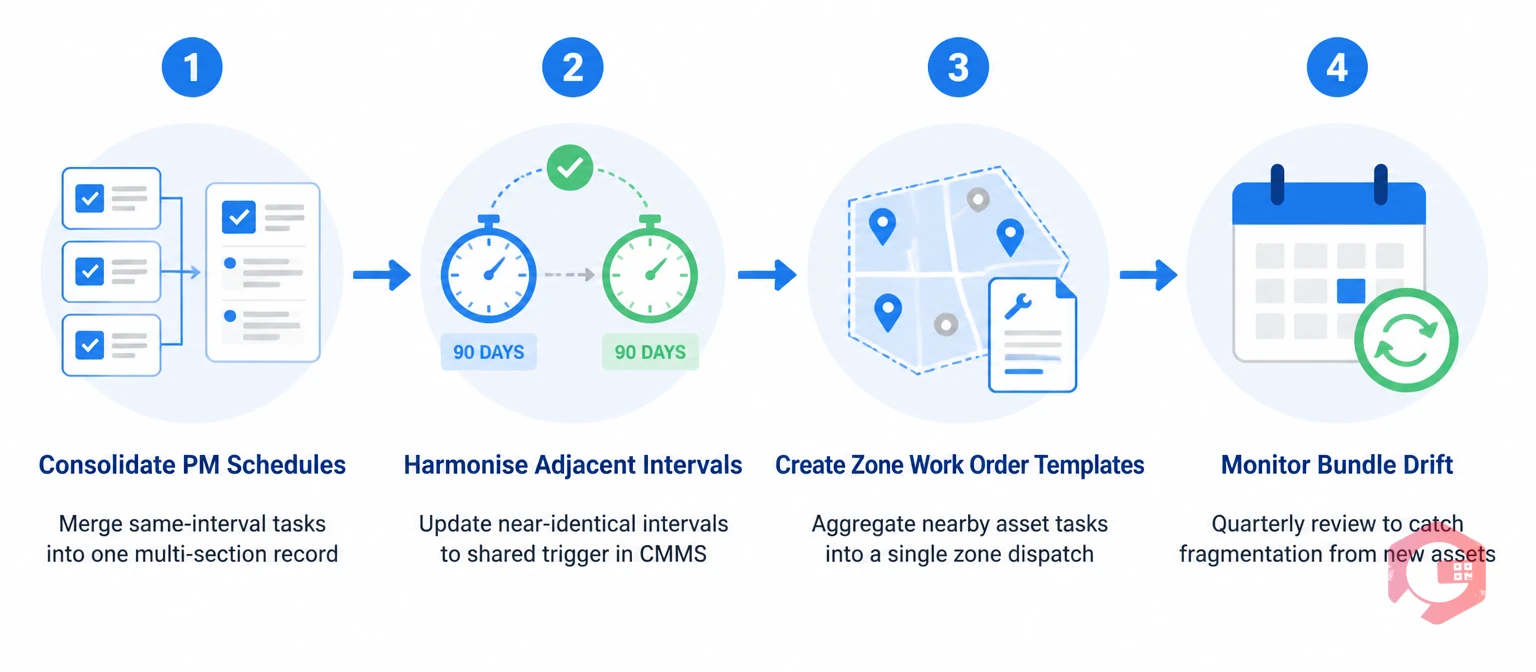
Implementing bundling correctly inside a preventive maintenance software platform requires four specific configuration steps. Doing these in the right order prevents the most common mistake: bundling at the work order level without updating the underlying PM schedule, which means the system continues to generate individual work orders that have to be manually merged every time.
Bundling is not universally applicable. Some tasks should never be merged into a shared window regardless of the interval savings. Knowing these limits is as important as knowing the bundling opportunities.
Keep your planned downtime log updated as bundling changes take effect — this lets you measure the actual reduction in planned downtime events per asset over the first three months, which is the clearest validation that the bundling strategy is working.
Cryotos is built for the kind of multi-task, multi-section work order structure that effective bundling requires. Each PM schedule record supports multiple checklist sections — you can combine six tasks across three subsystems into a single work order that routes to one technician, with each section carrying its own instruction set, measurement fields, parts list, and photo requirements.
The work order management layer handles zone-based routing natively. Zone PM templates aggregate tasks from multiple asset records into a single dispatched work order — the technician receives one job with all the tasks for a defined area, rather than five separate work orders requiring five separate dispatches. According to Reliable Plant's analysis of PM optimisation programmes, facilities that implement zone-based bundling reduce technician travel time per PM by 30–45%, with the same coverage achieved in fewer total work orders.
The reporting layer surfaces bundle effectiveness automatically. Cryotos tracks planned downtime events per asset over time — so after implementing a bundling strategy, you can pull a before/after report showing exactly how many fewer shutdown windows each asset required per month. This data justifies the strategy to management and identifies assets where further consolidation is still possible. The CMMS also flags newly added assets and recently adjusted intervals in the PM audit view — so quarterly bundle reviews take minutes rather than hours of manual schedule analysis.
PM task bundling is the practice of grouping multiple preventive maintenance tasks — either on the same asset or on nearby assets — into a single planned shutdown window rather than executing them as separate events. The goal is to pay the fixed cost of each shutdown (isolation, setup, LOTO, restart) once per window instead of once per task, reducing total planned downtime without reducing maintenance coverage.
The savings depend on how fragmented your current schedule is. Facilities starting from fully unbundled task-per-order scheduling typically see 20–35% reduction in total planned downtime events after implementing systematic bundling. The biggest gains come from same-asset, same-interval consolidation — which can eliminate 60–70% of redundant shutdown events on assets with many individual PM tasks — followed by proximity bundling, which reduces technician dispatch overhead across zones.
Not when done correctly. Bundling consolidates how tasks are delivered — one work order instead of several — but every task on the checklist still requires completion and sign-off before the work order closes. Compliance reporting in a CMMS tracks task-level completion regardless of how many tasks share a work order. The compliance rate for individual tasks is unchanged; only the work order count changes.
Regulatory and statutory inspections requiring independent documentation, condition-triggered tasks that fire on sensor thresholds and cannot be deferred, tasks requiring different certified trades on the same asset, and tasks on critical assets where interval extension — even minor harmonisation — exceeds the failure data safety buffer. For everything else, bundling is worth evaluating based on the interval tolerance and proximity analysis.
PM task bundling is one of the highest-leverage scheduling optimisations available to a maintenance team — it reduces planned downtime, cuts technician overhead, and simplifies compliance tracking without compromising asset reliability. Cryotos gives you the multi-section work orders, zone-based routing, and bundle effectiveness reporting to implement and sustain a bundling strategy across your entire asset fleet. Schedule a free demo to see how Cryotos helps maintenance teams cut planned downtime events by up to 35% through structured task bundling.




Cryotos AI predicts failures, automates work orders, and simplifies maintenance—before problems slow you down.



