
A point-of-work risk assessment is a short check of hazards, conditions and controls, made at the job site before work starts. It improves permit approvals because the approver decides on today’s conditions, not on a plan written days earlier. It improves maintenance safety decisions because the crew gets clear go, adjust or stop criteria.
Most maintenance teams already complete a risk assessment at the planning stage. The gap appears on the day, when isolation status changes, a neighboring crew starts hot work or the shift changes. Below are the two assessments compared, a five-gate method, a decision matrix and a real Cryotos case.
Key Takeaways
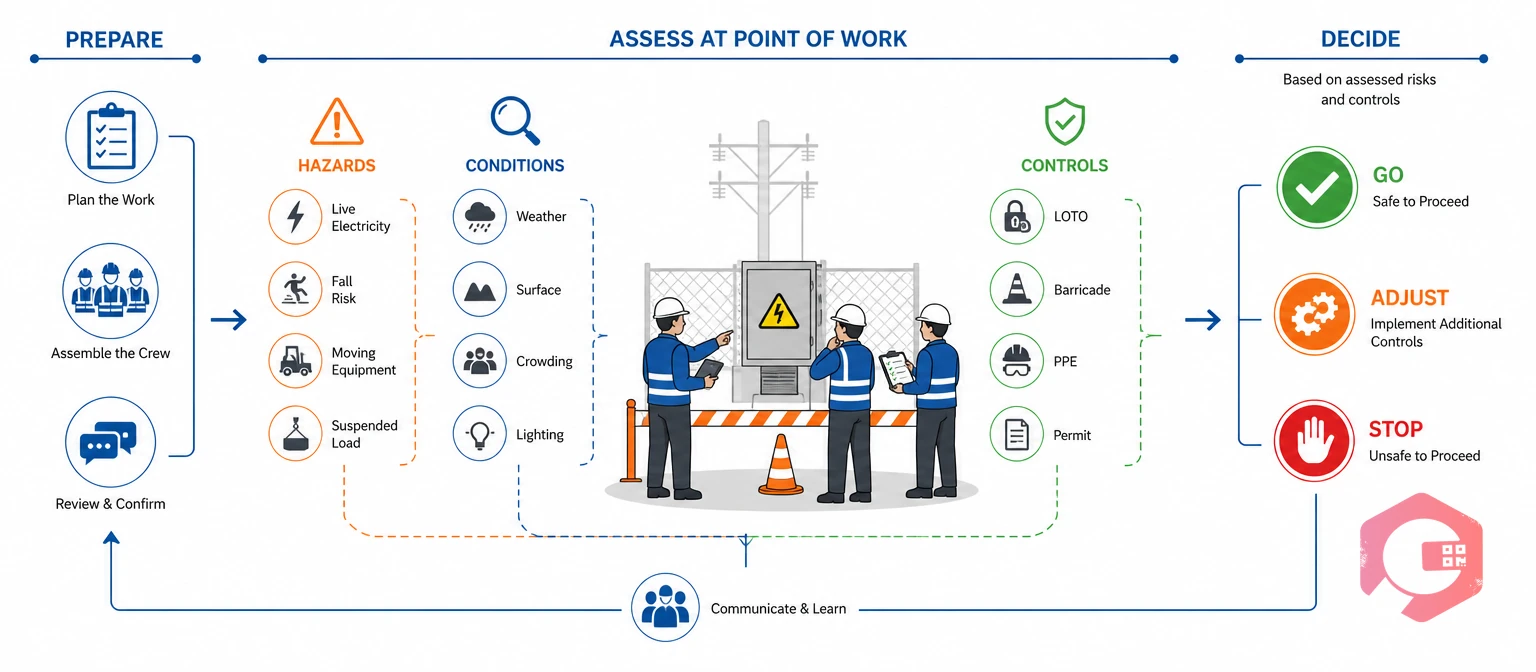
A point-of-work risk assessment checks the hazards, conditions and controls for one job, at the place the work happens. Teams also call it a last-minute risk assessment (LMRA) or a pre-task risk assessment. The crew completes it, so it reflects what they can see and test on the day.
Risk assessment is the process of finding hazards, rating the risk and choosing controls. A point-of-work risk assessment applies that process to a single task, minutes before it starts.
Recognized guidance supports the approach. OSHA’s job hazard analysis guide describes a technique that focuses on job tasks to find hazards before they occur. ISO 45001 asks organizations to run hazard identification that is ongoing and proactive. A one-off planning review struggles to meet that alone.
In short, it tests whether the plan still matches the job at the moment work begins.
A planning-stage risk assessment predicts the hazards of a job, while a point-of-work risk assessment confirms them on the day. Facilities need both, because each catches different failures.
| Area | Planning-stage risk assessment | Point-of-work risk assessment |
|---|---|---|
| When it happens | Days or weeks before the job | Minutes before work starts, and again after any change |
| Who completes it | Planner, engineer or safety adviser | The crew and the permit holder at the work site |
| Information used | Drawings, procedures and past incidents | Live isolation status, gas readings, weather and nearby work |
| What it catches | Predictable hazards and missing controls | Changed conditions, skipped steps and scope creep |
| Typical output | Method statement and permit requirements | A go, adjust or stop decision with a timestamp |
Neither replaces the other. Planning removes hazards by design, and the on-site check confirms that the design still holds.
To build your on-site questions, start from the free safety compliance checklist and trim it to the controls that matter for each permit type.
Permit approvals fail when the approver signs for conditions that nobody has checked since planning. The permit looks complete, but it describes the job as planned, not the job as it is.
A permit to work is a formal authorization that lists the hazards, controls and people for one hazardous job. Permit-to-work systems run across oil and gas, chemical, power and construction sites, and each approval accepts that the listed details are true today.
Most facilities see at least some of these patterns. In the 1988 Piper Alpha disaster, which killed 167 people, the public inquiry criticized the permit-to-work system, including how information passed between shifts.
A point-of-work risk assessment closes these gaps by putting fresh, specific evidence in front of the approver at the moment of decision.
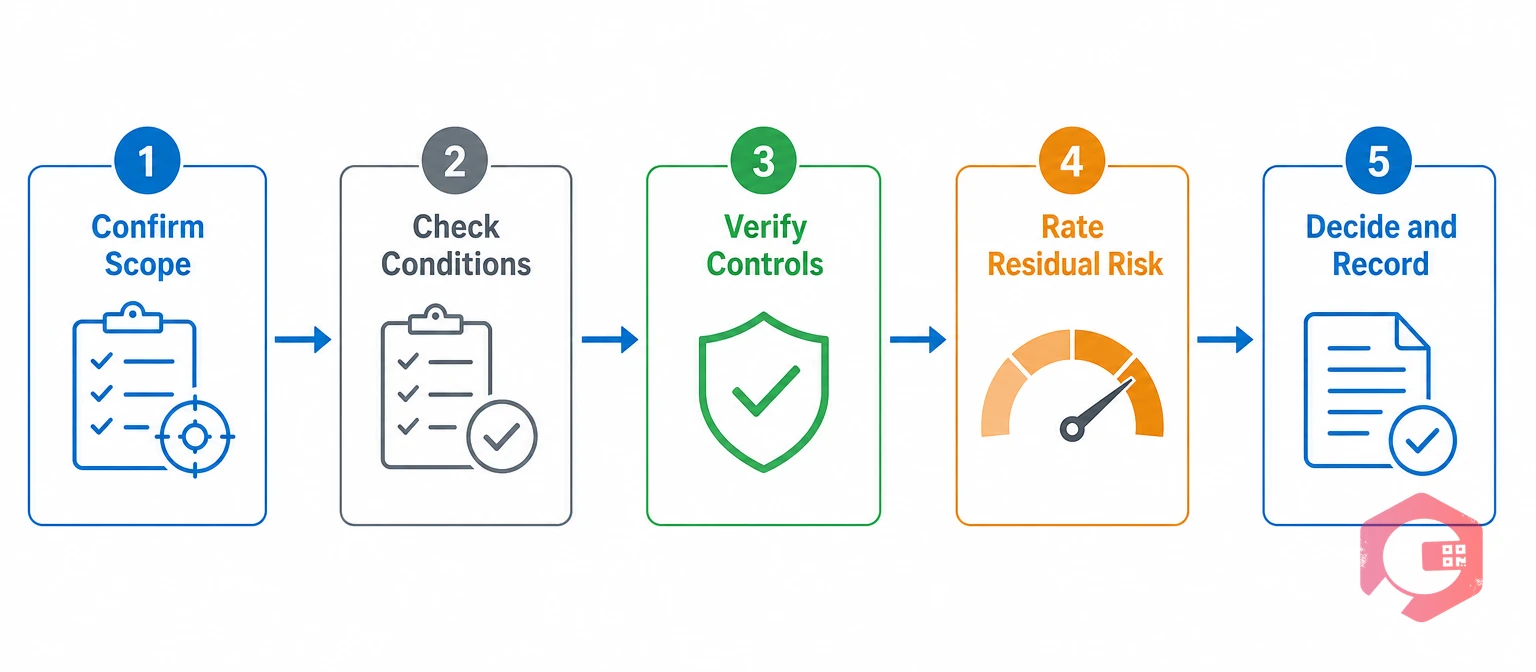
Run a point-of-work risk assessment through five gates, in order, before any permitted job starts. A gate stays closed until the crew has seen the evidence, not only read the paperwork.
The Five-Gate Point-of-Work Method:
Residual risk is the level of risk that remains after controls are in place. Rate it honestly at Gate 4, because an unrated risk cannot be compared with the acceptable level for your site.
Build Gate 3 around the hierarchy of controls: remove or isolate the hazard first, and treat PPE as the last line of defense. A common mistake is treating the five gates as a form to fill in, when the check only works if someone looks at the isolation points and the gas reading.

A risk rating matrix turns Gate 4 into a clear decision and a named approver. The example below is illustrative, so adapt the thresholds to your own site risk matrix.
| Risk rating | What the crew sees | Decision | Who approves | What to record |
|---|---|---|---|---|
| Low risk | Routine task, conditions match the permit, controls verified | Go | Permit holder with the standard approver | Time of check and sign-off |
| Medium risk | One condition differs, such as wind, a new crew member or nearby work | Adjust, then go | Supervisor plus area owner | Added control and who confirmed it |
| High risk | Hot work near flammables, work at height in a weather alert, or isolation not yet proven | Hold until controls are verified | Senior authorizer or safety officer | Readings, photos and re-approval time |
| Unacceptable risk | Isolation cannot be proven, gas reading is out of limits, or the scope has changed | Stop and withdraw the permit | Authorized person and manager | Stop-work reason and follow-up action |
Any crew member should be able to stop the job at any rating. Stop-work authority only works when stopping is never penalized.
The Cryotos Permit to Work case study shows the failures that a point-of-work risk assessment is meant to catch. It describes a boiler shutdown at a large plant, and the client is not named.
The challenge: the permit, the isolation record and the handover all lived apart.
How Cryotos solved it: the same job now runs through permit to work software with these controls.
The result: when the auditor arrives, the full record comes up in seconds. The source describes the outcome in process terms, so this post cites no figures for it.
South Jeddah Solar Plant, another Cryotos customer, faced a related challenge. It had to keep LOTO, PPE use and hazard identification consistent across electrical work, excavation, hot work and working at height. Its permits list hazards and precautions and require approval before work begins, and the case study reports improved safety and compliance.
Cryotos supports a point-of-work risk assessment by keeping the checks, approvals and records on the same job record the crew already uses. A Computerized Maintenance Management System (CMMS) connects assets, work orders and people, so the permit is never a separate piece of paper.
Across its wider customer base, maintenance teams using Cryotos have reported up to 30% reduction in unplanned downtime and 25% faster repair turnaround. Fewer emergency repairs mean fewer rushed jobs, which is where on-site checks tend to be skipped.
Software records and enforces the steps, but it does not replace the judgment of a competent person at the job site. Treat the risk assessment as a decision, not a form.
A job hazard analysis breaks a job into steps and identifies the hazards in each step, usually during planning. A point-of-work risk assessment checks that those hazards and controls still match the job on the day. Both belong in a permit process.
The crew doing the work completes it at the job site, led by the permit holder or supervisor. The approver reviews the result, and any crew member can stop work if conditions change.
No. The permit authorizes the work and records the controls, while the on-site assessment confirms those controls are valid when work begins. A permit without that check can describe a job that no longer exists.
The approver sees current, job-specific evidence, such as isolation proof and readings, instead of generic text. That makes it easier to refuse or condition an approval, and harder to sign one by habit.
No. Software can pre-fill job details, require each check and record every approval, but a competent person must judge the conditions at the job site.
A permit is only as safe as the check behind it. Schedule a free demo to see how Cryotos links risk checks, approvals and isolation to each work order.


Cryotos AI predicts failures, automates work orders, and simplifies maintenance—before problems slow you down.