

Predictive maintenance in the tyre industry is a condition-monitoring strategy that uses IoT sensors, vibration analysis, and machine learning to detect equipment degradation before it causes a breakdown. Unlike fixed-schedule servicing, predictive maintenance intervenes only when real data signals a risk — cutting unplanned downtime by 30–50% and reducing emergency repair costs by 25–40% in tyre manufacturing environments.
Tyre plants are among the most equipment-intensive facilities in manufacturing. A single unplanned failure on a Banbury mixer or vulcanizing press can halt an entire production line and cost anywhere from ₹5 to ₹25 lakhs per hour in lost output. A McKinsey & Company Industry 4.0 report found that predictive maintenance can extend equipment lifespan by 20–40% and reduce machine downtime by up to half — returns that make a compelling business case for any tyre manufacturer still running on reactive or time-based schedules.
This complete guide covers why tyre manufacturing demands predictive monitoring, which equipment to target first, how the technology works in practice, and what realistic ROI looks like over an 18-month deployment cycle.
Key Takeaways

Tyre plants operate at the intersection of extreme heat, intense mechanical pressure, and chemically aggressive materials. Banbury mixers run above 160°C. Vulcanizing presses apply 150–200 bar of curing pressure for thousands of cycles every day. Calendering rolls hold micron-level tolerances while processing carbon-black-loaded compounds that accelerate wear on every surface they contact.
This combination of thermal, mechanical, and chemical stress means tyre plant equipment degrades faster than most industrial environments — and fails more dramatically when maintenance is deferred. A reactive approach is simply too expensive. When a vulcanizing press fails mid-cure, the batch in the mould is scrapped. When a Banbury mixer stops without warning, the compound hardens inside the chamber and requires hours of manual cleaning before the machine can restart.
Time-based preventive schedules do not fully solve this either. They replace components on fixed intervals regardless of actual asset condition — generating unnecessary maintenance spend on healthy equipment while still missing failures that develop faster than expected between service dates.
Predictive maintenance closes that gap. By monitoring actual asset condition continuously, maintenance teams can intervene precisely when degradation crosses a risk threshold — before failure occurs, but not before it is necessary. The result is fewer emergency shutdowns, less wasted maintenance labour, and a production floor running closer to its designed capacity.

Not every asset in a tyre plant carries the same failure risk or production impact. Predictive maintenance programmes deliver the fastest return when focused on equipment where failure causes immediate production loss, quality defects, or safety hazards. These four asset categories consistently top the priority list.
The Banbury mixer is the starting point of every tyre compound. It blends rubber, carbon black, silica, and chemical additives under intense heat and mechanical force. Any inconsistency in mixing translates directly into compound quality problems downstream.
Key failure modes include rotor tip wear, seal leaks, and gearbox degradation. Vibration analysis on the rotor shafts and thermal imaging of the mixer body can flag these issues weeks before they become production-stopping faults — giving the maintenance team time to plan an overnight repair rather than an emergency shutdown.
A vulcanizing press cures raw tyre casings under heat and pressure for 8–15 minutes per cycle. Running 24/7, a single press completes tens of thousands of cycles per year. Bladder wear, hydraulic seal degradation, and heating element failures are the most common failure modes.
Pressure sensors and cycle-time monitoring can flag abnormal patterns early. A press taking longer than its baseline to reach target pressure typically signals a developing hydraulic leak — detectable weeks before a seal failure forces an unplanned shutdown.
Calenders apply thin, precise layers of rubber compound onto fabric or steel cord — the reinforcing structure inside every tyre. Roll bearing wear and temperature non-uniformity across the roll surface are the main predictive monitoring targets.
A bearing beginning to fail causes microscopic variations in nip gap, producing thickness inconsistencies that only appear as quality defects in the finished tyre. Catching bearing wear early with vibration analysis prevents both scrap and customer returns — two of the highest-cost outcomes in tyre manufacturing.
Extruders shape the tread, sidewall, and inner liner profiles of a tyre. Screw and barrel wear gradually shifts the extrusion output — widths, thicknesses, and cross-sections drift out of specification. Because the change is gradual, it often goes undetected until final inspection reveals a batch of out-of-tolerance profiles.
Continuous monitoring of motor current draw and compound output weight per unit time gives early warning of this drift before it generates significant scrap.
Use Cryotos' IoT meter reading integration to connect sensor streams from all four asset classes into a single monitoring dashboard — so every reading is timestamped, logged, and available for threshold analysis in real time.
Understanding where predictive maintenance fits relative to condition-based maintenance and traditional preventive schedules is essential before designing your programme. The table below compares the three approaches across the dimensions that matter most in a tyre plant.
| Dimension | Reactive Maintenance | Preventive Maintenance | Predictive Maintenance |
|---|---|---|---|
| Trigger | Equipment fails | Fixed calendar interval | Sensor threshold crossed |
| Downtime type | Unplanned emergency | Planned, often unnecessary | Planned, minimal duration |
| Parts replaced | After failure | On schedule, may be healthy | When condition demands it |
| Data required | None | Asset history, OEM specs | Real-time sensor streams |
| Cost profile | Highest — emergency rates, scrap | Medium — over-maintenance risk | Lowest — intervene only when needed |
| Best for tyre plants | Low-criticality ancillary assets | Safety systems, consumables | Banbury mixers, presses, calenders |
Most mature tyre maintenance programmes run all three strategies in parallel — predictive on critical production assets, preventive on safety-critical components, and reactive acceptance on low-impact consumables where the fix cost is negligible.
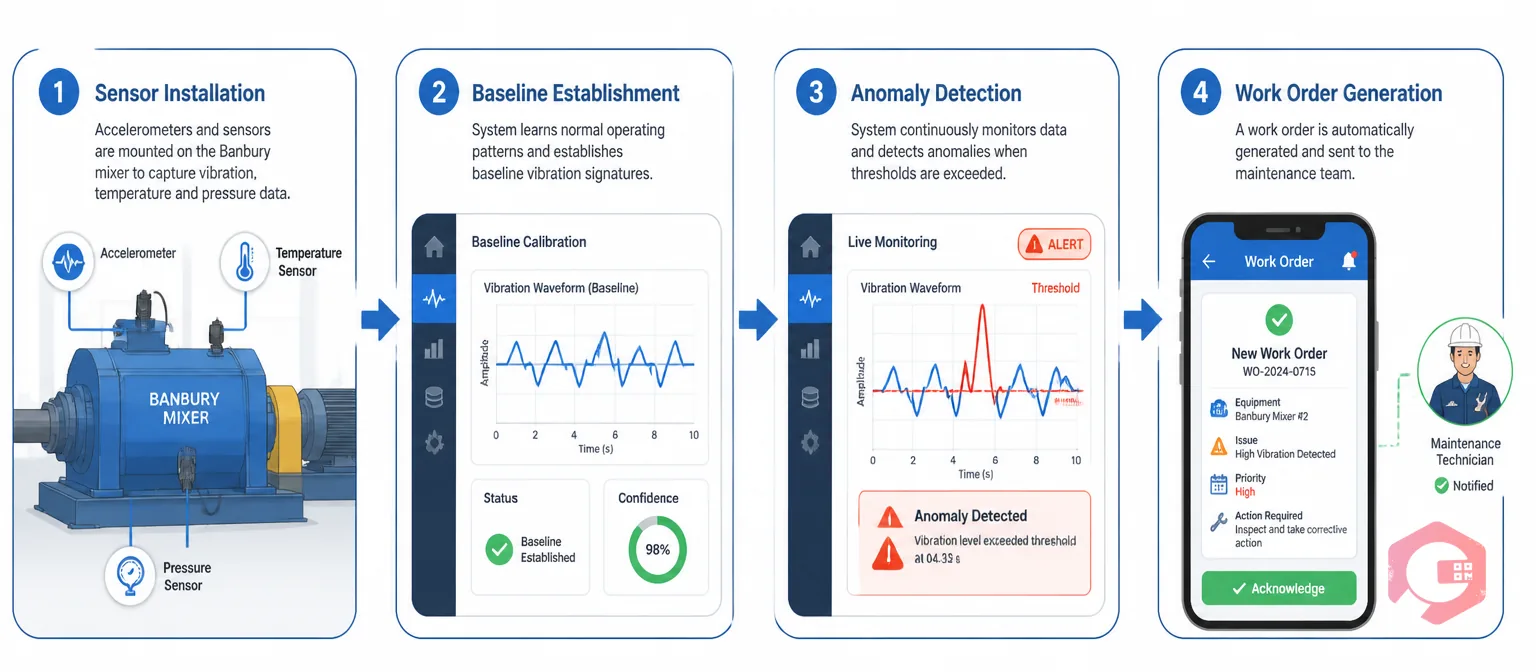
Predictive maintenance in a tyre plant runs as a four-stage closed-loop workflow. Understanding each stage helps you design an implementation that generates alerts maintenance teams can act on — rather than drowning them in sensor noise.
The foundation is instrumentation. Each critical asset gets fitted with sensors appropriate to its failure modes: accelerometers for vibration on rotating equipment, thermocouples and infrared sensors for temperature-sensitive processes, pressure transducers on hydraulic systems, and current transducers on motors.
All sensor streams route into a central platform where data is timestamped, stored, and made available for analysis. The quality of your sensor coverage directly determines the reliability of your predictive alerts — under-instrumented assets generate blind spots that defeat the programme's purpose.
Before anomaly detection can work, the system needs to know what normal looks like for each asset under different operating conditions. This calibration phase typically runs for 4–8 weeks after sensor installation.
During this period, the platform records baseline signatures for vibration, temperature, pressure, and current across the full range of production recipes and shift conditions. Assets at full load have different normal ranges than the same assets during a startup cycle — a good baseline captures both, and distinguishes between them automatically.
Once baselines are established, the system continuously compares live sensor readings against the expected range. When a reading crosses a configurable threshold — or when the rate of change itself is abnormal — the platform generates an alert.
Effective implementations use tiered alert levels: a warning at 80% of the failure threshold and a critical alert at 95%. This gives maintenance teams time to plan a scheduled intervention rather than scrambling for an emergency repair. Every alert-to-resolution cycle gets logged in the downtime tracking module, building an audit trail that helps teams refine thresholds over time.
An alert without a linked action is just noise. The final stage converts sensor alerts directly into work orders, pre-populated with the asset ID, failure mode description, recommended inspection steps, and required spare parts based on historical repair data.
Technicians receive a mobile notification with the work order details, confirm receipt on their phone, and log findings on the shop floor — all without returning to a desktop. This closed-loop approach is what separates a genuine predictive maintenance programme from a sensor monitoring exercise.
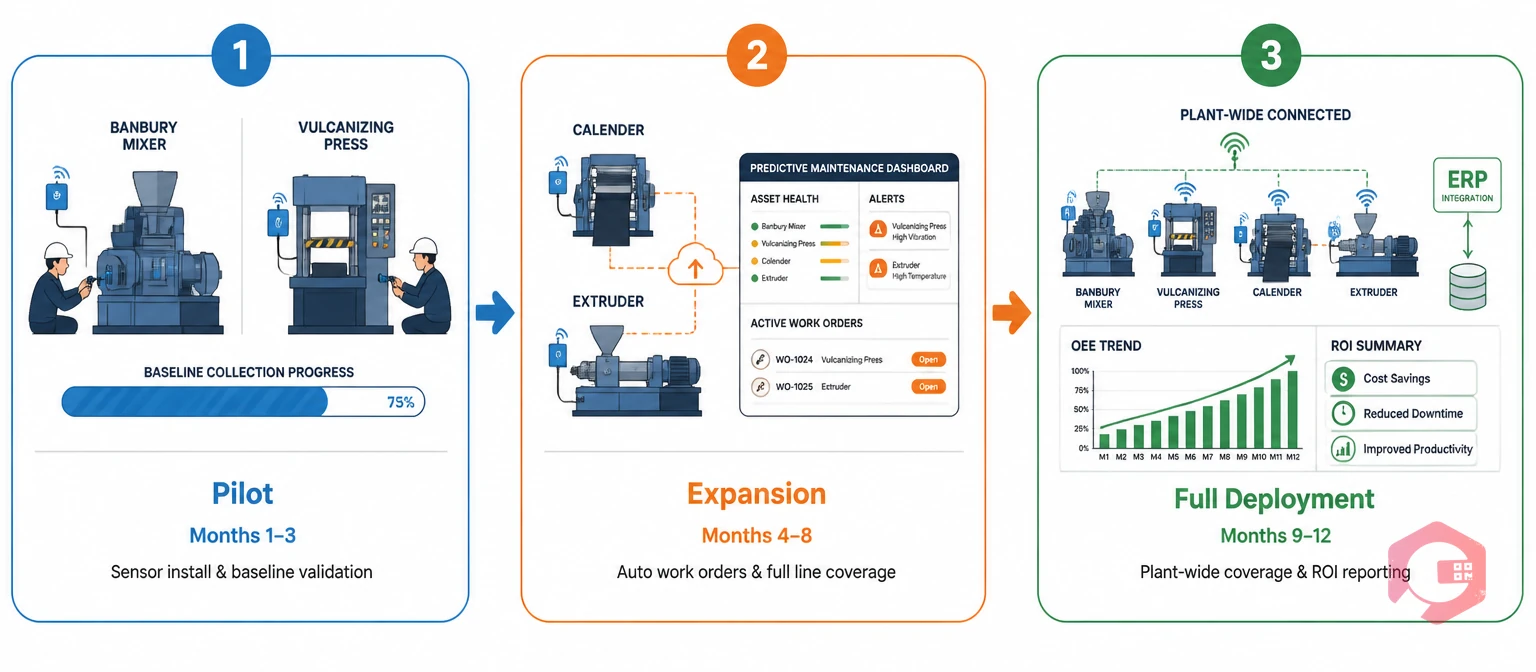
A successful predictive maintenance rollout in a tyre plant does not happen overnight. Manufacturers that achieve durable results follow a phased approach that builds capability without disrupting ongoing production.
Select two or three of your highest-impact assets — typically one Banbury mixer and one or two vulcanizing presses. Install sensors, configure your monitoring platform, and begin the baseline establishment period. The goal in Phase 1 is not to catch failures; it is to prove the data pipeline works and build team confidence in the alert system.
Set your preventive maintenance software to run parallel schedules during this phase so that existing PM tasks continue uninterrupted while the predictive layer is validated.
Once the pilot assets are generating reliable alerts and work orders, extend sensor coverage to calendering machines and extrusion lines. Introduce automated work order generation so that alerts convert to job cards without manual dispatcher involvement.
During this phase, start using maintenance checklists tied to each predictive work order — structured inspection steps ensure technicians capture the right data when they investigate an alert, which feeds back into threshold refinement.
Expand to all critical assets plant-wide. Integrate sensor data with your ERP for spare parts procurement triggers — so the right components are on hand before the predictive alert escalates to a critical level. Begin reporting MTBF trends and OEE improvement metrics to leadership to document the programme's financial return.

A tyre plant that implements predictive maintenance through a purpose-built platform can realistically expect measurable returns within 12–18 months of full deployment. The financial case rests on four distinct improvement levers.
Industry benchmarks — including research published by Deloitte on Industry 4.0 manufacturing — consistently show 30–50% reductions in unplanned downtime after full predictive maintenance deployment. In a tyre plant running at even ₹5 lakhs per hour in lost production, a 30% downtime reduction across a typical machine fleet generates crore-level savings annually.
Time-based maintenance sends technicians to service healthy equipment on schedule. Predictive maintenance sends them only when the asset actually needs attention. Plants that switch from pure time-based schedules to condition-based triggers report 20–30% reductions in maintenance labour hours — freeing skilled technicians for higher-value inspection and improvement work.
Components replaced at the right time — not too early, not too late — last longer in aggregate. Avoiding the thermal and mechanical stress of running-to-failure extends the life of surrounding components as well. McKinsey data suggests asset lifespan improvements of 20–40% are achievable in manufacturing environments with mature predictive programmes.
Quality defects caused by equipment drift — thickness variations from worn calender bearings, compound inconsistencies from a degrading Banbury rotor — disappear when the underlying asset is maintained in condition. Plants tracking scrap rate alongside maintenance data typically see 10–20% scrap reductions within the first year of predictive deployment.
Cryotos is purpose-built to bridge the gap between sensor alerts and planned maintenance actions. For tyre manufacturers, four platform capabilities deliver the most immediate impact.
Cryotos connects directly to SCADA systems, PLCs, and edge IoT devices via standard protocols. Each sensor stream is configurable with custom alert thresholds — different limits for a Banbury mixer versus a vulcanizing press, and different rules for day shift versus night shift operations. When a threshold is breached, the platform notifies the right technician immediately via mobile push, email, or WhatsApp — so response begins within seconds, not hours.
When a sensor alert fires in Cryotos, the system automatically generates a work order — no dispatcher required. The work order pulls in asset history, links to the relevant inspection checklist, and assigns to the technician on duty based on skills and current location. The time from anomaly detection to technician receiving a job card can drop from hours to under five minutes.
Every work order, sensor reading, and repair outcome is stored against the asset record. Over time, this history builds a failure pattern library — you can see that a specific Banbury main bearing typically shows elevated vibration about three weeks before failure, or that a press bladder has a consistent 8,000-cycle lifespan. This pattern data feeds directly back into threshold calibration, making the predictive model sharper with each maintenance cycle.
Cryotos' mobile app — with full offline capability — gives technicians everything they need on the shop floor: work order details, asset manuals, spare parts lists, and digital checklists. QR code scanning lets technicians pull up full asset history by scanning the tag on the machine, without typing a single ID. Completed work orders sync automatically when connectivity resumes, keeping the system of record current without manual data entry.
Predictive maintenance in the tyre industry is a condition-monitoring strategy that uses IoT sensors, vibration analysis, temperature monitoring, and machine learning to detect early signs of equipment failure before a breakdown occurs. It is distinct from preventive maintenance, which operates on fixed time-based schedules regardless of actual equipment condition.
The highest-value targets are Banbury mixers, vulcanizing presses, calendering machines, and extrusion line equipment. These four asset classes are responsible for the majority of unplanned production stoppages in most tyre plants and have well-established predictive failure signatures that IoT sensors can reliably detect.
A phased rollout typically takes 9–12 months to reach full plant coverage with reliable predictive alerts. The first 90 days are a pilot phase focused on two or three critical machines. Full plant coverage with automated work order generation usually comes in Phases 2 and 3, depending on the size and complexity of the facility.
Based on industry benchmarks, tyre manufacturers can expect positive ROI within 12–24 months, driven by 30–50% reductions in unplanned downtime, 25–40% lower emergency repair costs, and 20–40% extended asset lifespan. The exact payback period depends on your current unplanned downtime rate and the per-hour cost of production stoppages.
Technically no — you can collect sensor data without a CMMS. But without one, alerts do not automatically convert to work orders, repair history is not stored against asset records, and failure patterns cannot be analysed systematically. In practice, predictive maintenance programmes that lack CMMS integration generate alerts that teams struggle to act on consistently, and the programme loses momentum within 6–12 months.
The most common sensor types are accelerometers for vibration on rotating equipment (Banbury rotors, calender roll bearings), thermocouples and infrared sensors for temperature monitoring on mixers and presses, pressure transducers on hydraulic vulcanizing systems, and current transducers on extruder drive motors. The appropriate combination depends on the failure modes most likely for each specific asset.
Predictive maintenance is no longer exclusive to large automotive OEMs. Tyre manufacturers of all sizes — from regional producers to global tier-one suppliers — are implementing condition-based monitoring on their critical assets and seeing measurable reductions in unplanned downtime, maintenance costs, and scrap rates. The technology is accessible, the ROI is proven, and the competitive risk of staying on reactive schedules grows every year. Schedule a free demo to see how Cryotos can help your tyre plant move from reactive firefighting to predictive control.
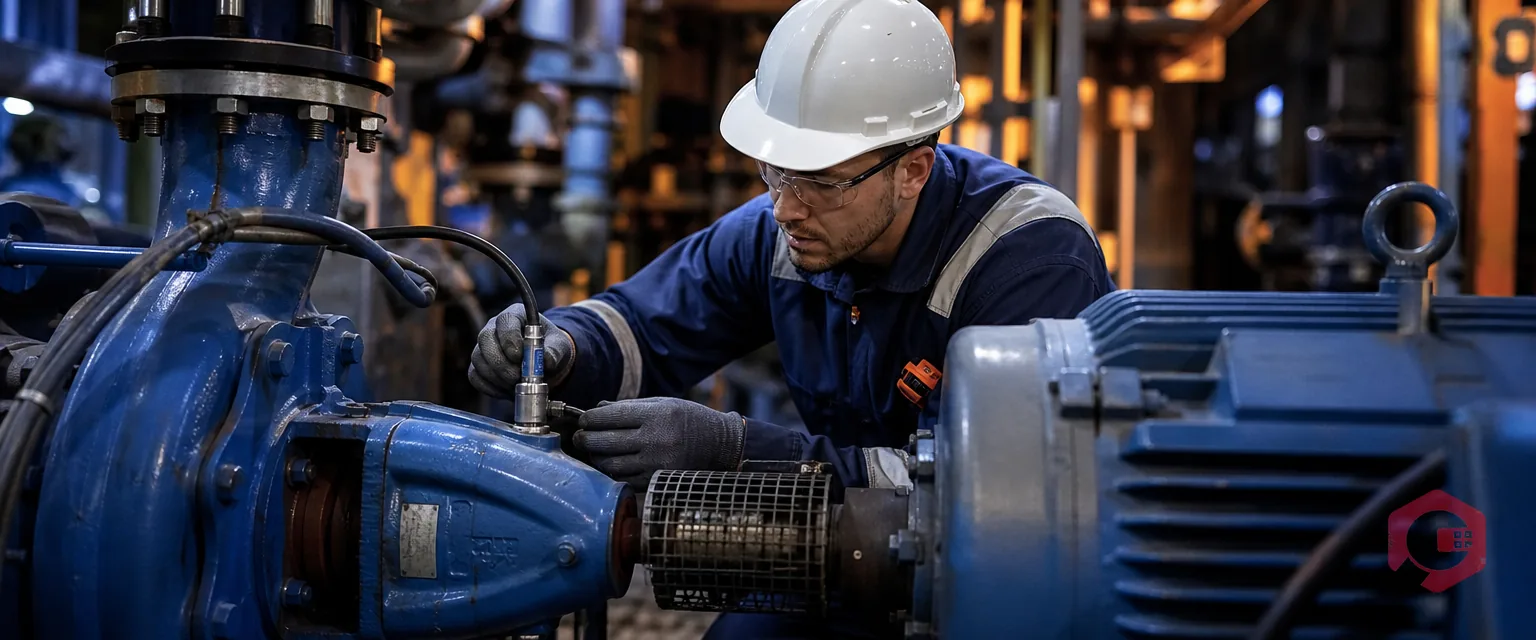
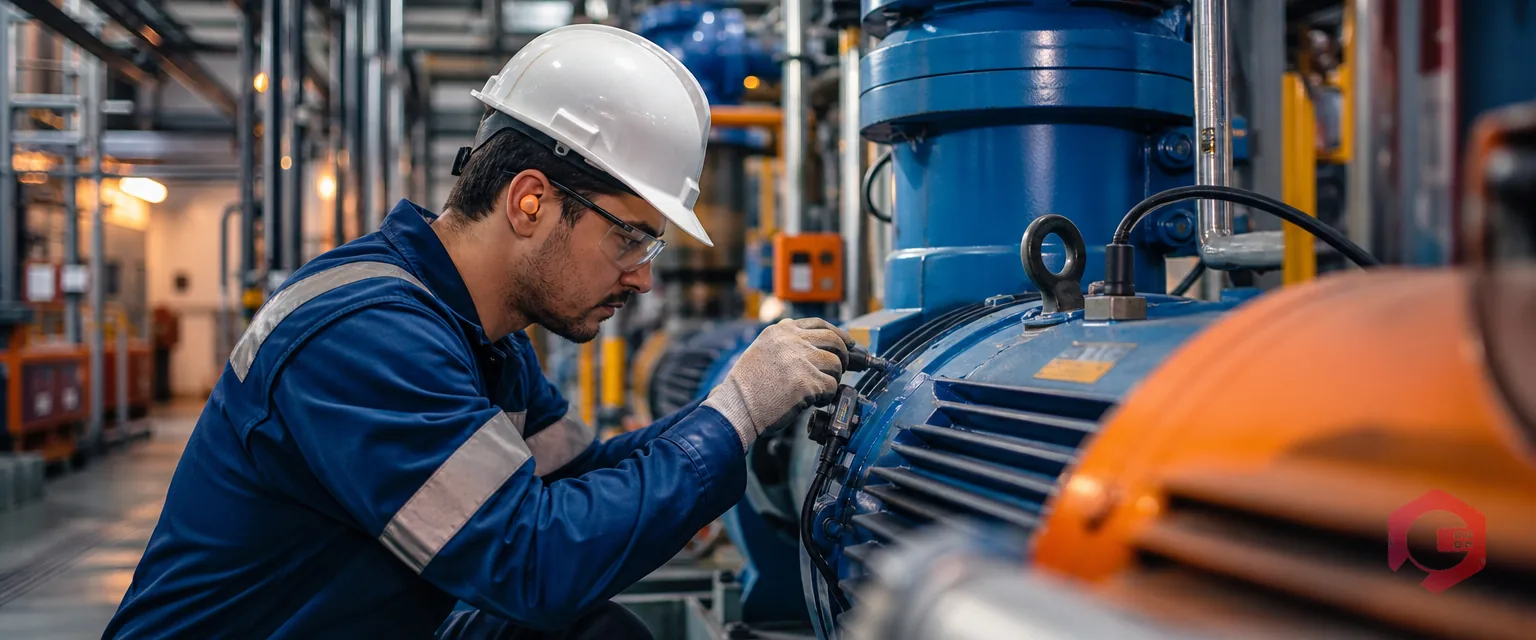

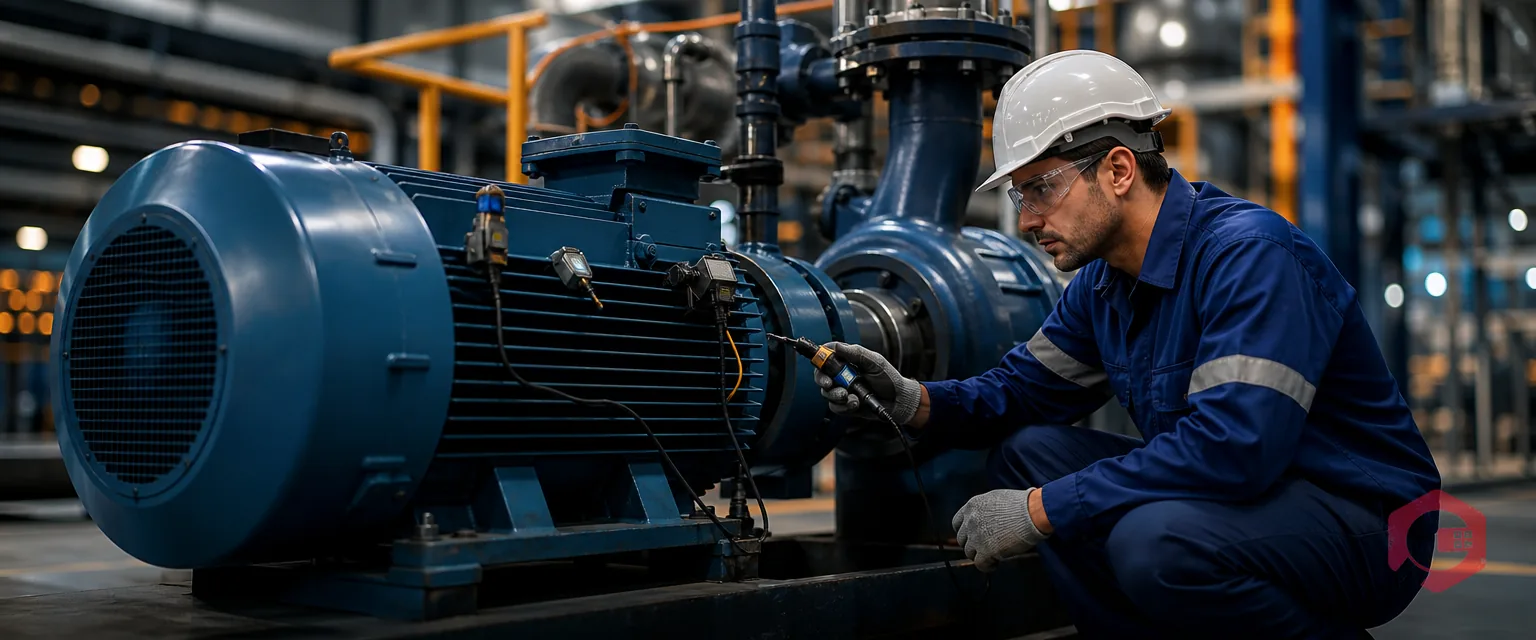
Cryotos AI predicts failures, automates work orders, and simplifies maintenance—before problems slow you down.



