
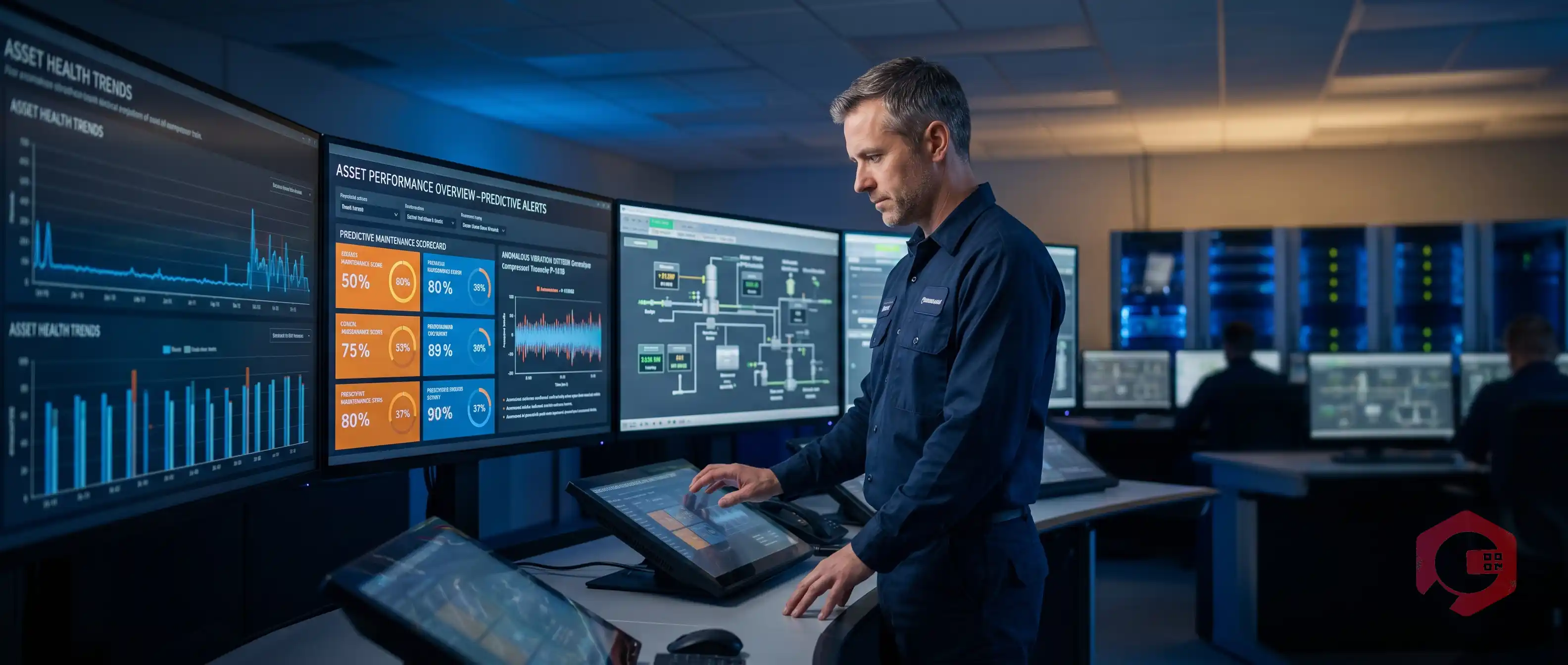
Prescriptive maintenance is a data-driven maintenance strategy that goes one step beyond predictive maintenance: rather than simply flagging that a failure is likely, it recommends the specific action to take, the optimal timing for that action, and the resource or procedure required to execute it. Where predictive maintenance says "this pump bearing is likely to fail within three weeks," prescriptive maintenance says "replace the inboard bearing race using Procedure PM-104, schedule during the planned Thursday shutdown window, and pull part #BR-7741 from bay 3 inventory." The distinction is the difference between a warning and a work order.
According to Plant Engineering, manufacturers that advance from predictive to prescriptive maintenance see an additional 10–20% reduction in maintenance costs beyond what predictive alone delivers — because prescriptive systems eliminate the interpretation delay between a sensor alert and a technician action. The data doesn't just sit in a dashboard waiting for a reliability engineer to review it; it automatically generates the work order, selects the procedure, confirms parts availability, and routes the job to the right technician.
This guide explains how prescriptive maintenance works, where it sits in the maintenance maturity model, the technology it requires, and how Cryotos serves as the operational execution layer that turns prescriptive recommendations into completed, documented maintenance actions.

The most basic maintenance approach: repair equipment after it fails. No scheduling, no monitoring, no anticipation. The failure is the trigger. Reactive maintenance is unavoidable for non-critical assets where the cost of prevention exceeds the cost of failure — but for critical process equipment, it produces the highest per-event repair costs, the longest unplanned downtime, and the greatest risk of cascading failures.
Fixed-interval maintenance performed on a schedule based on manufacturer recommendations, industry standards, or historical failure data. Preventive maintenance eliminates "run to failure" on critical assets and dramatically reduces unplanned downtime. Its limitation is that it doesn't account for actual asset condition — a pump running at 20% of rated capacity for the last month is treated the same as one running at 100% load. Some PM tasks are done too early, wasting labor and parts; others are done too late, missing a developing failure.
Condition-based maintenance triggered by sensor data, vibration analysis, thermal imaging, oil analysis, or other real-time monitoring. Predictive maintenance detects developing failures before they become catastrophic, allowing maintenance teams to act before the failure occurs rather than after. The limitation is that predictive systems are detection tools — they tell you a failure is coming, but they leave it to the maintenance team to decide what action to take, when to take it, and with what resources.
The highest level of the maturity model. Prescriptive systems combine real-time sensor data with historical failure patterns, asset context, operational constraints, and maintenance resource data to produce actionable recommendations. The output isn't an alert — it's a fully specified work order that tells the maintenance team exactly what to do, when to do it, and how. Prescriptive maintenance closes the gap between data and action that predictive systems leave open.
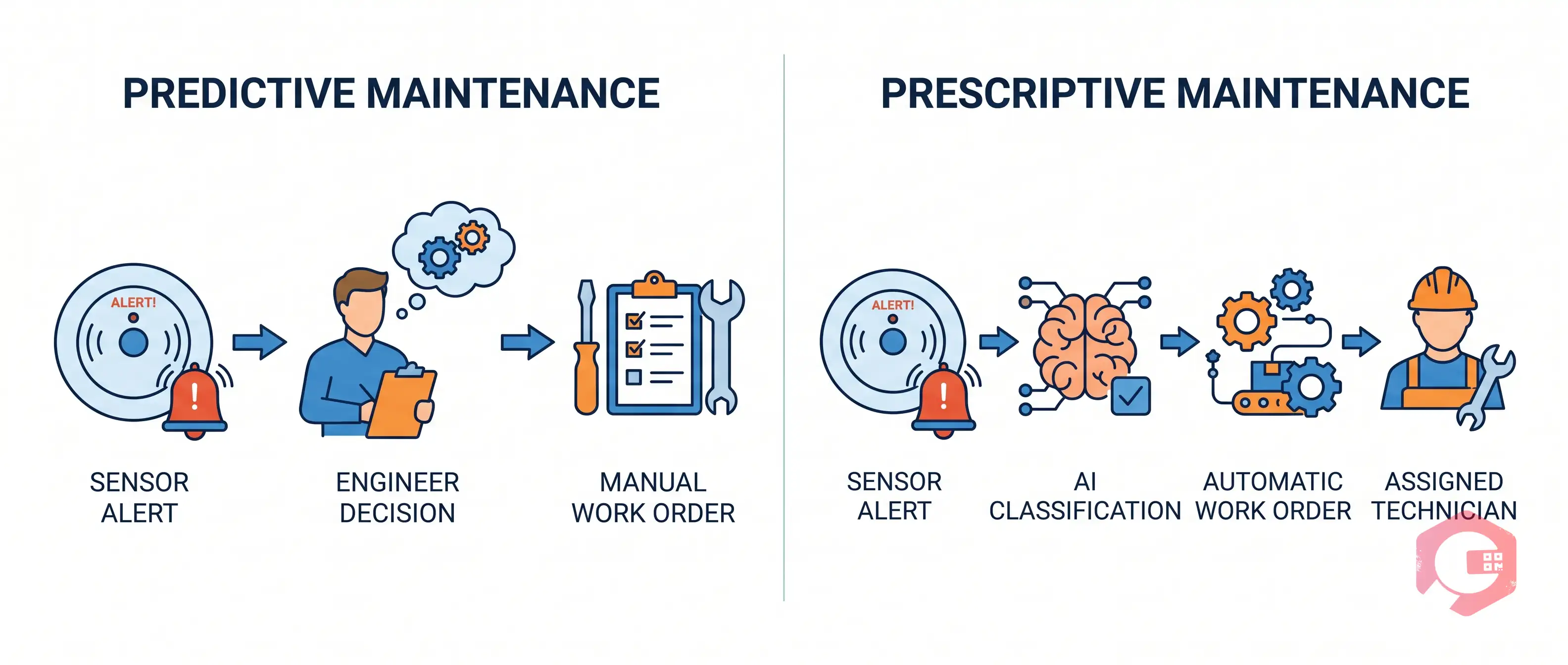
This distinction is the most important one in understanding prescriptive maintenance. A predictive maintenance alert arrives in a dashboard: "Bearing 4B on Pump P-101 showing vibration anomaly — predicted failure in 14–21 days." A reliability engineer reviews it, consults maintenance history, assesses the production schedule, checks parts availability, writes a work order, assigns a priority, routes it to the mechanical team, and ensures the right procedure is attached. That interpretation chain typically takes 12–48 hours — and in a high-pressure production environment, it often takes longer, or gets deprioritized.
A prescriptive system performs that entire interpretation chain automatically. It queries the failure pattern library, confirms the diagnosis against historical data for that specific pump type, checks the production schedule for the optimal maintenance window, confirms that part #BR-7741 is in stock in bay 3, retrieves the applicable maintenance procedure, generates a work order with all of that context attached, and sends a notification to the mechanical team lead. By the time the reliability engineer opens the dashboard, the work order is already routed and scheduled.
Prescriptive maintenance systems require three data inputs that predictive systems don't:

The data layer of prescriptive maintenance is built on continuous sensor monitoring: vibration sensors, thermocouples, pressure transducers, ultrasonic thickness gauges, oil quality sensors, and motor current analyzers. These devices generate the raw signal data that prescriptive algorithms use to detect anomalies. The key requirement is that data collection be continuous and structured — not periodic spot readings, but real-time streams tagged to specific asset IDs with consistent timestamp formatting.
According to Reliable Plant, the cost of IoT sensors for rotating equipment has declined by more than 70% over the past decade, bringing continuous condition monitoring within reach of mid-size industrial facilities that previously relied entirely on scheduled inspections. This cost trend is one of the primary drivers behind the growing adoption of prescriptive maintenance outside of large enterprise environments.
The intelligence layer of prescriptive maintenance is built on machine learning models that correlate sensor anomalies with known failure modes. These models are trained on historical data: sensor readings from equipment that subsequently failed, annotated with the confirmed failure mode (bearing wear, seal degradation, rotor imbalance, etc.) and the effective repair action. Once trained, the model classifies new anomalies against learned patterns and generates a failure mode probability distribution — "78% probability of inner race bearing wear, 14% probability of misalignment, 8% other" — that drives the repair recommendation.
The quality of these models depends entirely on the quality of the historical data they're trained on. Facilities without structured maintenance records — where failure modes were diagnosed verbally and repair actions were logged as "fixed" — cannot build accurate failure pattern models. This is another reason why CMMS data quality is a prerequisite for prescriptive maintenance, not an optional complement to it.
The execution layer of prescriptive maintenance is the CMMS. This is where the recommendation becomes a work order, and where the completed action becomes a data record that feeds back into the model. Without CMMS integration, prescriptive systems produce alerts that require manual interpretation — which degrades them back to predictive. With CMMS integration, the recommendation-to-action cycle is fully automated: anomaly detected → failure mode classified → work order generated → procedure and parts attached → job completed and documented → completion data feeds back into the failure model.
Cryotos's API architecture and IoT integration capability make it the natural execution layer for prescriptive maintenance systems. When a connected monitoring platform flags an anomaly, Cryotos receives the trigger, matches it to the asset record, retrieves the applicable procedure, confirms parts availability via the inventory management module, and generates a work order pre-populated with all of this context. The technician receives a job that's already specified — not a blank form to fill in from memory.
Rotating equipment is the highest-value application for prescriptive maintenance because failure modes are well-defined, sensor technology is mature, and the consequences of unplanned failure are significant — particularly in continuous process industries like refining, chemicals, and power generation. Vibration analysis identifies bearing wear, rotor imbalance, misalignment, and resonance; thermal imaging identifies overheating bearings and electrical faults; oil analysis identifies lubricant degradation and metallic contamination from wear surfaces.
In a prescriptive implementation, each of these sensor streams feeds into a model that classifies the developing failure mode and generates the corresponding work order automatically. A vibration anomaly that matches the "inner race wear" pattern triggers a bearing replacement work order with the correct bearing specification, lubricant type, and torque values attached — not a generic "check vibration" inspection request.
Cryotos's preventive maintenance module supports prescriptive execution for rotating equipment by allowing IoT-triggered work order creation with pre-configured procedure templates. When the sensor trigger arrives, the work order inherits the procedure, parts list, and skill requirements from the asset configuration — eliminating the planning step that typically delays response to predictive alerts.
Heat exchangers degrade through fouling, corrosion, and tube failure — processes that are measurable through differential pressure monitoring, heat transfer efficiency calculations, and ultrasonic thickness measurement. Prescriptive systems for heat exchangers calculate the rate of performance degradation and project the optimal cleaning or tube bundle replacement timing based on current fouling rate, production schedule, and the cost of a forced shutdown versus a planned one.
The prescriptive recommendation in this context isn't just "clean the exchanger" — it's "schedule bundle cleaning for the Q3 turnaround based on current fouling rate projecting to 15% heat transfer loss by August, with estimated 18 hours scope using Contract Team C." This level of specificity is only possible when the CMMS has the historical cleaning records, the fouling rate history, and the contractor and procedure data already structured and accessible.
Electrical failures in industrial facilities are disproportionately dangerous — they cause both production losses and fire/explosion risks. Thermal imaging detects loose connections, overloaded conductors, and failing insulation before they arc. Motor current signature analysis identifies developing rotor bar failures, bearing issues, and winding faults in electric motors without taking them offline for testing.
Prescriptive systems for electrical equipment generate work orders that include the specific conductor location, the measured temperature differential above baseline, the applicable repair standard (NFPA 70B, NETA, or facility-specific procedure), and the lockout/tagout isolation procedure for that circuit. The technician doesn't need to look up any of this — it's in the work order before the job begins, generated automatically from the thermal imaging trigger and the asset record in Cryotos.

Prescriptive maintenance is not a plug-and-play solution. Most facilities that attempt to implement it encounter the same set of barriers, and understanding them in advance is the difference between a successful deployment and an expensive pilot that never scales.
Data quality is the primary bottleneck. Machine learning models for failure pattern recognition require years of structured historical data: sensor readings correlated with confirmed failure modes and effective repair actions. Facilities with poor CMMS data — generic failure codes, incomplete work order histories, undocumented repairs — cannot build accurate models. The path to prescriptive maintenance runs directly through improving CMMS data quality, which is why organizations that invest in structured CMMS practices first reach prescriptive capability faster.
Integration complexity is underestimated. A prescriptive maintenance system requires real-time data flows between the sensor layer, the analytics platform, and the CMMS. Each integration point is a potential failure mode. Selecting a CMMS with documented API architecture and established IoT integration patterns reduces this complexity significantly — facilities shouldn't be building custom middleware to connect their condition monitoring system to their work order platform.
Change management is critical. Prescriptive systems change how maintenance work is initiated and prioritized. Technicians who are accustomed to receiving jobs from supervisors now receive them from automated systems. Reliability engineers whose value was in interpreting alerts now focus on validating model outputs and improving failure pattern libraries. Organizations that don't address these changes explicitly see adoption problems that undermine the entire program.
Most facilities aren't ready to start at prescriptive — and that's fine. According to research from McKinsey, fewer than 10% of industrial facilities have the data infrastructure required to support prescriptive maintenance today. The appropriate path for most is to systematically improve CMMS data quality and preventive maintenance compliance, implement condition monitoring on critical assets, and build toward prescriptive over 18–36 months rather than attempting to implement it all at once.
Most CMMS platforms are passive record-keeping systems — they store what happened, but they don't actively support the journey toward prescriptive capability. Cryotos is built differently: its architecture is designed to be the execution layer for both current preventive maintenance programs and future prescriptive workflows, without requiring a platform change when the organization is ready to advance.
Building the data foundation: Every work order closed in Cryotos contributes to the asset failure history that prescriptive ML models require. Structured failure codes, mandatory completion fields, photo documentation, and parts traceability mean that Cryotos data is usable for pattern recognition from day one. The BI Dashboard tracks failure frequency, MTTR, and MTBF by asset and failure type, giving reliability engineers the data they need to identify candidates for condition monitoring investment.
IoT and sensor trigger integration: Cryotos integrates with SCADA systems, PLCs, and IoT platforms to receive condition-based triggers that automatically generate work orders. When a sensor threshold is crossed, Cryotos creates a work order pre-linked to the asset record, the applicable procedure, and the relevant parts — transitioning the alert from a notification to an actionable job without human interpretation.
Procedure-embedded work orders: Prescriptive maintenance is only as good as the repair procedures attached to the generated work order. Cryotos supports procedure libraries linked to asset types and failure modes — when a bearing-related work order is generated for a centrifugal pump, the bearing replacement procedure, lubricant specification, and torque values are automatically included. Technicians arrive at the job with everything they need, reducing errors and improving first-time fix rates.
Downtime and failure mode tracking: Cryotos's downtime tracking module captures breakdown causes with structured failure codes compatible with ML training data requirements. Rather than logging a failure as "breakdown — pump," Cryotos prompts the technician to select the specific failure mode category, record the symptoms observed, and document the corrective action taken. Over 12–24 months, this produces the labeled dataset that supports accurate failure pattern modeling.
Wrench time optimization: Prescriptive recommendations are only valuable if the maintenance team has capacity to execute them. Cryotos's work order management module maximizes technician wrench time by eliminating administrative overhead — automated dispatch, mobile job access, digital checklists, and one-tap status updates mean technicians spend more of their shift on actual repair work. Higher wrench time means prescriptive recommendations get executed faster, which improves the feedback loop that makes the models better over time.
The path from where most facilities are today to a fully prescriptive maintenance program is a 2–3 year journey for most organizations. Cryotos supports that journey at every stage: structured preventive maintenance today, condition-based triggers tomorrow, and full prescriptive execution once the data and analytics layer is in place. The maintenance management software you choose now should be capable of supporting that evolution without requiring a platform replacement. Request a Cryotos demo to see how the platform maps to your current maintenance maturity level and your target prescriptive capability.
Predictive maintenance detects developing failures using sensor data and condition monitoring, then alerts the maintenance team that a failure is likely within a certain timeframe. Prescriptive maintenance takes the next step: it analyzes the available data, identifies the specific failure mode, determines the optimal intervention timing based on operational constraints, selects the correct repair procedure and parts, and generates the work order automatically. Predictive tells you that something is going wrong; prescriptive tells you exactly what to do about it and when. The practical result is a faster response, fewer decision errors, and a documented action trail that feeds back into the system to improve future recommendations.
Full prescriptive maintenance — where the system automatically classifies failure modes and generates specific repair recommendations — requires machine learning models trained on historical failure data. However, condition-based work order triggering (a step toward prescriptive) can be implemented with rule-based systems that don't require ML: "if vibration exceeds threshold X, create bearing inspection work order." Most organizations implement rule-based CBM first, then advance to ML-based prescriptive as their failure history dataset matures. The important thing is that both approaches require a CMMS with the data structure and API connectivity to act on the trigger.
A CMMS supporting prescriptive maintenance needs four capabilities: structured asset records with linked failure modes and repair procedures; API or native integration with IoT/condition monitoring platforms to receive automated triggers; work order generation that pre-populates procedure, parts, and technician assignment from asset data; and structured failure code capture at work order closure to generate the historical dataset that ML models require. Cryotos supports all four, and its IoT integration layer allows condition monitoring platforms to trigger work orders directly without manual intervention.
For most industrial facilities, the realistic timeline to full prescriptive capability is 2–4 years from the decision to pursue it. The first 12–18 months are typically spent improving CMMS data quality and PM compliance — creating the structured historical dataset that ML models require. Months 12–24 involve deploying continuous monitoring on critical assets and implementing rule-based CBM triggers. Full ML-based prescriptive recommendations typically require 18–36 months of labeled failure history before models are accurate enough to generate reliable repair recommendations. Facilities that start with a well-structured CMMS reach prescriptive capability significantly faster than those that begin with poor data foundations.



Cryotos AI predicts failures, automates work orders, and simplifies maintenance—before problems slow you down.



