

Lithium-ion battery fires at solar storage sites are prevented by controlling heat, electrical faults and trapped gas. They are handled with early detection, a defensive fire plan and trained responders. No single device does all of that. Most failures start small: a loose connection, a stalled cooling fan or a gas sensor nobody calibrated.
This guide is for Solar Industry operators and maintenance teams. It covers causes, a five-part framework, a maintenance schedule and a response plan. It also shows what one real solar plant case study does, and does not, tell us.
Key Takeaways

Thermal runaway is a self-heating chain reaction inside a battery cell that cannot be stopped once it starts. Heat from one failing cell can spread to its neighbors as the cells vent flammable gas.
Chemistry matters too. Lithium iron phosphate (LFP) cells are usually more stable under heat than nickel manganese cobalt (NMC) cells. Both can still enter thermal runaway and vent flammable gas.
In 2019, a storage fire in Surprise, Arizona, ended in an explosion that injured four firefighters. Flammable gas had built up inside the enclosure. In January 2025, a fire at the Moss Landing battery plant in California led to evacuation orders for nearby residents.
Lithium-ion battery fires remain rare compared with installed capacity. The Electric Power Research Institute keeps a public failure incident database and reports falling failure rates as designs improved. NFPA 855 is the U.S. standard for installing stationary energy storage systems. It covers hazard analysis, fire testing, explosion control and emergency planning.
Solar storage sites carry extra fire risk because they are often remote, hot, dusty and lightly staffed. Those conditions stress cooling systems and slow emergency response.
Where storage is DC-coupled to PV arrays, DC faults add another ignition path. Teams in the Solar Industry that plan for these conditions treat fire readiness as a standing job, not a commissioning task.
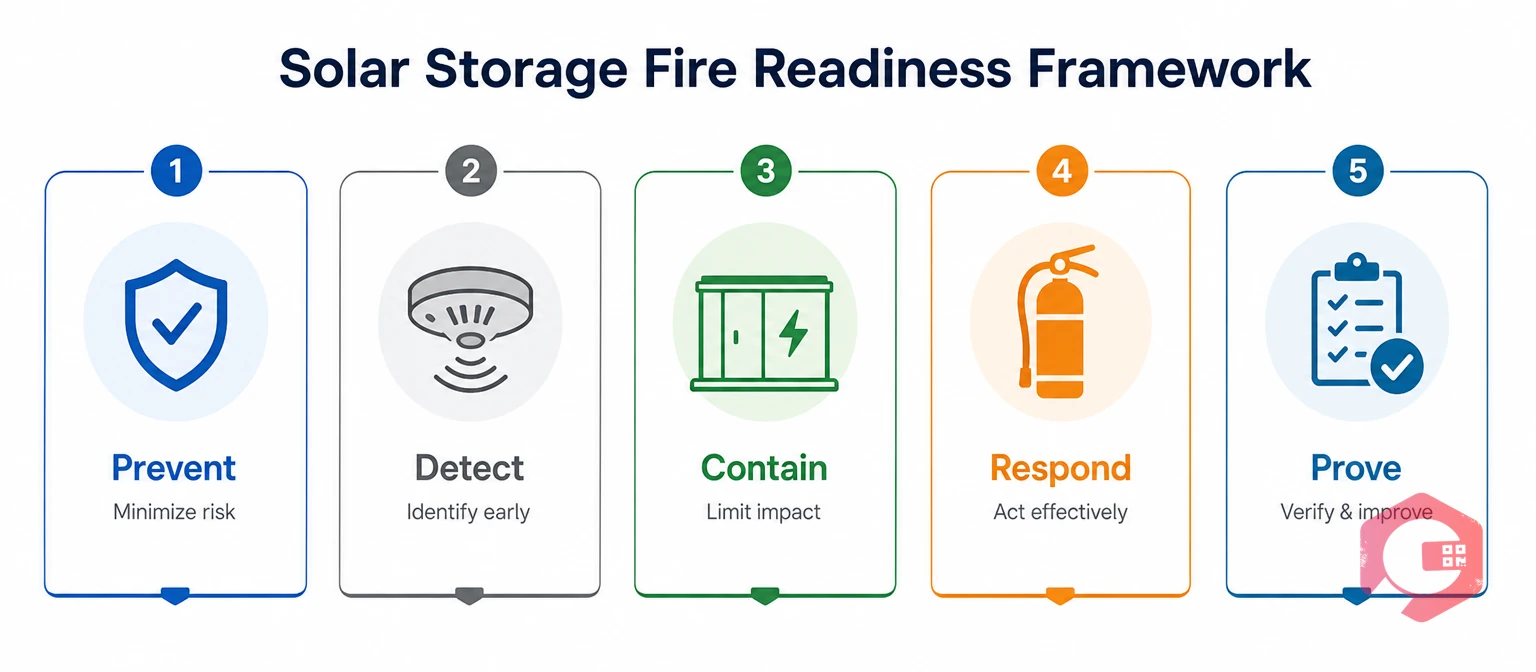
A fire readiness framework gives every shift the same playbook for lithium-ion battery fires. Safety then does not depend on who is on duty. This five-part version suits solar-plus-storage sites of any size.
The Solar Storage Fire Readiness Framework:
Most maintenance teams invest in Detect and Contain at commissioning, then let Prevent and Prove slip. That gap is where small faults grow.
The strongest prevention is routine maintenance on parts that create heat, carry current or give warning. Follow your manufacturer’s manuals and local code first. Then add these controls.
See how a thermal inspection round is logged with photos and signatures in Cryotos maintenance checklists.
A Computerized Maintenance Management System (CMMS) turns these controls into scheduled, assigned and recorded work. It does not detect or extinguish fires. It makes sure the checks behind those systems happen on time.
Cryotos IoT meter reading can bring readings from SCADA, PLC or edge devices into the asset record. What is available depends on your BMS and SCADA setup.
A maintenance schedule gives each control a frequency, an owner and the evidence to keep. Treat these intervals as starting points. Set final ones from manufacturer manuals, your hazard analysis and local code.
| Task | Frequency | Owner | Evidence to capture |
|---|---|---|---|
| Review BMS, gas and fire panel alarms | Daily | Control room operator | Alarm log and a work request for each fault |
| Check cooling, filters and coolant levels | Monthly | Technician | Checklist with photos |
| Thermal scan of DC and AC connections | Quarterly and after any overheating alarm | Electrician | Thermal images and readings |
| Torque check and cable condition | Per manufacturer | Electrician | Signed torque record |
| Test detectors, suppression and fire panel | Per manufacturer and local code | Qualified technician | Calibration and test certificates |
| Walk the site and review the plan with the fire service | Annually | Site manager | Attendance sheet and updated plan |
Load the schedule into preventive maintenance software so every row becomes a recurring work order with a named owner. Overdue items then surface on a dashboard instead of at an audit.
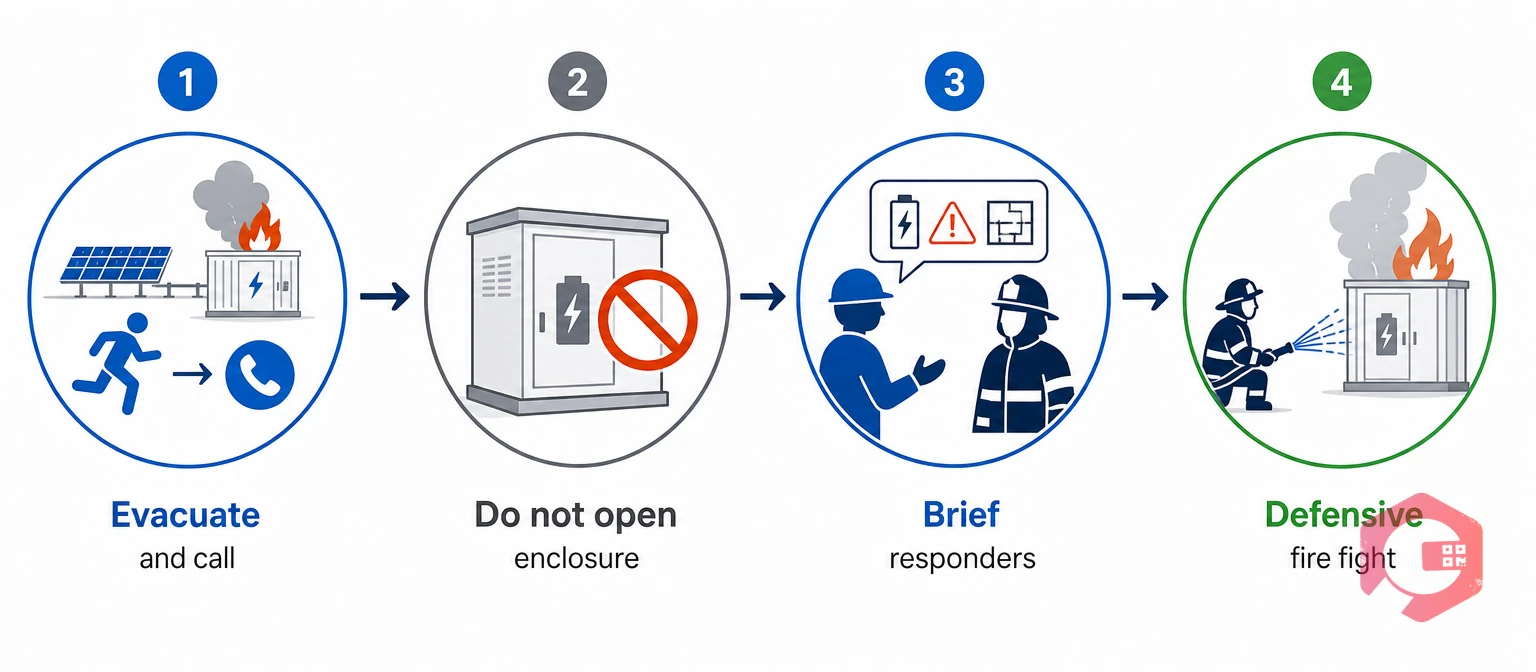
The safest response is to protect people first. Call the fire service and keep staff away from the burning enclosure. Your written emergency plan and local fire service guidance come before anything in this guide.
Re-ignition can happen hours or days later. Keep the area controlled and monitor temperatures until the fire service and your engineers agree it is safe.
Use permit-to-work software and lockout procedures for every re-entry task. Then run a root cause analysis and update the plan. OSHA’s 29 CFR 1910.269 sets safety rules for work on power generation installations. Check with your safety lead which parts apply to your site.
The South Jeddah Solar Plant case study shows how digital permits and tracked maintenance replace manual workflows at a renewable energy site in Saudi Arabia. It is a real Cryotos client. The limits matter as much as the results.
Before Cryotos, the plant ran high-risk work and routine maintenance through manual workflows. That covered permits for electrical work, hot work, lifting, excavation and confined spaces. It also covered preventive maintenance (PM), spare parts and paperwork.
The case study covers a plant with PV trackers, inverters and transformers. It does not describe a battery storage system or a fire incident, so this guide does not claim South Jeddah prevented one.
The link is the discipline. The same permit, PM and record controls apply to battery work. Maintenance teams using Cryotos have reported up to 30% reduction in unplanned downtime and 25% faster repair turnaround. Results vary by site, and those figures are not fire-safety measures.
The usual cause is thermal runaway. It is triggered by overcharging, cell defects, overheating, loose connections or physical damage. Failing cells vent flammable gas, which raises the explosion risk inside enclosed units.
Large volumes of water can cool cells and slow spread, and fire services sometimes use it. The decision belongs to them and your emergency plan. Staff should never try it on energized equipment.
Follow the manufacturer’s manual, your hazard analysis and local code. The schedule above gives starting points, such as daily alarm reviews and quarterly thermal scans.
NFPA 855 covers the installation of stationary energy storage systems. Your local authority decides which edition and rules are enforced. Confirm with your authority having jurisdiction and your design engineer.
No. A CMMS does not detect or extinguish fires. It schedules inspections, assigns owners and records evidence, so the checks that protect the site get done.
Invite them for a site walk-through before commissioning and every year after. Share the emergency plan, site plan and battery data sheets, and agree gate access and water supply.
Preventing lithium-ion battery fires starts long before an alarm sounds. Schedule a free demo to see how Cryotos plans battery site inspections, controls permits and records every test and repair.


Cryotos AI predicts failures, automates work orders, and simplifies maintenance—before problems slow you down.



