
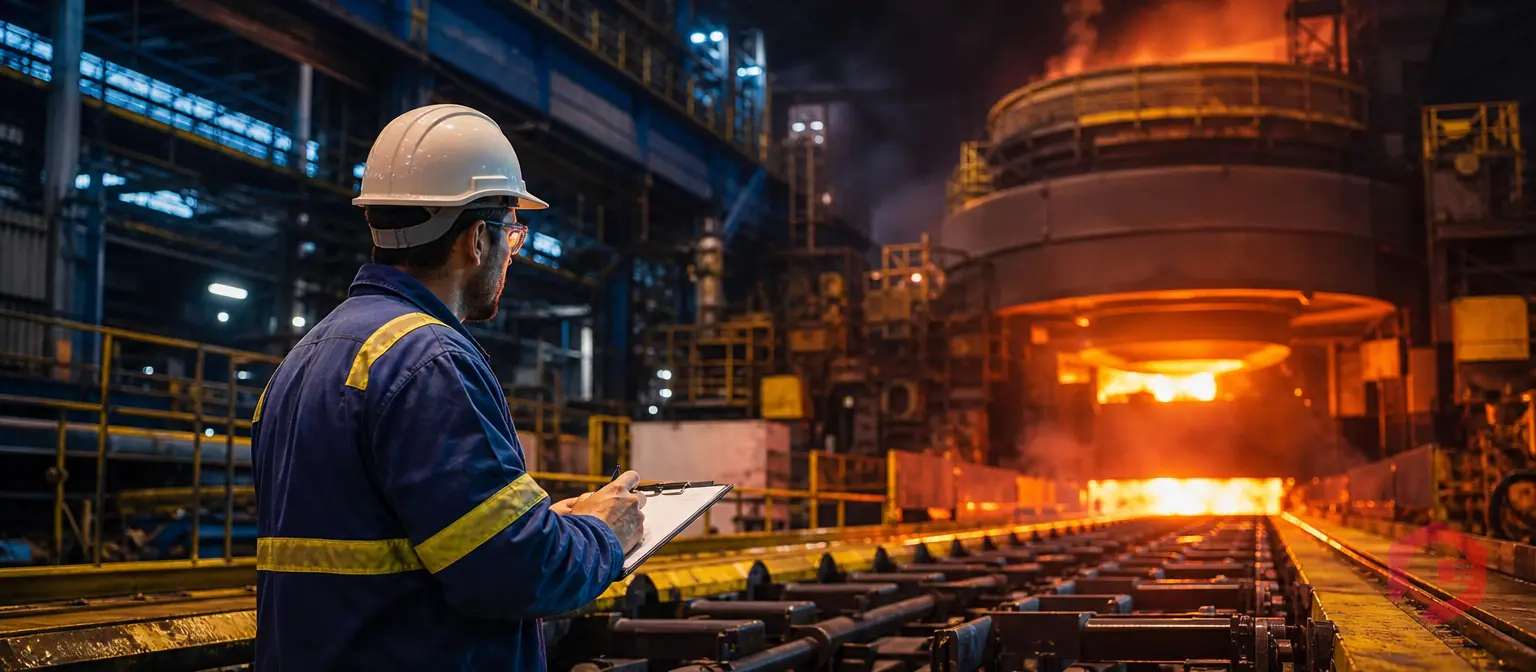
Preventive maintenance in steel plants is a planned program of scheduled inspections and part replacements before equipment fails. Steel manufacturing runs continuously on enormous, expensive equipment. A single unplanned stop on a casting line costs between $100,000 and $250,000 per hour according to World Steel Association data — and McKinsey research shows heavy industry loses 5% to 20% of total production capacity to unplanned stops every year. A disciplined preventive maintenance in steel plants program, managed through a Computerized Maintenance Management System, is the most effective way to protect that capacity.
Key Takeaways
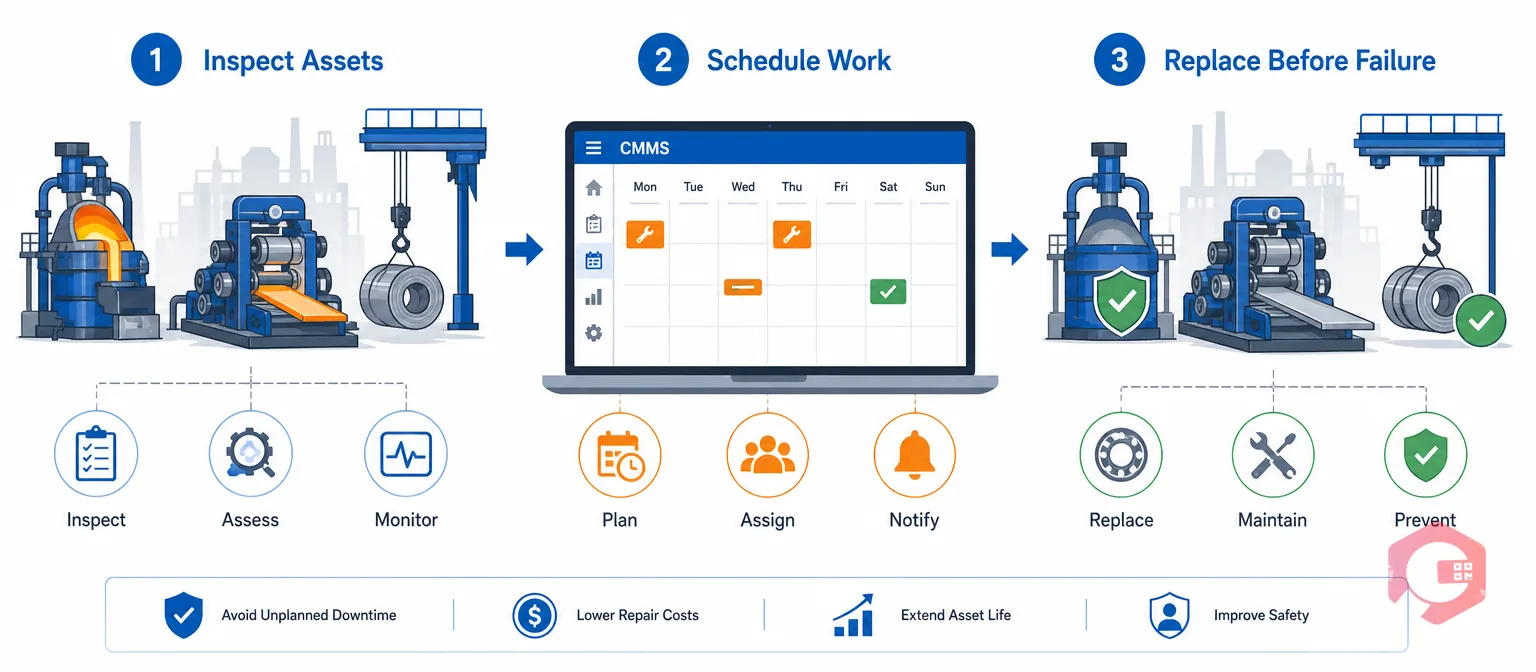
Preventive maintenance in steel plants is planned, scheduled work done at fixed intervals before an asset fails. In steel plants, it covers everything from weekly lubrication on roll chocks to quarterly hydraulic fluid sampling on continuous casters.
Steel assets operate under extreme heat, pressure, and chemical stress. The conditions are harsh. Equipment wears fast. That is why the distinction matters.
Thermal, mechanical, and chemical stress are the main wear drivers. A blast furnace runs at 1,500°C. A hot strip mill rolls steel slabs at 1,250°C. In those conditions, even small gaps in a preventive maintenance in steel plants schedule lead quickly to safety incidents and production losses.
Reactive maintenance — fixing equipment after it breaks — is the default in many plants. It feels cheaper until you count the full cost: emergency labour at 1.5x to 3x standard rates, expedited parts with premium freight, lost production during unplanned stops, and secondary damage when a failed component cascades into adjacent systems. SMRP benchmark data shows plants that move from reactive to PM-first maintenance see 25% to 40% lower maintenance costs over three years. The transition takes discipline. It also requires a system to run the schedule. But the return is measurable inside 12 months.
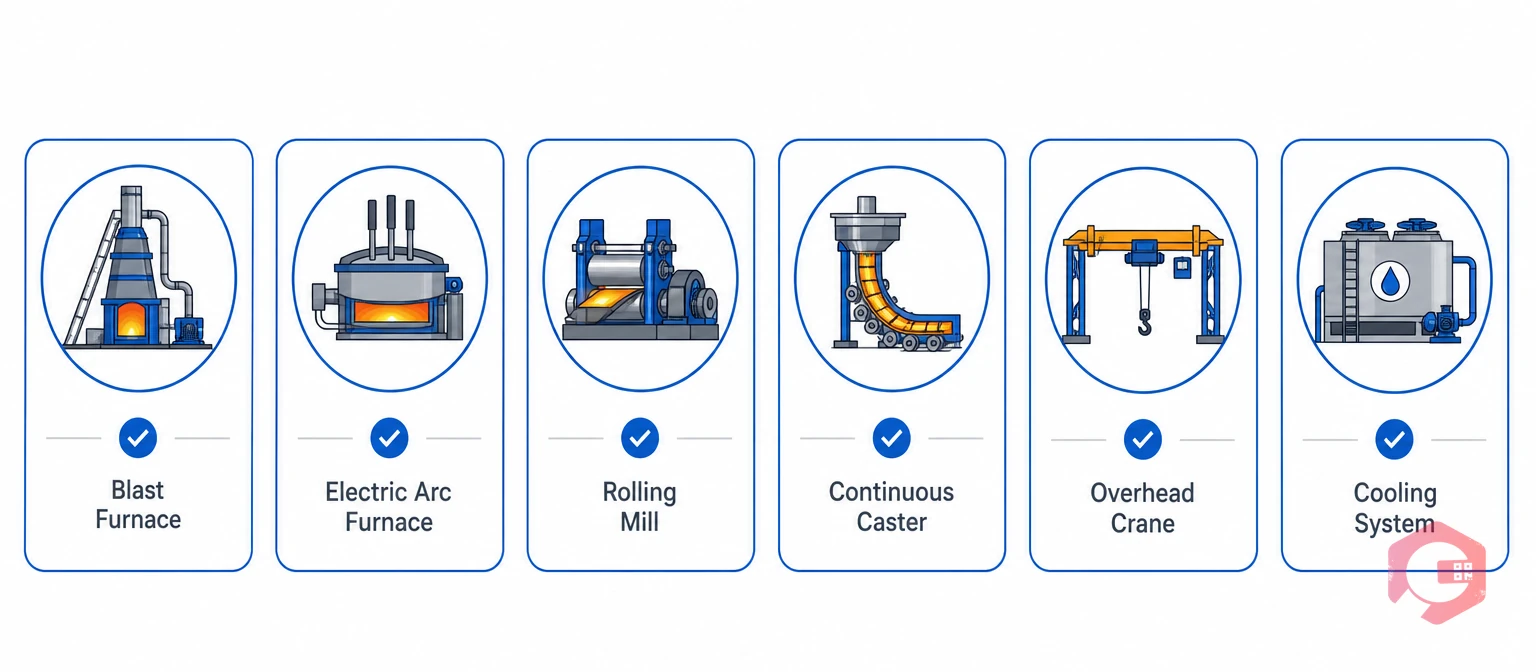
Not every asset in a steel plant carries the same risk. PM investment should follow criticality — the combination of failure impact on production, safety risk, and repair cost. These six asset categories consistently rank highest in steel plant criticality assessments and deliver the strongest PM return on investment.
Blast furnaces and electric arc furnaces are the most capital-intensive assets in a steel plant, and unplanned stops carry both production and safety consequences. Key PM tasks include thermal imaging on cooling staves every 3 to 6 months, tuyere and bustle pipe inspection at every tap cycle, weekly skip hoist lubrication, and EAF electrode arm hydraulic checks every 200 heats. Refractory inspection and replacement scheduling are driven by heat count and campaign length targets, not clock time.
Rolling mills fail more often than any other asset in a flat steel plant. Bearings and spindle couplings are the main culprits. A structured PM plan covers spindle coupling inspection every 2 weeks, roll chock and bearing replacement at fixed tonnage intervals, and monthly hydraulic checks. For continuous casters, cooling water nozzle flush-and-check every shift and segment roll gap verification at each campaign are the top prevention tasks. Connecting these assets to condition-based maintenance triggers — vibration sensors on roll bearings, temperature sensors on roller tables — extends PM intervals on healthy assets and shortens them on assets showing early deterioration.
Melt shop overhead cranes carry liquid steel. They operate in the most hostile environment in the plant. PM failures here are safety events, not just production events.
Conveyor idler bearing checks every 250 operating hours and weekly belt tension checks deliver the highest uptime-per-spend ratio on transfer conveyors.
Cooling tower performance directly affects furnace campaign length and roll product quality. Neglect it and furnace life drops fast. Non-negotiable PM tasks cover cooling water quality monitoring (weekly), pump seal inspection (monthly), tower fill and drift eliminator inspection (quarterly), and complete pump overhaul at annual intervals. Hydraulic systems serving press lines, casters, and roll gap adjusters need fluid sampling every 6 months, scheduled filter replacement at manufacturer intervals, and seal and accumulator checks at fixed operating-hour milestones.
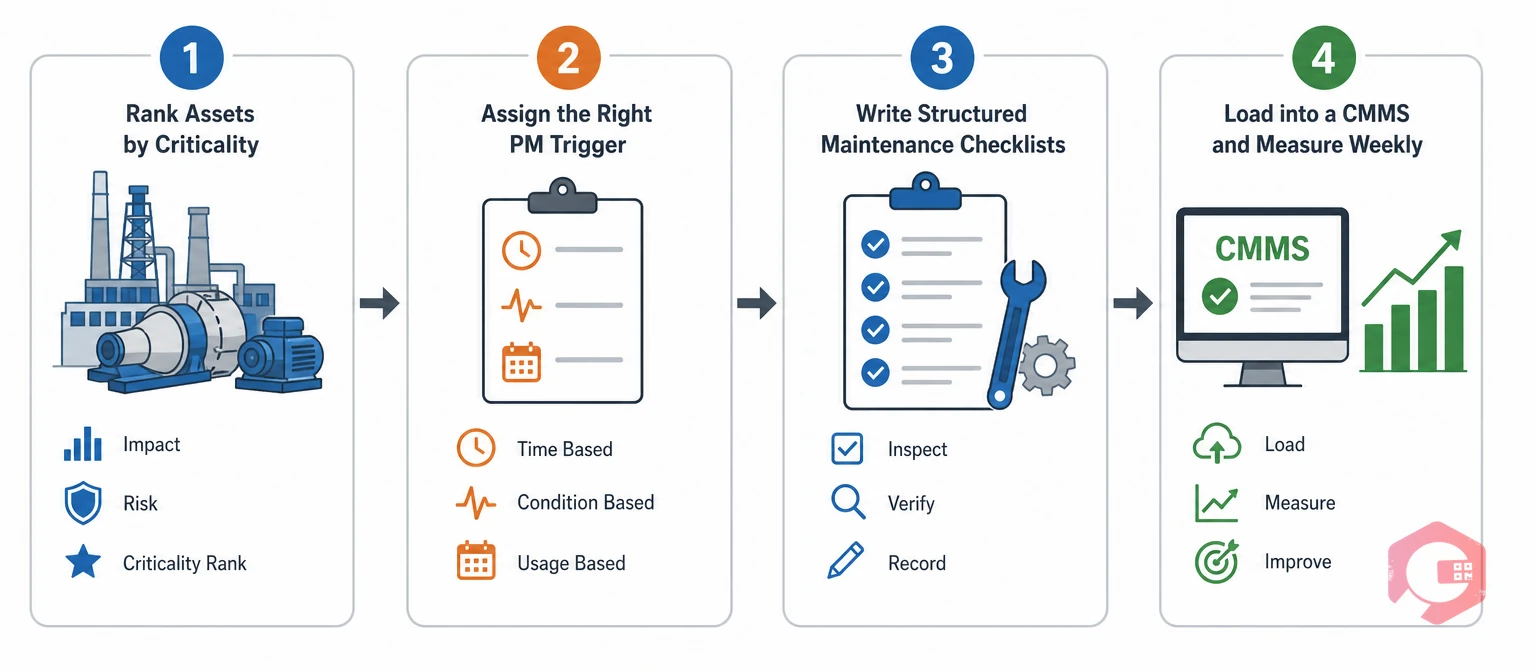
A PM schedule is only as effective as the process used to design it. Plants that copy OEM intervals without calibration miss real failure modes. These four steps build a schedule that works in practice.
Score every asset on two dimensions: production impact (what stops if this asset fails?) and safety risk (what is the worst-case safety outcome?). Combine the scores into a criticality tier. Blast furnaces, EAFs, hot strip mills, and melt shop overhead cranes consistently land in Tier 1. Secondary transport conveyors and non-process hydraulics typically land in Tier 3. PM frequency, budget allocation, and spare parts stocking strategy all flow from the criticality tier, not from OEM default intervals.
Steel plants need three PM trigger types, and using the wrong one wastes money or leaves gaps:
Each PM task needs a checklist. It names what to inspect, the acceptance reading, and the action if the reading is out of spec. Build checklists with senior technicians. They know the real failure modes — not just what the OEM manual says. Digital maintenance checklists capture findings with timestamps and photos. Out-of-spec readings flag automatically for follow-up.
Here is the weekly rhythm that works. Load the schedule. Let the CMMS fire the work orders. Check four numbers every Monday. Those four numbers are: PM compliance rate, MTBF by asset, MTTR on breakdowns, and asset availability. Look at the trend. Act on anything moving the wrong way.
Once the schedule is designed, load it into a CMMS. Set automatic PM work order generation at the right intervals. Track four metrics every Monday: PM compliance rate, MTBF by asset, MTTR on breakdowns, and asset availability. Trends matter more than single readings. A drop from 94% to 87% compliance over six weeks is a warning sign. Catch it at week four. Not week ten.
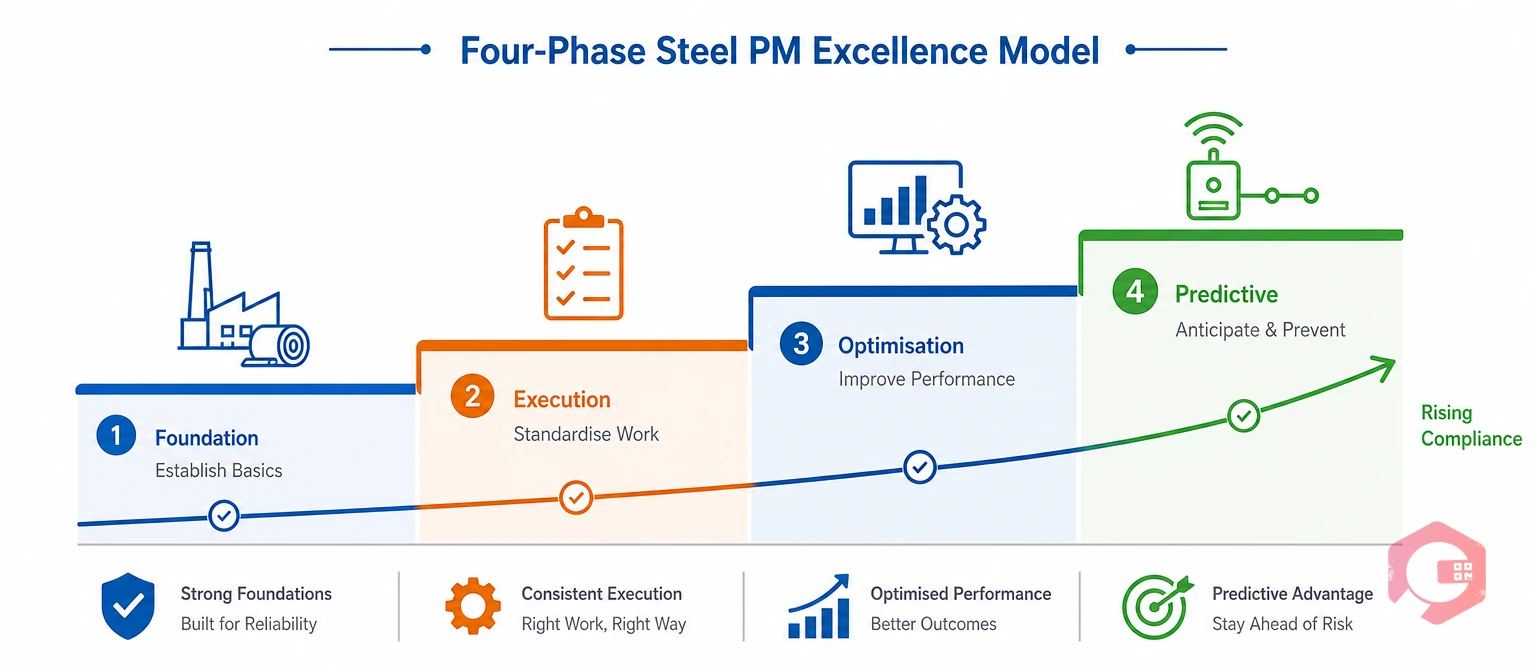
The Four-Phase Steel PM Excellence Model:
Use this register as your starting point for preventive maintenance in steel plants scheduling. The table gives baseline PM frequencies for the highest-criticality assets. These are starting points — calibrate against your actual operating hours, tonnage rates, and historical failure data.
| Asset | PM Task | Trigger Type | Frequency |
|---|---|---|---|
| Blast Furnace | Cooling stave thermal imaging | Time-based | Every 3-6 months |
| Blast Furnace | Tuyere and bustle pipe inspection | Usage-based | Every tap cycle |
| Blast Furnace | Skip hoist lubrication | Time-based | Weekly |
| Electric Arc Furnace | Electrode arm hydraulic check | Usage-based | Every 200 heats |
| Rolling Mill | Spindle coupling inspection | Time-based | Every 2 weeks |
| Rolling Mill | Roll chock and bearing check | Usage-based | Fixed tonnage interval |
| Rolling Mill | Hydraulic system check | Time-based | Monthly |
| Continuous Caster | Cooling nozzle flush and check | Time-based | Every shift |
| Overhead Crane | Wire rope condition check | Time-based | Weekly |
| Overhead Crane | Brake wear assessment | Time-based | Monthly |
| Cooling Tower | Water quality monitoring | Time-based | Weekly |
| Hydraulic System | Fluid sampling | Time-based | Every 6 months |
These intervals assume normal operating conditions and standard steel grades. High-alloy rolling or extended blast furnace campaigns require more frequent intervals on refractory and cooling assets.
Tracking the right KPIs tells you whether the PM program is delivering. Start by setting a baseline. Use the MTBF calculator before the program starts. Then track weekly from week one.
| KPI | Definition | Steel Plant Target | Review Cadence |
|---|---|---|---|
| PM Compliance Rate | % of scheduled PMs completed on time | >=92% | Weekly |
| Asset Availability | % of time Tier 1 assets are available to run | >=95% | Weekly |
| MTBF | Mean time between failures on critical assets | Year-on-year increase | Monthly |
| MTTR | Mean time to repair on breakdown events | Under 4 hours Tier 1 | Weekly |
| OEE | Overall Equipment Effectiveness | >=85% | Monthly |
| Blast Furnace Campaign Availability | Actual vs. target campaign length | >=98% | Per campaign |
Run these KPIs in a weekly maintenance meeting — ideally Monday morning before the shift begins. Trends over 4 to 6 weeks matter more than any single reading.
Spreadsheets, paper checklists, and whiteboard schedules work until the volume of PM tasks and assets exceeds what a maintenance planner can track manually. Most steel plants cross that threshold within the first year of a serious PM program. A manufacturing maintenance software platform removes the manual load and adds capabilities that paper systems cannot replicate.
The biggest PM scheduling problem is forgetting. A CMMS does not forget. It fires PM work orders automatically. No planner has to check a spreadsheet. No PM slips because of a busy week. Static time-based PMs generate on a calendar. Usage-based PMs generate when the asset hits its tonnage or heat count milestone, fed by SCADA or IoT meter readings. No PM gets missed because of a busy week or a planner on leave.
Technicians get the job on their phone. They complete the checklist in the field. They take photos of anything out of spec. They sign off with a timestamp. The CMMS records the completion time, the findings, and any corrective actions raised. Digital sign-off replaces paper checklists that get lost, illegible, or undated.
Vibration sensors on rolling mill bearings, thermal sensors on cooling staves, and oil analysis from hydraulic systems all flow into the CMMS. When a reading exceeds a threshold, the system opens a PM work order. It happens before the technician notices a problem. ISO 55000 requires that failure data is collected and used to improve maintenance planning. IoT integration is how steel plants meet that standard at scale. The connection is direct: better data, better timing, fewer failures.
A CMMS tracks which parts each PM task consumes. It sets reorder points from actual usage data. Critical bearings, seals, electrode tips, and refractory items reorder before they run out. No breakdown reveals an empty shelf. No emergency freight order at premium cost.
Maintenance teams using Cryotos have reported up to 30% reduction in unplanned downtime and 25% faster repair turnaround. Most steel plants see payback on the preventive maintenance software investment within 12 months of full deployment.
The data case holds across plant sizes. A 2 million tonne flat steel plant and a 400,000 tonne special steel mill face the same physics. Bearings fail without lubrication. Refractory cracks without thermal inspection. Crane wires fatigue without load cycle monitoring. Preventive maintenance in steel plants is not a large-plant luxury — it is a foundational discipline that pays for itself faster at smaller facilities, where a single unplanned stop represents a larger share of weekly production.
Most PM programs in steel plants fail not from lack of effort but from a handful of avoidable mistakes. These are the four most common.
OEM intervals are designed for average conditions, but steel plants rarely operate at average intensity. A rolling mill running 20% above rated tonnage per shift needs bearing inspection at shorter intervals than the OEM recommends. Extended blast furnace campaigns require more frequent refractory checks than standard schedules specify. Use OEM intervals as a starting point, then calibrate against your actual failure history within 6 to 12 months.
A PM is marked complete when the technician signs the checklist. That is the theory. In practice, a completed PM that missed two inspection points is not a real PM. It is a box-tick. It does not prevent the failure it was designed to catch. Digital checklists with mandatory measurement fields and photo requirements ensure the PM was actually done, not just recorded as done.
Not all assets carry the same risk. Applying the same PM intensity to a blast furnace and a secondary transfer conveyor wastes resources. Criticality-tiered PM programs concentrate technician time, budget, and spare parts on the assets where failure has the highest production and safety consequence. Most teams that switch to criticality-tiered PM reduce total PM hours while improving Tier 1 availability. They stop over-maintaining low-risk assets. They focus resources where it counts.
Every breakdown that occurs despite a PM schedule is a data point — it tells you the PM interval was too long, the checklist missed a failure mode, or the task was not completed properly. Maintenance teams that capture root cause on every breakdown event and feed that data back into the PM schedule continuously improve the program. Teams that do not repeat the same failures quarter after quarter. A planned downtime culture — where every unplanned event is analysed and corrected — is the outcome of a mature PM feedback loop.
OEE (Overall Equipment Effectiveness) is the clearest indicator of whether preventive maintenance in steel plants is working at the plant level. If PM compliance is high but OEE stays flat, the program is hitting the wrong failure modes. Review your PM checklist against your top 10 unplanned downtime events from the past 6 months. If those events are not covered by an existing PM task, add one. If they are covered but still happening, the interval is too long or the task execution is inconsistent.
Steel plants that tie PM review cycles to OEE and MTBF data improve asset availability faster than those that review PM schedules on an annual basis. The cadence that works in practice is monthly PM effectiveness review for Tier 1 assets and quarterly for Tier 2 and Tier 3 assets.
Preventive maintenance in a steel plant is scheduled work performed before equipment fails — inspections, lubrication, part replacement at fixed intervals — designed to prevent failure rather than respond to it. Reactive maintenance is repairs performed after a failure occurs. The difference in cost is significant: reactive repairs carry emergency labour premiums, expedited parts costs, and full production loss during unplanned stops. PM distributes maintenance work into planned windows that minimise production impact and eliminate emergency premiums.
Frequency depends on asset criticality, failure mode, and operating intensity. Blast furnace cooling stave imaging runs every 3 to 6 months. Rolling mill spindle couplings inspect every 2 weeks. Overhead crane wire ropes check weekly. Cooling water quality monitors weekly. Hydraulic fluid samples every 6 months. These are baselines — calibrate against your actual failure data within 12 months of starting the PM program.
Bearing failures cause the most downtime in rolling mills. Hydraulic failures stop casters and press lines. Cooling system blockages shut down furnace cooling circuits. These three failure types cause the majority of unplanned stops. The root cause is almost always the same: inadequate lubrication. Wrong lubricant, wrong amount, or missed interval. A CMMS-driven preventive maintenance in steel plants program with mandatory lubrication checklists addresses all three failure modes directly.
A Computerized Maintenance Management System automates PM scheduling, generates work orders at the right time or usage trigger, routes tasks to the right technician, captures digital checklist completion with photos and timestamps, tracks KPIs in real time, and manages spare parts reorder points based on PM consumption. It removes the manual load from maintenance planners and ensures no scheduled PM is missed due to human oversight.
Track six KPIs: PM compliance rate (target 92%+), asset availability (target 95%+ on Tier 1 assets), MTBF (target: year-on-year improvement), MTTR (target: under 4 hours on Tier 1 assets), OEE (target: 85%+), and blast furnace campaign availability (target: 98%+). Review them weekly. A PM program that does not move these numbers in the right direction within 6 months has a gap in schedule design, execution discipline, or data capture.
Preventive maintenance in steel plants is the foundation of profitable, safe, and stable operations. Plants still running on spreadsheets and reactive firefighting pay twice — once in surprise repairs, and once in lost production.
The good news: the path from reactive to a mature preventive maintenance in steel plants program is well-defined. Start with criticality ranking. Build structured checklists. Load them into a CMMS. Track compliance and MTBF weekly. Calibrate intervals every 6 months. Most steel plants reach 90%+ PM compliance and measurable availability improvements within 12 months of consistent execution.
Schedule a free demo to see how Cryotos runs PM scheduling, mobile checklists, IoT-triggered condition monitoring, and KPI dashboards for steel plant operations.



Cryotos AI predicts failures, automates work orders, and simplifies maintenance—before problems slow you down.



