

Preventive maintenance schedule compliance measures the percentage of planned PM tasks that are completed on time within a defined window. It is one of the most direct indicators of whether a maintenance programme is actually delivering the reliability it was designed to produce — because a PM that gets skipped or delayed by four weeks provides far less protection than the schedule intended. Industry benchmarks from the Society for Maintenance and Reliability Professionals (SMRP) set a target of 90% or higher for schedule compliance in well-run maintenance organisations, yet the average plant typically tracks between 60–75%.
This guide explains exactly how to calculate PM schedule compliance, why it drops, how to identify the specific causes in your operation, and the actions that consistently move the number toward and beyond that 90% target.
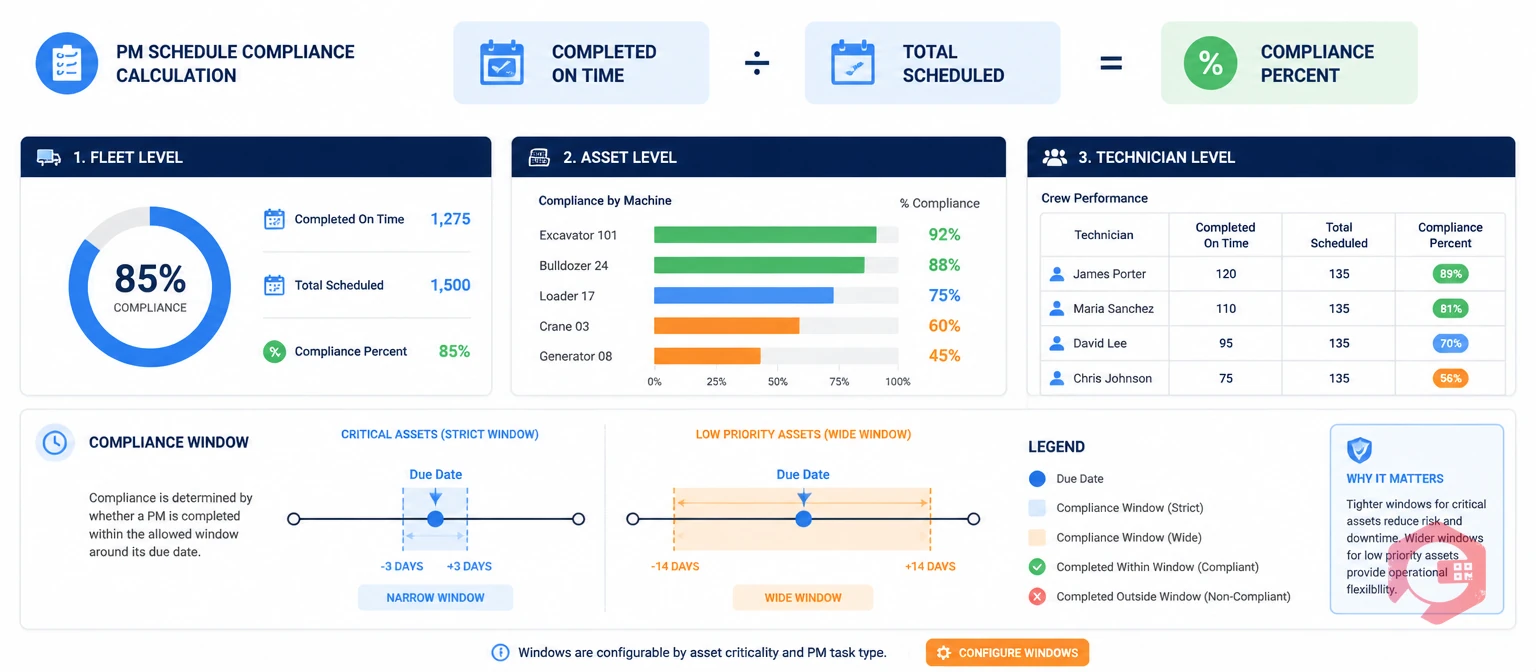
The standard formula is: Schedule Compliance (%) = (PM Tasks Completed On Time ÷ PM Tasks Scheduled) × 100
The key variable that organisations define differently is "on time." Some plants treat any completion within the calendar week as compliant. Others use a stricter window — within ±10% of the task interval (so a 30-day task must be completed between day 27 and day 33 to count). The right window depends on how critical the asset is and how tightly the PM interval was calculated. For safety-critical assets or tasks derived from an RCM analysis with a specific P-F interval, a narrow window (±5–10%) is appropriate. For general-condition tasks on low-criticality equipment, a weekly or monthly window may be acceptable.
You should track compliance at three levels for it to be actionable:
Tracking only the fleet-level number is the most common mistake. An 85% fleet average can hide a critical asset sitting at 40% and a non-critical asset at 99% — and the maintenance risk is entirely concentrated in the one you're not watching.
These two metrics are often confused but measure different things. Completion rate tracks whether a PM task was eventually done, regardless of when. Compliance rate tracks whether it was done on time within the defined window. A task completed six weeks after its due date counts as a "completion" but not a "compliant" event.
This distinction matters because the protective value of a PM is time-dependent. A lubrication task meant to prevent a bearing failure by refreshing the oil film every 30 days loses most of its effectiveness if it's done at day 60. The machine spent 30 days running on degraded lubricant — the window where the failure was most likely to develop. Reporting completion rate instead of compliance rate flatters the maintenance programme and obscures the real risk exposure.
World-class organisations track both, with compliance rate as the primary KPI and completion rate as a secondary signal that helps distinguish "tasks we skipped" from "tasks we did late." If completion is high but compliance is low, the problem is scheduling and prioritisation. If both are low, the problem is capacity or planning.

A 90% compliance target applied uniformly across all assets is a useful starting point, but mature maintenance organisations set differentiated targets based on asset criticality. Not all missed PMs carry equal risk.
A reasonable framework is:
This tiered approach prevents the compliance metric from being driven by low-consequence tasks while critical assets slip. Maintain criticality classifications in your asset tracking module so the CMMS can apply the right compliance window and escalation rule automatically per asset — rather than requiring a supervisor to manually assess every missed PM.
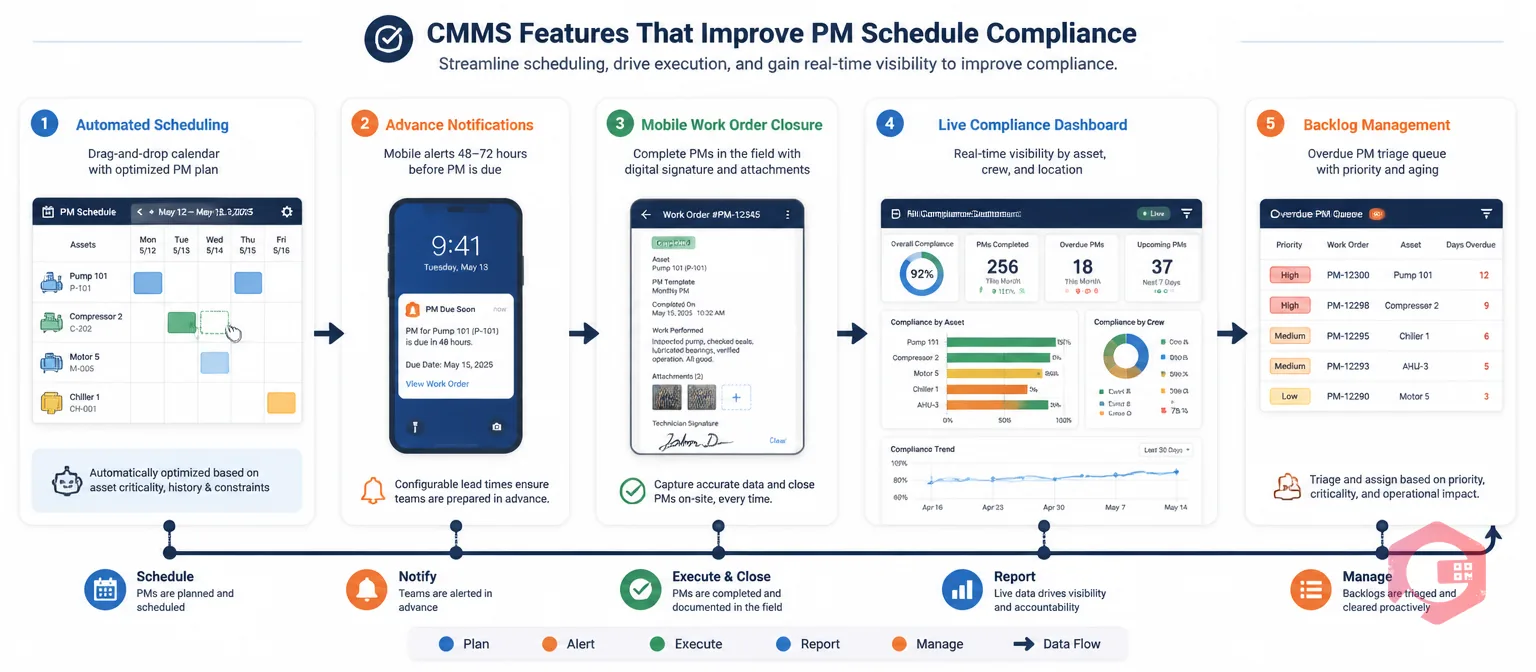
Manual compliance tracking — pulling PM due dates from a spreadsheet and cross-referencing completed work orders — takes hours per week and typically produces numbers that are already 2–3 weeks stale by the time someone reviews them. A CMMS makes schedule compliance a live metric, not a monthly report.
The specific CMMS capabilities that directly move compliance are:
Automated scheduling with forward visibility. A preventive maintenance scheduler that generates work orders automatically based on calendar intervals, meter readings, or runtime hours removes the manual dispatch step that most compliance failures hide behind. Drag-and-drop scheduling lets supervisors see the week's workload and identify conflicts before they become missed tasks.
Advance notifications. Pushing task-due reminders to technicians' phones 48–72 hours before a PM is due via WhatsApp or email cuts the "I didn't know it was due" failure mode entirely. For high-criticality assets, a second reminder at 24 hours keeps the task visible through shift handovers.
Mobile work order closure. The single biggest source of false-low compliance numbers is completed tasks that were done in the field but never closed in the system. A mobile CMMS with offline capability lets technicians close work orders at the asset, in real time, eliminating the end-of-shift batch update that loses completions. Digital signatures on task sign-off create a time-stamped audit trail that feeds accurate compliance calculations automatically.
Live compliance dashboards. A BI dashboard that shows schedule compliance by asset, by crew, and by time period — updated in real time — turns compliance from a backward-looking report into a daily operational metric. Supervisors can see which tasks are at risk of missing their window today and reprioritise before the breach happens, rather than explaining it in next month's review.
Backlog management. Every missed PM creates a backlog item that must be managed — either completed within a catch-up window or formally deferred with a risk note. A CMMS work order system that classifies overdue PMs separately from new PMs lets supervisors triage the backlog systematically rather than letting old overdue tasks accumulate invisibly behind current work.
If your current compliance rate is in the 60–75% range and you want to reach 85–90% within a quarter, here is a practical sequence that works in most plant environments.
Days 1–30 — Diagnose before you act. Pull 90 days of PM completion data from your CMMS, broken down by asset, crew, and reason code for any missed or late task. Identify the top three root causes. In most plants, 60–70% of compliance failures trace back to just two causes: reactive work crowding out planned work, and parts not available at task time. Don't try to fix everything at once — fix the dominant cause first.
Days 31–60 — Fix scheduling and visibility. Audit task durations in your PM library against actual time-to-complete from closed work orders. If your scheduled duration for a task is 45 minutes but the average actual completion takes 75 minutes, the schedule is guaranteed to fail — the math doesn't work. Recalibrate durations, then cap each technician's daily scheduled load at 80% of available wrench time. Use the wrench time calculator to establish a realistic baseline. Enable advance notifications and confirm all technicians can close work orders from their phones.
Days 61–90 — Close the parts gap and review the PM library. For every parts-blocked PM in the backlog, identify which parts caused the delay and set a minimum stock level for those items. Then review the PM library for the top 20 non-compliant assets: are all tasks justified? Are any tasks so low-value that technicians routinely deprioritise them? A 20% reduction in unjustified PM tasks typically produces a 10–15 percentage point improvement in compliance rate for the remaining tasks — because the workload drops while the critical tasks get more attention.
Review your maintenance audit checklist at the 90-day mark to validate the improvement and identify the next constraint in the system.
The SMRP benchmark for world-class schedule compliance is 90% or higher. Most plants operating without a formal compliance programme sit between 60–75%. A realistic 12-month improvement target for a plant starting at 65% is 80–85%, with 90% achievable in 18–24 months if the root causes are systematically addressed. Don't set 90% as a day-one target if your baseline is 60% — the improvement plan that gets you from 65% to 80% is different from the one that gets you from 85% to 92%.
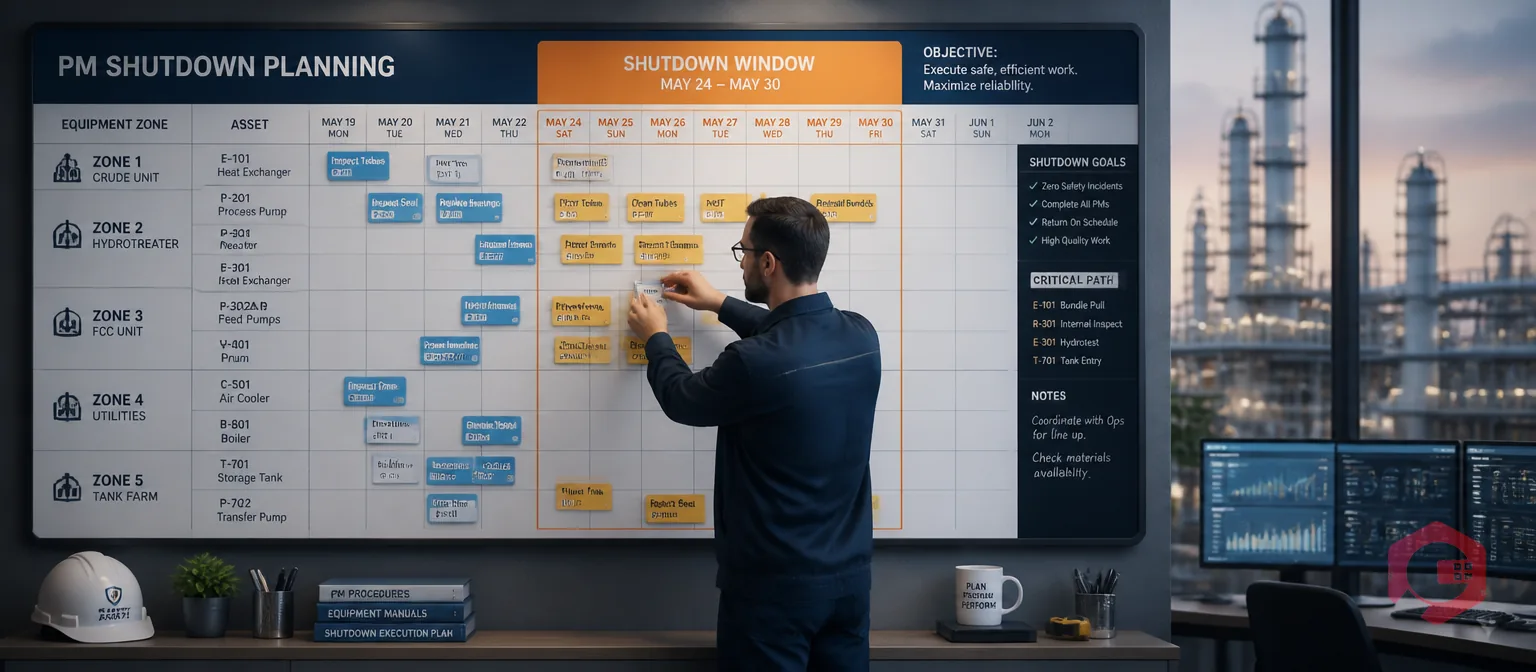
A deferral should always be documented with a reason code and a new due date — never silently rescheduled. Most CMMS platforms allow a "planned deferral" status that distinguishes a deliberate delay (production outage not available, waiting for a planned shutdown) from a missed task. Planned deferrals by an authorised supervisor don't count against compliance in a well-designed system. Undocumented delays always do — which is the right incentive, since undocumented delays carry real risk.
Condition-based maintenance tasks triggered by sensor data or meter readings operate on a different schedule logic than calendar-based PMs and should generally be tracked separately. A vibration inspection triggered by a sensor alert doesn't have a fixed due date in the traditional sense — it has a response-time target (e.g., respond within 48 hours of trigger). Mixing these into the calendar-PM compliance metric dilutes both numbers. Track CBM response compliance as its own KPI.
The most common cause is that the improvement effort increased compliance by working around the root cause rather than fixing it — for example, adding overtime to catch up the backlog without addressing the reactive-work ratio that created it. When the overtime ends, compliance drops back. Sustainable compliance improvements come from structural changes: reducing reactive work volume, fixing the PM library, right-sizing the schedule, and building parts availability into the planning process. If your compliance improved then dropped, look at which structural change was skipped.
Compliance should be reviewed weekly at the supervisor level — weekly is the right cadence to catch a developing problem before it becomes a month-end crisis. Monthly reviews at the plant manager level are appropriate for trend analysis and target-setting. Daily compliance dashboards in the CMMS are a best practice for high-criticality environments: supervisors should be able to see which tasks are at risk of breaching their window today, not after the breach has already occurred.
PM schedule compliance is the clearest early-warning metric for whether your maintenance management programme is actually protecting your assets or just generating paperwork. Getting from 65% to 90% doesn't require more people — it requires better scheduling, better visibility, better parts planning, and a CMMS that makes compliance tracking automatic rather than manual. Cryotos CMMS gives your team the drag-and-drop PM scheduling, advance notifications, mobile work order closure, and real-time compliance dashboards to reach and sustain that 90% target. Book a free demo to see the compliance dashboard in action.



Cryotos AI predicts failures, automates work orders, and simplifies maintenance—before problems slow you down.



