
Process validation is documented proof that a process consistently delivers correct results, while process verification confirms that specific requirements were met at a defined checkpoint. Both are required for regulatory compliance in manufacturing, pharmaceutical, food, and medical device industries. The distinction between process validation vs process verification matters because each produces different records, and auditors expect to see both in your maintenance documentation.
Maintenance records sit at the center of this distinction. Calibration logs, PM completion records, and signed checklists provide the evidence that both validation and verification depend on. This guide breaks down the differences between process validation vs process verification, shows which records support each, and explains how to keep your documentation audit-ready.
Key Takeaways
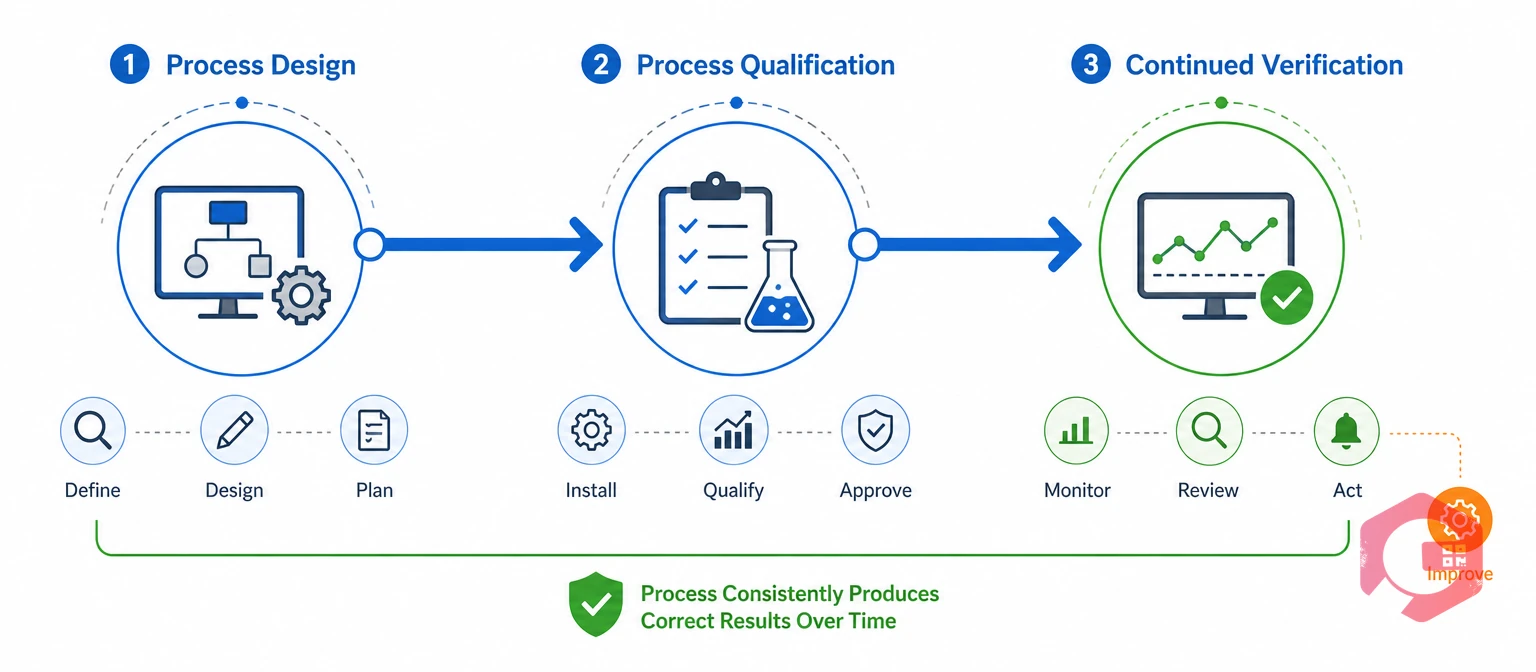
Process validation is documented proof that a manufacturing or maintenance process consistently produces results meeting predetermined specifications. The FDA defines it as collecting and evaluating data from the process design stage through production to establish scientific evidence that a process can deliver quality products repeatedly.
Validation answers one core question: does this process work the way it should, every single time? It is not a one-time check. Under FDA guidance and ISO standards, validation covers the entire lifecycle of a process, from initial design through ongoing commercial production.
Process validation typically follows three stages defined in the FDA process validation guidance:
Maintenance teams support all three stages. They keep equipment calibrated, document preventive maintenance completion, and flag process drift through meter readings and condition data. A validated process can lose its status if maintenance records show gaps in calibration, missed PM schedules, or undocumented equipment changes.
Industries that rely on process validation include pharmaceuticals (FDA 21 CFR Parts 210/211), medical devices (ISO 13485), food and beverage (FSMA, HACCP), and aerospace (AS9100). In each case, auditors ask the same question: where is your proof?
Process verification is the act of confirming, through objective evidence, that specified requirements have been fulfilled. While process validation asks "are we building the right process?", process verification asks "did we build it correctly?"
The ISO 9000 family of standards draws a clear line between the two concepts. Verification checks outputs against inputs at each stage. It is inspection, testing, and review applied to confirm that work was done to specification.
Verification activities in a maintenance context include:
Verification is narrower than validation. A technician who checks torque values against the procedure is performing verification. The broader question of whether that entire maintenance process keeps the equipment in a validated state falls under validation.
Understanding the difference between process validation vs process verification helps maintenance teams organize their records so auditors can find what they need. When a team cannot explain which records serve validation and which serve verification, it raises questions about whether either is truly controlled.
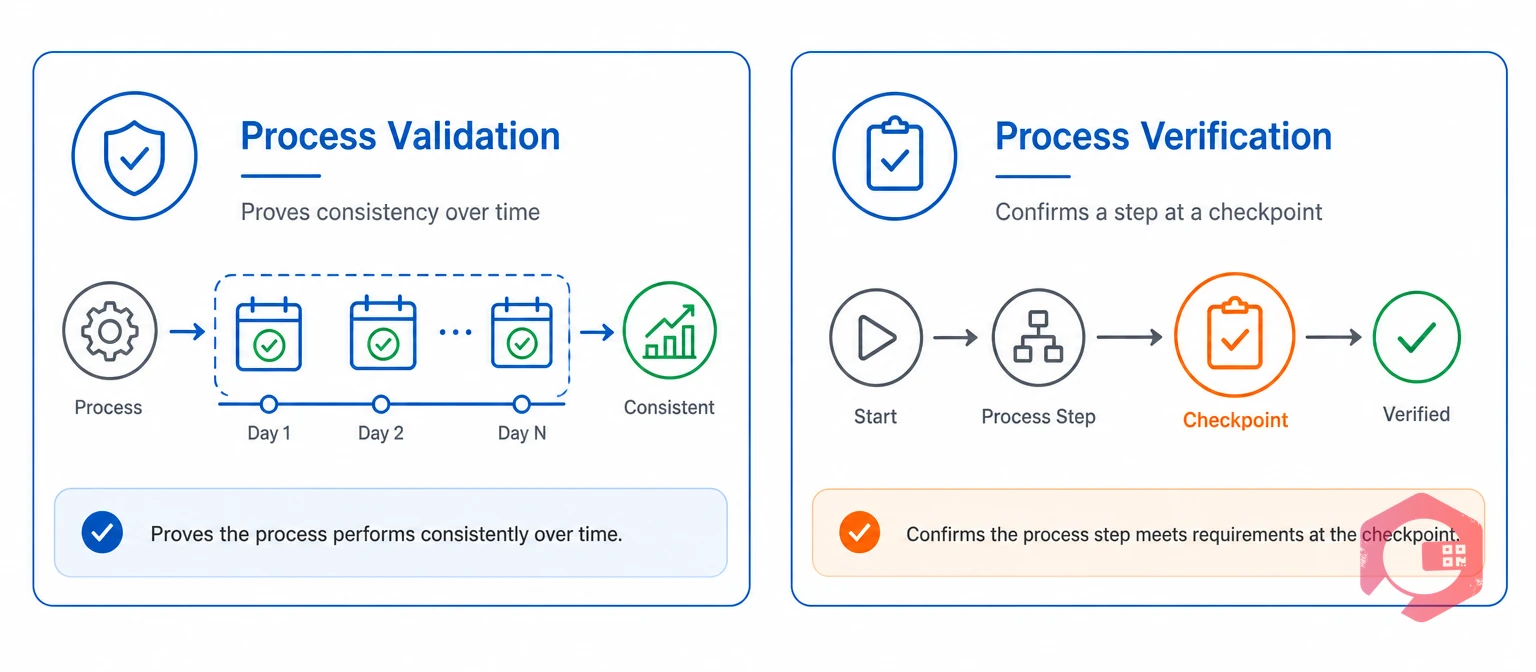
Process validation proves a process works reliably over time, while process verification confirms specific requirements were met at a point in time. Both are required for compliance, but they answer different questions and produce different records. The table below summarizes how process validation vs process verification compare across seven attributes.
| Attribute | Process Validation | Process Verification |
|---|---|---|
| Purpose | Prove the process consistently produces correct results | Confirm specific requirements were met |
| Scope | Entire process lifecycle | Individual steps or outputs |
| Timing | Before, during, and after production | At defined checkpoints |
| Key question | Does this process work reliably? | Was this step done correctly? |
| Records produced | Protocols, qualification reports, trend data | Inspection logs, test results, sign-offs |
| Regulatory basis | FDA guidance, EU GMP Annex 15, ISO 13485 | ISO 9001, 21 CFR Part 820, ISO 13485 |
| Maintenance role | PM records, calibration history, trend analysis | Completed checklists, torque checks, sign-offs |
Use validation when you need to prove a process can repeatedly deliver the expected outcome under normal conditions. Use verification when you need to confirm a specific task or output meets its requirements. Most regulated operations need both running in parallel.
A preventive maintenance program illustrates the relationship. The overall PM program is validated by showing that equipment stays within operating limits over time. Trend data, PM completion rates, and calibration histories build the validation case. Each individual PM task is verified by confirming the technician followed the checklist and recorded the correct readings.
Consider a pharmaceutical facility's HVAC system. Process validation covers the entire environmental control process: does the system maintain temperature and humidity within range 24 hours a day, 365 days a year? Process verification covers individual checks: did the technician confirm filter differential pressure was within spec during this morning's round?
Another example comes from food manufacturing. A pasteurization process is validated by proving that time-temperature combinations consistently eliminate pathogens. Each batch run is verified by checking that the recorded temperature and hold time met the approved limits. The validation stays intact only if maintenance records show the temperature sensors were calibrated and the heating equipment received its scheduled PM.
Planning a compliance review? Use a maintenance audit checklist to confirm your records cover both process validation vs process verification requirements before auditors arrive.

Maintenance records are the evidence that connects process validation and process verification to the physical equipment on the floor. Without them, both validation protocols and verification checklists lose their credibility during an audit.
Auditors do not take a team's word that processes are under control. They follow the paper trail. A validated process stays validated only as long as the supporting maintenance records prove the equipment has been kept in its qualified state. ASQ's quality resources emphasize that both V&V depend on traceable, objective evidence.
The V&V Records Triangle:
Each side of the triangle supports the other. A plan without execution records is theory. Execution without a plan is uncontrolled work. Both without evidence leave auditors with nothing to review. Most audit findings in maintenance departments trace back to a break in one of these three sides.
Regulatory auditors and internal quality teams typically start with these maintenance records when evaluating process validation vs process verification compliance:
Maintenance teams using Cryotos have reported up to 30% reduction in unplanned downtime and 25% faster repair turnaround. Fewer breakdowns mean fewer deviations that put the validated state at risk.
Audit-ready maintenance documentation is a set of records that an auditor can trace from a process requirement all the way to the completed work, without gaps or missing signatures. Building this takes discipline in how records are created, stored, and reviewed.
Paper-based systems still exist in many facilities, but they create problems that digital records solve:
Most facilities moving to digital records see immediate improvements in audit preparation time. What used to take a team two weeks of pre-audit preparation can shrink to two days when records are already organized, searchable, and linked to the correct assets.
Audit findings often come from the same recurring mistakes that apply to both process validation and process verification records:
Closing these gaps before an audit is far easier than defending them during one. A regulatory compliance checklist helps teams run a self-audit and verify their process validation vs process verification documentation is complete before inspectors arrive.
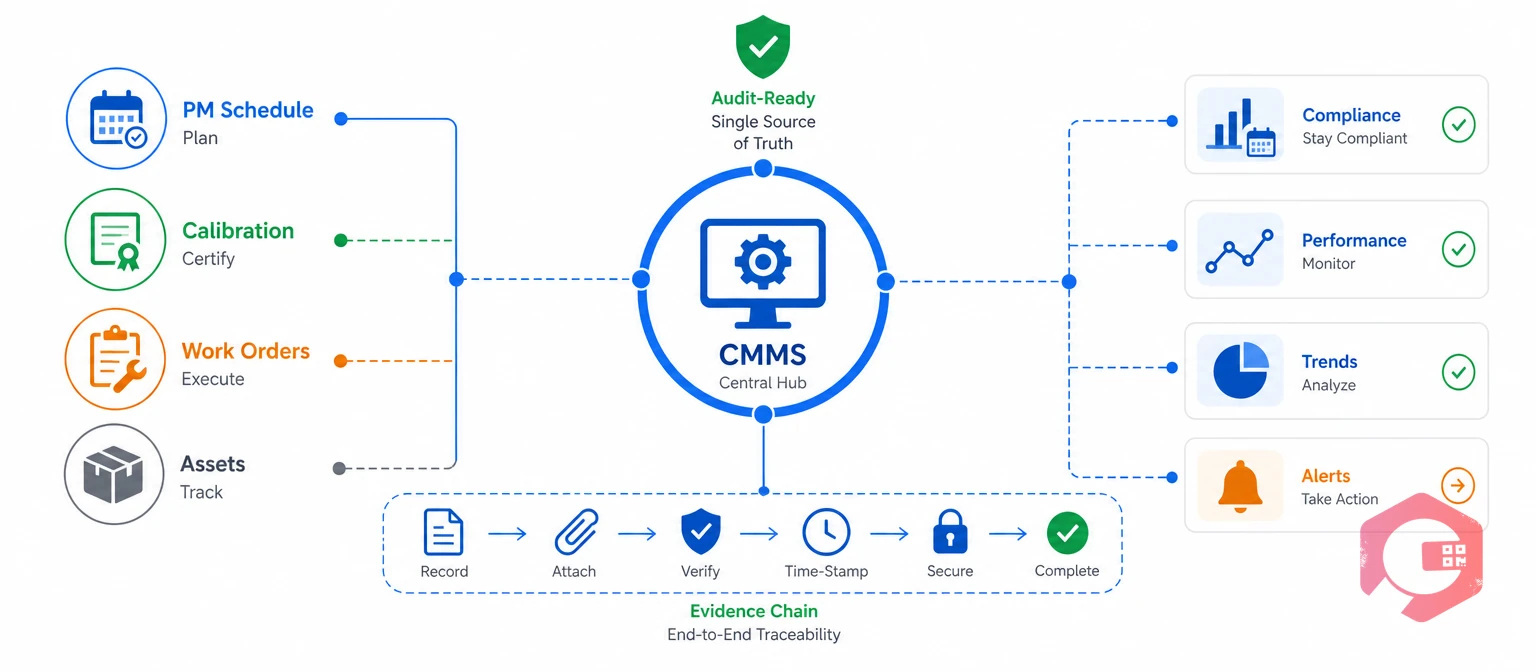
A CMMS centralizes every maintenance record that process validation and process verification depend on, making the entire evidence chain accessible from a single system. Instead of chasing records across spreadsheets, email, and paper files, teams pull the full history from one place.
Here is how a CMMS supports each side of the V&V Records Triangle:
The difference between passing and failing an audit often comes down to how fast the team can produce records. A CMMS cuts that retrieval time from days to seconds. When an auditor asks for the calibration history of a critical instrument or the PM completion rate for a validated process line, the answer is one search away.
Teams that switch from paper to a CMMS for compliance documentation typically find that the system pays for itself in reduced audit preparation time alone. The real benefit is fewer findings, shorter audit durations, and stronger confidence in the process validation vs process verification evidence the facility produces.
The connection between process validation and process verification becomes visible when all records live in one system. A CMMS links each PM schedule to the equipment it covers, each work order to the technician who completed it, and each calibration certificate to the instrument it certifies. Auditors can follow the thread from the process requirement through the maintenance plan, the completed task, and the supporting evidence without switching between systems.
Facilities that track process validation vs process verification records separately often discover during audits that the two sets of records contradict each other. A validation protocol may state that calibration happens monthly, while verification records show gaps where the calibration was missed. A CMMS prevents this disconnect by enforcing the schedule and flagging overdue tasks before they become audit findings.
Process validation proves a process consistently delivers correct results over its lifecycle. Process verification confirms that specific requirements were met at a defined checkpoint. Validation is broader and ongoing, covering the entire process from design through production. Verification is narrower and point-in-time. Both produce records that auditors review, and maintenance documentation supports both.
Maintenance records prove that equipment stayed in its qualified state between validation events. PM completion logs, calibration certificates, and repair histories show the equipment continued to operate within the limits set during qualification. Without these records, the validated state cannot be defended, and auditors will issue findings.
Auditors typically check PM completion rates, calibration certificates, work order history, change control records, and training documentation. They look for gaps in signatures, expired calibrations, and disconnected records that break the evidence chain between a process requirement and the completed work. The goal is to trace from the specification all the way to the signed, dated completion record.
Yes, a CMMS can replace paper records for most maintenance documentation that supports process validation and process verification. Digital records offer timestamped entries, enforced required fields, and instant retrieval. Confirm with your quality team that the CMMS meets 21 CFR Part 11 or equivalent electronic record requirements for your industry before making the switch.
Review verification records after each maintenance event to confirm the work met specifications. Review validation-supporting records on a scheduled basis, typically quarterly or annually, to confirm the process remains in a state of control. Trigger an immediate review after any significant equipment change, repair, or deviation that could affect the validated state of the process.
Strong compliance starts with records that connect every maintenance task to the process it supports. Schedule a free demo to see how Cryotos keeps your process validation and verification records in one audit-ready system.



Cryotos AI predicts failures, automates work orders, and simplifies maintenance—before problems slow you down.