

In facility maintenance, proof of work is a verified, timestamped, tamper-evident record that a specific maintenance task was performed on a specific asset at a specific time, by a specifically identified person, to a defined scope — and that the outcome was confirmed by an authorised representative of the site. It is not simply evidence that someone was on the premises, or that a job was verbally declared complete. It is a documented chain of custody from work order creation to verified closure that can withstand scrutiny from an auditor, an insurer, a regulator, or a court.
The word "defensible" is the operative one. Maintenance teams in retail chains create records constantly — job sheets, sign-off forms, WhatsApp confirmations, email chains. But most of these records fail the defensibility test when challenged, because they lack one or more of the elements that make a record verifiable: an unalterable timestamp, a confirmed identity, a documented scope, and photographic evidence of condition. A paper sign-off might prove that someone signed something. It cannot prove who signed it, when they signed it, what the asset looked like at the time, or whether the signed-off scope was actually completed.
Digital sign-offs — captured through a CMMS mobile application with role-based access, GPS logging, and photo attachment — generate proof of work that satisfies all four requirements simultaneously and stores it in a retrievable, unalterable record linked to the original work order.
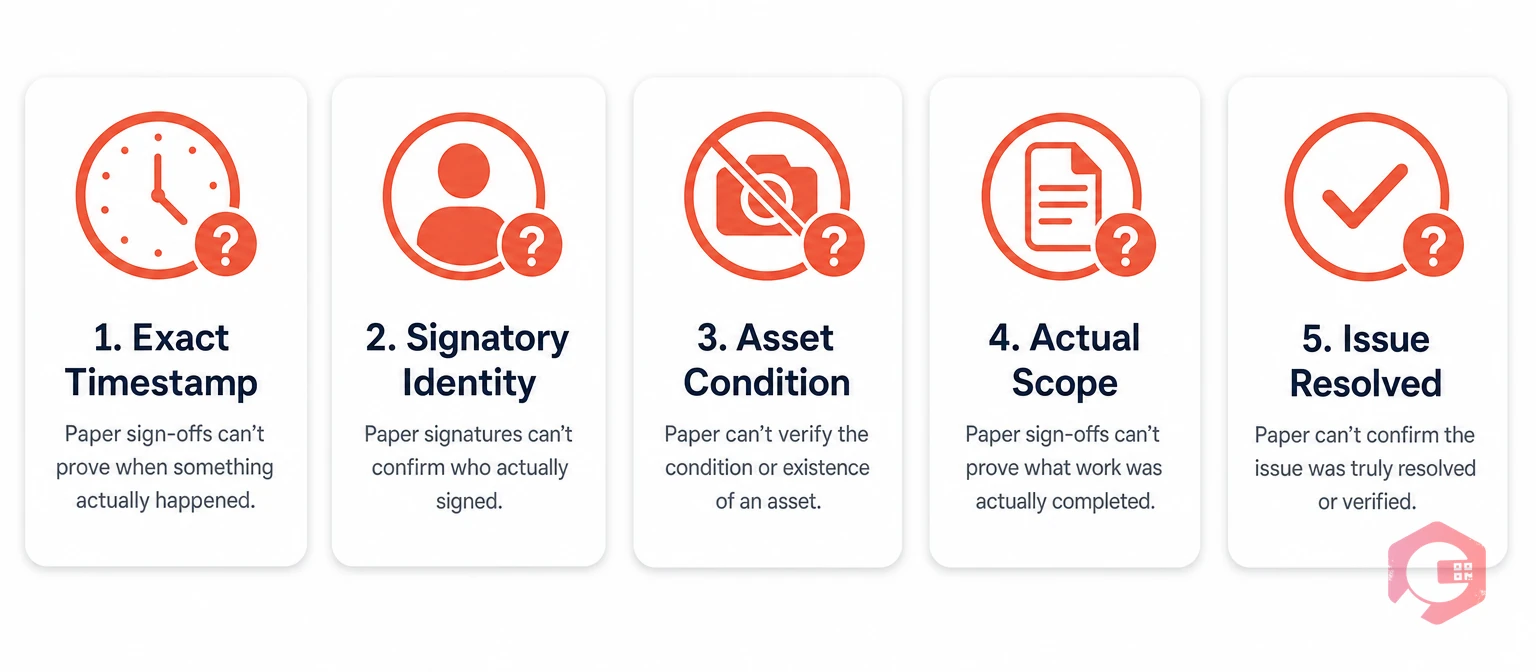
Paper sign-offs feel like documentation. They create the appearance of a completed process. But in any situation where the record is challenged — an invoice dispute, an insurance claim, a regulatory inspection, a landlord audit — paper sign-offs consistently fail to provide the evidence needed to defend the retail chain’s position.

A digital sign-off isn’t just a paperless version of the same process. It creates protection at four distinct levels that paper records structurally cannot provide.
The most immediate financial benefit of digital sign-offs is the ability to dispute vendor invoices with evidence rather than assertions. When a vendor submits an invoice for work that the store team says was incomplete, or for a scope that was never authorised, the digital work order record provides a factual reference point: the exact scope that was issued on the work order, the photos the vendor submitted at completion, the timestamp of the store sign-off, and whether the store user approved or rejected the completion claim.
Retail facility teams operate under a growing set of compliance obligations: landlord lease requirements specifying maintenance standards, insurance policy conditions requiring documented service histories, food safety regulations requiring proof of refrigeration and pest control maintenance, and fire safety regulations requiring documented inspection and remediation records.
Vendor accountability in retail maintenance depends entirely on the quality of the records generated at each job. Without digital sign-offs, vendor performance management is largely anecdotal. With digital sign-offs, every vendor interaction generates a measurable record: time from assignment to acknowledgement, time from acknowledgement to site arrival, time from arrival to completion, the quality of the completion documentation submitted, and whether the store sign-off was approved on the first attempt or rejected.
The most underappreciated protection layer. When an incident occurs at a retail location — a fire, a slip-and-fall, a food safety event, a structural failure — and the incident is connected to a system that was recently maintained, the first question insurers and liability investigators ask is: what maintenance was performed, when, by whom, and what was the verified outcome?

Not all digital sign-offs are created equal. A defensible work order closure record contains eight specific elements:
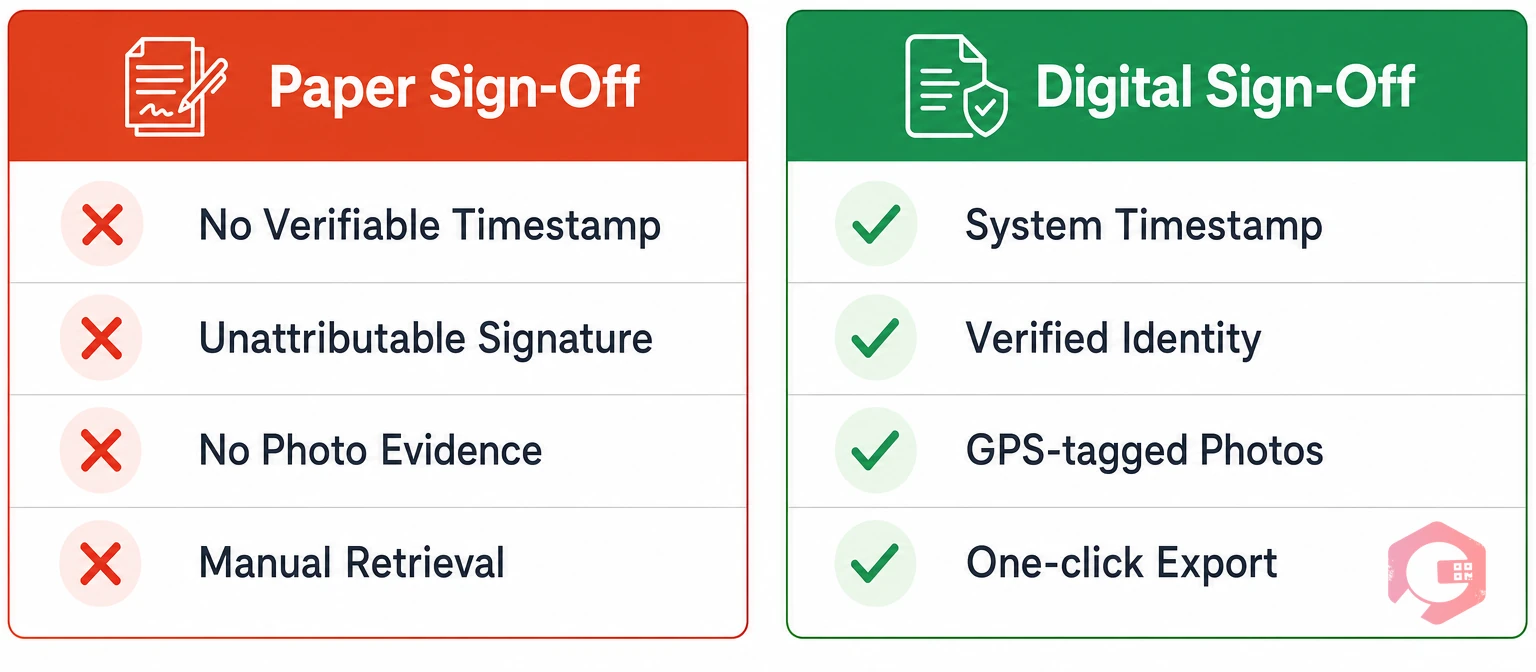
A digital sign-off generates proof of work that satisfies verifiability requirements simultaneously and stores it in a retrievable, unalterable record. Paper sign-offs fail on tamper evidence, timestamp accuracy, photo evidence, instant accessibility, multi-site aggregation, audit export, and SLA linkage.
Moving from paper sign-offs to digital isn’t a technology project — it’s a process change that touches three roles across every store in your network. Done well, it takes four to six weeks to deploy across a retail chain of any size.
Cryotos is built around the principle that every maintenance action should generate a verifiable, retrievable record. Across the full work order lifecycle, Cryotos creates proof of work at every stage: at issue reporting, at vendor assignment, at site arrival, at job completion, at store sign-off, and at FM closure and reporting.
If your retail chain is still closing work orders on paper, every job you complete without a digital sign-off is a missed opportunity to build the proof-of-work record that protects your business. Cryotos CMMS gives your store teams, vendors, and FM executives the digital sign-off workflow they need — with timestamped records, photo evidence, GPS verification, and one-click compliance reporting built into every work order closure, across every site in your network.




Cryotos AI predicts failures, automates work orders, and simplifies maintenance—before problems slow you down.



