PSM audit failures tied to maintenance documentation fall into three main areas. These are mechanical integrity inspection records, deficiency correction tracking, and Management of Change documentation. OSHA’s Process Safety Management standard — 29 CFR 1910.119 — requires facilities handling highly hazardous chemicals to maintain specific, auditable maintenance records across multiple PSM elements. Auditors consistently find the same gaps. Missing inspection dates. Orphaned deficiency findings. Incomplete MOC packages. Operating procedures that haven’t been updated after equipment modifications.
The U.S. Occupational Safety and Health Administration reports that mechanical integrity violations make up the largest share of PSM citations. These citations don’t come from equipment failures. They come from documentation problems — failing to document inspections, track corrections, and prove that work followed recognized engineering standards.
This guide covers the specific PSM maintenance documents that fail audits most often. It explains why each one creates compliance risk. It also provides a practical framework for fixing them — whether you’re preparing for an OSHA inspection or building a long-term PSM audit readiness program with a Computerized Maintenance Management System.
Key Takeaways

PSM maintenance documentation is the set of written records proving a facility meets OSHA PSM requirements. These records include inspection reports, deficiency logs, MOC packages, and pre-startup safety reviews. OSHA requires every PSM maintenance activity to produce a documented, traceable, verifiable record.
OSHA’s PSM standard contains 14 elements. At least six of them generate maintenance documentation requirements: Mechanical Integrity, Management of Change, Hot Work Permits, Pre-Startup Safety Review, Compliance Audits, and Incident Investigation. The standard doesn’t just require that maintenance be performed. It requires documentation that allows an independent auditor to verify what was done, when it was done, who did it, and whether the results met the applicable standard.
Facilities that perform excellent maintenance but keep poor records face the same enforcement exposure as facilities that skip maintenance entirely. From OSHA’s perspective, if you can’t prove it happened, it didn’t happen. This is why documentation failures — not equipment failures — drive the majority of PSM audit citations.
PSM auditors — whether internal, third-party, or OSHA compliance officers — follow a predictable pattern:
Most facilities don’t fail PSM audits because they lack a maintenance program. They fail because their documentation doesn’t hold up under the specific, granular scrutiny that PSM auditors apply. Cryotos’s maintenance checklists address this by embedding the documentation requirements directly into every work order — so compliance evidence is captured at the point of work, not reconstructed weeks later.

Five categories of PSM maintenance documents account for the vast majority of audit findings. The table below summarizes each document type, its most common failure mode, the PSM element it falls under, and the audit consequence when it’s missing or incomplete.
| Document Type | PSM Element | Most Common Failure Mode | Audit Consequence |
|---|---|---|---|
| MI Inspection Records | Element 6 — Mechanical Integrity | Missing dates, unsigned checklists, no reference standard cited | Citation under 1910.119(j)(4) |
| Deficiency Correction Logs | Element 6 — Mechanical Integrity | Found deficiencies with no corrective work order or closure date | Citation under 1910.119(j)(5) |
| MOC Documentation | Element 8 — Management of Change | Missing safety impact review, no pre-startup sign-off | Citation under 1910.119(l) |
| Operating Procedure Updates | Element 3 — Operating Procedures | Procedures not updated after equipment modifications | Citation under 1910.119(f) |
| PSSR Documentation | Element 9 — Pre-Startup Safety Review | No documented confirmation that modifications met design specs | Citation under 1910.119(i) |
Mechanical integrity inspection records are the single most cited PSM document failure in PSM audits. OSHA requires that inspections and tests on PSM-covered equipment follow recognized and generally accepted good engineering practices (RAGAGEP) — standards like API 510 for pressure vessels, API 570 for piping, and API 653 for storage tanks. Each inspection record must include five data points: the date of inspection, the inspector’s name, the equipment tag number, a description of what was inspected, and the results.
Auditors commonly find these MI record failures: missing or illegible dates, unsigned forms, no reference to the engineering standard used, and inspection intervals that don’t match the standard’s requirements. Any one of these gaps turns an otherwise compliant inspection into a PSM audit finding.
Deficiency correction tracking is the process of linking every inspection deficiency to a corrective work order tracked to closure. OSHA 1910.119(j)(5) requires that equipment deficiencies outside acceptable limits be corrected before further use, or that the employer demonstrate the equipment can be safely operated until repairs are made.
The failure pattern is always the same. A technician finds a deficiency during an inspection and notes it on the form. Then the finding disappears into a backlog. No corrective work order is generated. No one is assigned ownership. Six months later, the auditor pulls the inspection record and asks for the correction documentation. It doesn’t exist. This is one of the highest-risk PSM audit failures because it proves the facility knew about a hazard and failed to act on it.
Management of Change documentation must capture several elements. These include the technical basis for the change, the safety and health impact, any modifications to operating procedures, the time period for the change, and authorization requirements. The most common MOC audit failure is an incomplete package. The change was authorized, but the documentation is missing a safety impact assessment. Or the operating procedures weren’t updated to reflect the modification. Or the pre-startup safety review was skipped.
MOC failures are particularly dangerous because they often involve physical changes to equipment that create new hazard scenarios. A missing safety impact review doesn’t just create a documentation gap. It means nobody formally evaluated whether the change introduced a new risk. The U.S. Chemical Safety and Hazard Investigation Board has identified incomplete MOC processes as a contributing factor in multiple catastrophic incidents.
OSHA requires that operating procedures be reviewed and updated as often as necessary to reflect current operating practice. Every facility must certify annually that procedures are current and accurate. The most common failure mode is straightforward: a piece of equipment is modified through a Management of Change process, but the operating procedures that reference that equipment are never updated.
The result is a set of written procedures that describe a process configuration that no longer exists. Operators follow outdated instructions near highly hazardous chemicals, and the facility has documented evidence — the unchanged procedure — proving that the gap existed. PSM auditors check this by cross-referencing recent MOC records against the revision dates on related operating procedures. When the MOC was approved six months ago but the procedure revision date is two years old, the gap is obvious and the citation follows.
Pre-startup safety reviews (PSSRs) are required before you introduce highly hazardous chemicals to a new or modified process. The PSSR must confirm four things: construction and equipment meet design specs, safety and operating procedures are in place, training is complete, and a process hazard analysis has been done. The most common PSSR audit failure is a missing sign-off — the physical work was completed, but no one documented the verification that the modification met the approved design specifications.
Use the Cryotos regulatory compliance checklist to check your PSM document readiness before your next audit.
PSM document failures rarely happen because maintenance teams are careless. They happen because the systems those teams use — paper forms, shared drives, spreadsheets — were never designed for PSM-level documentation rigor. These tools work for simple record-keeping. They fail when records must be traceable, timestamped, linked to assets, and retrievable on demand during an audit. Understanding the root causes helps maintenance leaders fix the system, not blame the people.
Paper-based maintenance documentation is the single largest root cause of PSM audit failures. Paper forms get lost. They get misfiled. They get damaged by field conditions. They end up in binders that no one can find when an auditor asks for them. Handwritten entries are frequently illegible. Paper systems have no automatic escalation. If an inspection is overdue or a deficiency goes untracked, no alert fires. The gap exists silently until someone discovers it, usually during an audit.
Running PSM documentation on paper is a bet. You’re betting that human memory and manual filing will perform flawlessly for years. That bet consistently loses. A work order management software system replaces this bet with automated scheduling, mandatory completion fields, and permanent digital records that cannot be lost or misfiled.
When a deficiency is found during an inspection, someone must own the corrective action. In paper-based systems, ownership is often ambiguous — the finding is noted on a form, but no named individual is assigned responsibility for the correction, and no due date is set.
Without clear ownership, deficiency corrections compete with every other maintenance priority and frequently lose. The result is a growing backlog of unresolved findings that creates compounding PSM audit risk. Most facilities that receive repeat mechanical integrity citations share this pattern: the inspection program works, but the corrective action pipeline has no owner, no due dates, and no escalation path when items age past acceptable limits.
Facilities with multiple process units often allow each department to develop its own inspection forms, deficiency tracking methods, and MOC formats. This inconsistency makes it nearly impossible to produce a consolidated PSM audit report.
It also creates blind spots. One department’s documentation standards fall below the minimum OSHA requires, but nobody at the corporate level notices until an audit exposes the gap. Standardizing on a single digital platform with uniform templates — the same fields, the same completion requirements, the same reporting structure across every unit — eliminates format inconsistency as a root cause of PSM audit failures.
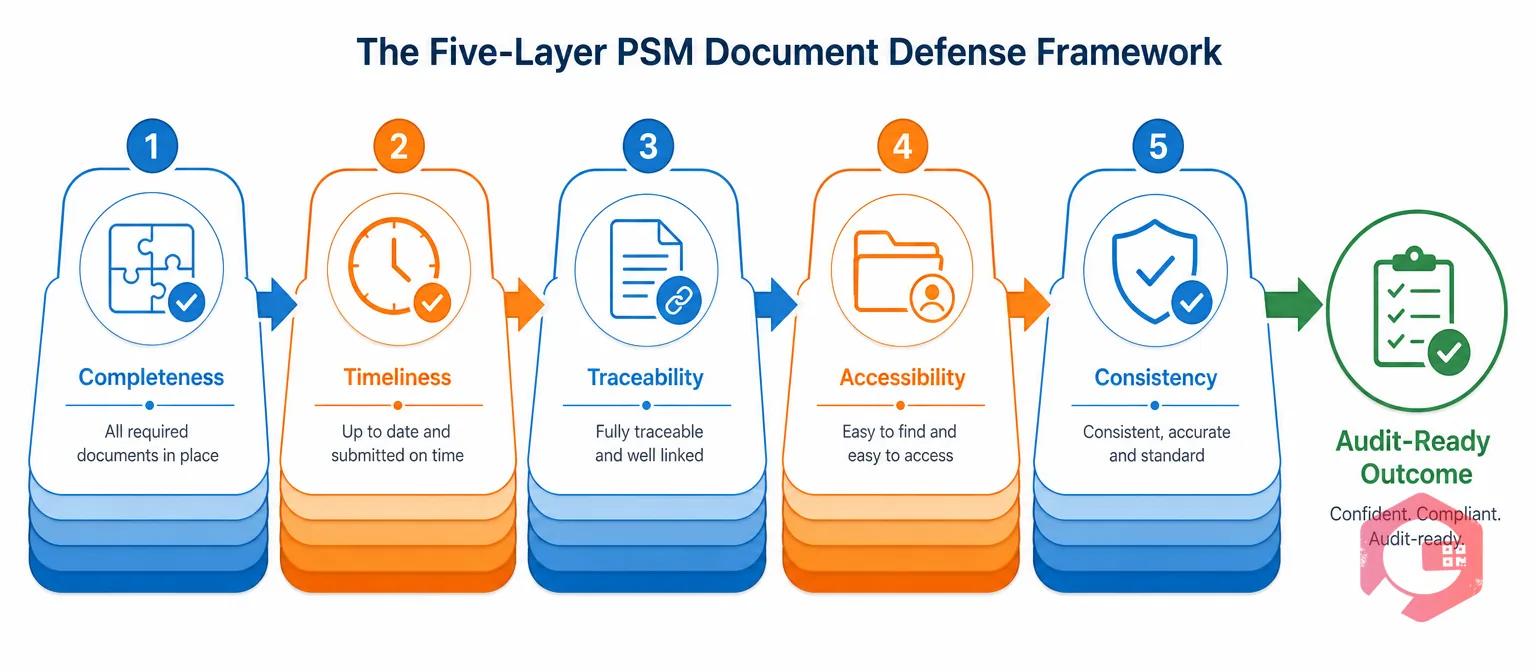
Fixing PSM document failures takes a systematic approach. It’s not a one-time cleanup. It’s a permanent change to how maintenance documentation is captured, stored, and reported. The framework below provides a structured method for evaluating and improving every PSM document in your maintenance program.
The Five-Layer PSM Document Defense Framework:
Every PSM document that fails an audit violates at least one of these five layers. Most fail on two or three. Applying this framework as a pre-audit self-assessment tool allows maintenance teams to identify and correct documentation gaps before an external auditor finds them.
The most impactful step a facility can take is replacing paper records with a digital system. Cryotos’s preventive maintenance software schedules every PSM-required inspection automatically based on the applicable engineering standard, generates work orders with mandatory fields that cannot be bypassed, and stores completed records permanently against the asset — creating the completeness, timeliness, and traceability layers in one step.
Digital work orders fix MI record failures at the root. Dates are system-generated and cannot be omitted. Inspector names come from login credentials. Reference standards are embedded in the work order template. The record is permanent, searchable, and instantly retrievable — satisfying the accessibility layer.
The deficiency tracking gap is eliminated when the CMMS creates a corrective work order the moment a technician marks a finding as out-of-tolerance. The corrective work order inherits the asset reference, the deficiency description, and a priority-based due date. It’s assigned to a named owner and escalated if overdue. No deficiency is ever orphaned.
This automation directly addresses the OSHA 1910.119(j)(5) requirement and removes the human-memory dependency that causes most deficiency tracking failures. The Cryotos maintenance audit checklist provides a ready-made template for verifying that your deficiency-to-corrective-action workflow captures every required data point.
PSM audit readiness shouldn’t be a special project that starts two weeks before an inspection. It should be the default state of the maintenance program. When every inspection generates a timestamped digital record, every deficiency produces a tracked corrective work order, and every MOC modification links to a verified PSSR, the facility is always audit-ready — because the daily maintenance workflow is the audit documentation.
Facilities that treat audit preparation as a separate activity from daily maintenance are the ones that consistently find documentation gaps under time pressure. Facilities that embed PSM documentation requirements into every work order, every inspection, and every MOC workflow produce audit-ready records as a byproduct of doing their jobs.
That’s the consistency layer — and it’s what separates facilities that pass PSM audits from facilities that scramble to survive them. The practical test is simple: if an OSHA compliance officer walked into your facility today and asked for the last 12 months of mechanical integrity inspection records on any PSM-covered asset, could you produce them in under 10 minutes? If the answer is no, your documentation system needs redesign — not more effort from the people using it.
Missing mechanical integrity inspection records are the most cited PSM audit finding. The citation falls under OSHA 1910.119(j)(4). Common gaps include inspections done without recording the date, the inspector’s name, or the reference standard. Deficiency correction failures rank second. These happen when findings are documented but never tracked to corrective action closure, which falls under 1910.119(j)(5).
OSHA requires that operating procedures be certified as current and accurate on at least an annual basis. Mechanical integrity inspection frequencies are governed by the applicable recognized and generally accepted good engineering practices (RAGAGEP) — such as API 510, API 570, and API 653 — which set risk-based intervals. PSM compliance audits must be conducted at least every three years under 1910.119(o). Management of Change documentation must be completed before any change is implemented, not retroactively.
A CMMS directly prevents the most common MI record failures by automating inspection scheduling, requiring mandatory completion fields on every work order, generating timestamped records linked to specific assets, and escalating overdue inspections to supervisors. The system eliminates the root causes — lost paper forms, missing dates, untracked deficiencies — that drive MI-related PSM audit citations. Maintenance teams using Cryotos produce audit-ready MI records as a standard output of their daily workflow.
A PSM compliance audit is a self-assessment required by OSHA 1910.119(o) that must be conducted at least every three years. An OSHA inspection is a regulatory enforcement action conducted by OSHA compliance officers, which can result in citations and penalties. The key difference is that compliance audits are proactive and facility-initiated, while OSHA inspections are reactive or programmatic and carry legal enforcement authority. Both review the same documentation, but audit findings allow facilities to correct deficiencies before they become OSHA citations.
Retroactive MOC documentation repair starts by identifying all changes made without complete documentation, then assembling the missing elements — safety impact reviews, updated operating procedures, training records, and PSSR sign-offs — for each one. This process should be documented as a corrective action from an internal PSM audit finding. Going forward, the fix is systemic: implement a workflow where no physical modification can begin until the MOC package is complete, and no equipment can be returned to service until the PSSR is signed. A digital system that enforces this sequence — blocking work order creation until MOC approval is recorded — prevents the problem from recurring. The key is making MOC completion a gate, not a suggestion. When the system won’t let a technician start work without a complete MOC package, retroactive fixes become unnecessary.
PSM audit readiness starts with getting your maintenance documentation right. That means keeping it right through every shift, every inspection, and every equipment modification. The facilities that pass PSM audits consistently aren’t doing more paperwork. They’re using systems that capture the right data at the right time — automatically, every time. Schedule a free demo to see how Cryotos automates PSM maintenance documentation and builds audit-ready records into your daily maintenance workflow.




Cryotos AI predicts failures, automates work orders, and simplifies maintenance—before problems slow you down.