

Putaway and picking are the two most critical movements in any warehouse - one gets inventory to its storage location, the other retrieves it for customer orders. Together, they determine how fast, accurately, and cost-efficiently your warehouse runs. According to a McKinsey report, warehouse picking alone accounts for up to 55% of total operating costs in a distribution center. Yet most warehouses still treat putaway and picking as separate problems - and that disconnect is costing them time and money every day.
This guide walks you through how putaway and picking work, the strategies behind each, and - critically - how the quality of your putaway directly shapes the speed of your picking. You will also see how modern inventory management software like Cryotos connects both into a single, efficient workflow.
Putaway and picking are the inbound and outbound movements of inventory within a warehouse. Putaway moves received goods from the dock to a designated storage location. Picking retrieves those stored goods to fulfill a customer order. Together, they form the complete inventory cycle - what goes in must come out efficiently.
Most warehouse inefficiencies trace back to one of these two processes. A poor putaway decision made at 9am can still be slowing down a picker at 4pm. That is why the best warehouse operations design putaway with picking in mind from the start.
Putaway is the process of moving received inventory from the unloading dock to its designated storage bin, rack, or shelf. It sounds simple, but in a high-SKU ecommerce warehouse handling thousands of products daily, a single misplaced item can cascade into delayed orders, incorrect shipments, and unhappy customers. Effective putaway uses predefined rules - based on product size, demand frequency, weight, and expiry - to assign each item to the best possible location.
Picking is the process of retrieving specific items from their storage locations to fulfill a customer order. It is the most labor-intensive step in order fulfillment. A warehouse that picks 500 orders a day with a 2% error rate is shipping 10 wrong orders daily - each one a potential return, refund, or lost customer. Picking efficiency depends heavily on how well inventory was stored during putaway.
Think of putaway as setting up the chessboard and picking as playing the game. The better the setup, the faster and smarter every move becomes. When fast-moving SKUs are stored near dispatch zones, pickers travel less. When barcodes are scanned and logged during putaway, pickers always know exactly where to go. The two processes are not independent steps - they are two halves of the same system.
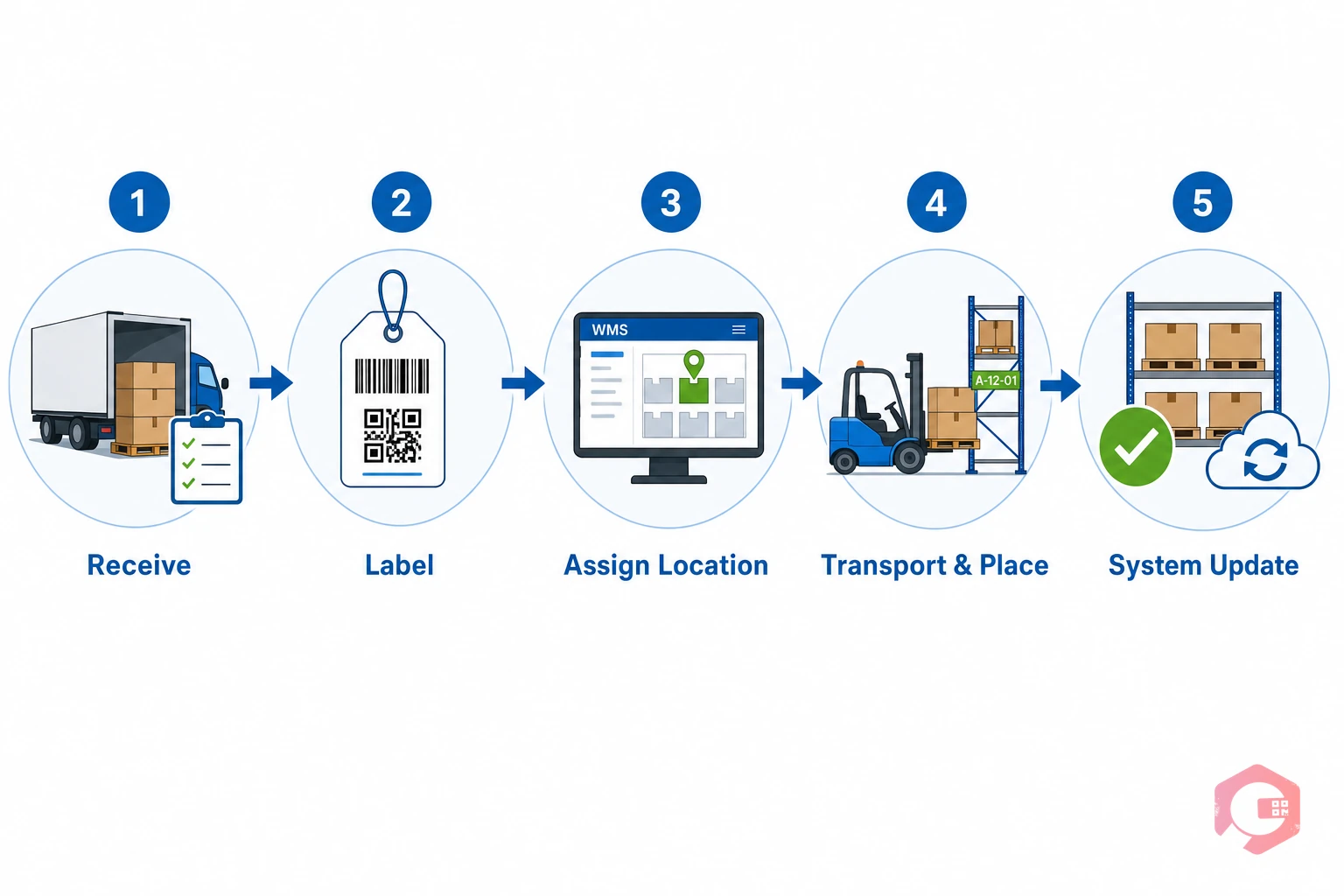
A reliable putaway process follows a consistent sequence regardless of warehouse size
The right putaway strategy depends on your inventory profile and warehouse layout. Here are the four main approaches
Picking methods determine how your team processes orders. Choosing the wrong method for your order volume and warehouse layout can waste hours of labor every day. Here is a breakdown of the four most widely used picking methods:
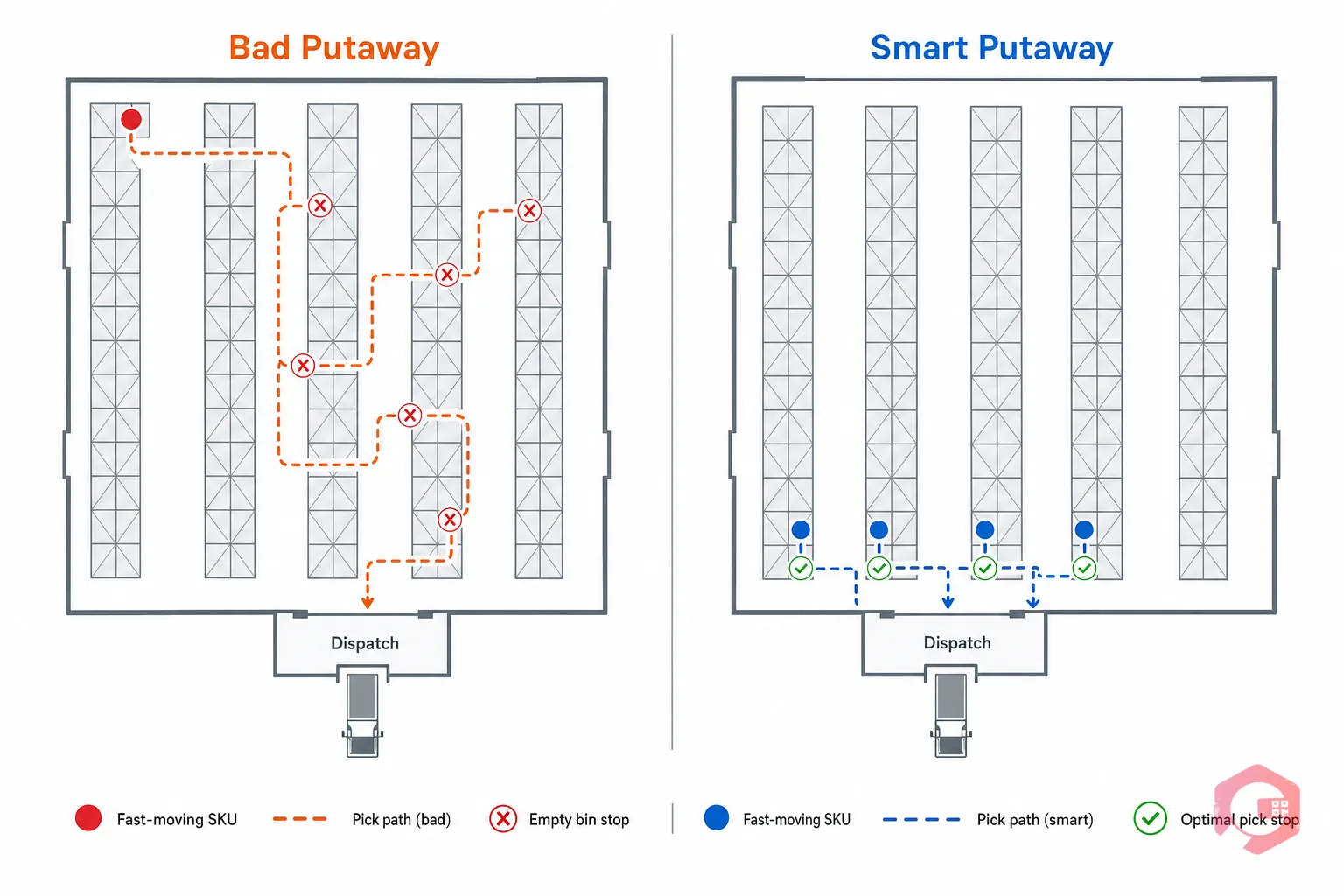
This is the connection that most warehouse guides miss: every shortcut taken during putaway creates extra work during picking. And because picking happens far more often than receiving, a single bad putaway decision compounds across hundreds of orders.
Here is how the link plays out in practice
The takeaway is straightforward: investing time and process discipline in putaway pays back multiple times over in picking speed and accuracy.

Improving putaway and picking does not always require a full technology overhaul. These four practices deliver measurable results in most warehouse environments:
Use your order history data to identify your top 20% of SKUs by order frequency. Store these items in the pick zones closest to your packing and shipping areas. Review your slotting every quarter - demand patterns shift, especially in ecommerce, and your storage layout should shift with them.
Every putaway move should include a scan - at receiving, at the storage location, and as confirmation in the WMS. Skipping a single scan creates a data error that could send a picker on a wasted trip hours or days later. Barcode and RFID scanning during putaway is the cheapest insurance policy against picking errors. The Gartner Supply Chain research consistently shows that scan-based putaway reduces inventory discrepancies by 30-50% compared to manual putaway processes.
A warehouse management system that directs putaway removes the guesswork from storage decisions. Instead of leaving location assignments to individual judgment (which varies by staff member and shift), the WMS applies consistent rules every time - by product size, weight, demand velocity, and available space. The same system then generates optimized pick paths, so putaway and picking decisions are made from the same data set.
Run a slotting audit at least quarterly. Pull your order data, identify your top movers, and confirm they are stored in your fastest-access zones. At the same time, identify slow-moving SKUs occupying prime space and move them to secondary storage. A Reliable Plant study found that regular slotting audits reduce average pick travel time by up to 25% in distribution environments.

Cryotos is a CMMS platform with a built-in inventory and warehouse management module that connects putaway and picking into a single, trackable workflow. Here is what that looks like in practice
Whether you are managing a single ecommerce fulfillment center or multiple warehouse locations, Cryotos gives you the inventory accuracy and workflow visibility to make both putaway and picking run faster and with fewer errors. Explore Cryotos CMMS or request a demo to see how it fits your warehouse operations.
Putaway moves received inventory from the receiving dock to a designated storage location inside the warehouse. Picking is the reverse - retrieving stored items from those locations to fulfill a customer order. Putaway is an inbound process; picking is an outbound one. The accuracy of putaway directly determines the speed and accuracy of picking.
For most ecommerce operations processing high volumes of small, multi-item orders, batch picking offers the best balance of efficiency and accuracy. It reduces picker travel time significantly without requiring the complex zone coordination of wave picking. As your operation grows, combining batch picking with zone assignments gives you further efficiency gains.
A warehouse management system improves putaway accuracy by directing workers to specific, pre-optimized storage locations rather than relying on individual judgment. It enforces scan confirmation at each step, updates inventory records in real time, and flags discrepancies immediately. This eliminates misplacements and ensures every picker who follows has accurate location data to work from.
Yes - a CMMS like Cryotos that includes an inventory management module can manage putaway and picking workflows alongside equipment maintenance. This is particularly valuable in warehouses where forklift or conveyor downtime directly affects the speed of both processes. Having a single platform for inventory tracking and asset maintenance reduces operational blind spots and gives managers a complete picture of warehouse performance.


Cryotos AI predicts failures, automates work orders, and simplifies maintenance—before problems slow you down.



