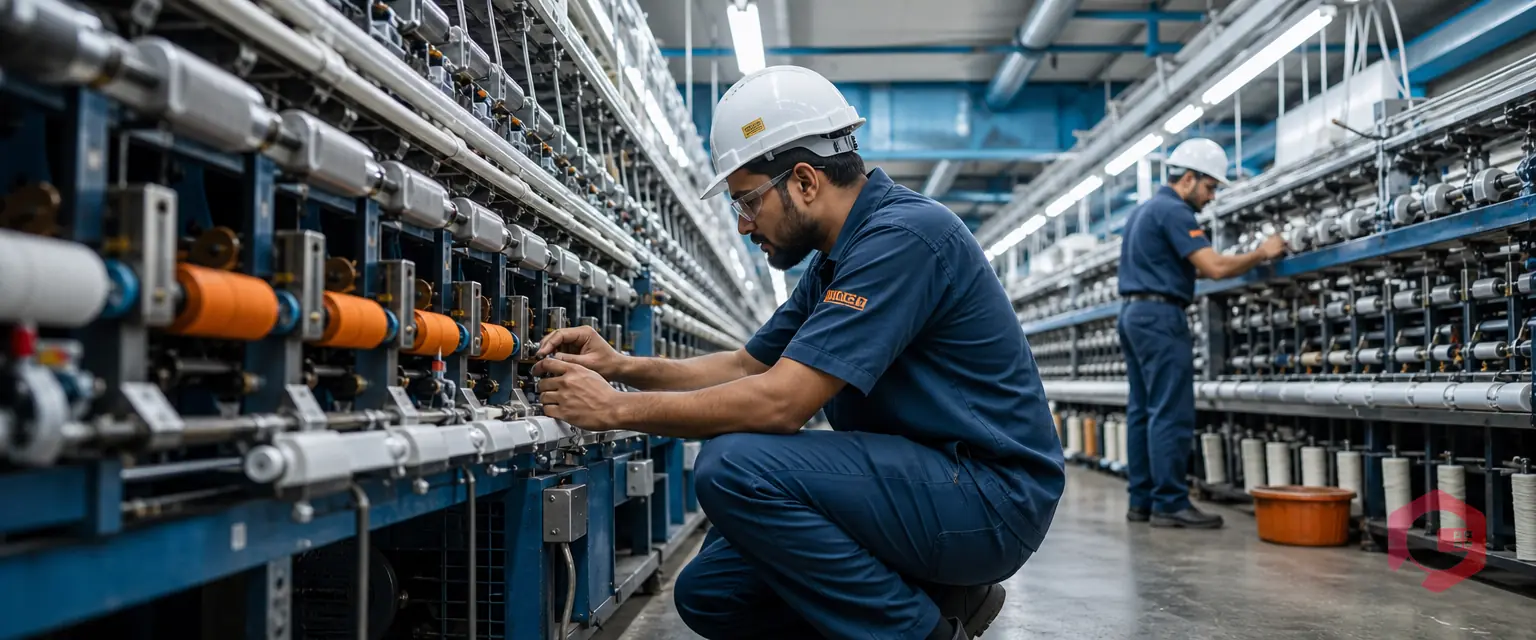
Textile industry mills apply RCM — reliability-centered maintenance — by first identifying which machines cause the most unplanned downtime, then mapping each machine’s failure modes to a specific maintenance task type (on-condition monitoring, scheduled replacement, or time-based restoration), rather than applying a uniform calendar interval to every piece of equipment. The result is a maintenance programme where ring frames, air-jet looms, and winding machines each get tasks that match their actual wear patterns — not the same PM frequency applied to everything on the floor.
A single ring frame running at 94% efficiency instead of 98% across a 60-machine bank costs the equivalent of running three machines at zero output. For a mill producing 10,000 kg of yarn per day at Rs 150/kg, each 1% OEE improvement is worth roughly Rs 15,000 per day. That number explains why RCM in the textile industry is the highest-return maintenance investment most mills can make.
Key Takeaways
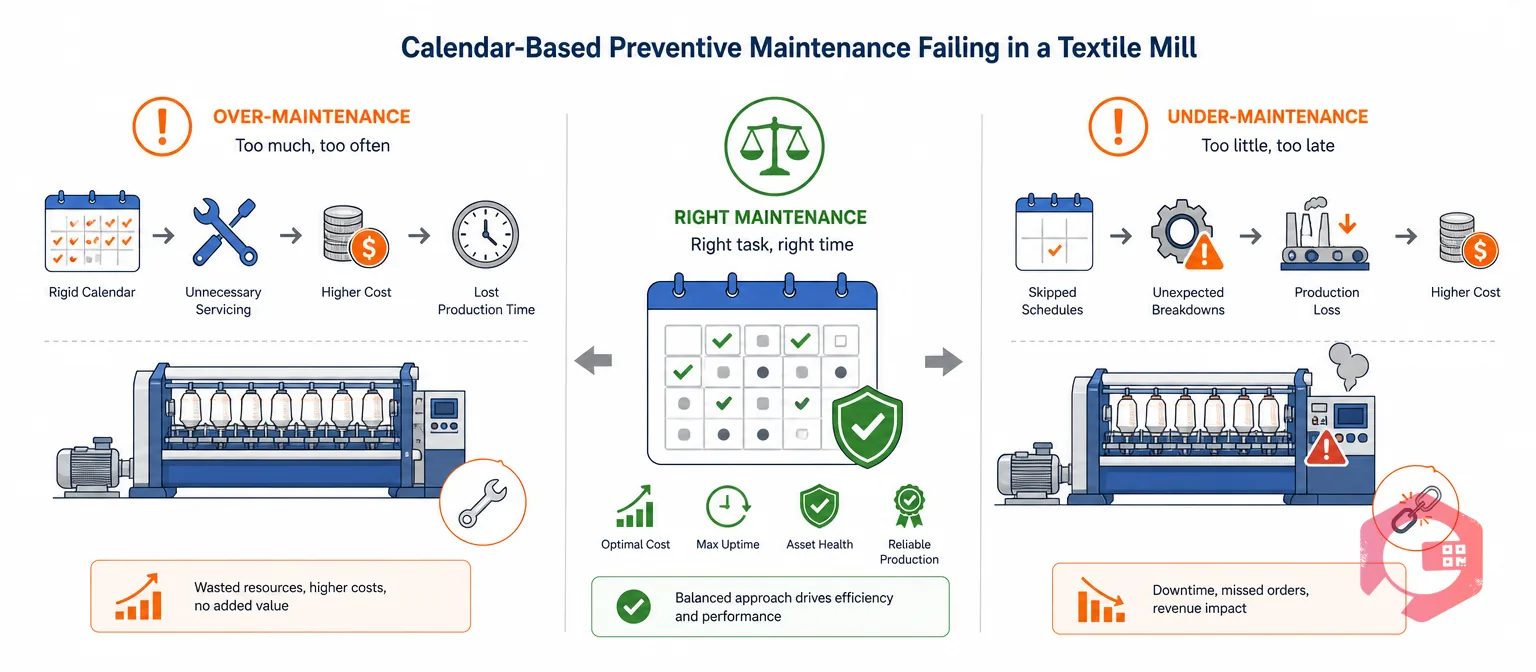
Reliability-centered maintenance is a methodology that selects maintenance tasks based on failure mode consequences, not fixed calendar intervals. Applied in a textile mill, it replaces blanket replacement cycles with tasks matched to actual wear patterns — on-condition monitoring where process signals are available, scheduled restoration where wear life is predictable, and run-to-failure only where consequences are genuinely non-operational.
Calendar-based preventive maintenance creates two equally damaging failures in a textile plant: over-maintenance and under-maintenance — often on the same machine at the same time. A spinning mill applying a uniform 500-hour spindle bearing replacement interval replaces bearings that still have 300 hours of life left, while missing the traveller degradation that happens after 180 hours of running in a dusty environment.
Ring spinning travellers are typically replaced on a fixed-week schedule regardless of the yarn count being processed. Fine-count yarn on a high-speed frame burns through travellers in 10–12 days; coarse-count yarn on a slower frame may still have 90% traveller life at the same point. Replacing on a calendar means the coarse-count machines are being stopped unnecessarily — generating labour cost, restart waste, and mechanical wear from repeated re-threading without any reliability gain.
Air-jet loom nozzle blockage builds gradually over weeks of operation. Calendar-based maintenance that checks nozzles at 90-day intervals often misses the point at which partial blockage is generating 3–4% excess weft misses — a quality and efficiency cost that’s invisible until the next scheduled check arrives. RCM’s founding principle, codified in SAE JA1011, is that the only rational basis for a maintenance task is the failure mode it prevents — and the only rational interval is the one that detects or prevents that specific failure before it affects function.
Build your maintenance programme into preventive maintenance software and you can track weft miss rate by loom, traveller replacement history by machine and yarn count, and spindle bearing run hours — data that makes the transition from calendar PM to RCM in the textile industry practical rather than theoretical.
RCM in the textile industry analysis consistently surfaces the same high-consequence failure modes across ring frames, air-jet looms, and winding machines. The FMEA table below maps each failure mode to the RCM task type and trigger that actually prevents it — not a generic calendar interval.
| Equipment | Failure Mode | Effect on Production | RCM Task Type | Trigger |
|---|---|---|---|---|
| Ring frame — spindle | Bearing fatigue failure | Spindle stop; yarn breakage spike | On-condition (vibration) + scheduled re-lubrication | Vibration amplitude threshold OR yarn breakage rate >20/100 spindle-hours |
| Ring frame — traveller | Overheating and breakage | Yarn breakage surge; quality defects | Scheduled discard | Hours run + yarn count (not calendar weeks) |
| Ring frame — ring groove | Groove wear | Rising yarn breakage; traveller instability | On-condition inspection | Groove depth gauge at defined interval |
| Air-jet loom — nozzle | Partial blockage | Pick finding failure; weft miss; machine stop | Scheduled restoration | Weft miss rate threshold OR time-based clean |
| Air-jet loom — timing | Cam wear / timing drift | Pick finding errors; weft breakage; efficiency drop | On-condition (pick-finding error rate) | Error rate threshold exceeding 3% of picks |
| Winding machine — drum | Drum surface wear | Yarn slippage; package density variation | Scheduled restoration | Surface roughness measurement at interval |
| Draw frame — top roller | Roller eccentricity | Drafting faults; yarn CV% deterioration | On-condition (sliver CV% monitoring) | CV% above upper control limit |
The pattern in this table reveals something important: the highest-consequence failures in textile mills are almost always detectable before they cause a full stop. Vibration monitoring on spindle bearings provides weeks of warning before failure. Yarn breakage rate is a leading indicator of traveller or ring condition. Weft miss rate is a real-time signal of nozzle blockage. RCM in the textile industry works precisely because these process signals exist — and because most mills are already generating them without acting on them.
Use the MTBF calculator to establish your current baseline for ring frames and air-jet looms before starting your RCM analysis — it gives you the starting point for measuring improvement.
RCM in the textile industry task selection follows a priority hierarchy: on-condition tasks first, then scheduled restoration, then scheduled discard, and run-to-failure only when consequences are genuinely non-operational. In textile mills, this hierarchy produces a very different task mix than calendar-based PM — more condition monitoring, fewer blanket replacement cycles.
On-condition tasks use a measurable parameter to detect deterioration before it causes functional failure. In textile operations, the most valuable on-condition signals are yarn breakage rate per 100 spindle-hours (ring spinning), weft miss rate per 1,000 picks (air-jet weaving), sliver CV% deviation (draw frames), and spindle vibration amplitude. Each of these is a process-quality signal that the machine is already generating — the RCM step is simply formalising the threshold that triggers a maintenance response.
Maintenance teams that successfully apply on-condition tasks in textile mills typically see their worst-case unplanned ring frame stoppages drop by 40–60% within the first six months, because the signal always precedes the failure by enough time to schedule a response.
A textile mill with 300 ring frames has a statistical advantage that almost no other manufacturing environment can match: every failure on any of those machines feeds the same failure mode library. If ring 047 has its third spindle bearing failure in six months, that data point changes the optimum replacement interval for all 300 spindles — not just ring 047. This fleet-level failure data makes RCM in the textile industry intervals significantly more accurate than OEM-recommended intervals, which are derived from lab conditions rather than the actual fibre type, humidity, and speed your machines run at.
Connect your ring frame and loom assets to IoT meter reading and every vibration reading, yarn break count, and weft miss event becomes data in the same failure mode library — updated in real time across the entire fleet, not just on the machines where someone happened to check.
Overall Equipment Effectiveness (OEE) in textile mills is the direct output of maintenance quality, because availability — the component most sensitive to maintenance decisions — is typically the lowest of the three OEE factors in spinning and weaving.
In spinning mills applying structured RCM, the shift in maintenance mix is consistent: planned-to-unplanned ratios move from approximately 50:50 to 80:20 within 12–18 months of implementation. MTBF for ring frames typically doubles, moving from 800–1,200 hours between unplanned stoppages to 1,800–2,500 hours. Yarn breakage rates — which directly impact both OEE quality and availability — typically fall from 22–28 breaks per 100 spindle-hours to 14–18.
The OEE arithmetic is straightforward: a 5-percentage-point OEE improvement in a 300-ring-frame spinning section running at 98% nameplate speed, with yarn valued at Rs 150/kg, recovers Rs 22–25 lakh per month in output — without adding a single machine. The enterprise asset management software that tracks this improvement generates the before/after data that justifies the RCM programme investment to plant management within the first quarter of measurement.
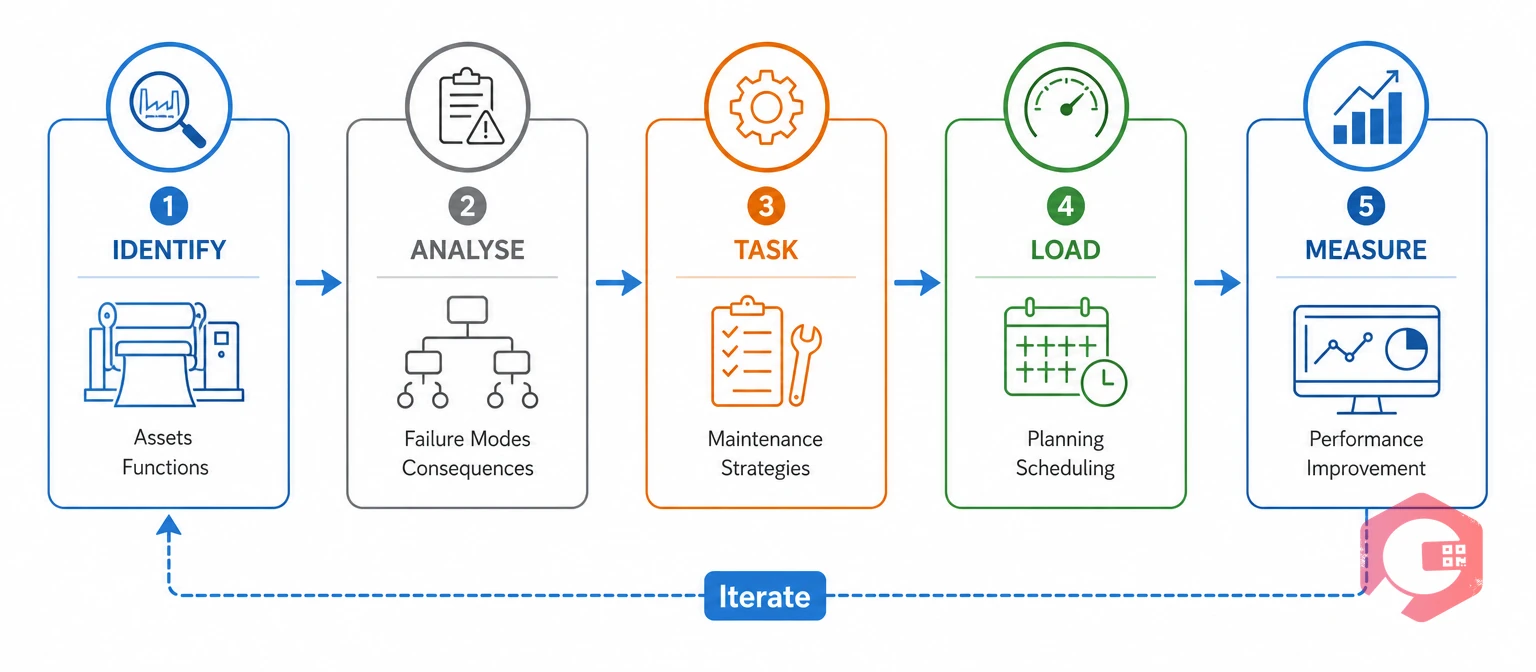
Maintenance teams that successfully implement RCM in the textile industry follow a consistent five-stage path. The framework below organises that path into actionable stages, each with a clear deliverable.
The IDENTIFY-ANALYSE-TASK-LOAD-MEASURE Framework:
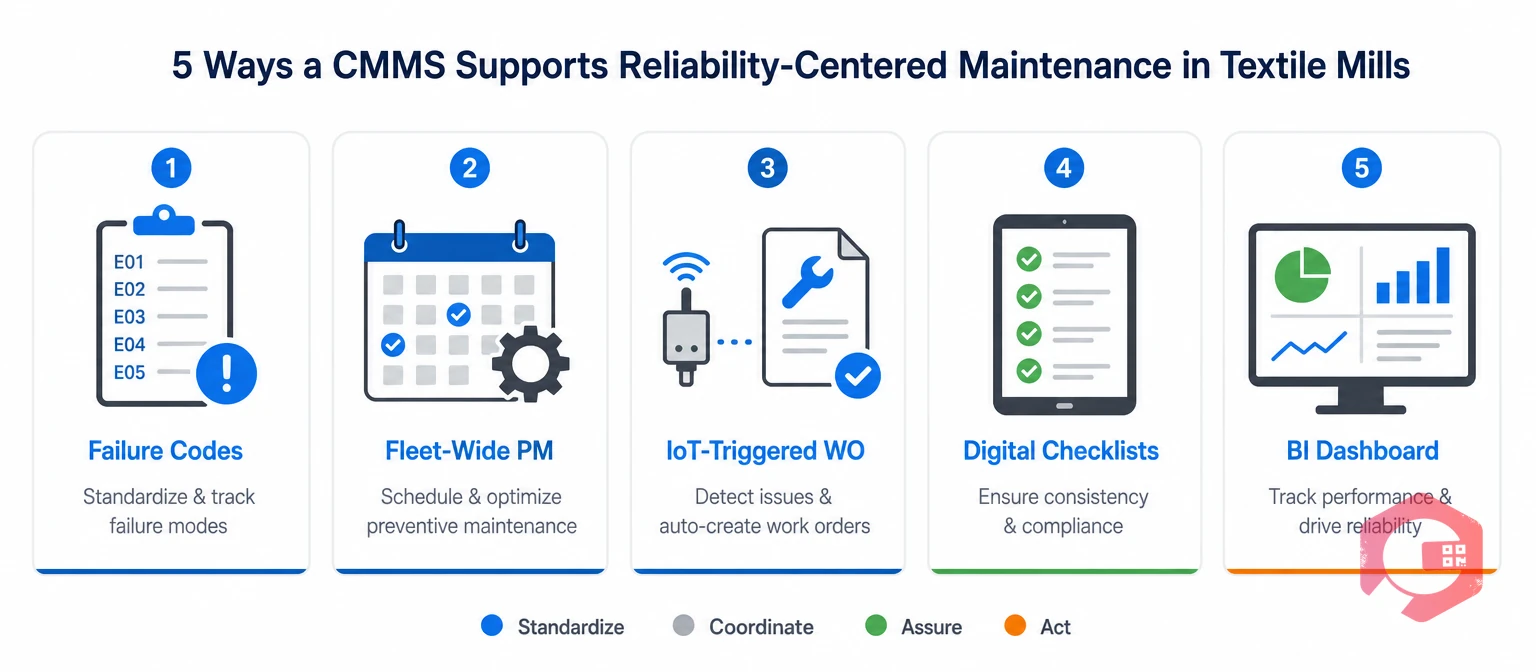
The IDENTIFY-ANALYSE-TASK-LOAD-MEASURE framework for RCM in the textile industry requires a system that stores failure mode data, triggers tasks from sensor readings, and reports MTBF trends across a fleet of hundreds of machines. A Computerized Maintenance Management System is what makes the framework operational rather than theoretical in a textile plant.
Maintenance teams using Cryotos have reported up to 30% reduction in unplanned downtime and 25% faster repair turnaround — outcomes that translate directly to the OEE gains that make RCM adoption financially self-evident in textile mills. Explore textile maintenance software built for the specific requirements of spinning, weaving, and finishing plants.
A focused RCM in the textile industry implementation covering ring frames and air-jet looms — the two highest-impact asset classes — typically takes 3–4 months from the IDENTIFY stage through to LOAD. This includes 6–8 weeks of work order failure code accumulation for the ANALYSE stage, 2–3 weeks of task selection and checklist development, and 2–4 weeks of CMMS configuration and technician training. The first MEASURE review, showing meaningful MTBF improvement, typically arrives 6 months after the first RCM tasks go live. Full programme maturity usually takes 18–24 months of iterative refinement.
Ring frames and air-jet looms deliver the highest RCM in the textile industry return in most integrated textile mills, because they have the highest unplanned downtime frequency and the clearest process signals for on-condition monitoring (yarn breakage rate and weft miss rate respectively). Winding machines rank third — drum surface wear and tension device degradation are both measurable before failure. Blow room beaters and draw frames are also strong candidates if failure code analysis shows them as recurring downtime contributors.
RCM and TPM address different aspects of the same reliability problem. RCM focuses on selecting the right maintenance task for each failure mode — it answers the question “what maintenance should we do?” TPM (Total Productive Maintenance) focuses on maximising machine effectiveness through operator involvement, including autonomous maintenance, visual management, and loss elimination. In textile mills, most successful reliability programmes applying RCM in the textile industry run both: RCM determines what the maintenance tasks are and at what triggers; TPM determines how operators participate in routine cleaning, inspection, and early-warning detection.
A CMMS sustains RCM in the textile industry implementation by converting the task library into automatically generated work orders — removing the human memory and manual scheduling that cause RCM programmes to drift back toward ad-hoc maintenance within 12–18 months. When a ring frame’s spindle vibration sensor crosses the RCM-defined threshold, the CMMS creates the corrective work order, assigns it to a qualified technician, and tracks it to closure with the post-repair reading logged. Without that automation, the threshold crossing still happens — but the response depends on whether someone noticed the reading, remembered the protocol, and had time to act. In a 300-machine spinning section, that dependency on individual memory is not a sustainable maintenance system.
Textile mills lose more revenue to preventable downtime than to almost any other operational variable — and RCM in the textile industry is the systematic methodology that closes that gap permanently. Schedule a free demo to see how Cryotos configures the IDENTIFY-ANALYSE-TASK-LOAD-MEASURE framework for your spinning, weaving, or finishing plant.



Cryotos AI predicts failures, automates work orders, and simplifies maintenance—before problems slow you down.