Reliability-centered maintenance programs fail in the majority of cases — not because the methodology is flawed, but because the outputs of the analysis never become operational. Industry practitioners estimate that 50–70% of reliability-centered maintenance implementations fail to achieve their intended outcomes within two to three years of initiation. The causes are almost never technical. They are structural: the gap between completing a rigorous FMEA analysis and consistently delivering the resulting tasks at scale is where most programmes quietly collapse.
This guide names the eight root causes — with the warning signs that tell you a programme is heading toward each one before it fully fails.
Key Takeaways
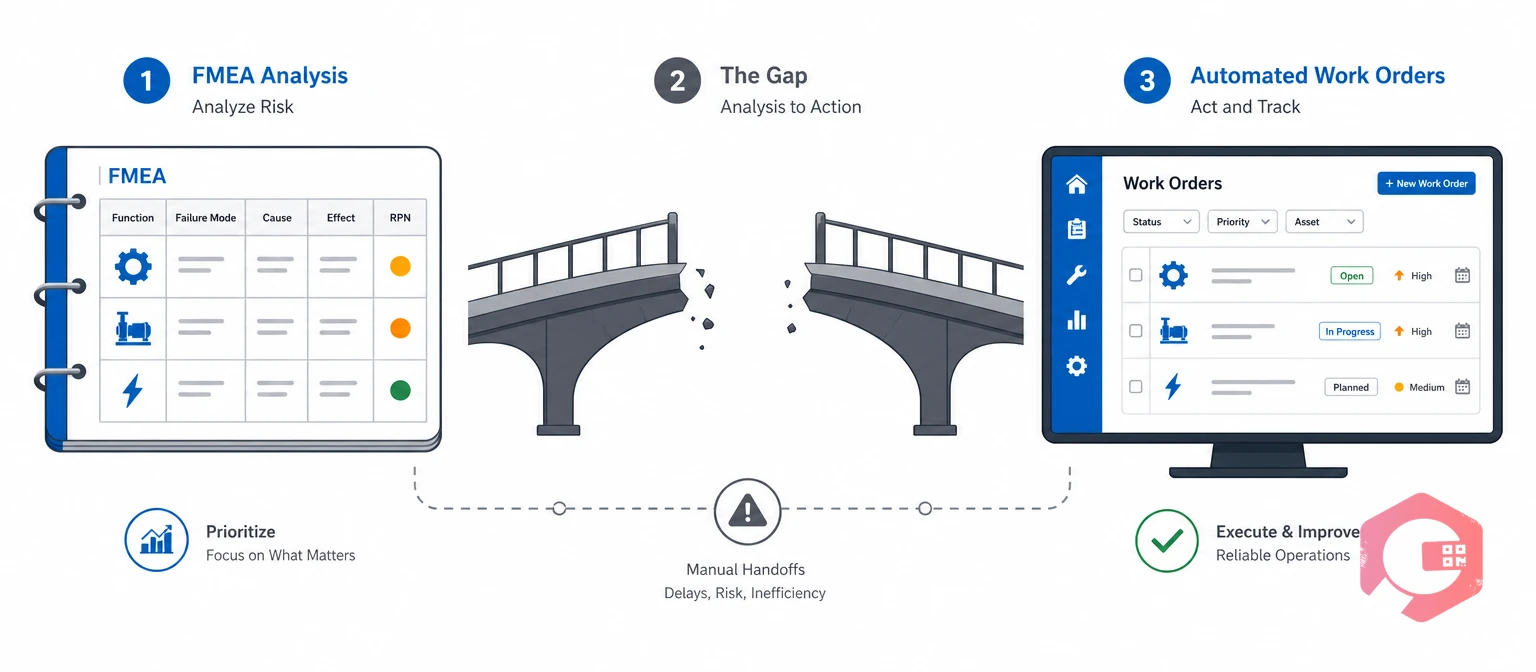
The most common reliability-centered maintenance failure is treating the FMEA analysis as the programme’s goal rather than its starting point. Organisations invest months of engineer time in structured analysis workshops, produce detailed workbooks documenting hundreds of failure modes and their associated tasks, and then close the project. The analysis is complete. The programme has failed.
An FMEA analysis is the specification for a maintenance programme — not the programme itself. Until the selected tasks are configured as recurring work orders in the operational system, they have no effect on asset reliability. Organisations that celebrate the completion of the analysis as programme success have confused the map with the territory.
Scope paralysis occurs when an organisation defines success as completing RCM analysis for every asset in the plant before implementing any tasks. A thorough FMEA for a single complex asset takes 20–40 hours of team analysis. Applied to 2,000 assets, this becomes a multi-year project before any benefit is realised.
The correct approach prioritises by criticality: identify the 20% of assets driving 80% of downtime, implement tasks for those assets first, measure outcomes, then extend scope. Most programmes that attempt full-plant analysis before any implementation run out of budget or management patience and are abandoned before any tasks go live.
RCM is designed to be iterative — the initial analysis is a starting point, not a permanent answer. After implementation, actual failure data should continuously update the failure mode library: confirming failure frequencies, identifying missed failure modes, and retiring tasks for failures that never occur in practice.
Most failed reliability-centered maintenance programmes are static. The analysis is done once, tasks are implemented, and the failure mode library is never revisited. Five years later, the programme maintains assumptions from the original analysis rather than responding to how assets actually behave. The FMEA methodology itself demands iteration — a programme that does not update its analysis is not running RCM, it is running an ageing PM schedule with a better origin story.
Before implementing your RCM programme, establish your baseline reliability data. Use the MTBF calculator to calculate your current mean time between failures for each priority asset — the reference point for measuring post-RCM improvement.
The reliability-centered maintenance implementation gap is the failure to translate RCM task outputs into live, correctly configured work orders in the operational maintenance system. This is the highest-frequency, highest-impact failure cause in real-world RCM programmes, and it is almost never discussed as the distinct failure mode it represents.
Three variants of this failure occur in practice:
Use preventive maintenance software that supports both time-based and condition-triggered work orders, and that can link each PM task to the specific failure mode it addresses. Without that link, the CMMS cannot close the feedback loop even when the right tasks are loaded.
A reliability-centered maintenance programme without measurement cannot learn, cannot improve, and cannot justify its continued investment. The SMRP Best Practices Metrics framework gives clear guidance on what to track. Yet most RCM programmes define success as PM completion rate alone — a measure of effort, not outcome.
Four KPIs drive RCM programme health: PM completion rate by RCM cohort (effort); on-condition finding rate — what share of on-condition tasks detect a developing failure (task quality); MTBF trend vs. pre-RCM baseline (outcome); and maintenance cost per output unit vs. baseline (financial return). Without the second and third measures, a programme cannot tell which tasks work from those with the wrong interval, wrong trigger, or a failure mode that never occurs.
Maintenance teams using Cryotos have reported up to 30% reduction in unplanned downtime and 25% faster repair turnaround — outcomes that only become visible when MTBF and downtime data is being tracked and compared to baselines. A maintenance KPI dashboard that auto-generates these metrics from work order data is the difference between a programme that can prove its value and one that cannot.
RCM analysis conducted without the involvement of the technicians and supervisors who will execute the resulting tasks almost always produces cultural rejection. Reliability engineers who run analysis workshops without operations staff create an adversarial dynamic. Technicians receive work orders from an analysis they never saw, describing failure modes they were never asked about.
The result is compliance without engagement — tasks signed off but not properly done. Findings go unrecorded because nobody explained what the data is for. Over time, the maintenance team routes around the RCM-generated tasks and the programme becomes invisible in practice even as it appears complete on paper.
RCM has a delayed payoff structure that most organisations underestimate: the investment is front-loaded, and measurable outcomes arrive 12–18 months after tasks go live. When a budget review hits at month 9 with no measurable improvements, commitment erodes. Resources shift. The programme loses its sponsor and ends.
Programmes that survive had a sponsor who understood the 18-month timeline upfront. Regular interim metrics — on-condition finding rate, failure mode detection rate — showed the programme was working before MTBF numbers improved.
Analysis quality failure occurs when the FMEA is done but the output does not meet SAE JA1011 — the formal RCM evaluation standard. The most common quality failures are: failure modes described at system level rather than mechanism level; intervals set by gut feel rather than P-F interval analysis; and consequence ratings that do not justify the task investment.
Nowlan and Heap’s original reliability-centered maintenance study found that only 11% of failure modes follow the “bathtub curve” that time-based PM addresses. The other 89% require different task types. Applying time-based tasks to all failure modes is structurally wrong.
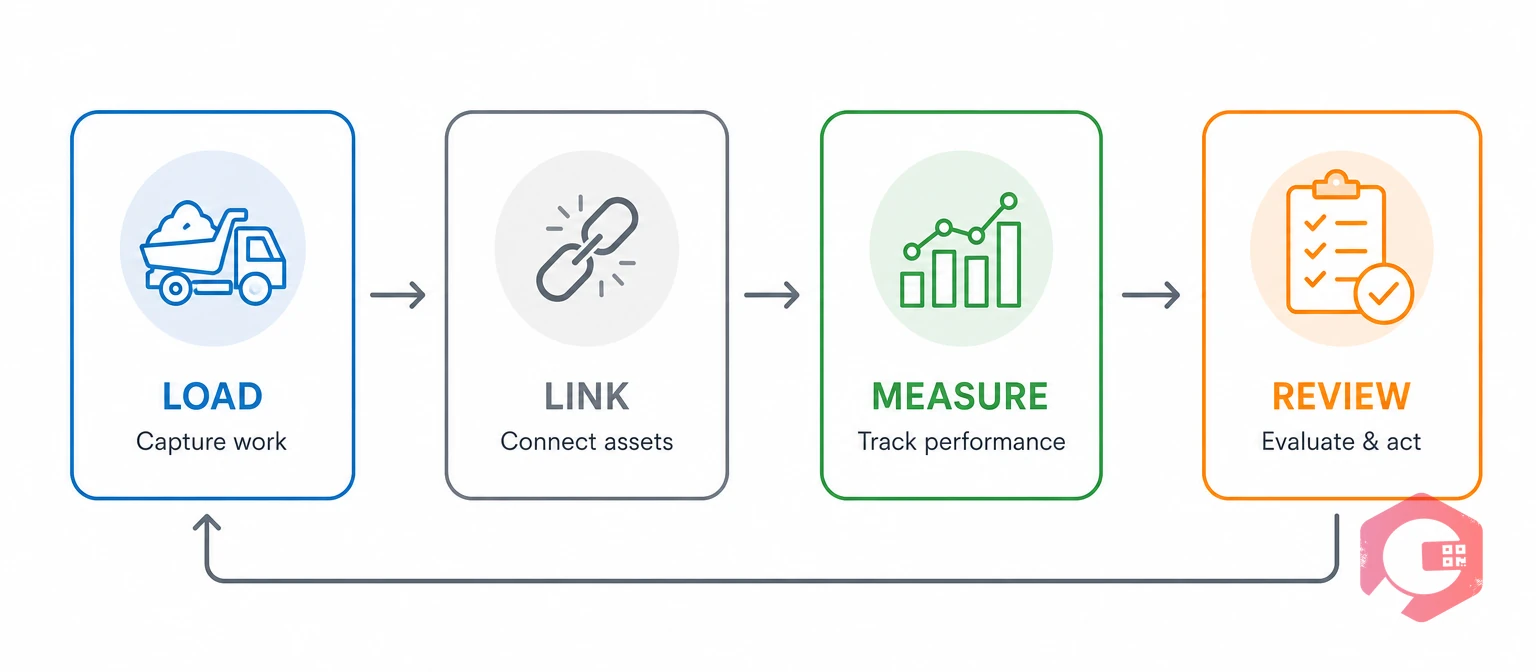
The four most damaging failure causes — analysis without operationalization, CMMS implementation gap, no feedback loop, and no measurement — share a structural solution. The LOAD-LINK-MEASURE-REVIEW framework addresses all four in a sequence that can be applied to a new programme or used to rescue a failing one.
The LOAD-LINK-MEASURE-REVIEW Framework:
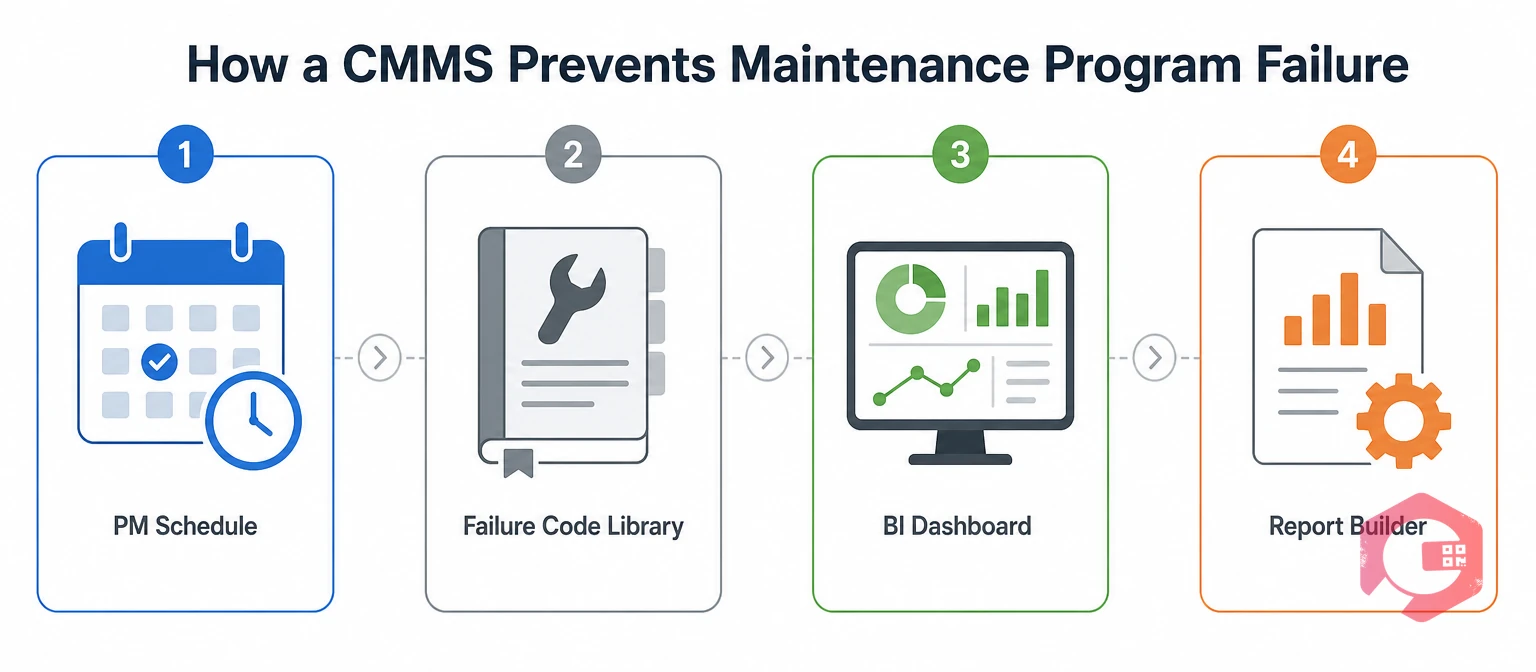
The structural failures that destroy most reliability-centered maintenance programmes are addressable at the system level. A Computerized Maintenance Management System that is designed to support RCM — not adapted from a generic PM scheduling tool — closes the gaps that cause programmes to collapse between the analysis and the outcome.
Most reliability-centered maintenance programmes that fail do so not because the analysis was wrong, but because nothing was in place to make the outputs survive contact with daily operations. Use enterprise asset management software designed to bridge the gap between reliability analysis and operational delivery.
Industry practitioners estimate that 50–70% of reliability-centered maintenance programmes fail to deliver their intended outcomes within two to three years. This reflects not analytical failure but implementation failure — programmes in which the analysis is completed but the resulting tasks are never operationalized, never measured, and never updated. The SAE JA1011 standard defines seven criteria that a process must meet to qualify as RCM. Programmes that meet fewer than all seven are far less likely to succeed long-term.
Yes — and the LOAD-LINK-MEASURE-REVIEW framework provides a recovery path that can be applied at any programme stage. A programme that completed its analysis but never loaded tasks into the CMMS can start at LOAD. A programme that loaded tasks but has no feedback loop can start at LINK. A programme that has lost management support can start at MEASURE with a 90-day data sprint to demonstrate results from the tasks already in place.
The most common reason is that the analysis outputs were never loaded into the operational maintenance management system as scheduled work orders. The tasks exist on paper. No technician ever receives a work order from the analysis. This implementation gap causes more programme failures than all other causes combined.
A CMMS significantly improves RCM programme survival when integrated into the process from the start — not added after the analysis is complete. The CMMS must support condition-triggered work orders, link PM tasks to failure modes, capture structured task findings, and report MTBF trends against pre-RCM baselines. A generic PM scheduling tool repurposed for RCM often lacks these capabilities. That is why the CMMS implementation gap remains the highest-frequency failure cause.
Reliability-centered maintenance programme failure is a solvable problem — but only if you address the root causes. Schedule a free demo to see how Cryotos supports the full LOAD-LINK-MEASURE-REVIEW cycle and keeps RCM programmes operational beyond the first year.



Cryotos AI predicts failures, automates work orders, and simplifies maintenance—before problems slow you down.