
Real-time inventory alerts prevent maintenance delays in FM operations by catching parts shortfalls before a technician reaches the job — triggering a notification the moment stock drops below the minimum threshold, linking that alert to the open work orders that require the part, and routing it to the right person to take action while there's still time to stage the parts, raise a purchase order, or reschedule the job before the SLA clock runs out.
In most FM operations, inventory shortfalls are discovered at the worst possible moment: when a technician is on site, the part isn't there, and the SLA window is already counting down. The discovery triggers a scramble — an emergency call to the stores, an ad-hoc local purchase, or a job reschedule that creates a second SLA event. All of that cost and disruption was avoidable. According to Reliable Plant's spare parts management research, between 15–20% of reactive maintenance delays in facilities management are caused directly by parts unavailability — a failure mode that real-time alerting eliminates by moving the intervention point from discovery to prevention. The International Facility Management Association's operations research similarly identifies materials availability as one of the top five constraints on FM service quality across commercial and industrial portfolios.
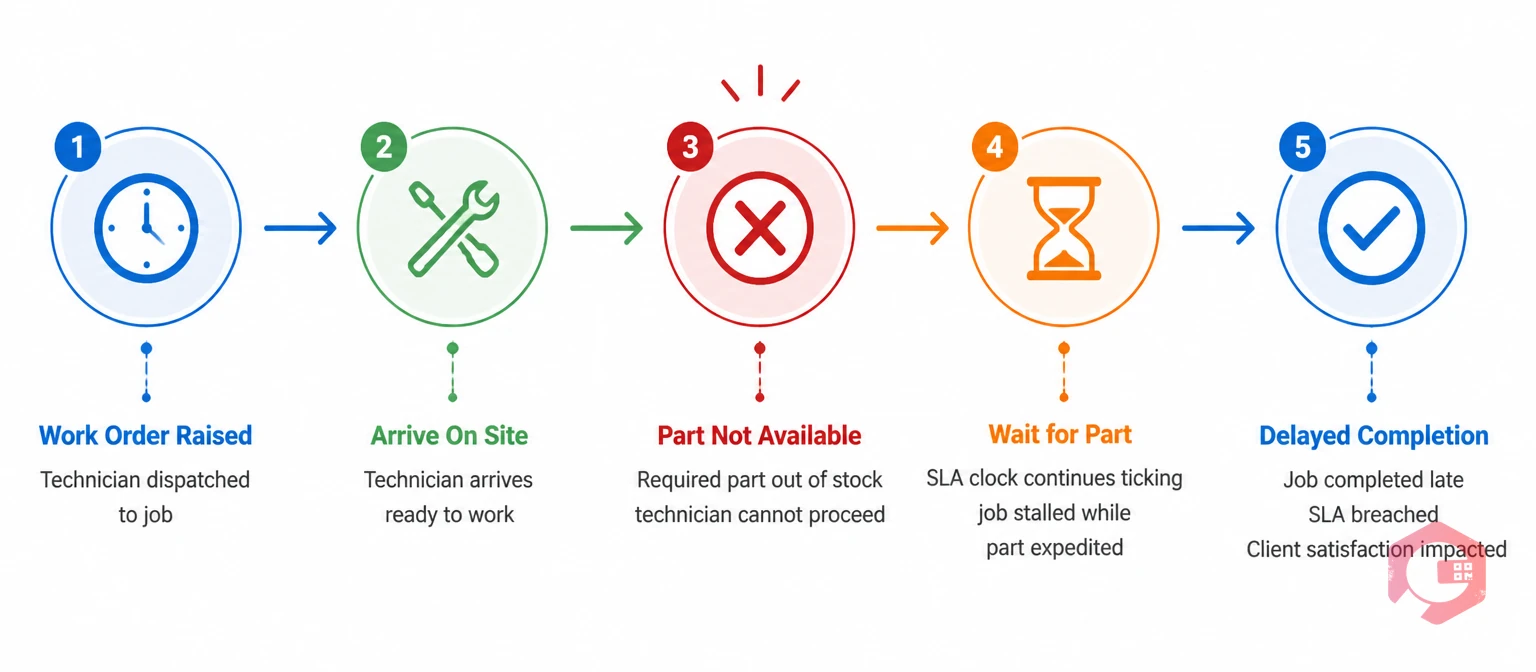
Understanding where inventory shortfalls actually create delays is the starting point for designing an effective alert system. The delay doesn't happen when the stock runs out — it happens downstream, at three specific moments in the FM work cycle where the missing part meets an active job.
For planned maintenance jobs — scheduled PM tasks, pre-booked reactive repairs — the FM planner should stage parts before the technician is dispatched. If the storeroom system shows the part as available but it has actually been consumed on an earlier job without being booked out, the planner dispatches the technician to a job that can't be completed. The technician arrives, checks the stores, and the part is gone. The job fails before it starts.
A real-time alert that fires when stock is consumed — not just when a reorder point is crossed — catches this at the point of consumption. The storekeeper or planner gets an immediate notification that the part has been taken from stores, which triggers a check against upcoming work orders requiring that part. If there's a scheduled job in the next 48 hours that needs it, the planner knows now — not when the technician is standing at an empty shelf.
The on-site discovery is the most expensive version of the stockout delay. The technician has travelled to the property, signed in, completed the PTW sequence, and is ready to start work. The part needed for the repair isn't in the site storeroom. The clock has been running since the fault was reported. The technician calls the helpdesk. The helpdesk calls the stores manager. The stores manager identifies an alternative source. The technician waits, or leaves and returns, or the job is rescheduled.
Every minute of that sequence is time on the SLA clock. In an FM contract with a 4-hour resolution window for a P2 fault, an on-site discovery of a parts gap can consume the entire remaining SLA allowance before a wrench has been turned. The only way to prevent this is to ensure the gap is known and acted on before dispatch — which requires real-time inventory visibility, not a weekly stock report.
A rescheduled job creates a second SLA window. If the original job was a P2 fault rescheduled because the part wasn't available, the new job carries the same priority. If the rescheduled job also encounters a parts problem — because the emergency order was delayed, or the wrong part was ordered — the delay compounds. In FM contracts with penalty clauses for repeat SLA breaches on the same fault, this cascade is a direct financial exposure.
Real-time alerts break the cascade by ensuring that the rescheduled job is only dispatched when the part is confirmed as available. An alert that links the purchase order status to the work order record gives the FM planner a live view of whether the part has been received before the rescheduled appointment is confirmed to the client or tenant.
Most FM operations have some form of reorder mechanism — a minimum stock level configured in the storeroom system that triggers a purchase requisition when stock hits zero or crosses a defined threshold. This is better than nothing, but it's not the same as a real-time alert, and the gap between them is where maintenance delays live.
A reactive reorder system responds to the stock level as it stands at the moment someone checks it. If the system is checked weekly, the stock level that triggered the reorder may have been at zero for several days before the purchase was raised — long enough for two or three planned jobs to be dispatched without parts. If the minimum stock level is set too conservatively (a single unit for a part used frequently), the reorder fires when the last unit is taken — which means there's no stock available for any job raised between the reorder date and the delivery date. According to McKinsey's enterprise supply chain research, organisations that respond to stock movements in real time rather than on a review schedule reduce stockout frequency by 35–45% while simultaneously reducing overall safety stock levels.
A real-time alert system responds to stock movements as they happen. Every time a part is consumed — booked out against a work order, taken from the storeroom, or allocated to a job — the system checks the resulting stock level against the threshold and fires an alert if the threshold has been crossed. The lead time between the alert and the stockout is the entire order-to-delivery window, not the window between weekly stock checks. For FM operations with supplier lead times of 24–72 hours on common parts, that difference is the difference between zero delays and several delayed jobs per week.

A well-configured FM inventory alert system covers four distinct risk types — each targeting a different point in the parts availability chain.
The foundational alert fires when stock for a specific part drops below the configured minimum threshold. The threshold is set based on the part's consumption rate at that property (derived from work order history), the supplier's lead time, and the SLA category of the jobs that use the part. A drive belt used in monthly PM tasks at a specific property might carry a minimum of two units — enough to cover one emergency replacement while a replenishment order is in transit. When stock drops to two, the alert fires and a purchase requisition is raised automatically. The storeroom never reaches zero for that part during normal operations.
When stock for a part hits zero, the system fires a second, higher-priority alert — and crucially, this alert includes a list of all open and upcoming work orders that require the part. The FM planner can see immediately which jobs are at risk, what their SLA categories are, and how much time is available before each job's deadline. This alert drives a triage decision: which jobs can be rescheduled, which need emergency procurement, and which have alternative parts that can be substituted. The decision is made proactively from the alert, not reactively from a technician's phone call.
Some FM inventory items — lubricants, sealants, cleaning chemicals, gasket materials — have shelf-life limits. In many FM storerooms, these items are held until they're needed and only discovered to have expired when a technician opens the container on site. An expiry alert fires a configurable number of days before the item's expiry date, giving the stores manager time to raise a replacement purchase order before the current stock becomes unusable. This alert type is particularly important in FM operations that maintain chemicals or specialised compounds for HVAC, fire suppression, or water treatment systems.
Once a reorder has been raised, the FM planner needs to know when the parts will arrive — especially if there are scheduled jobs waiting on them. A purchase order status alert notifies the planner when a PO has been acknowledged by the supplier, when the expected delivery date changes, and when the goods are received and booked into stock. This closes the loop between the original stockout alert and the moment the part is available for use — allowing planned jobs to be confirmed to clients and tenants only when the parts are in stock and the job can actually be completed.
The value of a real-time inventory alert depends entirely on who receives it and how quickly they can act. An alert sent to the wrong person — or sent to everyone and therefore owned by nobody — is operationally useless. Alert routing in a well-configured FM CMMS matches each alert type to the person who can take the required action fastest.
A low stock threshold alert for a commonly-used PM consumable routes to the stores manager and the maintenance planner simultaneously: the stores manager to raise the purchase requisition, the planner to check whether any upcoming jobs need to be rescheduled or restaged. A zero stock alert with work order linkage routes to the FM operations manager as well — because jobs at SLA risk need immediate senior visibility. An expiry alert routes to the stores manager alone, as it's a stock management action rather than an operational scheduling decision. A PO delivery date change routes to the planner and any client or tenant contact who has been given a confirmed appointment date for a job that depends on that delivery.
This routing logic — configurable by alert type, part category, and urgency level — is what separates an alert system that prevents delays from one that generates notification noise that people learn to ignore. The email and WhatsApp notification builder in Cryotos allows FM operations teams to configure exactly this routing logic without custom development — defining recipient groups, escalation paths, and notification channels per alert type.
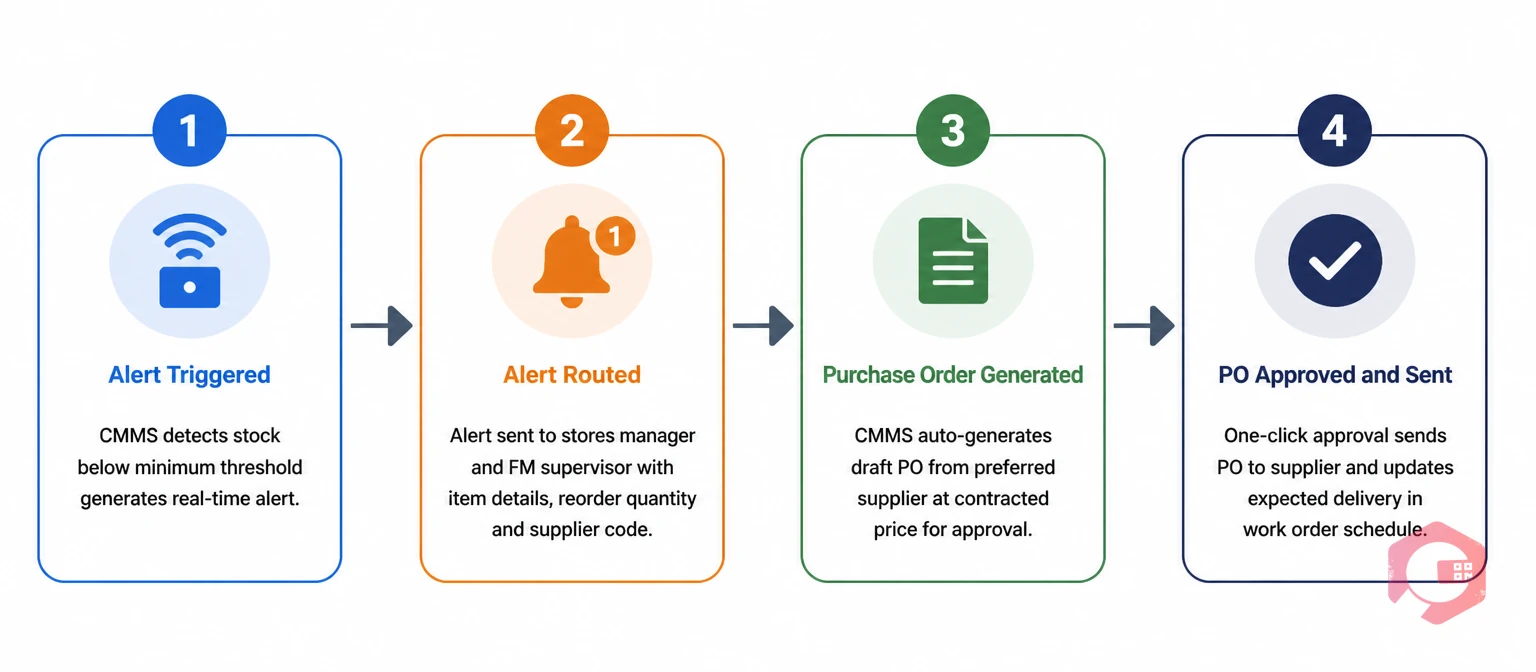
An alert that requires manual action at every step adds overhead without removing delay. The most effective inventory alert systems in FM operations close the loop automatically — converting a threshold breach into a purchase requisition without requiring the stores manager to notice the alert, log into the procurement system, and manually raise the order. The ISO 55001 asset management standard specifically requires that organisations establish information systems capable of supporting timely procurement and maintenance scheduling — a requirement that auto-PO creation from real-time alerts directly satisfies.
Auto-PO creation triggers when a configurable low stock threshold is crossed for parts designated as standard replenishment items — parts with a known supplier, a standard order quantity, and a pre-approved unit price. The system raises the purchase requisition, routes it for approval if the order value requires it, and sends it to the supplier through the purchase order management module once approved. The stores manager's role shifts from manually raising routine orders to reviewing and approving them — a significantly lighter touch that reduces response time from hours to minutes.
For non-standard parts — specialist components, items with variable pricing, or parts requiring engineering specification sign-off — the alert still fires, but the purchase action requires human review. The system raises a draft requisition with the part details, the relevant work orders, and the urgency classification, and routes it to the appropriate person for action. The human decision is informed by system context, not initiated from scratch.
Cryotos CMMS gives FM operations teams a real-time inventory alert system that connects parts availability directly to work order scheduling, SLA tracking, and procurement — within a single platform rather than across separate systems that don't talk to each other.
Key capabilities for real-time inventory alerting in FM:
FM operations teams using Cryotos report significant reductions in parts-related job delays, faster first-time fix rates, and lower emergency purchasing costs — outcomes that flow directly from catching inventory shortfalls at the threshold rather than at the job site. If your current inventory process means your technicians are discovering stockouts on site, Cryotos CMMS gives your operations team the real-time visibility to prevent it.
A real-time inventory alert is an automatic notification triggered the moment a part's stock level crosses a configured threshold — not at the next manual stock check or weekly report. In FM operations, these alerts are linked to the CMMS so they surface alongside the work orders that require the affected parts, giving planners immediate visibility of which jobs are at risk. When configured correctly, real-time alerts create a gap between the stockout event and the job date — time that can be used to replenish stock, substitute an alternative part, or reschedule the job before the SLA clock is affected.
SLA clocks in FM contracts run from fault notification to confirmed resolution — and they don't pause for parts. When a technician discovers a missing part on site, the remaining SLA window is often too short to procure the part and complete the job. Real-time alerts prevent this by firing when stock crosses a minimum threshold, giving the FM planner time to stage parts, raise an emergency order, or reschedule the job before the technician is dispatched. The intervention point moves from discovery to prevention, and the SLA is protected.
The four most important FM inventory alert types are: a low stock threshold alert that fires before stock reaches zero; a zero stock alert with work order linkage that shows which jobs are immediately at risk; an expiry alert for shelf-life-limited items like lubricants, chemicals, and sealants; and a purchase order status alert that tracks whether a replenishment order has been acknowledged, delayed, or received. Together, these four alert types cover the full parts availability chain from pre-stockout to replenishment confirmation.
A reactive reorder system checks stock levels on a schedule — typically weekly or when someone manually reviews the storeroom — and triggers a purchase order when stock is found to be below minimum. A real-time alert system responds to every stock movement as it happens, firing the moment a threshold is crossed regardless of when the last manual check occurred. In FM operations with supplier lead times of 24–72 hours, this difference can represent several delayed jobs per week that a reactive system misses but a real-time system catches.
Yes — for pre-approved standard replenishment items, a well-configured CMMS can trigger a purchase requisition automatically when a low stock threshold is crossed, route it for approval based on order value thresholds, and dispatch it to the supplier once approved. This removes the manual step of the stores manager noticing the alert and raising the order, reducing response time from hours to minutes. For non-standard or specialist parts, the alert fires and surfaces a draft requisition for human review — the system provides the context and urgency, the person makes the procurement decision.
Every FM maintenance delay caused by a missing part is a delay that the CMMS data could have prevented. The part that wasn't in the storeroom when the technician needed it had a consumption history, a minimum threshold, and a supplier lead time — all of which the system already knew. The gap was that nobody was notified when those data points converged on an imminent stockout.
Real-time inventory alerts close that gap. They move the intervention point from the job site to the storeroom, from the day of the job to the day the threshold was crossed, and from the technician's discovery call to the planner's proactive decision. In FM operations where SLA compliance is a contract performance metric and parts delays are a controllable variable, that shift is directly measurable in SLA performance, emergency purchasing cost, and client retention.
If your FM team is still finding out about stockouts when the technician calls from site, book a free Cryotos demo to see how the real-time inventory alert system works in practice — and what your current exposure looks like when the data is visible.




Cryotos AI predicts failures, automates work orders, and simplifies maintenance—before problems slow you down.