

Spare parts obsolescence occurs when components held in maintenance inventory are no longer usable — because the equipment they support has been retired, the part has been superseded by a newer version, or the part has degraded beyond its usable shelf life. Dead stock is the result: inventory that occupies warehouse space, ties up working capital, and contributes nothing to equipment reliability. According to the Society for Maintenance and Reliability Professionals (SMRP), MRO inventory carrying costs typically run between 20–30% of the total inventory value per year — meaning a storeroom with $500,000 of parts stock is consuming $100,000–$150,000 annually just to hold those parts, whether they are used or not. Reducing obsolescence and dead stock directly cuts that cost while freeing capital for parts that actually support your active asset base. This guide explains how to identify obsolete stock, prevent it from accumulating, and use your CMMS to keep inventory aligned with real equipment needs.
Key Takeaways

Obsolescence and dead stock build up for predictable, avoidable reasons. Understanding the root causes is the prerequisite for eliminating them.
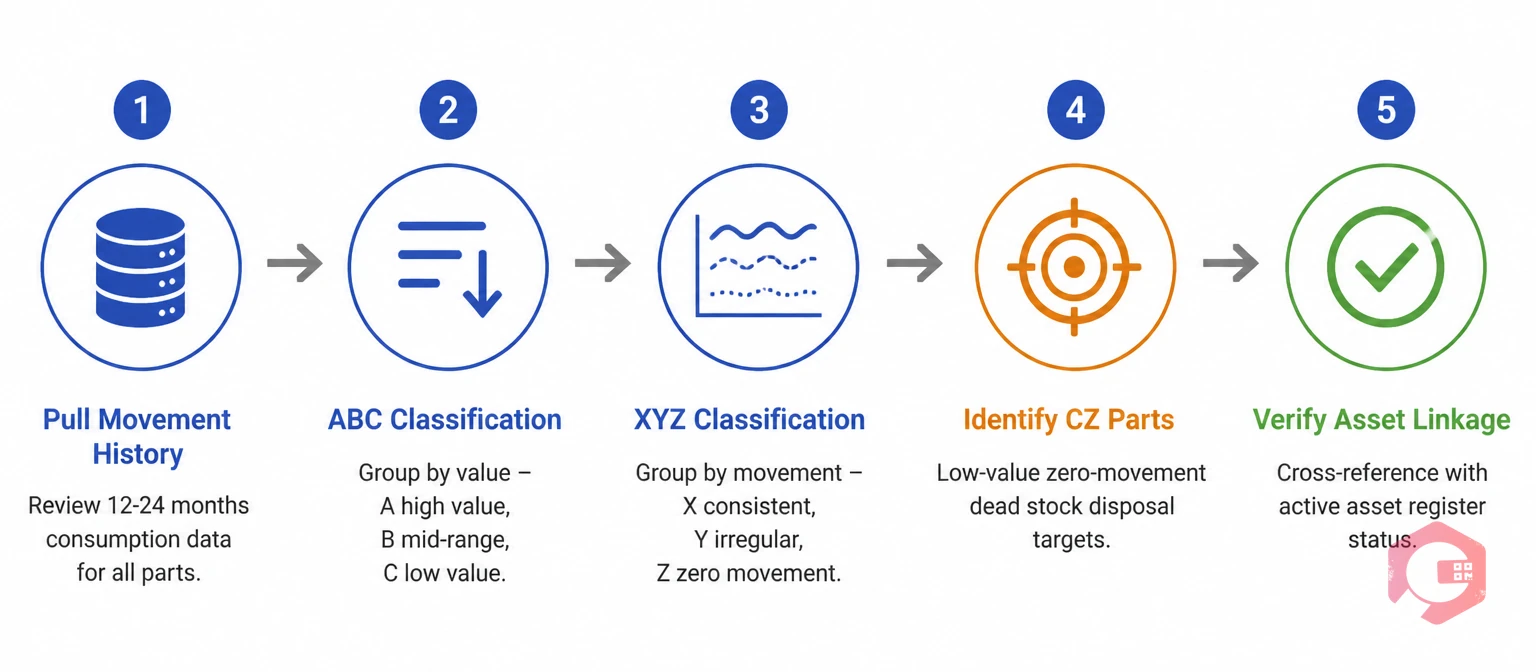
The starting point is a consumption analysis across your entire parts inventory. Pull the movement history for every stocked item and classify each part by its consumption pattern over the past 12–24 months.
Parts with zero consumption in the past 12 months that are not linked to any active asset, or that are linked to assets with a retirement date in the past, are immediate obsolescence candidates. Parts with zero consumption in 24+ months that are linked to active assets but have never been used in a work order are secondary candidates — they may be legitimate safety stock for critical spares, or they may be forgotten over-purchases from years ago.
Use ABC/XYZ classification to prioritise your review. ABC classifies parts by value: A-class parts make up ~80% of total inventory value (few parts, high value), B-class are mid-range, and C-class make up the tail. XYZ classifies by movement regularity: X-parts move consistently, Y-parts move irregularly, Z-parts rarely or never move. The combination that most reliably identifies dead stock is CZ — low-value parts with zero or near-zero movement. These are your first disposal targets. According to Reliable Plant's MRO inventory analysis, CZ parts typically represent 30–40% of total line items in a typical MRO storeroom but less than 5% of total inventory value — meaning you can eliminate a large portion of your dead stock problem by cleaning out a relatively small value of parts.
Use the MRO inventory checklist to structure your initial obsolescence audit — covering part linkage verification, consumption history review, and asset status cross-reference for every item in scope.
| Factor | Active Stock | Dead Stock |
|---|---|---|
| Consumption pattern | Regular movement — used in work orders within the past 12 months | Zero or near-zero movement for 12+ months |
| Asset linkage | Linked to active assets still in the asset register | Linked to retired assets, or no asset linkage at all |
| Reorder justification | Backed by consumption history and PM task association | Restocked by default — no consumption trigger |
| Capital impact | Working capital actively supporting equipment reliability | Trapped capital generating holding costs with zero reliability return |
| CMMS visibility | Appears in PM task parts lists and work order consumption logs | Not referenced in any open work orders or PM schedules |
| Action | Maintain optimal stock level with data-backed reorder points | Dispose, return to supplier, or redistribute to other sites |
The most reliable indicator of dead stock is the absence of a work order or PM association. If a part has not appeared in a single work order in 24 months and is not listed in any active PM task's parts list, the probability that it will ever be used is extremely low.
Clearing existing dead stock solves the backlog. Preventing new obsolescence requires systematic changes to how purchasing decisions are made and how inventory is linked to the active asset base.
Identified dead stock needs to leave the storeroom — it does not improve with age. There are four practical disposal routes, in order of value recovery:
Track the value of dead stock disposed each quarter through your maintenance costs reporting. This number — disposed obsolete inventory value — is one of the clearest indicators of how well your procurement and lifecycle management processes are working. A declining trend validates the prevention measures; a stable or rising trend means the root causes have not been addressed.

Managing parts obsolescence across a large, active asset fleet without software support is effectively impossible. The volume of asset changes, procurement decisions, and consumption events that need to be cross-referenced exceeds what any manual process can handle reliably. Cryotos's CMMS addresses obsolescence at every stage of the parts lifecycle.
The inventory module links every stocked part directly to the assets it supports. When an asset is decommissioned or replaced in Cryotos, the system automatically flags linked parts for review — surfacing them in the storeroom manager's dashboard rather than waiting for the next annual stocktake to reveal the problem. Consumption-based reorder calculations pull from actual work order data — if a part has not appeared in a work order in the defined review period, the reorder trigger is suspended pending a manual review decision.
The warehouse management layer provides real-time visibility across multiple sites. Parts with zero movement at one location that are actively consumed at another are flagged for redistribution — preventing simultaneous write-offs at one site and emergency purchases at another for the same part number. According to Plant Maintenance Resource Center's analysis of MRO inventory optimisation, organisations using CMMS-integrated inventory management reduce total spare parts holding costs by 15–25% within 18 months of implementing asset-linked, consumption-driven stocking policies.
Expiration reminders automate shelf life management — parts approaching their expiry date trigger alerts to the storeroom team, ensuring FIFO consumption and flagging stock at risk before it crosses from active to waste. The warehouse management module tracks batch receipts with date stamps, making FIFO enforcement automatic rather than dependent on manual labelling discipline.
Obsolete stock is parts inventory that can no longer be used because the assets it supports have been retired, the part number has been superseded, or the component has degraded beyond its usable shelf life. Dead stock is the broader category — any inventory with zero movement over a defined period (typically 12–24 months) regardless of the reason. All obsolete stock is dead stock, but not all dead stock is technically obsolete — some dead stock is simply over-purchased active parts that have not been consumed.
Formally, at least annually — with a structured review of every part's movement history, asset linkage status, and shelf life. Practically, the most effective approach is event-driven: trigger a parts review every time an asset is retired, replaced, or significantly modified, and every time a part number is superseded by a manufacturer change. Annual reviews catch accumulated problems; event-driven reviews prevent them from accumulating in the first place.
ABC classification groups parts by value contribution to total inventory (A = top 80% of value, B = next 15%, C = bottom 5%). XYZ classification groups parts by movement regularity (X = consistent, Y = irregular, Z = rare or never). Combining them — particularly the CZ segment — identifies low-value, zero-movement parts that are the most cost-effective targets for disposal. Focusing disposal efforts on CZ parts removes large numbers of line items and their carrying costs while recovering minimal write-off value.
Yes, when parts are linked to asset records and the CMMS tracks asset lifecycle status. Cryotos flags linked parts for review automatically when an asset is decommissioned, when a part's consumption falls below the defined review threshold, or when a part approaches its shelf life expiry date. This automated flagging replaces reactive annual stocktakes with proactive, event-driven obsolescence management — catching the problem before the purchasing cycle creates more of it.
Every dollar tied up in obsolete and dead stock is a dollar not available for parts that actually support your active equipment. Cryotos gives your storeroom team the asset-linked inventory management, consumption-based reorder calculations, and expiration tracking needed to eliminate dead stock systematically and prevent it from accumulating again. Schedule a free demo to see how leading maintenance teams use Cryotos to cut spare parts holding costs by up to 25%.




Cryotos AI predicts failures, automates work orders, and simplifies maintenance—before problems slow you down.



